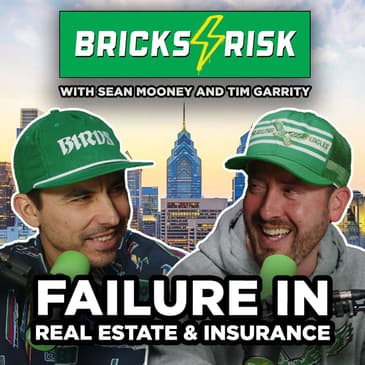
The "failure rate" numbers are staggering for both Sean & Tim's industries for agents who have been in the industry less than 5 years: Life Insurance Agents = 93%, Insurance Agents = 90%, and Real Estate Agents = 87%. Wow, but to honest, we're not shocked. It's hard to make it in real estate and insurance: You traditionally work for yourself, money is typically tight the first few years, and competition is fierce. Our advice: Know that the failure rate is high and use that as fuel to keep pushing through the mud. Motivational nuggets abound on this Bricks & Risk ep.
Our goal with Bricks & Risk is that you walk away with 1 or 2 valuable nuggets that help build YOUR business. Our audience grows through word of mouth, so if you would please take a moment of your time and give us a review on the platform you’re on, that would be fantastic!
Please also help spread the B&R word by sharing your favorite episode with a friend. You can find all B&R episodes on Spotify, Apple Music, YouTube, and anywhere else you get your podcast content. We greatly appreciate your time and trust.
Until next time, keep learning and keep growing!
** Episode Shout-Outs **
→ Ocean City, NJ: https://www.ocnj.us/, and Brigantine, NJ: https://brigantinebeach.org/
📲 Contact Info 📲
→ Sean Mooney, Mooney Insurance Brokers: www.mooneybrokers.com/
→ Tim Garrity, The Tim Garrity Team: www.timgarrityteam.com/
💥 Watch us on YouTube 💥
→ YouTube, Bricks & Risk Podcast, @bricksandrisk: www.youtube.com/@BricksandRisk/?sub_confirmation=1
💥 Follow us on Social Media 💥
→ Instagram, Bricks & Risk Podcast, @bricksandrisk: https://www.instagram.com/bricksandrisk/
→ Instagram, Sean Mooney, @sean.moonee: https://www.instagram.com/sean.moonee/@sean.moonee
→ Instagram, Tim Garrity, @realestateinphl: https://www.instagram.com/realestateinphl/
→ Facebook: https://www.facebook.com/bricksandrisk
→ LinkedIn: https://www.linkedin.com/company/bricksandrisk
[00:00:00] People start like internalizing, what's my time worth? Like, what's my hourly rate? What should my salary be? And they've been in this industry for like a year. And I'm like, get over that. Like you're a business owner. If you want to go make a salary, go work for an employer. Like that's why people do that. I think it's important to have those conversations at some point in your career. It's very educational to know what your time is worth. Yep. Not in the first year. Yes.
[00:00:27] No, as you get going, there is truth in that. And so in the first couple years for me, it was, I know how I can be successful. I can be the first one here. I can make the most phone calls. I can make the most follow up calls. I can be the last one out of the office at night. And if I'm putting in more time than anybody else, chances are- I'll beat them. I'm going to be successful.
[00:00:58] Welcome to the podcast dedicated to real estate, insurance, and building your business. Join us as we take you along our own business building journeys with additional wisdom from our network of local and national experts. Welcome to Bricks and Risk. Hey everyone. Welcome to another episode of Bricks and Risk. I'm Timothy Michael Garrity.
[00:01:27] And I'm Sean Money. W-A-M-B-C. What's up, man? Hey. Where are you living? We are, uh, bricks and risking today. We are? Mm-hmm. Yep. In what way? Uh... What is this shirt? You just did, you had a little wardrobe change. What the hell is that?
[00:01:56] Some guy Parker Lewis sent it over to me. Does it got boats on it? He's a listener of the show. D8 and 55. Do you know what it looks like? It looks like, like a five-year-old boy's bed sheets. Oh, you're right. That someone cut, threw on a sewing machine and added buttons. I think you're right. Yeah. I'm sure you paid under 10 bucks. Top dollar. Top dollar. All right. This is a one of a kind. All right. We got a good one for today.
[00:02:23] But before we dive into this episode, we want to read another listener watcher review. This one comes from Keon Whiting. What's up, Kei? Fantastic guest. If you haven't listened to or watched his episode yet, please do because it was excellent. I had the number. Nuggets galore in that one. So Keon goes on to say, this is a great podcast. Super insightful and educational. Can't wait for more upcoming episodes.
[00:02:52] Thanks, Kei. We appreciate you taking the time out of your day, man. Giving us five stars and some kind words. So. All right, son. What we got going on today? Today's topic is based around the question as to why there's such a high failure rate. When it comes to real estate and insurance professionals. Yeah, this is interesting. So we've talked about it before.
[00:03:22] I actually did a guest podcast appearance on real estate rock stars. If you're familiar, if you're in real estate, you've probably heard of them. They have over a million downloads. What's up, Aaron and Mucha Stegi. And I was his guest. And the title of my episode was actually about the failure rate in real estate.
[00:03:40] Because even at the time, no one was really talking about how that's kind of like a staggering statistic that if you get your license in real estate, like the survival rate in five years or less, that 87% of the people who get licensed, they get in the business and they get out of the business. But what was even more staggering is that we found some insurance numbers. Yeah. And again, you're going to have to take these with a grain of salt. You could probably pull it up on different websites that say different numbers.
[00:04:07] But overall, this is what we found and what we're putting out there. I don't even think it numbers are important to give it a reference point. Yeah. But overall, you can see what's going on with these industries and the survival rate. Yeah. So in insurance, 90% of agents in five years or less get in and out.
[00:04:34] But life insurance agents specifically, which you do life insurance, it's probably just got to be a really difficult industry to break into. 93% in five years or less. So. I know Tom tool, what's up, man, has called it, you know, club 87. If you're unfortunately one of the people that doesn't survive in real estate after five years in club 13, if you do. But I thought that was interesting about insurance.
[00:05:04] Like, have you always experienced that? Like when you were working for Allstate and State Farm, did you experience people kind of coming and going from the industry? Yeah. So here's two things. Okay. The first being life insurance. The life insurance, there's a lot of outfits out there. Yep. That play this game of. Hey, we'll get people signed up.
[00:05:33] We'll get them licensed and have them write as much insurance as they possibly can. Okay. Knowing they're not going to be around in a year or two. Whoa. Whoa. Because then what happens is Jimbo writes the policy, right? Yep. Is his name Jimbo? Jimbo leaves, goes to a different industry, gets a new job.
[00:06:01] Then the company just absorbs that business. They're like, that's our client now. Yep. Whoa. So it's, it's so. That's interesting. So if the design by the company, if that's, is that, if that's the way you want to build and grow. Like the industry mindset is failure is high. Like let's just let it go that way. And then this is how we'll train our people. So they just pump in as much business as they can while they're doing it.
[00:06:29] Because even if they get out, we get to accumulate all that. And then that adds to our snowball. So there, there, there's a carrot aspect of interesting of the, um, there's an incentive to these, some of these companies and outfits. Yep. To have it designed where the people fail. Here's one. Here's one in real estate.
[00:06:52] So you're giving a little, little failure nugget from insurance that I didn't know that, that maybe how the industry looks at the failure. Maybe they're perpetuating it a little bit, you know, the, the big box insurance, let's call it. In residential real estate. Here are a few things that I see that also perpetuate that. One is a lot of brokerages today will charge monthly fees. So if you get your real estate license, I'm not even going to name the brokerages. My brokerage does not do that.
[00:07:21] When I was at Copper Hill, I didn't have monthly fees. None of the brokerages I've ever worked at had a monthly fee involved. Well, but if you pay a monthly fee in real estate and you only survive a year, they're making nothing but money. Now, again, this might be like a hundred bucks a month, but to your point, they're going to get their 1200 for that. They'll get a couple hundred bucks for, uh, E and O insurance. Probably there may be some profit in that. Maybe not. Um, any kind of marketing, you know, if you purchase stuff through a big company, they, they make a little bit of money there.
[00:07:52] And then they're like, hit the phones, knock on doors, postcards, you know, talk to everyone in your network, find deals. And they do like two transactions or three transactions. You know, I'm going to say one to two would be more common in your first year. You do those one to two transactions, they make another five K and you're out the door. So they're like, bring in 10 more. Cause every time you bring in another one, we'll make five to seven grand. Every time they come in, whether they stay or they go.
[00:08:21] And then what happens is maybe if they had a database similar to life insurance, now they're part of our office's database and we're going to continue to market to them. So it's kind of a similar thing. And I don't want to say everyone does that, but that exists in my world that people do that knowing that there's a high rate of failure. If they get out in two years and they did no business, then at least you collected a monthly fee. There's a hedge. There's, there's a nug there for you.
[00:08:50] Um, all right. So here's a question. Why do you think our industries in general have high failure rates? Is there something you see in insurance that is like helping that? Like it's how it's structured. So one, I think is similar to real estate in that it's, it's training, right?
[00:09:18] Or, or lack of training in that insurance really doesn't prepare you all the time to, to make no money, to be successful. And doing it. Right. Right. And so I think one of the key, one of the factors that's in play as to why the failure rate might be high is lack of training.
[00:09:41] So if you're bringing new employees in and it's a sales position, well, if you're not training them how to sell, uh, if you're not educating them about the products that you're selling, if you're not training them how to prospect and build that database. Sooner or later, the odds are that they're not going to get out. Successful. They won't make enough money to eat. Yeah. It's almost like we just did an episode on authenticity. We just shot that. Yeah.
[00:10:10] I'm in my same outfit. You're in a different outfit, different outfit, same day, different looks is how we roll folks, same office, same office. Um, and I think part of that too, is like when I got into real estate, no one was really teaching that like the different don't just do what everyone's doing. You do what everyone's doing. You're, you're one of a large number of people who are capable, who are licensed in real estate, who can help you buy a home, sell a home. I did, you know, I'm a realtor too. I'm also, you know, a stay at home parent.
[00:10:40] And I also have a, you know, I have an Etsy shop and you know, and I deliver pizzas on the weekends and there's nothing wrong with hustling and having multiple jobs. But if your choice of agent is the person who does it, you know, when, when they feel like it one, you know, once a year, let's call it versus the person who does it all day, all night, they live, sleep, eat and breathe real estate or insurance.
[00:11:05] You'd probably rather work with the person who knows what they're doing, especially if the costs traditionally is going to be the same. It depends, you know, it depends on the situation. But when we were talking about authenticity on this last episode, we were saying why that matters so much.
[00:11:22] Like day one, like when you get in to one of our industries, finding a way to differentiate yourself, whether it's your customer service, whether it's your brand, whether it's in your marketing, you know, your content strategy, like how hard you want to work versus people who aren't working very hard, whatever your hustle, whatever it is. Because that relates to this because no one really teaches you that.
[00:11:47] Like when you got into insurance, was anyone really teaching you like how to build like your own, like, let's call it book of business. It just said here, here's the phone. Dave Hill, who works in insurance. What's up, Dave? I'll never forget this story. It was literally the story of day one start like here's a phone book. Go to work. Go to work. Have fun. Yeah. We need insurance.
[00:12:14] Report back with report back once you're halfway through the A's. And so I think there's a lot of that, like this expectation that someone's just going to come in and know exactly what to do. Just go out and find the business. Yeah. And so you're setting everyone up for, you know, failure by having it set up that way, the structure that way. There's not enough emphasis on. Okay.
[00:12:42] Like, let's talk about the steps you need to do to implement to build a network because without a network sales is really nothing. Well, here's what's interesting. Opening the phone book, making phone calls, whether you're in real estate or insurance, you can, you can make money. Yeah.
[00:13:03] If you're really good on the phone and you're like, I'm going to make as many calls as I can every day, week in, week out, month in, month out. We've talked to people, we've had interviews with guests where they look at as like, I'm having conversations with people, which could lead to an appointment consultation, which could turn into business, turn into deals. Well, funny enough is you can build like it all hinges on you being good at it. Right.
[00:13:33] Um, Nick Giganti talks about what's up, Nick, about building his Rolodex. Yeah. And I think that the people that become successful from doing that have the ability to be good on the phone, but they're, they're also good at, uh, converting those people into a contact. Yeah. Right. Right. They know how to like, once they get someone's attention, they know how to cultivate that. Yeah.
[00:14:03] Into something more. Right. Into a meet and greet in person, into a consultation, into another phone call. Whatever. I'll circle back with you in a month. Or whatever. Or, hey, do you know anyone that might, you know, need my services? You know what's funny? Like how we use words sometimes like Rolodex and we, we have some younger people listening to and watching Bricks and Risk.
[00:14:27] Like, wasn't Rolodex the actual name brand of the thing where you had all your business cards and your little, your little notes on people? It was. It was like a little, little piece of plastic. You would open it up. It was like a roll. Like a shell cover. Yep. And then on the side was a wheel. Yeah. You just flip through it to the letter of the alphabet. You're like, okay, uh, Sean Mooney. I go to M. Dylan, can we just drop that?
[00:14:53] Yeah, we'll drop an image in of what a Rolodex actually looks like because. We'll get the AI video generator of me and Tim playing with Rolodexes. I'm going to guess I have not seen a Rolodex in the business world in probably a solid 23 years. But I could be wrong. Which is funny. Do you, do you give out business cards? Do I live under a rock? No, of course I give out business cards. Right. But like, where does that business card go? I think it goes in their pocket. Like if you don't have a Rolodex.
[00:15:22] To their house. The Rolodex was like home. And they added to their iPhone, not their droid. The Rolodex was home base. It was. For the business card. That was where you. It was. But you don't need that now. When you got one of these in your pocket. I know, but. Like, why wouldn't you be like, text me your contact? Put it this way. I'm not giving out a business card to someone hoping that I make their Rolodex. All right. We spent way too much time on Rolodex. Sorry about that. Sorry, folks.
[00:15:51] We're getting off track here. Get back into the. All right. So, well, this brings up another point of like the failure rate. And again, we're not talking about the failure rate because we're trying to be downers. We're not trying to be glass half empty Mooney over here. We're trying to be honest about how hard it is to do well in our industries. And we're not saying that to discourage anyone. We're actually saying it to encourage you to get better at what you do.
[00:16:20] Like, be part of that 13% in real estate that survives after five years. Be aware of the steps that you need to take. Exactly. In order to be successful. In order to succeed. Like, I think. And here's an example. In my industry, a lot of people think the business is going to come to them solely because they have a license. I got a license. I did. That's what I thought. I told you I'm in real estate. Remember, I saw it at the barbecue. I said I'm a realtor. Remember, I sent you an email.
[00:16:50] I said I'm a realtor. Yeah. Remember. You're definitely going to use me. Remember, I had a sign on the street for one of my listings that said I'm a realtor and you saw it. So why aren't you working with me? I'm a realtor. Well, there's thousands of realtors in and around Philadelphia. They might have six cousins that do real estate. And this was one of the things. When I used to do training at Copper Hill Real Estate, one of the things I used to teach on was something I called the 80-20 rule. And there's different ways to look at this rule.
[00:17:16] But the way I looked at it in residential real estate, which was pretty true off some stories I read, was that 80% of the agents who are licensed in residential real estate do 20% of the business. So if there was 10 bucks, 8 out of the 10 are sharing $2. Okay? But then 20% of the agents are doing 80% of the business. So think about that. If 8 of them are sharing 2 bucks, but 2 of them are sharing 8 bucks, who's doing well?
[00:17:45] And by a big margin, the 20%. Yeah. And it might even be thinner now. I mean, if the failure rate is 13 or the success rate is 13%, it might be more like 10% are really owning the market. So it's almost like you had just said, how do I get to that 10%? How do I get there? And I think one of the big things besides authenticity is really in your commitment and your consistency. It's another episode we did recently that's done very well.
[00:18:14] We've had a lot of people listen to and watch that episode. I've gotten a lot of feedback on that one, actually. People said that was awesome. That was helpful. Yeah. It's, I think part of the other part that I was going to mention early on was specific to insurance was the commissions are so light. Yeah. Yeah.
[00:18:42] You don't make anything off a commission in insurance. I remember when I went into my first job over in Contra Haken and the guy sat me down and he said... In Contra? In Contra. He had this list and it was like a sales matrix or whatever it was, this grid. And he's like, oh, if you do this and you do this and you do this, this is what you're going to make. And I'm like, wow, that's awesome. I would love to get here. Yeah. How do I get here? Yeah.
[00:19:11] And like the reality is... Like that takes 35 years, Sean. You know that? Yeah. So I guess if we go back to the burnout rate for new insurance agents, it's like you get licensed, you're sold this bill of goods, like just sell this amount of insurance and this is what you'll make. And after the first year or two, like... Like, where's... I'm not at half. I'm still barely affording Wonder Bread. Yeah.
[00:19:40] And so the difficult part is that the commissions are so small. It's a volume game. Yep. And you have to build it over a period of time. Like you have to build that book of business over years. Years. Years. And so people aren't willing to just... Like, wait for it.
[00:20:07] Get in and have that mindset is like, okay, if I just stick with it a couple years, down the road, I'll be... Everyone has that, where am I at now? Where am I at now? What am I doing now? How much am I making now? I need to make more. This isn't working out. Yeah. Or I don't like it. I don't even like what I'm doing. I don't like selling insurance because even when I'm good at it, the deal falls through and I lost $100. Whatever it may be. Yeah.
[00:20:33] People just can't think down the road. Yeah. They can't put all this time in to make it worthwhile three years from now. It's true. So I think that that plays a significant part of a 90% that get in, get licensed, get going, and then stop. Here's an interesting stat that just came out in real estate. I think it came out through Inman News.
[00:21:00] Great resource for anyone that's in residential or commercial real estate. It's helpful. Was that the study that they did or whoever did the study in the story said that in 2024, that 70% of people who are licensed to do residential real estate in the United States did not do any transactions at all. So seven out of 10 agents did not even do one deal.
[00:21:25] Which makes sense because on a normal year, in a normal market, you probably have 40% that don't do a deal. That's right. Yeah. Or even like in a good market. Right. Yeah. So now you're really only talking about 30%, 25% more. Right. Because of the market. Because the market's tightened or people just kind of gave up last year. I'm getting out in 25, 24 was my last year to see if it would work.
[00:21:51] So I think that the numbers would probably follow that line of thinking. Yeah. And again, you know, 70 to me sounds high. I was just listening to Knowledge Brokers recently with Tom Toole, Byron Lazine, and Lisa Chinati. What's up, guys? You made our top three real estate-based podcasts. And Tom's episode will be coming out in a couple weeks. Yep. We just interviewed Tom. And on that episode that they did recently, it was either like a week or two ago from now, they were talking about this study of the 70%.
[00:22:20] I think Lisa went into her MLS up in the Boston area. And Tom went into Bright MLS here in Philadelphia. And they just did a quick search. And I think both of them said it was around like 50 to 60% of people who weren't writing any business that they just looked at like agents that did a transaction. So it's probably about, let's just call it half of people who have a real estate license are just not helping anyone.
[00:22:48] And they're kind of just waiting. Like maybe they got their license because like when I buy my house, I want to represent myself. I want to make $10,000 in the commission. So I'm going to pay, you know, the $500 to get my license and the $500 a year to be an MLS member and the $500 a year to be a realtor. I'll just pay that for like two years because I know I'm going to buy a house in three years. So some people do that.
[00:23:12] And then they want to represent themselves on the biggest purchase of their lives, which I wouldn't recommend that to anyone. And here's the thing. Would you go to a dentist that moonlights as a dentist? No. Would you go to a part-time doctor? No. No. Right? Right what? That's my point. Yeah, exactly. Like, no, you wouldn't do that. Like, oh, I need this cavity filled.
[00:23:42] Oh, my brother does. This is only my second time doing it in five years. He does that on every other Friday. You have to come in here at 7 p.m. Just to keep his license. That would be cheaper, but you got to come in here at 7 p.m. So have a light dinner and floss before you come. It's just my point that big decisions or big transactions that have a real significant impact on your life
[00:24:09] should be done with the ones that are doing it, that doing it every day, know the markets, know the trends, and can counsel you through that trend. And here's the thing. Like, there's nothing wrong with having a real estate license or an insurance license and helping clients here and there. There really is nothing wrong with that. But as long as your expectation or mindset, which is what we're going to get into next,
[00:24:37] is that I'm just doing this as more of a hobby. Like, I'm kind of interested in it. Be a referral agent. Yeah, I'm making a little bit of money here and there. And maybe they're just doing slam dunks that don't require a lot of customer service. It's still not what I would recommend, and I know you wouldn't recommend that. Be the referral agent. We have people, I know agents, I know insurance agents out there. Yeah. They want to do business development, basically. Hey, listen. You're licensed.
[00:25:04] You don't want to do all the in-office, back-office minutiae. You make the connect. Yep. I'll do all the hard work. Yeah. And I'll give you a little rip. Yep. All right. So this kind of, so enough with the glass half empty. Let's go into the glass half full. I don't know anything about that. Garrity style perspective is really, you know, what is the correct mindset then?
[00:25:31] We've talked about mindset a lot on Bricks and Risk. We've had guests that have talked about mindset. Mike McCann. What's up, Mike? His episode was huge on mindset. Remember, he was like, he was just going through his whole story, which was just awesome. Like one of our best episodes. Yeah. It was weird. Like he knew, Mike knew that I got to get here. Yeah. And this is, this is my vision. Yep.
[00:26:00] I'm going to, I'm going to be a millionaire. That's what he said when he was like 12. Yeah. And how am I going to get there? And it was just then configuring his life and his profession. And then once he got into that, it's like, then he was able to map out, oh, if I do this and if I do this and this, it's going to take me there. Eventually I will get there. Yeah. And that's true. It's like, I've said it before. It's a marathon, not a sprint.
[00:26:27] And looking at real estate or insurance as more of a marathon, like it's going to take longer than the 10 second sprint. Like anyone can do that. Like you can go out and race someone at the, at the shore. South Jersey. We did it at the Poconos. What's up, Ocean City? What's up, Brigantine? I came in first place. You did? Mm-hmm. Yeah. You can still run? Yeah. I almost had a heart attack after it. When's, I can't even tell you the last time I sprinted. It was a couple of years ago at Pete McCann's.
[00:26:56] We did like a heptathlon or. Okay. So people were like trying to like pull hamstrings and like injure themselves. Oh, it was so funny. And there's a picture of Callen's face where Callen was running and he was, Callen was good at track. Yeah, he was an excellent. What's up, Jeff? He was running, but with like a leisurely look on his face. That's great. Yeah. All right. So when we're talking about mindset, when you're starting out in either of our industries,
[00:27:27] like we'd said before, I think understanding that the failure rate is high is a good thing to keep on your mind while you're getting started. No doubt. Not to bring you down. No. But to pump you up. Think of it to be like, I want to be one of the people who are going, who's going to survive after five years. Turn this. If I survive after five years and I'm making decent money, like this turns into a career.
[00:27:54] Like insurance can turn into a career and so can real estate. If you like it enough and you want to just keep going with it, you want to keep growing, you want to keep getting better. You want to meet more clients. You want to just, you know, make your marketing strategy that much tire. You want to grow a little bit every year, whatever it is. But if you don't have that mindset. It's like anything in life, right? So you want to know what the pitfalls are ahead of you, right?
[00:28:21] You know that the attrition rate on these agents blowing out after the first couple of years is very high. So knowing that and having the proper context as to why it's so high and then developing strategies to avoid what those agents, what leads to those agents, you know, it's not a bad thing, right? It's like learning from mistakes. Yeah.
[00:28:49] And so if nothing else, if you are committed to doing this as a profession and staying committed and listening to people who are successful about it, you're probably going to win. Hey everyone, this is Tim, your favorite bricks and risk co-host. But don't tell Sean. I hope you're enjoying this episode and I'll get right back to it in a moment. Our audience grows through word of mouth.
[00:29:18] So if you would please take a moment of your time and give us a review on the platform you're on, that would be fantastic. Please also help spread the BNR word by sharing your favorite episode with a friend. We greatly appreciate your time and trust. Now, back to the show. All right. Let's go in the way back machine. Yeah.
[00:29:43] Let's go back to the days of Sean P. Mooney when you first got into insurance. Yeah. What were some of the things you were doing or at least what questions were you asking of like, let's say management or leadership or a mentor to not be one of those 10, 7 or 10% in your industry? Nothing. Do you remember back then? I do. What were you doing? Just grinding? Yeah. So it was all about the grind. Grind.
[00:30:12] First one in, last one out. Wednesday, Thursday night making calls. Wow. Wow. It was in my mind. It wasn't like, what information can I glean from this person? Hey, what tips can you give me to do this? You just said, I can, I'll just work as hard as I can work. And if I outwork most people in my office, I'll make more money. Yep. That's, hey, you know what? That's admirable because a lot of people don't have that.
[00:30:42] I would say the high, high majority of people. It's really in the grind and not making, I'm working so hard. Like people start like internalizing. What's my time worth? Like what's my hourly rate? What should my salary be? And there'd been this industry for like a year. And I'm like, get over that. Like you're a business owner. You are not a salary. If you want to go make a salary, go work for an employer. Like that's why people do that. I think it's important to have those conversations at some point in your career.
[00:31:11] It's very educational to know what your time is worth. Yep. Not in the first year. Yes. No, as you get going, there is truth in that. And so in the first couple of years for me, it was, I know how I can be successful. I can be the first one here. I can make the most phone calls. I can make the most follow-up calls. I can be the last one out of the office at night.
[00:31:36] And if I'm putting in more time than anybody else, chances are I'll beat them. I'm going to be successful. Dude, that's really interesting because that's not the approach I had. Yeah. You know, when I got into real estate and we've talked about how I got into blogging was one of my ground level marketing ideas that added to my marketing strategy. Um, the way I really looked at it in real estate was how do I, uh, how do I gain visibility
[00:32:06] and how do I gain visibility online? So this is like 2010 that the top people are already doing, even though I'm new. So even though I'm new, like, let's say I'm starting my first six months and I haven't done any sales, which I didn't. I think I did my first sale toward the end of my first year, but I was doing rentals. Like I got into the office, like my first brokerage was doing property management. They're like, Hey, tenant wants to go see this place. You want to do it? It's over in West Philly. It's a $700 rental.
[00:32:36] I was like, give me the keys. I'll go. And then I was like, just hustle, like meeting people, like meeting good people, good Philadelphia fans who just needed help. And they're like, yeah, I don't even know if I can afford this. Okay. Well, what can I help with? Like, how can I help you get to, what do you want to know? Like educating people. So I think when I first started, I didn't have the mindset of, I'm just going to put in more hours than everyone else.
[00:33:00] I looked at it as like, how do I become more visible than everyone else so that people see me over and over and over again. It was almost like, um, I think my marketing, uh, background from LaSalle University explores, um, that I think I just said, that's what I know. I understand marketing. I've had it, you know, I had a couple of jobs where marketing was part of it. I was in the mortgage business. Did you ever have class with Kush? I don't know if I ever had class with him. Wasn't he a marketing major? He was communications.
[00:33:30] He was calm. Come on, dude. What's up, Andy? How you doing, man? Andy. Um, what up, Kush? Double O seven. Um, so basically I think for me, my mindset was a little different than yours was like, I'm going to strategically place myself in these different spots. I tried everything. I had Craigslist. I had Trulia. I mean, I was like, you know, I had blogger was a free website.
[00:33:57] My website looked like absolute trash, but my content was good. Nobody doesn't even care. It's like you with the desk and the phone, you know, and, and being this crappy little office, you're like, I don't care because I'm just going to work my ass off to meet more clients and treat them right. Well, I think with you, it's a little different in that there's strategy behind it. Yep. Is like, how can I kind of figure this out?
[00:34:23] And with me, there was, I mean, what, what was the strategy for insurance? You know, I mean, I guess there could have been something like. Maybe networking. Networking. Yep. Uh. Did a lot of, you did a lot of networking. I did. Do you still do much networking in person? No. Besides this? No. Besides, besides the Sean and Tim show? No, it's more like the one-off stuff, like, um, like, uh, like an event. Tommy Mallett, uh, you know. What's up, Tom? I talked to him the other day.
[00:34:53] He's like, oh, let's get together, you know, for coffee or something like that. Yeah, like one-on-one networking. Yeah. Uh, that's where the bulk of my, quote unquote, networking, uh, that's, that's most of mine today. Yeah. As well. Um, the, the bigger, you know, networking stuff, um, I don't, I don't do. Okay. All right. So we talked about mindset, um, understanding the failure rate is high.
[00:35:17] And then also what we wanted to talk about with mindset, again, like you going in and grinding it out in, you know, and again, you still grind it out. Looking at it as like, this is a numbers game. Like, let me get as many numbers as I can. And that leads to income. And then I'll keep growing and growing from there. Um, was basically of saying like the relationship focus of our industries.
[00:35:43] So even though you were grinding, I'm sure you still had that relationship mentality because you grew up here. You got relationships when you're a little kid, just like me to still have some of those relationships today. We're 45, about to be 46. Crazy. And we look our age or do we look like we're like 38, 42? What do you think, Dil? We look our age. We look young.
[00:36:18] Oh, okay. I'll take that. Yeah. I'm a junior at McDevitt. Okay. Appreciate that, Dil. Um, so being relationship focused early on is going to help you understand customer service in both of our industries and know that it's not about the deal. It's about the relationship.
[00:36:39] But it's also yet another step that puts more time on the success. Yep. So totally. If your, if your focus was relationships, the relationships take time. And so if, if the, they have to be nurtured, no like and trust. Right.
[00:37:06] But what, what I'm saying is if, if your goal is to succeed, it just makes it that much harder because it takes more time. Yep. So if you want to be successful, you, you have to commit, right? Like you have to commit to the idea that in order to be successful, this is going to take a couple of years. Yep.
[00:37:37] And again, it's, it's a lot harder to do. It's just, it's just one more reason to add on to why the, the failure rate is so high. Yeah. No, it is. And it's, I think it's really, especially today, like we live in an instant gratification society. Yeah. We do. I can order anything I want in the world from my phone and it can be delivered usually within a week or less. $30,000 home.
[00:38:06] I can watch any movie or any show or any hilarious commercial since I was born. Most of them for free on YouTube and all the entertainment we have like right, like in our pocket. It's, it's the entertainment from bricks and risk is in your pocket. Do you think they have ALF shows on streaming?
[00:38:31] You mean, I'm sure I was a huge ALF fan and ALF bed sheets. I had the doll. Did you have, I never dressed like ALF on Halloween, but I should have, you should have tailored his, your sheets into an ALF shirt. Hey, Willie. All right. So let's get to the final point of, of mindset. Day one, you want to succeed. You want to be, you know, part of the 13% that succeed after five years in residential real
[00:38:59] estate or part of the seven to 10 in insurance is you're a business owner. Like when you get into either of our industries, unless you work for it, there are a few models in residential real estate where they actually pay you a salary and you get very small pieces of the commission when you close deals. And that's a very small piece of the rental residential real estate industry that actually offers that. Yeah.
[00:39:27] The high, high, high majority is a hundred percent commission. So when you get into either of our industries, you have to understand that this is your business that you're building. Like even at State Farm and Allstate, you know, did, was it salaried and pieces in the beginning? Was it all commission? Do you remember? You told me before, usually insurance is a little bit of salary and commission. Yep. Even when you start. Yeah.
[00:39:54] And that you're getting just tiny little rips off the commission. Yep. And then when you went out on your own 12 years ago, that again, you're, you're a hundred percent commission now. Yeah. Like there is no, there is no safety net. No. I mean, you have your residual book of business that's renewing. Right. But it's a hundred percent. Sales. And when, you know, so when you're a business owner, like it's a hundred percent commission,
[00:40:22] like because the sales come from your effort. So if it's a hundred percent commission, it means you have no boss. And usually you don't really have much accountability, especially in residential real estate. Like you can get your license and even join a team. Like you could join my team, someone else's team, whatever you go in as a solo agent, however you want to do it. And technically most teams and most brokerages do not have accountability. They don't. Yeah.
[00:40:51] They're just like, let's see where this goes. They might say after a year, if you're on a team, like you're not cutting it, I'm going to have to remove you from the team because my team has standards. But even that in the beginning, it's like, they're like, oh, we'll get together for training or we'll get together for a camaraderie or we'll get together for an event or let's all hop on this zoom together. Let's all go to the seminar together. You know, read this, watch that, whatever it is, like they're, you know, curating contents that you learn.
[00:41:19] But yeah, on that Mauricio show, they had one of the team members. They're like, we have to sit you down. Like you're not a good fit. And I'm buying Beverly Hills. Yeah. Yep. And I'm thinking to myself, like, it's no skin off of your nose. Like, what do you care? But it's not. It's there's time invested in this person. And for them to make the investment in that time, in that person, they got to produce. Yeah.
[00:41:49] And I think I'll speak from a residential real estate standpoint, my own experience. Like no one ever said to me, still to this day, has said that I'm a business owner in residential real estate. Like I've had to teach myself. There's not many people even in my industry or even in commercial real estate, let's say, that say that this is like, you're a business owner. When you get your real estate license, you, whether you become a realtor or not, most people are realtors. Like this is your business.
[00:42:18] Like whether it's a full-time or a part-time gig, it doesn't matter. It's your business. So if it's your business, how are you going to meet clients? Like, how are you going to help people buy, sell, invest, and rent in real estate? How are you going to meet people to have conversations about how you can help them? Like no one teaches you this. Again, probably a large reason why there's such a high rate of failure.
[00:42:45] You're just not really getting that advice from anyone, which again, when we started this podcast, like when we started this, like one of the main reasons we started, we're like, we want to help people out. We want to give some information from our own experiences. You know, whether you agree with it or not, whether it's right or wrong, it doesn't matter. But we're going to put information out there that we've either learned, experienced, or embraced ourselves.
[00:43:12] Like we've, we've learned things along the way. Most of it didn't work out, but the stuff that stuck, it stuck for a reason because it worked. And then when it works and it helps propel your business forward, you grow a little bit. You, okay, maybe I, okay, if I want to take my business up a little bit, what's my next step? Like, how do I do that? Do I start a team? Like, do you start a brokerage? Do I ask for a better split? Do I work with a higher price point? You know, do I work with investors? Do I get development listings?
[00:43:42] Like all this stuff comes into play when you grow your business in residential real estate. And when we started this podcast and we were like giving information, like one of our main goals of, of doing that, like, I hope someone listens to or watches this thing and gets something out of it and then takes their business up a notch or at least like shifts their perspective,
[00:44:08] their mindset into their own business so that they look at it differently, that they get on a different path, a different track, and then they start seeing more success than before they listened. There's nothing better. I mean, we talked about it. There's nothing better than I, this hasn't happened yet. Yeah. To the, to the extent I'm going to draw out. But if someone came to one of our events and said, Hey, you know, when you were talking
[00:44:36] in this episode, you were talking about this, Hey, I did that. And it really helped my business and led to X, Y, and Z. Yep. Like that would be like a dream for me. I'm going to give you a good one. Okay. So again, let's go. I remember I did that agent workshop I said at the end of last year. And, um, one of my buddies at real broker, Justin Heath, what's up, Justin? Um, after I was done with the agent workshop, I was showing people tangible items that I
[00:45:04] do things that I use in my own marketing strategy to grow the Tim Garrity team. Yeah. And I did this at Copper Hill. I did this at my previous brokerages before, not exactly the same. And I've learned different things along the way and added things on. Um, but when I did the workshop, I also sent a followup email to everyone, the workshop because again, you and I are more of a helpful nature. Like it's why we do this. And I said, so everyone that was there, here's where I get my magazine. I get it from Luke Acre at reminder media, contact him. What's up, Luke?
[00:45:34] Uh, here's where I get my, uh, trucker hats. I get them from custom patch hats. Uh, here's where I get my custom handwritten note cards. I get it from mood.com. Uh, here's where I get my, uh, pop by holiday gift boxes. I get it from market dwellings. And then, so like after I, I did the workshop, you know, I did the email and then like a week later, he's Justin's like hit me. I was like, you know, tell me about those. Tell me about those pop by gift boxes again.
[00:46:03] So again, he's like asking questions. He's, he's diving deeper. Then he sends me a picture of him doing it. You know, a couple months later, he's like, this is, this is great, man. And then not only that, he was sharing feedback from the people from his network that were receiving these things. And what, you know, it didn't a hundred percent come from the podcast. Yeah. But he's been listening to him, watching the podcast. He attended the workshop.
[00:46:31] He put it all together and said, I'm going to try that. So, and there've been a couple, like a handful of people that have said different things to me about different things we've talked about, even things that you've talked about. Number one, Justin is already a really good real estate agent. Yeah. He's a superstar. And he, and I love it because it's like, how can I get better? And that's his mindset. I mean, if you watch him on Instagram, if you talk to this guy, it's just looking for ways to get better. Right.
[00:47:01] And I think that that's a lot like you and a lot like me. I would be the same way as to like, Hey, remember you told me that? Like I would share a, I would do the same exact thing. A lot of our guests, same thing. Yeah. He actually hit me up cause he was doing this Monco thing and I guess he saw your post and was like, yo, I just voted. Nice. They vote. Yeah. Are you crushing? How are we doing? We're at like, let's get some live results. You don't have to give the percentages, but just tell me if you're ahead or not. That's what I want to know.
[00:47:30] We were leading the pack as of yesterday. Good lead. And there's like two weeks left, maybe. Good lead. It was like 50 to 32 or something. That's a good lead. Yep. All right. But it's, it's people that want, that are good, that want to get better. I think, or you're new and you want to get on the right track to getting going. I think that those are the two kind of people that I hope that we're, we're reaching with the show.
[00:48:28] Yeah. Oh, it's like a year and a half later from when we started recording. We're still two months ahead in content today. Just like we were in the beginning because consistency was one of our number one rules. Like we can't ever miss a week. Like we have to stay ahead of it. We can't get lazy. We can't be like, ah, I'm out of ideas. I don't have any more guests to talk to. Like, no, we're always ahead of it. We're always thinking two months out.
[00:48:55] Well, who's our next guest and why? What's our next topic and why? And again, this is, you know, the podcast is not a business. And I'm not saying like it's, you know, we're business owners. But we treat it like a business. Like we look at it as the mindset is like, this thing's not going to go anywhere if we don't work hard, stay committed and stay consistent. And then we've even gotten better.
[00:49:23] Like, you know, LinkedIn, like our LinkedIn group now has over 500. It's like insane. We haven't even been releasing episodes for a year. And someone may look at that and be like, that's nothing. Yo, when you're doing things organically by word of mouth, you got 500 people to follow you on it. Anything after a year is incredible. And all of our shorts get a ton of views on YouTube. The impressions we get on LinkedIn, the impressions we get on Facebook or Instagram is humbling.
[00:49:52] No, and it's because we are committed. It's because we're committed. We treat it like it is another business that we run. And it's hard. It's difficult. It's, you know, there's, what was it last week or two weeks ago? We had to cancel out our whole entire day. We got snow. Thanks, Philly weather. So then we, we had three fantastic interviews scheduled for one day and I'm like, and it bombed out because of the weather. But that, that same day, we're then just rebooking out, like, oh, lining up our schedule. You're right here.
[00:50:22] You're right there. We'll go in next week when we weren't planning to, we'll knock it, which is what we're doing right now. Yep. And you know, you don't, you pick up the slack when slack is good. I mean, that's where the success is. Every business, you're going to hit those bumps along the way. Stuff's not going to be the way that you expect it to be. And it's really the way that you can maneuver around and, and reposition yourself to fall back in line. Totally agree, man. All right.
[00:50:52] Why don't you shut us down? So we are on social media. If you didn't know, because we didn't mention it at all on this episode, you can find us on another episode, Instagram, Facebook, or be one of the members inside of our LinkedIn group for, uh, special releases. What's your favorite platform to kind of like look at things for bricks and risk?
[00:51:21] Which one do you like best? I think I know the answer, but I'll let him speak up. Um, where is my favorite platform to find all things? Yeah, analytics and stuff like that. Oh, analytics. And social media. We're just talking social media here. Uh, well, you know the answer and I would just say it to just rub you the wrong way. Yeah. What is it? Facebook. Yeah, it's Facebook. Um, the insights that, uh, the, the way they measure them out in, and I'm sure Instagram does the same thing. I don't know.
[00:51:50] Um, but inside there, the insights that we get, um, it's pretty cool to see, uh, you know, like 5,000 people were hitting on a monthly. Yeah. We don't get it, but we really appreciate it. Um, so anyway, find us on social media, Facebook, Instagram, LinkedIn, become a part of our group. YouTube subscriber. Subscribe to YouTube.
[00:52:17] And then, uh, on the auto platforms, Apple, Spotify, leave a review just like we did in the beginning of the show. We'll get you up on the screen and we'll shout you out. Five stars, please. If you would be so kind. Or four, I'll take a four. I'll take a four. Hey, I'll take a three. Just don't tell me what I'm doing wrong and I'll get better for the next one. Although it would be fun. Listen, leave a one. Leave a one so you guys stink. We'll read it up there. Blow it up real big. It'll stink and it'll be one of those old like fart emojis like at the end.
[00:52:46] Or shoot us an email bricksandrisk at gmail.com to leave some notes or maybe like suggest a guest that we should have on here that would be helpful. Awesome. Well, that's all we have for this one, folks. Thank you for tuning in again to another episode of Bricks and Risk. See you soon. Thank you for joining us on another episode of Bricks and Risk. Our goal is that you walk away with one or two valuable nuggets and we greatly appreciate you sharing your time with us today.
[00:53:15] You can find all BNR episodes on Spotify, Apple Music, YouTube, and anywhere else you get your podcast content. Until next time, keep learning and keep growing. ,