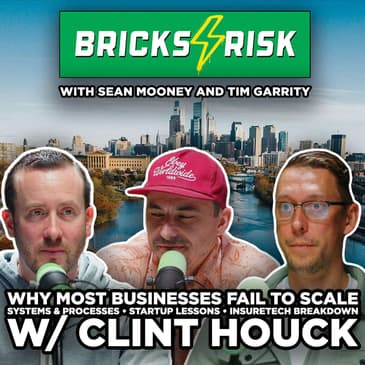
Why do processes and efficiency matter? Well, first and foremost, they save time; and time is money. But, they can also help in other ways that don't present themselves ... until tragedy strikes. Clint Houck is not only an insurance expert, he's an entrepreneur, VC guru, and start-up veteran. Sean & Tim extract wisdom from Clint on how he got his start, what he's learned along the way, and how you can better prepare yourself for life's learning lessons. Dive right in, peeps!
Big shout-out to our show's loyal and dedicated sponsor: Property Management Redefined. John Sacks and his property management squad love our show and continue to support our mission of helping people through podcasting!
Our goal with Bricks & Risk is that you walk away with 1 or 2 valuable nuggets that can help build your own business. Our audience grows through word of mouth, so if you would please take a moment of your time and give us a review on the platform you’re on, that would be fantastic!
Please also help spread the B&R word by sharing your favorite episode with a friend. You can find all B&R episodes on Spotify, Apple Music, YouTube, and anywhere else you get your podcast content. We greatly appreciate your time and trust.
Until next week, keep learning and keep growing!
** Episode Shout-Outs **
→ Canopy Connect: https://www.usecanopy.com/
→ Episode Sponsor, Property Management Redefined: https://gopmr.com/
📲 Contact Info 📲
→ Sean Mooney, Mooney Insurance Brokers: www.mooneybrokers.com/
→ Tim Garrity, The Tim Garrity Team: www.timgarrityteam.com/
💥 Watch us on YouTube 💥
→ YouTube, Bricks & Risk Podcast, @bricksandrisk: www.youtube.com/@BricksandRisk/?sub_confirmation=1
💥 Follow us on Social Media 💥
→ Instagram, Bricks & Risk Podcast, @bricksandrisk: https://www.instagram.com/bricksandrisk/
→ Instagram, Sean Mooney, @sean.moonee: https://www.instagram.com/sean.moonee/@sean.moonee
→ Instagram, Tim Garrity, @realestateinphl: https://www.instagram.com/realestateinphl/
→ Facebook: https://www.facebook.com/bricksandrisk
→ LinkedIn: https://www.linkedin.com/company/bricksandrisk
Then that dealership, when you're on the way of out of buying your car, they go, Hold on a second. I got to go talk to my financing guy. And they come back and they go, by the way, we have all these three additional products. You've got warranty, you've got gap coverage, you've got wheel and tire. It's an extra 10 grand for this. You go, well, that wasn't what I was thinking about coming in to pay and buy for my car. Well, that's because those products, those those dealerships have the ability to artificially mark them up. In fact, when you actually purchase that extended warranty coverage above and beyond the manufacturer's warranty, car dealerships on average will mark those up anywhere from 100 to 600%.
SPEAKER_01Welcome to the podcast dedicated to real estate, insurance, and building your business. Join us as we take you along our own business building journeys with additional wisdom from our network of local and national experts. Welcome to Bricks and Risk.
SPEAKER_03This episode is brought to you by Property Management Redefined. PMR is not just managing properties, we're creating partnerships that build long-term success for property owners. John and his team can be reached at manage at gopmr.com or by phone 267-753-6005. Tim. Yes, Sean. Who's a good client for PMR?
SPEAKER_01Property management redefined is looking for property owners who value three things accountability, reliability, and a results-driven approach. I want to maximize returns, but still provide client and tenant satisfaction.
SPEAKER_03There's a lot of property managers out there.
SPEAKER_01What does PMR do really well? Biggest thing is they're steamless and they're worry-free. So with that approach in mind, it allows the property owner to put their trust in PMR and know that the results will be there. The other thing I think a property owner is really going to value because they do it so well is that they have a local expert team, boots on the ground, managing your properties and your tenants' expectations every day so that you feel good about your investments.
SPEAKER_03We have millions of listeners out there. Tens of millions. If they want more information, how do they find PMR?
SPEAKER_01Right here, guys. Reach out to John Stacks and his team at Property Management Redefine. We'll take good care of you. I'm Tim Garrety. And I'm Sean Mooney. Today, Sean, we have one of your connections on that I recently found out. We have Clint Hauck, VP of Insurance and Distribution at Fair. What's going on, Clint? Hey, happy to be here, guys. Thanks for having him. Thanks for coming on. So some background on Clint. Clint has nearly two decades of insurance industry experience, spanning roles as an agency owner, as well as multiple leadership roles with carriers and insure techs. I'm going to need to get some more info on insured techs today because that comes up a lot and I've never really gotten a full definition. Throughout his career, he is focused on helping agencies implement the tools, systems, and processes they need to grow, operate more efficiently, and deliver a stronger client experience. At Fair, Clint leverages his background to build scalable distribution and deepen carrier and agency partnerships across the country. With a BS in management from Penn State University. He also hails from Bucks County, Pennsylvania. I'm going to start this one different. I've never started an episode this way. I'm going to start it with your quote. Okay. Because I really liked it. So your quote was objective judgment, unselfish action, willing acceptance. Never in a hurry, never worried, never stopping short. And it was from Ryan Holliday's work in Stoicism. Talk about that quote and stoicism in general.
SPEAKER_02Yeah, yeah. So uh, you know, I think uh if I counted now, this is my fifth or sixth startup to be a part of, depending upon how you uh count starting insurance agencies uh as a as a startup or not. Yeah, absolutely. And so with with the stress that that comes from that experience and growing, uh I was looking for ways to uh mentally find that balance. And so that's where I came across Stoicism. Actually, originally it was the Tim Ferris podcast, uh and and listening to that, and he had brought on Ryan Holliday. Ryan Holliday has really taken all of these ancient stoic texts across generations and individuals and condensed them and and reworded them pretty much for modern day times and written a number of books on different components of stoicism. And at the end of the day, you know, those are two of the quotes from his different texts that is really just talking about hey, show up every day, do the things that things that you need to do, and ultimately have the patience for them to develop. And I think that's sometimes some of the hardest things when building a startup is you're like, hey, I am grinding, I am doing all the things I'm supposed to be doing and checking all the boxes and in all the different ways, and nothing seems to be happening, and nothing seems to be happening, and nothing seems to be happening, and then all of a sudden there's that avalanche uh moment or that breakthrough moment when it starts to all come to fruition, uh, where in the past in other uh roles I may have given up or stopped short. Uh, but that experience has taught me that you just keep doing the right things day in and day out, and the results come.
SPEAKER_01Awesome. Correct me if I'm wrong, because I like stoic quotes. Stoicism is it more or less, and again, I'm probably like, you know, not explaining it completely correctly. It's more, it's like control the controllables. Right. Like things that are outside your control, don't try not to worry about them as much because if they're outside of your control, what good is it doing you to worry about it? If it's within your control, let's say it's like trying to wake up earlier. That's up to you. Control the controllable, and that way a lot of the things will fall into place. Keep you a little less stressed, keep you a little bit more patient. Is that like semi-correct?
SPEAKER_02Yeah, yeah. I I think of it as hey, I can I can control what happens inside of me. I can't control what happens externally. Uh, and so how I think about things, how I carry things, uh, even how I operate in a daily basis. Um, I joke, I call it optimizing laziness. Yeah. Uh so like a perfect example of that is hey, uh, I've been traveling on the road nonstop for the last week and a half for conferences and events. And uh, you know, the opportunity came up to jump on this uh podcast this morning. And, you know, one of the things I'll do is, and it's simple, right? But you prep your coffee the night before. So I wake up in the morning, I don't have to be thinking, I don't have to decide if I want caffeine or not. I hit the button and the the coffee's prepped for me. Uh, and so I think about that in every aspect of life. That's a really simplified example. But it's a good example. But it's yeah, it's it's how do you prep your life to be able to be lazy, uh, for lack of a better term. You know, everybody talks about maximizing efficiency, maximizing effectiveness, and that can that can sound uh yeah overwhelming, but yeah, like a little too much. Yeah, yeah. But if you're just saying, like, how can I make life as enjoyable as possible, but still get done what needs to be getting done, uh, that's where that optimizing laziness comes in.
SPEAKER_03I think it was uh it might have been uh Bill Gates or something. Some of them your boy, Steve Jobs or Bill Gates, I forget. Um one of them said, I look to hire some of the laziest people that I can find because they have a way to figure out how to like do things, but in a very easy manner. Interesting. Yeah.
SPEAKER_02Well, I think about that, like even as as you know, building this company this time around, you know, we're in this age where everything's AI focused, right? Uh, and you go to insurance conferences, every company there is now an AI company. And there's this big debate on you know how practical and useful truly AI is in the insurance industry and where it's smoke and mirrors and and where it's reality. But you know, when we think about growing our team at fair now, uh as we continue to grow and scale, it's not necessarily the easy way would be to just hire more bodies, do the traditional carrier model of you know, hire a bunch of reps and and be you know very people heavy. Uh but we think about it now of saying, all right, can we be lazier and saying, hey, what if we don't have to manage so many people? Yeah. Right? What if instead we can wear it? Saves money, saves time. Yeah. Uh, in using technology in an efficient way, in an effective way, not a smoke and mirrors way, but in a way that says, hey, we can get more out of people without them feeling more stressed or overwhelmed by uh the workloads.
SPEAKER_03A good segue opportunity to tell everyone what fair is and define for Tim what an insure tech is. I was just gonna say that.
SPEAKER_02Yeah, so I'll start with an insure tech. So an insure tech is really uh there's there's many different ways that people will define it or nuances to it, but at uh at a broad level, it is a technology-focused company that is uh working inside the insurance industry.
SPEAKER_01Like fintech is finance, prop tech is real estate, insure tech is insurance.
SPEAKER_02Right, right. So it can be software and systems that help at a carrier level, at a broker level, at an agency level. Uh it can even be a digital insurance agency or a company that uh set themselves up as digital first, and the product that they happen to sell is an insurance-related product. So it depends on on the person you talk to, on where that line is from a technology standpoint.
SPEAKER_01Very cool. And then what about FAIR? Like what is FAIR exactly? Like what do you guys do? Like who are you servicing, that kind of thing?
SPEAKER_02Yeah, yeah. So FAIR, we are a new carrier in the space. Uh traditionally, our industry You're like an actual insurance carrier. So we're not insurance. We're traditionally people would define our product as warranty, or that's what you adhere. You know, all those extended warranty commercial mostly auto is this it's all auto. All right auto. Okay. Um we'll be expanding. But uh right now it's all auto. And traditionally, our competitors would solely sell 100% through car dealerships or through mailers or uh TV ads, right? Direct to consumer or through the car dealerships. We're taking a different uh approach to this. We believe that mechanical breakdown, uh, which is really what a warranty is, it protects your vehicle if it has a breakdown. We believe this coverage more closely aligns with the insurance industry and being offered through that trusted advisor that's looking at all of your risks and protecting either your business or your home and your family, uh, and not live outside of that ecosystem or attached to a car sale.
SPEAKER_01Yeah. So instead of like, so the original warranty, let's call it, the one that we know, bumper-to-bumper warranty, you get that through the dealership. You buy a Jeep, Jeep comes with a warranty if it's new, and you're the it's like the warranty company has a relationship with the company selling the Jeeps. But you are doing the relationship with guys like him. Correct. Because you want to offer that warranty, what, like alongside his insurance policies as a set as a separate thing? Like, how does it work if we're working with him?
SPEAKER_02Yeah. So think about it this way. So where it really complements is with auto insurance. So your average consumer, and I've built multiple insurance agencies, I've worked with a number of customers, hundreds of customers for for auto insurance. And, you know, a lot of folks don't fully understand their auto insurance policy end-to-end, right? Could you could you name all the coverages on on your policy today?
SPEAKER_01Hell no.
SPEAKER_02Right, right. It's something that you think about when you need to purchase it, and then you think about it again when you have a claim. So what happens for a lot of consumers, they think, hey, if something happens to my car, insurance comes in and covers me. And logically, that makes sense, right? So if you have a act of nature, fire, flood, hail, theft, well, that's covered covered under comprehensive, under your auto insurance. If you strike an object or an object strikes you, that's covered under collision under your auto insurance, because there's those are both accident related. But let's say you have a breakdown or you get yourself locked out of your car, you get a flat tire, you run out of gas. Well, there's emergency road service to help uh get you back on the road through your auto insurance. Even though there's no accident there, it's just, it's just, hey, you're you're you need some some towing support or lockout support. There's coverage for that. But if your car just breaks down, just has a mechanical breakdown, there's no coverage for that under our auto insurance. So from a consumer experience, it's like, wait a second, 90% of the things that happen to my car are covered under auto insurance, but this one thing isn't.
SPEAKER_01Yeah, the 10%.
SPEAKER_02Why does it live outside the ecosystem? Not only that, I can't even buy that through my insurance provider or agency. The only place I can buy that is at point of sale when I bought my car and it got pushed on me by the FI shop trying to get out the door with my new car, or because I happen to answer one of those direct mail ads or see one of those TV infomercials and call the phone number. So it's a it's a broken ecosystem from a consumer experience standpoint in the way it's offered today.
SPEAKER_01Yeah. So like for uh I'll take, I'll put my I'm buying a car hat on. So I go buy the new car from the dealership a lot of times, if not every time. I don't know this whether it'd be right or wrong, it comes with a warranty. Yeah. And the warranty is like mileage-based or year-based or both, or whatever. So you're like, cool, I just bought new. If something goes wrong with the engine, like year one or under this mileage, like I'm fine. Like everything will work out. But if I go buy the used car, there's not really gonna be any, the dealership's not really gonna offer anything. Maybe they will, maybe they won't, probably not. But if I want to control it myself, I could go to Sean and say, Hey, do you have is there a warranty option through you that I could put onto my insurance policy?
SPEAKER_02Would that be like a correct Yeah, you're you're you're close to enough example? I mean, so the the first half of that example is hey, you go to buy the new car at the car dealership, you get a manufacturer's warranty, right? The manufacturer of the vehicle gives you an initial manufacturer's warranty coverage. Then that dealership, when you're on the way of out of buying your car, they go, hold on a second, I gotta go talk to my financing guy. And they come back and they go, by the way, we have all these three additional products. You've got warranty, you've got gap coverage, you've got wheel and tire. It's an extra 10 grand for this. You go, well, that wasn't what I was thinking about coming in to pay and and buy for my car. Well, that's because those products, those those dealerships have the ability to artificially mark them up. In fact, when you actually purchase that extended warranty coverage above and beyond the manufacturer's warranty, car dealerships on average will mark those up anywhere from 100 to 600%.
SPEAKER_01Damn.
SPEAKER_03Yep. Did you know this? I knew that there was uh they sell you on that extended coverage. Yep. I know that they can like give you the price, and then when you say no, they say, Well, well, let me go back to my finance manager and so I say five grand. So I I know that there's like games to be played when you're at the dealership in terms of taking people's temperature.
SPEAKER_02Yeah. Seeing how how important that is to them. It's their margin is whatever they can convince you to pay. Very interesting. You know, quite honestly, it feels almost predatory uh in a consumer experience because you're you're uneducated in the space. Just like, do I know what my auto insurance coverages are? You know, do I know how much a warranty coverage should actually cost or not? And when you have a claim, do you go back to the dealership? Well, no, they direct you towards your your provider that was in your paperwork. Do you still have that paper contract somewhere? Well, I don't know. I worked with the car sales guy.
SPEAKER_00Yeah.
SPEAKER_02Right. So then the experience on the claim side of the house, you're you've got to chase down who do you contact. And usually there's two or three intermediaries between the warrant, ultimate warranty carrier, then the end consumer for being able to take care of a claim. Interesting. Other really uh tricky part is these costs, then the dealerships will roll those costs into the actual vehicle loan. So not only have you now paid 400% more than the cost of the cost of the cost of the colour. Or they'll just add it on and do the the finance will be basically.
SPEAKER_03Take that 10,000, put it into your finance agreement. So it's a$50,000 car, now it's a$60,000 car. And now you're paying interest on that because it's tied in with the financing. Oh, slick.
SPEAKER_02So you're just getting overcharged, and now you're stuck in a product that's built into your loan. So you can't even really get out of it until you refinance your loan. And so you can quickly see how this system has been built to really, let's say, nicely maximize the revenue that these players can can generate from consumers. Nice way to put off your auto emotions. Yep. So uh we we uh think there's a better way for consumers, and we think there is a more valuable product for agencies to be able to bring in and and help protect their clients. Did you help start this company? Uh so I came in about six months ago. Uh I actually met the founder Will Betteridge and the team at Fair when I was on the ventures and innovation team at State Farm. Um wow. So uh State Farm has a$200 million uh CVC fund. They've got a very large innovation team that looks to they're looking to like invest in things. Invest in things, bring them in as partners. Yeah. Oh, wow. There's a there's a number of large insurance carriers out there that that have similar programs and and platforms. And so uh the way a CVC works is saying that it has to be a strategic partner. So not only do they invest in companies, but that company has to be um become a product that that that State Farm uses as well, uh in as a general rule of thumb. So Fair was in its very early days, uh getting their seed round of funding, more of an idea than uh than a company at that point. But I saw the value in it immediately because of the coverage gap and the customer experience. So I stayed close with the team as they continued to build out the product. Their thesis was always to distribute outside of the dealership and distribute through the insurance channel. So just helped provide some some guidance there. And then uh they got to a level where they said we needed somebody to run distribution partnerships in the insurance channel, and so I joined. We're uh we're 11 people right now in size. Very cool.
SPEAKER_01Are you guys based locally?
SPEAKER_02Are you based uh somewhere else? We're an all-distributed team. So um our headquarters is out of Scottsdale, Arizona, but we've got a team in Boston, New York, Philly, Chicago. Uh so wherever we find good talent, uh, that's where our folks are.
SPEAKER_01Did you know about that VC stuff from the big box insurance companies?
SPEAKER_03So not specifically to that, but the one thing that came to mind was there was the TV show. Uh, if you remember the guy from uh the Houston Rockets, uh the owner, and he was the golden nugget guy in an Atlantic.
SPEAKER_01Oh, yeah, yeah. I remember. Oh, I remember the show. What the hell was that guy's name?
SPEAKER_03So what he used to do was he used to superstar. I can't think of I could see his face. But right now. What he would do on that show was he would be an investor in a company. Okay. But it was only companies that would align with what his current roster of companies were. Meaning he'd own in Fortita Fertita. Yeah, yeah. So like he owns hotels. And so people would come in and there was one person. It was great. What was the name of that show? Remember? It was like not like the rookie or not the apprentice, but something like that. Oh, that was really good. But um, so like I remember the one, she was like this small little like woman who owned a business and she would make like soaps or shampoos, and he would invest in that, but he would also be the guy who would make like a purchase order of like fifty, you know, billion billion, billion. Uh and so it was what it was called. Hey, I'm buying you, but I'm also propping you up, yeah, and giving you this massive deal so that it can be your first of many. Like it's good for me, but it's good for you.
SPEAKER_01So is it like the strategic partnership?
SPEAKER_02Yeah, that strategic if you can automatically become almost uh overnight one of their largest, if not their largest customer, you instantly mark up your own investment return. Right. Right? Because the valuation of the company increases because now you got a seven-figure deal uh from as a as a new customer, and that customer happened to invest in you in your prior round, but you know, uh it's it's one hand supports the other uh in that.
SPEAKER_01Yeah, it's so what was great about that show, because I watched it too. Oh, it's a great show. He was always like, hey, you know, we sell X amount of like you know, uh sandwiches per year. I mean, again, I'm just putting an example out there. No, it's true, yeah. And then you make this bread. What do we pay for our bread? What's your bread? And your bread is so much better. Is there a way that we can get the cost of your bread down to the cost of our bread? Yes. So that your company is growing, we have better bread, and strategically we're aligned. Like you want to keep making bread to support the fact that we sell a shit ton of sandwiches. And dude, that show was so good.
SPEAKER_03So it's it's the same kind of thing. So, like you have a warranty product, right? Right, that insurance. aligns with because now as an insurance agent I can offer that a better pricing, better protection all around my clients better protected. And then it becomes one phone call. Oh, I was in a car accident. Oh, I I had this happen. Oh, this broke down. So it does uh align in that way.
SPEAKER_02Well and and Sean, so inside your agency, when you sell an auto insurance policy, how long on average would you say it takes one of your agents to to sell auto insurance only?
SPEAKER_03Like start like start start to finish. I would say I don't know a couple days. Okay.
SPEAKER_02Um actual talk time. Back and forth a couple times a couple hours. Okay. Now add homeowner's insurance into it. A couple more days, a couple more hours. Great. Yep. So that's the normal sales cycle to cross-sell inside of an insurance agency when you go from auto to home. Yeah because completely different questions. Yeah. Completely different coverage. Two totally different things. Two totally different things. The cross sell from auto insurance into warranty is all right, Sean, we've talked about liability, we've talked about medical payments, we've talked about funeral benefits. Next section of coverage is about protecting your car if it's damaged. Yep. Comprehensive acts of nature collision if you strike an object mechanical breakdown if your car breaks down you select a deductible and then the companies pay the rest. What would you like your deductible be? That's the cross sell. Yep. Interesting. You took 15 second cross sell from auto insurance into warranty, that mechanical breakdown coverage, because from a consumer experience and from your agent's experience, it's just talking about one more coverage in the already existing coverages that that you're reviewing for their auto insurance. And then from an underwriting question standpoint, there's only one additional question that isn't asked in auto insurance and that's how many miles are currently on your car.
SPEAKER_03So there's not even you know capture that on intake and it's already it's already there.
SPEAKER_02Right. So it feels like one same sales conversation versus having to have a completely different sales conversation. And quite honestly, you know agencies can see that they're doubling their revenue per auto as a as a result of that with a a 30 second cross sale.
SPEAKER_03The the the more appropriate I think analogy might be on the home side with flood insurance because you have your homeowners flood is not included and the presentation of flood is well here your your your home policy doesn't cover flood here's your proposal for flood coverage. And so it becomes uh you're rounding out that coverage making them aware of what's available and similarly with the car it's the car it's a different company different uh because the home you can't really just add flood on right so it has to be outside of who that homeowner's insurance company is so it's it's kind of similar in that way where you're you're rounding out the coverage it's different but it's like just linked.
SPEAKER_02Yeah um Neptune Flood is a private flood provider that I don't know what five eight years ago at this point has uh that started up and they proved out and validated that that exact workflow that you talk about.
SPEAKER_03And as long as you and Nick Russio is our Neptune rep shout out to Nick he's a shout out to Nick Russo he's a great uh he's a great guy to talk uh about flood business technology like he's he's got it dialed in but what makes Neptune go is that I can be prior to them to get uh a flood insurance quote it was brutal yeah it was get on the system you've got to log the address you've got to does it have a basement what's the oh it doesn't have a basement how many feet above they were starting a lot of the work on you all of it all of it so you wouldn't go down that road because you kind of knew like oh dude this is just a pain in the butt now Neptune you like put the address in and it it'll draw the work from address input to to quote is like five minutes. Oh wow yeah so they they what the what they did was they took uh a problem uh of quoting where it just became something you didn't want to deal with it and then they enabled you to do that same thing where you could get the quote and they just shrunk it down and made it uh within a couple minutes.
SPEAKER_02Yeah and we took that same approach at fair because you know we distribute through a lot of different partner types in insurance it can be a main street insurance agency it can be a brokerage it can be a digital agency uh it can be a carrier or an MGA so you know we've built simplified UI UX for that Main Street agency that doesn't necessarily have the technical capabilities to integrate we've got fully exposed APIs that take 48 hours to stand up for full quote and bind. So if you're a digital agency or an MGA and you want to build that into your ecosystem and white label it, you can do that. We even partnered with Canopy Connect uh from our APIs. So now any agencies that use Canopy Connect to collect deck pages for prospects, a warranty quote is automatically generated. And we don't have the same uh negative concerns around quoting like P and C does because we don't have clue report costs. We don't have MVR report costs. So there's no downside to quoting and we've made it remote your data points are like four. Like yeah I need this, this, this, and this and here's your quote right right and so it's just a really simplified process that doesn't break or disrupt the existing sales processes and systems inside of an agency just like what Neptune did to simplified Flood.
SPEAKER_03Same thing.
SPEAKER_02Yep.
SPEAKER_01Hey everyone this is Tim your favorite bricks and risk co-host but don't tell Sean. I hope you're enjoying this episode and I'll get right back to it in a moment. Our audience grows through word of mouth so if you would please take a moment of your time and give us a review on the platform you're on that would be fantastic. Please also help spread the BR word by sharing your favorite episode with a friend. We greatly appreciate your time and trust now back to the show all right so here's a question before Mooney goes too far down the insurance nerd track. Um how did you get into the VC work estate farm? Like what what got you into that?
SPEAKER_02So I started fresh out of college pure insurance right I was a commercial fire underwriter. And it was actually for State Farm that's where I got started in my career. Oh wow uh runs in the family my parents owned a state farm insurance agency and and grew up from there and I graduated in 08 when the economy collapsed. So insurance was really the only industry that was hiring at the time. Let's go down this down this track. But you know um my career has always been when I see an interesting opportunity or I see a roadblock that's been hit and I don't understand why it hasn't been solved, I take that that next step to go sit in that seat. So uh as an underwriter I saw what agents were doing and the the struggles they were having with applications and knowing uh uh eligibility guidelines. I went and became a state farm agent. And then internet leads were really big at that time. This was 2012 and consumers were starting to shop online and the insurance industry is scrambling to try to figure that out. Well uh connected with a couple of lead gen companies out there locally in the greater Philadelphia area and saw how we could successfully distribute insurance digitally. Well at that time the state farm model wasn't allowing you to be able to sell outside of your territory or outside of your state. Oh, because of the franchises. Because of the franchises so I go well why can't we distribute nationally as a digital insurance product? Well let me go figure out how to solve that. So that was my foray into the independent channel. Oh damn so I surrendered my state farm agency to go start an independent agency with a couple of co-founders that were running this lead gen company. You started one from scratch and independent like this guy. Exactly yep yep so uh built that in 2000 That's why he looks so much younger. He's out right yeah exactly he was in and out you're you're never getting out uh so I did that in 2014 2015 stood up a digital independent agency uh thought okay I can build my own tech stack I can I can design it how I want and everything's gonna work great. Well didn't realize that the insurance industry didn't know what an API was let alone how to spell it uh so uh spent a couple of years you know with these really manual processes disparate systems that weren't talking carriers wouldn't open up APIs uh it insurance focused technology system AMS systems comparative raters weren't opening up APIs at that point couldn't understand why that didn't work didn't have enough leverage as an individual agency so one of our carriers that we represented was state auto at the time they were going digital they brought in a brand new leadership team that were taking an old school pen and paper carrier and modernizing it and so uh I joined uh state auto to say all right how can we modernize the insurance industry uh I just found this passion for for building tech within insurance and not just tech for tech stake, but tech that actually solved the problems that I experienced as an agent and as I saw our clients had inside my agency. And so spent a couple of years at State Auto. State auto got acquired by Liberty Mutual during my time there got a lot more exposure to a lot of the insure techs that were starting up in the industry. Oh all right. Started joining insure techs uh to help solve these challenges because these things were starting to open up APIs were starting to get to be known but then VC investment was a challenge in the early days in insure tech because these VCs didn't understand the industry and the market. And so they were investing into companies that were coming outside of the industry to replace insurance right they were going to replace carriers they were going to replace agencies. And so the That's always the fear. Right, right and and that was really attractive to VC because they had seen that happen on the finance side right you were seeing that with stripe payments uh you were seeing this with this on-demand banking experience and they thought it would be just as easy to do that in insurance. Well it didn't end up being the case right a lot of these companies struggled and went out of business and we won't even remember their their names at this point uh from from when that first kicked off but it was hard to raise money as a true expert in insurance. Insure techs built by the industry or by folks from the industry didn't understand the VC world. And so I had some of those experiences with our early insure techs that I was a part of and said it so I said well let me go figure that out from from the VC side of the house and uh happened to reconnect with some peers at State Farm who were in the innovation and ventures team and they were looking for somebody to bring on and so that was my opportunity to jump into that side of the business. So every time I've had a problem I've tried to go solve it from the other side of the table.
SPEAKER_03Listen there's nothing there's no more available job security out there than trying to find technology to fix insurance problems and and non-connectivity. Yep absolutely well and part of it too is like four companies control all of the levers within I could see that the distribution of data within the insurance yeah yes all right so you're a process driven guy.
SPEAKER_01I am why why processes like is your upbringing you remember from when you were young was it college was it your professional life like what why do processes drive you this this plays into stoicism yep yep so so I had a full circle I had to learn from a a very hard and painful experience early in my agency career.
SPEAKER_02So I started my state farm agency in January of 2012. One of my early clients uh was a single mother of two young kids in elementary school she was a uh an IT consultant she was an independent contractor 1099 which meant she had no benefits so she came into my office for auto and homeowner's insurance I helped her take care of that I was 24 years old at the time first time learning how to sell run a business doing do all of this stuff and try to do it well right uh so I asked her about life insurance that's how I was trained to cross sell into the life insurance uncovered the need she expressed interest but uh to Sean's point we had just spent an hour and a half talking about auto and homeowner's insurance right that's that's a long time to invest for anybody let alone a single mom who's running you know an IT consulting business uh for herself so she expressed interest but said hey I don't have time today I called her once left her a voicemail emailed her a week later and no response off of that and then promptly just forgot right things slipped through the cracks. I didn't have a CRM system at the time I didn't have systems inside of my agency I didn't fully know what I was doing in the city notes right yeah I'd post it notes and a and a notepad right so pick your excuse whatever the reason ultimately she slipped through the cracks she was out for a run um in the middle of the day uh a couple of months later and uh she actually ran by my office and there was a slight hill about 300 yards away and 18 year old kid in a car uh was under the influence came up over the rise struck and killed her oh my god no life insurance in place two kids two kids a single mom grandparents called my office and I had to explain that there's no coverage in place for her. Damn that's crazy that will sit with me for the rest of my career. And that's what sent me down this path of process driven of technology of there's no reason that anybody should slip through the cracks these days with the technology that's available. Any disconnect of disparate systems isn't because of lack of technology it's because of a lack of partnership or lack of alignment in moving forward.
SPEAKER_03So is it from your standpoint like and I I'm going yeah further but like could I have done more? Is that like absolutely right?
SPEAKER_02Absolutely yeah and so when I think about that I I bring that into us as a carrier right um my experience as an agency owner and then even on the carrier side a lot of the relationships the partnership relationships that P and C carriers say they have with agencies that experience is me coming in as a territory manager sitting down in Sean's office once a quarter and going hey Sean how's business? You know I'd really love if you'd send us more like shitty what do you want? And uh you know uh what have you done for us lately? That's the partnership conversation where's my quarter zip yep yep uh and by the way or hey you were a top producer for us here's a little glass uh a award or plaque that you can hang on your wall we always talk about acrylic acrylic yeah that to me isn't partnership right partnership is saying how do we help your agency be more productive and successful and meet both of our mutual clients. You win, we win. Yep. So you know one example of this is we know that FAIR is a new carrier. We know that mechanical breakdown protection is a new coverage or a new product for these agencies to sell. And so we don't just come in and say hey you're appointed here's a technical product guide go and sell it. We'll come in and we've got a fully built out learning management system. We have a small in-house sales team that works with our credit union partners. We'll have them come in and help coach agents and producers on how to sell. We'll even do marketing on behalf of agencies where we'll say hey share your your autobook with us. We'll batch rate everything and we'll send out personalized quotes and email campaigns that are co-branded and so to help you activate and kickstart and get off to that fast start. And so we have found that these these things you can't just do one you've got to help with the training you've got to help with the coaching you have to be there with the check-ins you have to be there with the early activation and help with the batch quoting we'll provide all service on the back end and be that ongoing resource we've even got joint Slack channels set up with certain partners with our internal operations and product people so we can jump on in real time and answer questions. And these are the things that we look at that says this is what partnership looks like looks like and when we do that we see the results from those agencies. For the agencies that don't engage with us on that they don't activate with us. We don't see the production that comes out of them our number one performing agency in October November of last year they were writing one contract a month um this they have doubled and tripled every month since then so they wrote just under a hundred contracts this month with us and we'll be writing them a commission check for over 25 grand. Damn right so it's really profitable for them and it's really beneficial because they're addressing that coverage gap for their clients.
SPEAKER_03Very cool. Did you look at all the other carriers and say this is how these companies view partnership and all we have to do is exactly the opposite of what they're doing and then men we'll be successful.
SPEAKER_02Yeah I mean it's not completely fair right they're so large they're so established they have to think Sean's got an opinion on that they have to transition out of this legacy world but I have felt that pain that Sean has felt we get we have this opportunity that we're scaling and we're growing but we get to be very thoughtful about how we do that in today's world with the tools and systems. We don't have to unwind bad habits, bad practices, bad tech. There's no technical debt there for us we just get to build the right way going forward.
SPEAKER_01It's why when we hire we hire people that have never looked at insurance before get them fresh all right so your tip for our bricks and riskers our listeners and watchers that I've been calling it now so foundational best practices beat shiny objects every day of the week why are you kind of like shiny objects over here keep the fundamentals foundational stuff here. Why why is that your thought process?
SPEAKER_02Yeah if you don't have good systems and processes in place uh as that foundation doesn't matter how what tools or technology that you you purchase it doesn't matter how many carrier appointments you have or or markets you're available to uh because you're not going to see the results. You know Canopy Connect's a great example of this it's a really really powerful tool. What is Canopy Connect so Canopy Connect will help you as an agency that says hey if you're coming to quote me and I'm your prospect, uh normally you'd have me fill out this fact finder or go find my insurance documents and email them to you. Well that requires a lot of work on my behalf as a prospect just to get started. Right? And I don't I don't even know if you're gonna be able to to help me right instead what Canopy Connect does for your agency is you send me a link and it says hey log in here and Canopy Connect will automatically go out to my existing insurance carrier and pull all of my deck pages.
SPEAKER_01Oh damn pull all of my coverage so I don't need to so you're like giving Canopy Connect access right to go get all the details of what you have.
SPEAKER_02Think of it almost as like a plaid but for insurance. Oh it is a plaid right yep and so really really powerful tool which is great it it it cleans up a lot of the initial pain points from prospecting but it doesn't solve the actual insurance sales process. You still need your agent in-house to pull that information prepare the proposal come in with uh strong advice follow up with your customer right they you still need that person to take those right actions and to have the right systems in place to actually do something with that information when it comes in. So Canopy Connect doesn't solve it it just makes it more efficient. And I think about that with all technology or companies that you bring into your business.
SPEAKER_03Well it's like you get into these channels right in like different Facebook groups or whatever and it's the question goes out hey which CRM system should I choose? And you're like doesn't matter like like what are you looking to solve number one like what like there's obviously a problem if you're looking for either a CRM or a new CRM so what's what's the problem and what are what is your goal and what is your process so if you don't have that other information to build around it it's like right does it matter right does it matter which CRM you know which one are you using now and why isn't it working right so you might have the answer you might already be have the platform that's right for you you just don't know it.
SPEAKER_01So many people so I'm in residential real estate so many people in residential real estate will constantly ask me and ask each other like what are you used for CRM? What are you use for CRM? Like everyone wants well what's your CRM like how much is it like how good is it does it have AI like people are so that's the shiny object they're just they're like obsessed with like who are you using for AI content this day using Claude or using Gemini using chat like chat's lame like Claude's like here's the thing all like tech is awesome. I I think CRM tech is great. I think AI tech is great but let's go with CRM because that's where I started if you don't know how to meet people get phone numbers and get email addresses and build some kind of rapport a CRM is completely useless. Exactly because if you go out and get a list of a thousand people you don't know which you can do that and get their names and their emails and their phone numbers and set them up for automated SMS messaging or automated email How good is that gonna go for you if you don't have any rapport? So I think the foundational fundamental thing that you were talking about relates to me as well, and I'm sure to Sean. It's like, look, if you if you don't know how to like business develop, the tech is not gonna do you any good. You could have the nicest website in the entire city of Philadelphia, but no one's gonna care if they don't know who you are, what you're doing, like what you're all about, who do you know, like who have you helped, where do you sell, where do you not sell? Why should I trust you? Exactly. And I feel like the the tech, the shiny objects, again, some of them can be a waste of time and money, but some of them are amazing when you need them. Right. You know, you there's certain people, like for me example, I've been blogging for like 15 years, and I only started using AI a couple years ago. I did it from scratch. But now when I use it for blogging, it's so easy because I know how to write. Right. I know what I want to say, like I know how long I want it to be, I know how often I want to do it. So when I bring chat in now, when I do a blog post, I mean I'm done in like 30 minutes. It used to take me like three hours. And it was like, what am I gonna talk about now? Like how like now I can use that shiny object to improve my my foundation, which is writing.
SPEAKER_02Yeah, makes complete sense. I mean, I think about it, we use uh Google, uh Google Suite for our company and Gemini Note taker, right? In in all of our calls. Well, now I'm not writing stuff down and and not paying attention to what the person's saying to me. But then that allows me to use those notes that when I do my follow-up, which still requires good processes and systems, I can go refer back and find those key pieces of information and personalize the follow-up.
SPEAKER_01Right.
SPEAKER_02And so, but AI by itself wouldn't solve that follow-up process, it just makes it more efficient.
SPEAKER_01Absolutely. Good tool, dude. Great conversation. Really appreciate you coming in today. So before we shut this one down, why don't you tell our listeners and watchers where they can learn more about you and everything you got going on?
SPEAKER_02Yeah, absolutely. You know, best place to find me, LinkedIn, Clinton Houck. Love it. Otherwise, you can go out to fairwarranty.com and we're actively looking to build partnerships and uh appointments across agencies, brokers, MGAs, and carriers right now in the industry.
SPEAKER_03Is there an ideal candidate out there that you're uh looking for?
SPEAKER_02Or yeah, uh ideal candidates would be those that have the capacity and systems to bring in a new carrier and a new line of business because it it's only successful if if you're willing to put the time into it.
SPEAKER_03Did you go to Kennepy Connect and say, can I have a list of agents that you work with?
SPEAKER_02No, but we we did a great webinar together and uh yeah, uh they've got a really active user base. Uh and we've gotten a lot of great responses.
SPEAKER_03It is the, I'll say it, it is the number one technology ad indoor stack that's not even close with others.
SPEAKER_01Love it. All right, that's all we have for this one, folks. Thank you for tuning in again to another episode of Bricks and Risk. See you next week. Thank you for joining us on another episode of Bricks and Risk. Our goal is that you walk away with one or two valuable nuggets, and we greatly appreciate you sharing your time with us today. You can find all BR episodes on Spotify, Apple Music, YouTube, and anywhere else you get your podcast content. Until next time, keep learning and keep growing.