
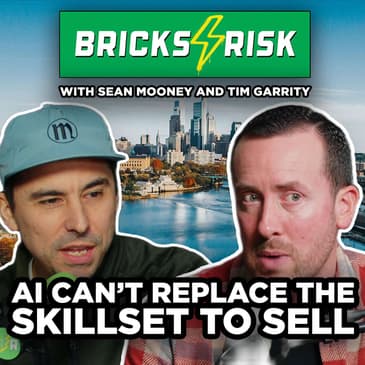
Our good pal, AI. You can't even turn around these days without getting smacked in the face with another AI article, video short, and social post. It's gonna eliminate jobs. It's gonna speed up innovation. It's gonna change the world. Yes, yes, and yes. But, there are some things that AI won't (and can't) replace. In this Bricks & Risk toppy, Sean & Tim go back and forth as to why they both believe AI will never replace the human ability to sell. Agree or disagree?
Big shout-out to our show's loyal and dedicated sponsor: Property Management Redefined. John Sacks and his property management squad love our show and continue to support our mission of helping people through podcasting!
Our goal with Bricks & Risk is that you walk away with 1 or 2 valuable nuggets that can help build your own business. Our audience grows through word of mouth, so if you would please take a moment of your time and give us a review on the platform you’re on, that would be fantastic!
Please also help spread the B&R word by sharing your favorite episode with a friend. You can find all B&R episodes on Spotify, Apple Music, YouTube, and anywhere else you get your podcast content. We greatly appreciate your time and trust.
Until next week, keep learning and keep growing!
** Episode Shout-Outs **
→ Open Claw: https://openclaw.ai/
→ Episode Sponsor, Property Management Redefined: https://gopmr.com/
📲 Contact Info 📲
→ Sean Mooney, Mooney Insurance Brokers: www.mooneybrokers.com/
→ Tim Garrity, The Tim Garrity Team: www.timgarrityteam.com/
💥 Watch us on YouTube 💥
→ YouTube, Bricks & Risk Podcast, @bricksandrisk: www.youtube.com/@BricksandRisk/?sub_confirmation=1
💥 Follow us on Social Media 💥
→ Instagram, Bricks & Risk Podcast, @bricksandrisk: https://www.instagram.com/bricksandrisk/
→ Instagram, Sean Mooney, @sean.moonee: https://www.instagram.com/sean.moonee/@sean.moonee
→ Instagram, Tim Garrity, @realestateinphl: https://www.instagram.com/realestateinphl/
→ Facebook: https://www.facebook.com/bricksandrisk
→ LinkedIn: https://www.linkedin.com/company/bricksandrisk
OpenClaw is this new version where you can basically set up a computer and this thing runs as your uh agent and it can do anything and everything that you tell it to do. And just works on its own. Yeah, yeah. Autonomously. Apparently, one computer got in touch with another computer. Well, that's ominous as f and they start a little computer fight. They created a Craigslist of jobs that they need humans to do. What? So they realized that they're limitation, like uh Umpenclaw can't go to Wawa to get a sandwich.
SPEAKER_00Yeah, yeah.
SPEAKER_03So they created uh like a job board of on like what humans could do that they can't do.
SPEAKER_01Welcome to the podcast dedicated to real estate, insurance, and building your business. Join us as we take you along our own business building journeys with additional wisdom from our network of local and national experts. Welcome to Bricks and Risk.
SPEAKER_03This episode is brought to you by Property Management Redefined. PMR is not just managing properties, we're creating partnerships that build long-term success for property owners. John and his team can be reached at manage at goPMR.com or by phone 267-753-6005. Tim.
SPEAKER_01Yes, Sean. Who's a good client for PMR? Property management redefined is looking for property owners who value three things accountability, reliability, and a results-driven approach. I want to maximize returns, but still provide client and tenant satisfaction. There's a lot of property managers out there. There are. What does PMR do really well? Biggest thing is they're seamless and they're worry-free. So with that approach in mind, it allows the property owner to put their trust in PMR and know that the results will be there. The other thing I think a property owner is really going to value because they do it so well is that they have a local expert team boots on the ground, managing your properties and your tenants' expectations every day so that you feel good about your investments.
SPEAKER_03We have millions of listeners out there. Tens of millions. If they want more information, how do they find PMR?
SPEAKER_01Right here, guys. Reach out to John Sachs and his team at Property Management Redefine. We'll take good care of you. I'm Timmy G. And I'm Sean Mooney. Just like it read on my Bricks and Risk suit for invading Atlantic City, on my sleeve embroidered, it said Timmy G. What did it say on my chest patch? You had uh Sean. So that in case someone wanted to be your 112th follower on Instagram, they could find you easily.
SPEAKER_03113. Let's go. It was actually at Sean.
SPEAKER_01Was it at Mooney? Well, that would be the right way to do it. And you did it the right way. So kudos. Thank you. All right, man. What are we talking about today?
SPEAKER_03Today we're gonna dabble in the space of AI and how AI is connected to sales, and it's going to be based on a recent post that I caught where it was Ryan Ryan Sirhant.
SPEAKER_01Shout out to Ryan Sirhant. Guest episode, I think he was number seven. Seven. Yep.
SPEAKER_03Yep. Um, sell it like Sirhant was his book, and he talked about uh a recent sale that he had, which was his client uh was one of the founding guys or gals of AI, bought the house, dealt with him, and AI and sales and how they're kind of related.
SPEAKER_01Well, this came from your famous nothing doc. Nothing document. So nothing divided by nothing equals nothing, but then there's a new nothing doc. That's version one. I just found out what is what is version two called?
SPEAKER_03Nothing times nothing equals something. Um that's version that's uh the version two folder.
SPEAKER_01So we wanted to run this clip of Ryan Sirhan, and basically in the clip, he's saying he sold like an over $200 million house. Like $218, super cool to a very high profile client who's in the AI space. And when he goes in, he's reading his book, Sell It Like Sirhan. So we're gonna let the guys play it. No, cue that up. Yeah, we'll talk about it. Take a look here.
SPEAKER_02And the buyer who I represented is in the AI space. One of the grandfathers, actually. I can't tell you who it is because I'll be erased. At the closing, when I went there, he's reading my first book, Sell It Life Surgeon. And I thought that was weird. And he started talking to me about it. Why are you reading my book? He's like, I need to know everybody that I work with. You have books, I need to know what they are. I'm giving this book to everybody that works with me because AI will replace almost every skill with the exception of the skill set to sell. And I thought he was just punking me because him in that position, his job is to replace everything that we do. And he says, computers will never be able to build up a no, like, or trust factor. Bobby Bird. He said, You should re-release this book with a new chapter on how to sell like a machine is how to become superhuman. And I started working on that chapter the next day, which is now the re-release of Sell Like Sur Hant with a new chapter inspired by one of the wealthiest people on earth telling me to write it. I just sold a house.
SPEAKER_01Well. What was cool about that is that not only was Ryan one of our guests, but also Bob Berg. Shout out to Bob Berg, author of The Go Giver, co-author. And um Bob was very much making that example because it's one of the underlying themes of a lot of his books, is the no like and trust business model. Someone's got to get to know you, then you figure out if they like you, and then eventually, if the relationship goes further, you build trust. So that's sales, right?
SPEAKER_03And that's you know, that's even the un the understanding from a person who's building a world of computers knows that there's a disconnect when it comes to sales, that the computer isn't capable, no matter how much you give it or program it or whatever, the computer, the computer program, AI, avatars, whatever, is incapable of capturing the no like and trust detail when it comes to sales.
SPEAKER_01So aside from his secret AI fire client and him saying no like and trust, you know, that's that's something that can't really be done by a machine, at least in by comprehension today. Maybe never. No one's gonna know. What's your take on what he was saying? Do you agree? Do you disagree? You kind of mix in the middle. I know you I know you're you're a big AI dude. You like all the weird stuff, making pictures. What? Creating way too long YouTube descriptions for our shorts, songs, videos, videos, you know. You've sent me some hip hop songs from Breaks and Risks that you've created through AI. Um, what's your question? My question is do you agree, disagree? Do you have like a different take on how they put it that you identify with what they said?
SPEAKER_03Yeah. So earlier in the day, uh I was actually talking with Terry and Noah. And shout out to Terry and Noah at Young Junk. They were discussing the topic of a pretty well-known local uh real estate professional. Oh, AI is gonna change this, AI is gonna change that, this is gonna be dramatically different in the future. And my point to that was is it really? Is it is it really going to change the way that real estate transactions take place?
SPEAKER_01Well, real estate's a good one because again, it's one of the highest, if not the highest, financial transactions someone's going to make in their life for the most part, in one time, let's call it. So let's let's stick to the topic of real estate and why you think real estate, let's say the people who can do the no-like trust business model with their clients, why you think they're not going to be replaced. Well, my question was how?
SPEAKER_03I want to know how this transformational technology is going to impact the sale of my home. Right. And oh, well, you see, AI is going to allow the technology, and you're going to have a VR experience, and you're going to put on the headset, and you're going to be able to just go to Maui and walk through this house, and you're going to be able to see every inch of this house, and you're going to experience what it's like to live in this house on the side of an ocean and be in the beach. And and I my response to that was really if I'm going to spend in that situation five million dollars for a beachfront home, aren't I going to want to be in that home to smell what that home smells like? Aren't I going to want to walk on the floors, open the drawers, see the closets, and look at the ceilings and smell that salt air? I just think that there's a limitation when we're talking about how transformational technology is going to be when it comes to in this case, real estate.
SPEAKER_01Yeah, and I think too, it's like I think the point that Ryan was getting at, and again, his AI person was making that point, someone who's an expert in that space. It's just there's it's too big of a decision. There's there's too many factors that require a guide, an expert, someone to vent to, someone to ask questions without grabbing your phone and just saying, hey chat, well, why isn't the kitchen drawer in this house in Maui soft closing? It said soft close on the description. Why is it not doing that? And and what are they going, what is AI going to do to solve your problem? The the answer is nothing.
SPEAKER_03You know, and again Well, they they would say, well, in the contract, we will say that we will make it a requirement that you said soft closing drawers and we will put that in as an amendment on the you know that like it's not realistic. The solution that technology offers is is limited because it's not a lot of times real world scenarios.
SPEAKER_01Yeah, there's no empathy. There's, you know, there you're not gonna be able to vent to AI. Like, you know, Ella in our kitchen will like talk to Alexa and like ask questions and stuff like that, just like you know, she's constantly putting on music. Uh, Alexa, who sings this song? And then they start talking about, oh, like when did this song come out? And they start having this conversation. But as soon as she asks something a little bit more difficult, like you're just not gonna get a response. And that's not the point. The the I think the point that you're making, which I agree with, and I'll dive into it too, is that having a human being along for the ride when you're making a big financial decision like that is part of the reason why people make big financial decisions like that. Because if there's a lot of financial risk or even liability or personal liability, uh we all walk in this house and my family hates it because we didn't understand it before we bought it, then that's why it's going to be a problem. Because once you own it, guess what? You're not getting out of it. You you're not taking it back to the real estate store and saying, yo, here's my receipt. I don't want this place. I want to return. So, you know, real estate in general is a good example. Um, I'm gonna dive just into like the human side of it. Because the reason I want to dive more into the human side is I actually believe this, like, the more AI is around and the and the more powerful it gets, which it's just gonna get more powerful every minute, every day, every month, year, because it just feeds on itself, the more powerful it gets is also going to increase the value of humans in certain professions, depending on what they do, the value of them. Because you're starting to lose a little bit of what it means to be human through AI. Talking to a screen or a speaker or your phone about what your problems are and what you need, you're you're lacking. This is why people have a family, why they have friends, why they have confidants, mentors, bosses, managers, you know, coworkers, neighbors. Because they just need to go to a person and tell them what's on their mind and get a human reaction. Like if you go to your neighbor and say, Oh man, like this weather, like we've been getting crushed with snow in Philly. This weather is awful. Like, you go, even today, you tell that to ChatGPT, you're not getting much anything back. Now you go to your neighbor and you're like, this weather is awful. You're gonna get probably two general responses. Oh my gosh, I totally agree. This sucks. Glass half empty. Where's my next beer? Blah, blah, blah. And then you talk to someone like me, and it'll be like, you know what? I agree with springs right around the corner. So everything's gonna be all right, neighbor. Hey everyone, this is Tim, your favorite bricks and risk co-host. But don't tell Sean. I hope you're enjoying this episode, and I'll get right back to it in a moment. Our audience grows through word of mouth. So if you would please take a moment of your time and give us a review on the platform you're on, that would be fantastic. Please also help spread the BR word by sharing your favorite episode with a friend. We greatly appreciate your time and trust. Now, back to the show.
SPEAKER_03Some computer forward people, technology forward people, would probably argue this would be the counter argument, is that nobody knows you as well as Chat GPT. Yes, that's a good point. Right? So, like if you're constantly talking to them every single day, you know, if you look up your we I do it with um ChatGPT, where it has our whole diary of bricks and wrists, like every episode. You guys go on dates together? We don't. We get a couple cocktails? No. Chat has our whole history, yeah. So which is a lot, it's a lot. So you could argue that nobody knows the intricacies of our show like ChatGPT. So the counter-argument being is that when you go and go to Chat GPT about the snow, ChatGP ChatGPT knows exactly what your emotions are, knows exactly what emotional response you need, and therefore is the best qualified to answer your complaint about the snow.
SPEAKER_01No, that's true. Um, here's another example. I made the example like you, if you don't like the house in Maui, you can't just you say, oh, here's here's my Alta, you know, I want to return this. Uh we don't like it very much. Oh, yeah, you're out. Yeah, you're done. So I also think they're look again, when we make big financial decisions in life, like, you know, you can go sell your home cheaper with like other companies that don't give you much human interaction, and they'll save you half the money or more. So it's like, well, why isn't the whole market like that? Because there's value in dealing with an experienced human being with empathy, with trust that just understands the market, has intangibles, as Rory and Mikey put it on their episode. Shout out to those guys, marathon mortgage happy hour. Um, like they said, look, there there are just intangibles, like having relationships with people, there are intangible benefits. It's like having things in common, liking the same music, having an understanding of each other, like compassion, you know, the these things are this is how this is uh how people get through life, you know, having a partner, having children, parents, uncles, neighbors. Like if you're gonna live in solitude with a screen, again, it's not to say you can't do it. Of course you can do it. I don't know how many people are gonna be pleased with that decision saying, I'm just gonna go this route.
SPEAKER_03I think a lot too, just as we're talking about the big decision about the big uh purchase when it comes to a home, it's very similar with insurance in that people are coming to us to then protect their biggest asset. Yep. Right? So it's very similar in the fact that do they want a robot on the other end to put together an insurance portfolio of protection to make sure that they are protected, or do they want to work with someone that knows that that person has their best interest in mind and will will tailor the coverage for their specific needs. Yeah. Similar in that way.
SPEAKER_01Yeah, I think also too, it's it you could even attribute it to just like human accountability. So again, whether it's insurance, real estate, you know, the pizza shop. If you just walk up and it was a vending machine with with all these hot pizzas, and you just go get your pizza and like you need something or you have a question or something, like you're not you're not gonna get that. Yeah. So again, it it almost comes from just like the customer service standpoint of being like, I need to like empathize with another human being to let them know why I loved this experience or why I hated this experience. It could be as complicated as a house, as simple as a pizza. Yeah. And I think, you know, what a lot of the experts are saying is like the ability to be human is not going to be replaced by AI. It will replace tasks, it will put people out of work, um, it will simplify things, it'll save time, it'll save you money, there'll be less labor for lots of different things. But it doesn't mean that you don't need a human to make good decisions as you go through day in, day out, week in, week out, year in, year out.
SPEAKER_03Well, there's transactions. Transactions that need a human and transactions that don't. Right. Right? Like years ago, Amazon would have a warehouse that they needed people to put packages together to get it to go out the door on a delivery. Yep. Now they don't. But there was no human emotional component to that job. Right. And I think in the video when Ryan's talking about it, there's a a knowingness of the home sale and needing a certain skill set, which he references in order to complete that that transaction. So there's always going to be things that are need to get done that don't require that, and some that do. And some that do is always going to require that human component to it.
SPEAKER_01Yeah, let's let's stick let's stick with the theme of sales. Because I feel like that was a lot like a sell it like Sir Hand. It's a book about sales. Yep. Like that he's teaching people how to sell. Yeah. Anything. Doesn't matter what it is. Right. Like, you know, you can go to Wawa. Shout out to Wawa. You can go into Wawa, you can pay for your gas all by yourself, you can park your car, you can walk into a Wawa, you can pick up a drink or a snack or whatever. You can go to the self-checkout, you can pay for it and not have to interact. You've done three or four different things and not have to interact with one human being. Nope. Okay? Now, also, maybe in the future, maybe you'll walk into a Wawa and a robot will make your hoagie. Maybe. So that could be the Wawa experience, it's possible, could be completely automated and done through robotics and AI.
SPEAKER_03Well, I mean, it was not that many years ago where they didn't have a touch screen order. Correct. And now it's like, again, these are fit, these are tools, efficiencies, save time. So within a couple years, like, can you imagine going in to order from to someone? Yeah. Like what your order was?
SPEAKER_01Yeah. I used to be the order taker when I worked at Wawa. I used to have the carbon copy forms and that little like black crayon thing, whatever the heck it was. I don't even know what it was. And you'd be like, okay, what do you want? You want junior, you want shorty, you want classic, okay. Last tomato onion, boom, salt pepper oregano, boom. What do you want? Turkey cheese, you want to go Italian? Like, that's how you if you wanted a hoagie, that's how you ordered it.
SPEAKER_03But but I can't think like I can't You can't remember that. I I can remember it, but it's so distant. And so like this is a couple years ago. And my point of that is the technology goes so quickly, and it makes it brings you to a point where you really can't I was 20.
SPEAKER_01That was 26 years ago.
SPEAKER_03Yeah. But they were probably doing it after you were there. You know what I mean? Exactly. Yep. But I can't imagine doing that now.
SPEAKER_01No.
SPEAKER_03I can't like it would be so foreign to me to walk into there. So it's just the speed at which it which it works is it's dramatic. All right. And I will say that I do, I do think, and I'd be willing to bet a ham sandwich. You're gonna bet that Wawa is already tinkering with you know how they have those Wawa shops where they're testing?
SPEAKER_01Yeah, like the small, like almost like an Amazon style thing where like you can walk in, walk out type of thing.
SPEAKER_03I guarantee that there's some warehouse down in Chester County somewhere where they have a setup where it shoots out a roll, and that order gets shot into the roll, and it works down the conveyor and it gets wrapped and it shoots it out. I I would be willing to bet. Totally.
SPEAKER_01Yeah. All right. So let's stay on the theme of Wawa. So I used to be taking the orders, making the hoagies. Now you can just walk in, you order what you want, you take your slip, you go pay for it, you go pick up your sandwich, but a human still makes it. Let's talk about the people who are negotiating the products that they want in a Wawa. What kind of snacks should we have? What kind of drinks should we have? Should we get rid of all the brands? Should we have a Wawa brand of this? You know, where are we building our next Wawa? Like, let's go do a real estate deal. So when you think about, you can have as a customer, you could probably go into a Wawa and eventually like get your entire experience without dealing with a human being. The people that are running Wawa and the people that have to make the deals that keep Wawa going, improved customer service experience for the consumer, which is sales, is going to have to be understood and directed by a human being. Because what's going to happen? That human being is saying, What would I want if I went into a Wawa? And you're not going to match up to what everyone wants, but you need to ask yourself that. Like we talk about this all the time in our industries. You've said this, and so have I. I say this to buyer clients all the time. And they're like, they're looking for a house, they have paralysis by analysis. This happens all they can't get out of their own way. Okay? Yep. So then I'll start saying to them, let's look at the things that are important. Is it close to this? Yes. Is the payment where you want it? Yes. Does it have the yard? Yes. You're literally going the okay, okay, okay. But there's still, it's got everything. But what about next week? What if another home hits the market that's a little cheaper? So then a lot of times what I'll do is say, look, if you're getting about 80% or so of what you want, that's a good indicator of you should at least make an offer. Now, if the offer doesn't work out, it doesn't work out. And you move on to the next one. Do you ever get emails after the fact?
SPEAKER_03Have you ever gotten that where you close on a C- I made the greatest mistake of my life? No. Can I return this? No. Did you ever get an email? Closing goes through, and then three weeks later, someone goes, Tim, look at this house that that's up for sale.
SPEAKER_01You know what? Let me let me finish my thought here. So it's will we get into the position, you and I, of saying, look, if it were me, and and if it were me and I were you, yeah, and I were in your spot, I'd probably be making an offer. Yep. And and you're doing that because you understand them. You've been listening to them for days or weeks or months or years about their decision to buy a house.
SPEAKER_03Yeah.
SPEAKER_01And you can give them the confidence and the empathy and the understanding they need to get out of their own way so that a decision gets made. Now, to answer your other question, this is pretty funny. So, like, you know, when people are shopping for homes, you can set them up for like an MLS auto search, the multiple listing service. Right. So, oh, you want price range, this town, this bed's best, whatever. And they just get automatic emails. Oh, you got to turn that off once you And it doesn't go off automatically. So there have been a handful of times in my 16 years of being in residential real estate where I haven't turned it off. They've bought a home and they get an email from me. It says, Hey Bill, hey Sally. Is coming soon. 123 Main Street is an absolute banger. Do you want to buy me? And here's, you know, I've had this a couple times, and they'll be like, What about this? And then I'll it has come up and I'll say, Remember how hard it was to even get the home that you had? There's no guarantee that you would have had this home. Yeah. Pictures, lie, there could be unforeseen comments, whatever. It doesn't matter. But it has had that's a very good question. Yeah, it has happened a couple times. My mistake, we're human, we all make mistakes. Let's let's talk about that from like an insurance standpoint. So you do different kinds of insurance. You do uh property, you do auto, you do business, you do life. Yep. Talk about any of those from the human perspective on why you agree with what Ryan's AI client said.
SPEAKER_03Um I will answer it by saying this. I think that when in that clip, when he's talking to the AI person, the buyer.
SPEAKER_01The $218 million client. Yeah. It must have been one hell of a rip.
SPEAKER_03Uh even if you're getting like one percent.
SPEAKER_01You're freaking killing it.
SPEAKER_03Um my takeaway is that he defines the the success in the person who can adopt AI and the person that's like really good at sales, and he's got the AI capabilities, that's when that person becomes superhuman. And I think that that's really the winners going forward are going to be are going to be the people that can adopt a lot of the AI things to enhance what they're doing. And I think with insurance, that's definitely the way that it's going. Is is how can I become better by adopting AI into really everything that I'm doing? Because that's going to set me apart and that's going to make my offering so much better. So you you have the know like and trust. And if you're able to capture that, you're you're already two steps ahead. And now, if you can inject the AI capabilities, yeah, from a customer service efficiency, customer service, processing, all of that, you're gonna be like the one percent. You know, you're gonna be the top-tier insurance professional that can do so much more than some of the other people.
SPEAKER_01All right. Before we shut it down, if you had to give any kind of words of wisdom, what would you say, someone who sees it a little differently after watching that video than you and I see it?
SPEAKER_03So the take being what?
SPEAKER_01The take being take being that someone, someone's very fearful. There's pl there's probably more people that are fearful of AI than there are people that believe it's going to be a useful tool that will enhance your business no matter what you're doing. What would you say to the person who's fearful?
SPEAKER_03I would say be fearful.
SPEAKER_01Great advice.
SPEAKER_03Uh if you're not trying listen half empty. If you're gonna go through life with blinders on uh, I don't need AI, AI is not gonna impact my life. You know, that that's over there. You're not gonna eat my lunch. It's it's it's coming, it's here. It's here in a big way already. I will say I was watching somewhere online um open claw. Do you know what open claw is? Clawed? No. Open claw. Oh, claw.
SPEAKER_01Yeah. Is that glance out accent?
SPEAKER_03Um open claw is this new version where you can basically set up a computer and this thing runs as your uh agent and it can do anything and everything that you tell it to do. And just works on its own autonomously. And apparently, one uh computer got in touch with another computer, and they start a little computer fight, they created a Craigslist of jobs that they need humans to do. What? Yeah. So they realized that they're limitation, like Claude uh Umpenclaw can't go to Wawa to get a sandwich.
SPEAKER_00Yeah, yeah.
SPEAKER_03So they created uh like a job board of on like what humans could do that they can't do. Yep. So kind of like a reverse on what it is. So a little scary.
SPEAKER_01Uh little beer, so be fearful. Understand that it's that it's here. Yeah, it's going to get more intense. Yep. But use that fear to drive you to to understand it and to use it, like if you can.
SPEAKER_03You have to bring it into your business, you have to bring it into your life. You have to start getting um familiar with the the workings that AI is doing right now. Because if you don't, you're going to be left in the dust. Okay. So be a few be fearful.
SPEAKER_01Mine would be um, again, I'm gonna go a little bit more positive. Yeah, shine a little light on uh what we're talking about here. Um, I would say um, you know, know your worth, like know your value. Understand that you do offer something outside of technology. And I don't, you know, it's gonna be different for everyone. Like some people are just really good listeners. Like some people are really good talkers, some people are really good marketers. Some people are just, you know, they're five minutes early for every single appointment in their life. So there are skills that will build that trust with your client that you understand that you're good at. Now, I'll also agree with what you said, and knowing that a lot of people say this is very common in the podcast world in business books, like get 1% better every day. People say this all the time. And it's so true because it is more of a marathon where it's like if you're gonna if you're gonna run a marathon at some point, you first you gotta learn how to run, then you gotta do the short runs, then you got to do the mile run, then you got to do the 10 miler, and then maybe at some point, if you're dedicated enough and you get better, you can do a marathon. It's the same thing with your job. Like whatever you're doing, knowing that there's a no like and trust uh skill set that probably won't ever be replicated, at least not that we can comprehend now, go with that. How do you build trust? Is it because you're punctual? Is it because you're a good listener? It doesn't matter. Figure out the things that you're really good at. Use AI to make them better so that you have more time to either improve upon those skills, become more efficient, drop things off that you're not already good at, but understand that AI is here to stay. It's going to be a part of your business. And I think, again, realizing that and focusing on what you bring to the table is just going to drive your business into the future.
SPEAKER_03Well said. Shut this one down. All right, folks. If you want to hit us up, get a sticker, drop us an email, bricksomrisk at gmail.com. Find us on the interwebs, LinkedIn, Facebook, Instagram, anywhere else, YouTube. I'd find us.
SPEAKER_01Discovered we had a TikTok account. TikTok? We don't do anything with it, but we have one. Of course, Mooney started it without saying a word to me, and I went in and updated the profile because that's what I do.
SPEAKER_03Um, find us on TikTok. Hit us if someone hits us up on TikTok.
SPEAKER_01Yeah, that'd be pretty cool. Follow us on TikTok.
SPEAKER_03Uh, shoot us a message, tell us how we did. We'd love to hear from you.
SPEAKER_01That's all we have for this one, folks. Thank you for tuning in again to another episode of Bricks and Risk. See you next week. Thank you for joining us on another episode of Bricks and Risk. Our goal is that you walk away with one or two valuable nuggets, and we greatly appreciate you sharing your time with us today. You can find all BR episodes on Spotify, Apple Music, YouTube, and anywhere else you get your podcast content. Until next time, keep learning and keep growing.