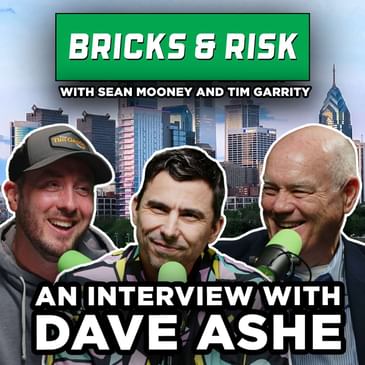

Not only has Dave Ashe survived and thrived in residential real estate for 40 years, he has 3 kids, 7 grandkids, a vacation home at the South Jersey Shore, and multiple businesses. In other words, Dave has found long-term balance with success as a business owner, as well as with his family. He's also a firm believer in educating new agents, as well as educating his clients on why real estate is the best investment there is. Sean & Tim dive deep into passive income, why timeblocking works, and why "turning it off" has consistently been one of Dave's biggest struggles.
Our goal with Bricks & Risk is that you walk away with 1 or 2 valuable nuggets that help build YOUR business. Our audience grows through word of mouth, so if you would please take a moment of your time and give us a review on the platform you’re on, that would be fantastic!
Please also help spread the B&R word by sharing your favorite episode with a friend. You can find all B&R episodes on Spotify, Apple Music, YouTube, and anywhere else you get your podcast content. We greatly appreciate your time and trust.
Until next time, keep learning and keep growing!
📲 Contact Info 📲
→ Sean Mooney, Mooney Insurance Brokers: www.mooneybrokers.com/
→ Tim Garrity, The Tim Garrity Team: www.timgarrityteam.com/
💥 Watch us on YouTube 💥
→ YouTube, Bricks & Risk Podcast, @bricksandrisk: www.youtube.com/@BricksandRisk/?sub_confirmation=1
💥 Follow us on Social Media 💥
→ Instagram, Bricks & Risk Podcast, @bricksandrisk: https://www.instagram.com/bricksandrisk/
→ Instagram, Sean Mooney, @sean.moonee: https://www.instagram.com/sean.moonee/@sean.moonee
→ Instagram, Tim Garrity, @realestateinphl: https://www.instagram.com/realestateinphl/
→ Facebook: https://www.facebook.com/bricksandrisk
→ LinkedIn: https://www.linkedin.com/company/bricksandrisk
[00:00:00] Well I know I probably will never retire because I enjoy what I'm doing. I'm making a decent money at it. So why retire? That's fun. I'm independent. If I wanted to go to Florida for three months, I can go to Florida for three months because I've set up my system to help that, to do that. This is one thing I tell people about residential real estate specifically all the time. If you've been doing it for a while and you're good at it, it means you absolutely love it.
[00:00:27] Which also means you have to love people. It's a people business. Agents are people. Buyers and sellers and landlords and tenants are people. Your vendors are people. You got to have the patience of a saint to do it for a very long time and you have to be interested in people. Mostly from the aspect you just want to see people do well in life.
[00:00:52] Welcome to the podcast dedicated to real estate, insurance, and building your business. Join us as we take you along our own business building journeys with additional wisdom from our network of local and national experts. Welcome to Bricks and Risk. Hey everyone. Welcome to another episode of Bricks and Risk. I'm Tim Garrity. And I'm Sean Mooney.
[00:01:22] Today, Sean, we have an excellent guest, a suburban guest of the greater Philadelphia area. We have Dave Ash, team leader, broker of record at Keller Williams Exton. How are you doing today, Dave? I'm great. How about you guys? Welcome in. Doing great. Thanks for being here today. Thanks for inviting me and it's a pleasure. Of course. So some background on Dave. So the office that he runs at Keller Williams and Exton is the largest real estate office in Chester County, Pennsylvania, which is impressive.
[00:01:50] So he's been a realtor for 40 years, been a broker of record for 30 years. And I really want to dive into some of that today because I was a broker of record as well. He's a board member of Tri-County Suburban Realtors Association out in Malvern. He's a mediator and a real estate instructor. Went to Clarion University in Pennsylvania, Upper Marion High School. You have a wife, Donna, three sons, seven grandchildren.
[00:02:17] And once a week you walk dogs at the La Mancha Animal Rescue. Is that correct? That is correct. Every Tuesday afternoon. Are you just a huge dog lover? Is that, how did that happen? Yes, I am a huge dog lover. Um, my wife, not so much. Okay. And so I've always had... So that's why you got to get out to the rescue. Yeah. I've always had dogs. Um, and we, my kids all, my three of my boys all have dogs. Nice.
[00:02:42] Um, so I have a couple grand dogs that we take care of as well, but we lost our dog about three years ago. Oh, I'm sorry to hear that. Um, she was, you know, a rescue and, and she was about 13. That's right. And so, uh, about six months after Stella passed, I said, okay, let's, it's time. Let's get involved without getting involved. And Donna said, no, no. You had your time. You had your time. My time is now, you know, and she's right.
[00:03:09] I mean, you know, we have a house down the Jersey shore and... That's hard. You know, it's sometimes to load the dog in, even when she was getting older, she couldn't jump up in the car anymore. You had to, you know, hang her in there. But, um, so she's, I said, well, what am I going to do? And she goes, well, why don't you just go walk dogs at the animal rescue? So I did some research, went to La Mancha. It's a great place just south of Coatesville. Oh, fantastic. And it's, uh, on a farm, a 45 acre farm. Wow. Oh, great.
[00:03:38] They have not just dogs, but animals, horses, pigs, you know, emus, the whole bit. Wow. Oh yeah. Um, and so I go back, I go every Tuesday and, and you walk the dogs and you get to know them. Yeah. Um, we not just walk them to let them go do their business, but we train, we help train them, get them on the leash, walk them on the leash and, you know, sit and give paws and that kind of stuff. So it's fun. I get, I get out.
[00:04:06] As a matter of fact, last week I dressed up as Santa and, uh, we had, we had pictures taken of all the adoptable dogs. Oh, that's cool. So it's on the website at La Mancha. Um, with me as Santa with individual dogs on pictures. So it's pretty cool. Very cool. All right. So first one I want to get to is, so you've been helping realtors for almost 40 years, you know, to live a great life, prosperous agents, which is not easy as you know, as I know.
[00:04:35] Um, you've also been a broker of record for 30 years. So what is it about seeing other agents succeed that drives you? I think it's more of, especially the young, young men and women nowadays. Yeah. Like new agents. New agents getting in the, and they're getting younger. I mean, there's, there are kids coming out of college, um, straight out of college and they get their real estate license before they graduate from college and they want to get in.
[00:05:02] And, and those are some of the best ones, especially at Keller Williams, we're very involved with training all the time. Yeah. And so these kids, these young adults come out into the, into the real estate market. We train them and they, they absorb it. They're like a sponge and they absorb it and they go out and they're not afraid to do whatever needs to be done. Uh, call making calls and that kind of stuff. So it just, I enjoyed that part.
[00:05:30] Um, I have a small team in my office of four or five people on my team, but they're all part-timers. My one son is a police officer and he's part-time. Yeah. Um, and the other one, there's only one full-time really. The other ones are all part-time that had been with me for 10 or 15 years. That's awesome. So when they're, one's a school teacher, um, when he's, he is a settlement in January 10th and he just called and said, I can't take the day off. Can you go? So I go to the settlement for him, you know, that kind of stuff.
[00:05:59] So I'm more of a mentor teacher than a team leader that gives you leads and buys leads and do all this stuff. I don't do that. You're teaching to fish. Yes. You're not feeding fish. And, and if they are with me on my team for a couple of years and they come to me and they say, so I'm, I'm ready to, to move on and be on individually. Yeah. I absolutely give them a big hug and kiss and say, go for it. Catch and release. Absolutely.
[00:06:29] So that's kind of what I've been doing for the last, I'm more of a teacher. All right. So let's, let's, let's expound on that a little bit. So, cause you know, I'm, I'm like that. Sean's like that. You know, he's, he's got a junior agent under him. He's got an operations person, but he's also big on being in the office with them every day, like teaching them things, showing them things, how to get better, how to succeed as individual people through his company.
[00:06:56] So there's so many teams out there, as you know, especially like at a Keller Williams where there's tons of teams. Right. Where they just, they take their credit card, they throw it on Zillow or realtor.com. They're like, just look at me 20 leads in a month. I got five team members. I'll just give them like four each and we'll just see how it goes. And I'll teach them the scripts. I'll teach them, you know, what to say when they meet them in person. I'll teach them, you know, how to do this, how to do that.
[00:07:20] Like it's very much built on like this churning process of meeting people and only working with a small percentage of them. Yep. So I feel like when you're teaching people to fish, you're not really talking about the scripts and the churn. You're talking about how do you stay in front of your network and grow your network and provide them with value. Yeah. And that's, that's really what I teach my, the people on my team. They can take listings. They can have buyers.
[00:07:49] They do all this stuff and they do the paperwork from the beginning to the end. Right. So that they know what's, what needs to be done. I'm there to help them. Um, and I think that's much, much better than having a buyer's agent and they go to with a buyer, they find the buyer house, they turn everything over to the transaction coordinator and on the team. And they don't see the buyer again at settlement, even if they go to settlement, sometimes they don't even go to settlement where my team members are, they do what they need to do. Thanks.
[00:08:19] And I'm there to help them with it. And I think that's the best way, best way to learn. Cause you can't be just a listing agent the whole time. You have to, you have to be involved in everything. You need to know how the sausage is made. That exactly. That's exactly right. I like that one. You need to be able to, to change the recipe on the sausage every once in a while because it, the sausage doesn't come out perfect every time. Yeah. There's, there's adjustments. Yep. And a lot of people love sausage. Yeah. But they don't really want to see how it's made.
[00:08:47] They don't want to see it's how it's made. Probably myself included. Scrapple. Sausage isn't as bad as, as Scrapple or. Yeah. And I love both. Mush. They're just so good. Mush in Pittsburgh is, they call it mush in Pittsburgh. What's mush? What's that? Mush is very much. Is it like a Scrapple kind of? It's like a Scrapple, but not, it's not as, it's more a lot, there's a lot more flour in it type of stuff. Oh, okay. So it's more of a, they, they're flat and they fry it. But I went to school in Claring, Northwestern, Pennsylvania.
[00:09:17] Yeah. So a lot of my college buddies are all from Pittsburgh. People are crushing mush out there. Yeah. They're crushing mush. We had mush day. Pretty good. And pop instead of. Well, you know how big Scrapple is around here. So I wouldn't be shocked to know that mush is huge in Western Pennsylvania. But that, you have to kind of know the parts, right? You have to be aware of how the transaction's going to end up on the other side. Yes. And. Because if there's a problem that occurs, you're going to need to get involved.
[00:09:44] And if, if it's always just a pass through or a pass off, how are you going to resolve your client's problems? Well, not only that, but you're right, Sean, but the, your client, that's the key. Yeah. It's your client. Yeah. It's not someone to pass on to someone else. Yeah. Stay involved. And your client is the one that wants to call me and say, Dave, what's going on?
[00:10:05] And I always try, I always tell people, look, our job is to get to the settlement table and it's a, make it a win-win for everybody, but get to the settlement table. So calm down, let's figure out what's going on. And there's bad, there's, you can make good phone calls when you're, you know, one of 10 offers and you get the phone call from the listing and you say, oh, Dave, you got the offer. Great. And you want to call your, your buyers right away.
[00:10:32] But three weeks later when something major goes wrong and they come to me and say, ah, now what do I do? I said, pick up the phone and call your buyer. Right. You know, suck it up and you have to do the bad calls as much as the good calls. And they learn that way. And that's, it's not so bad. It's not the end of the world. Right. We're still going to get to the settlement table. It's just, we're taking a little bit of a detour. Yeah. Well, it's like, you know, you've been doing this for almost 40 years. Mm-hmm. Like this is a people business. Yeah. We're there to solve problems. We're there to meet people.
[00:11:02] Like we're there to guide them through probably the most difficult financial transaction. Absolutely. Of their life. At least at that stage, sometimes even you do it a few times over and it just gets better and better and bigger and bigger. Yeah. And look, if they could do it themselves, then we wouldn't have jobs. Right. So part of our role, again, I see a lot of the benefit in a transaction coordinator because it saves time. The paperwork. For sure. Yeah. It saves time.
[00:11:29] It's like, they're better at dot and I's and crossing T's than maybe like I would be. Yeah. But it doesn't mean I didn't learn what I was supposed to learn before I started working with a transaction coordinator.
[00:12:08] Yeah. You're going to take off your mortgage and all of a sudden you're going to have a check for this amount at the end of settlement in three weeks. Right. That's all they're focusing on. Yeah. And then all of a sudden you come and say, well, this happened and this happened. We may have to pay or give them a credit for something. Right. Well, that's the way it was when they bought it. I painted that garage. Oh, my gosh. That's the way it was when they bought it, the house. Yeah. No, you've been in the house for 30 years. Yeah. You've maintained it well and you've got to maintain it from the day you sign the contract till you go to settlement. Yeah.
[00:12:38] It's still your house. It is. It's a very buying and selling real estate is a very emotional journey. Oh, it's horrible. Yeah. It's a horrible job. I mean, the buyers, you know, they're usually or could just be a buyer. Yeah. That's their next step in life. Yep. And it's like usually like, hey, I want to like buy something because it's smart to do it. It's another one wealth builder in the US. Plus, I want to like kind of lay down some roots. I want to have like a home base. Yeah. Like, and I don't want to have to ask a landlord when I want to paint something or improve something
[00:13:05] or change something like just do whatever I want to do and it's mine. Yep. And sellers, like you said, 30 years, 40 years, 50 years in a house. Like the kids grew up there. Their grandkids hang out there. Like I had someone, I had a sale in Concha Hocken recently and there was a piece of trim on the back porch that had all the measurements of all, I don't know how many kids. Yep. It could be, it could have been grandkids or tons of notches. Yep.
[00:13:31] And like literally two days before closing, the listing agent calls me and says, hey, they want to rip that piece of molding, that piece of trim off the back door. And I'm like, then replace it. I'm like, one, this is like a hundred year old house. Yeah. So once you remove that, that could, that could be another problem. Sure. And two, you would have to replace it. Yeah. And how are you going to match that? Yeah. Like that was probably like maybe even like hand. With the trim. Yeah, for sure. Sure. So I said, look, I understand there's history in that.
[00:14:02] Here's my recommendation. Yep. Have them take a picture. Yep. And have them frame the picture if it's sentimental. Yeah. Like a picture will look much better in their home than a piece of wood sitting somewhere with notches in it. And sometimes you don't even need it. Yeah. Same situation we saw, I sold my in-laws house in King of Prussia probably four years ago before my mother-in-law passed away and they'd been in the house for 56 years. Right.
[00:14:26] And they had the door going into the closet with the, well, not my markings, my wife's markings, her sisters. Yep. And then our kids, the grandkids and all that stuff. Yep. And so I just, I told him it was an exclusion. The door was an exclusion. Yeah. If you exclude it perfectly fine. And I excluded it and we took the door and the door's still sitting in my basement. Right. I haven't done anything with it. Like what am I going to do? Take this with me on a car ride? Yeah. It's there. Yeah.
[00:14:54] I took, I took a- Took a door on a car ride? No, I didn't take a door in the car. I took our table from Flower Town. We had a dining room table and we were going to get rid of it cause it didn't fit. So I took the legs off of it. I took it apart so it was just the top piece. Okay. And that's in my garage. Yeah. Really? And what I'll do with it, I don't know. Yeah. You're like, I'll put some legs back on it.
[00:15:20] Like at some point and someday I will decide what I'll do with it. Yeah. And yeah. But at least I have it. But hey, that- But you're right. Moving is not fun. Nope. And especially if the bot, it's your friends and they've been in the house for 20, 30, 40 years. Yeah. And they start getting rid of the China closet in the dining room. Well, none of their kids or grandkids want the China, let alone the China closet. How can they not want this? Yeah.
[00:15:49] No, it's been in the family for years, that kind of stuff. So it's very emotional. It is. No, that's a really good point. All right. So here's another one. So you have a passion for real estate as an investment. Mm-hmm. So why do you personally believe real estate is such a good investment? And then I usually say, especially for those who are stock market driven, you know, real estate's the number one wealth builder in the US and usually is year after year. Yep. And the stock market is usually number two. Mm-hmm.
[00:16:17] Why do you find real estate to be a smart investment? Because you can touch it and feel it and live in it. That's a really great reason. Our first investment, I mean, we invested a little bit in some student housing down in the Westchester area years ago. Yeah. We sold it quickly, which we should have never sold it. We should have kept it. But, and we should have kept every house that we sold, but we didn't. Right. And 10 years ago, it'll be 10 years in March, we bought the house down in Ocean City, New Jersey. Nice.
[00:16:47] And paid $4.95 for it. And it's probably, and it's a four bedroom with a one car garage. Oh my gosh. Eight months old. And, um, it's, it's probably worth about 1.1 million right now, which I look at it and go, who the heck would pay 1.1 million? Who would pay me that? But it's been great for my, my three boys, my seven grandkids, you know, it's pops is beach house. That's where they go. And, and so that's an investment, but we're living it and feeling it and breathing it.
[00:17:16] And we also rent it out for seven weeks in the summer, in the summertime, the height of the summer. Yeah. And it pays for the mortgage for most of the mortgage for the year, just those seven weeks. All right. So here's a question. Have you ever had a client that was looking to sell something and let's say like buy something else or sell something and move somewhere? Mm-hmm. And you said, have you considered renting this? Mm-hmm. All the time. Talk about that scenario, like why that is also why real estate could be like a good investment.
[00:17:45] Because if you're getting older, like my generation, you either have a very small mortgage balance or you don't have one at all. Mm-hmm. And our mentality, my generation's mentality is to take that money, sell that house and take that money and buy cash for the new house. And I don't want a mortgage. I already paid my mortgage off. I've earned that right. Yeah. I've earned that money for 30 years, but I paid the mortgage off. Yeah. That's just not a great investment.
[00:18:13] If you have that kind of money coming in and you're that comfortable, then try and keep it for an investment and rent it out. You've maintained it so you know what you're getting. It's not, you're buying as is, but you know what you're getting because you invested in it or you maintained it properly. Yep. And keep it for a year or two. And if you don't like being a landlord, then sell it. Yeah, exactly. So, but there's a lot of people that, you know, I don't want to do that. You know, my generation is now. Right, right.
[00:18:40] Sell it, pay cash for my new one because I'm still going to have utility costs and all that stuff. So. It's a very uniform approach, right? Yeah. Like, nope, I did this. I'm going to do this and do this. But you get the young guys. I have a young agent in my office and he bought a pretty as is house in twin in Westchester. Lots of charm. Lots of charm. Yeah. Yeah.
[00:19:08] And what he and his girlfriend have done to that house is absolutely amazing. It's the place that they're living right now. Nice. But they were living through not having a bathroom for probably three or four weeks. Mm-hmm. But they've, what they've done now to that house and, and they're going to hold it. I mean, they'll live in it for probably four or five years. And when they're ready to move on to get something different. Rent it out. Rent it out, keep it as an investment. Now it's a high end rental. Now it's a high end rental. Cause they did the work. Yep.
[00:19:36] They know that it's done and they know what's going on with it. What do they say? The best investment is the crappiest house in the best neighborhood. Yep. Yeah. Worst house in the best block. That's why you get the flippers. The flippers that come in, they want to be in that neighborhood. They can get it at a decent price for sure. They're going to turn around and, and. No, they're going to sell it. Not how to sell it. Either keep it for an investment, uh, rental property or turn around and, and flip it. You get a good buy if you're in a good neighborhood. Yeah. Yeah.
[00:20:02] And definitely like, I agree, like being able, like you said, to touch it, to like live in it, to like see it and feel it like, because it's tangible. Yes. Like the stock market is not tangible. Right. You know, even if you own gold, unless you have it in your closet, it's not tangible. Yeah. And crypto is sure as hell not tangible. Yeah. I can see it on my. Yeah. Yeah. I know you can. And that, that intrigues me too, but I'm scared to death of that because I don't understand it. Do you know what I will say?
[00:20:32] And I've never really even talked about this on bricks and risks, but I've never done anything with crypto. And I think the reason I personally don't like it is probably the reason why I like real estate so much. I like being able to touch it. I like that it's tangible. Plus I think I like that it has like history to it. Like it's got purpose to it. Like, again, you can make lots of arguments about crypto. If I sit here and talk to Sean, especially if we have a couple of beers, we'll probably be yelling at each other after like three hours. Episode coming up shortly.
[00:21:01] But you know, there's tons of, you know, pros and cons. Sure. Back and forth. It's just, I think my like deep down, like my soul, like why I would want to invest in something. I like those aspects of it. I don't like the intangible ones, which is why I'm probably not suited. Not saying I won't ever invest in crypto. Here's what I would say. Yeah. Give me the. Very easy. Give me the flip side of crypto.
[00:21:27] But you're going to go to a professional or someone you trust that understands crypto. Right. And someone who's wearing a shirt like this. Well, I don't know about that, but. You know, I mean, why? I don't know. Why would you not go to him and say, please? Take my money. Take my money. Explain to me how this 20 grand gets invested. Here's what I would say is diverse. If you're a 30 or a 40 year old person, you should absolutely have exposure to crypto.
[00:21:58] That's at whatever percentage of your portfolio you'd like. And you're, you're more of a long-term crypto sinker. Yeah. You're not, you're not trying to like flip stuff, make rips. Nope. Nope. Same with stocks. I buy stocks because I find that long term, like Tesla, Tesla is graded out as an F on Schwab. Like don't buy it. It's no good. Right. And I've been buying it and buying it and buying it. But because I think in 20 years. Long term. It's going to be an amazing stock. Like an Apple or a Google.
[00:22:28] Because you don't need the money right now. Right. There's people that invest in crypto or wherever they're investing. Yeah. And then they like, okay, cash out because I need that money. You shouldn't be investing like that if you don't, if you need the money right away. It's long term as you say. So for me, you know, I have my stocks, I have crypto. I'm in fund rise for investments in real estate. Like I think. Really? This is the first time this is coming up. Yeah. Interesting.
[00:22:55] I think everybody should have a diversification of their portfolio. Yeah. I agree. And I think you should have exposure in all of them. Absolutely. Yeah. I mean, I do invest in the stock market. I just, I haven't invested in crypto yet. Yeah. No, I haven't. Probably because they don't own a shirt like that too. That could be one reason. Well, the funny thing is I, I'm in real estate for 40 years. I don't pay my mortgage. My wife does that. I don't even know what our mortgage is. Right. I don't even know who it's with. I don't know their interest rate.
[00:23:24] I mean, I don't know anything. Like I'll just bring home some, I'll bring them some bacon. You know what I do? I get a commission check or whatever. And pay the bill. I put it in the Mac machine. I still call it the Mac machine. The Mac machine. Tap Mac? Tap Mac. Tap Mac. And I put it in the Mac machine in the checking account and I take the receipt home to my wife and I said, oh, by the way, I put that in and she does it. She makes sure everything's paid. So I sell real estate, but, and I, you know, I'm fortunate my oldest son is with guaranteed rates. So he's a mortgage loan officer. Great company.
[00:23:54] Does all of our stuff for our buyers and stuff. So I just kind of turn everything over to him and my wife and I'm like, okay, I'm out. I'll go buy a house at the shore, but I'm, I'm out. It's a good position to be in, dude. Yeah. I saw, I saw a t-shirt the other day on Instagram that said Mac on it. Like the old school Mac machine logo. And I was like, should I? I'm like. Money access machine. Yeah. Money access center. Maybe center. Yeah. Yeah. And my grandkids now will say, pops, what's, what are you talking to Mac?
[00:24:22] Now people were like, I have to go hit the ATM. We were always like, yo, I gotta go tap Mac. Yeah. Tap Mac. That's exactly right. Yeah. That was Philadelphia or not. Tap Mac was, yeah, that was, I say it all the time. Yeah. I think that was Philly. I can imagine. I think the Mac was going. Although you do, you do criticize me for some of the words I say. Yeah. And, uh, water. Like when you guys had that. Yeah. Yeah. He's got a thicker Philly accent than I do. Yeah. He does.
[00:24:53] Hey everyone. This is Tim, your favorite bricks and risk cohost, but don't tell Sean. I hope you're enjoying this episode and I'll get right back to it in a moment. Our audience grows through word of mouth. So if you would please take a moment of your time and give us a review on the platform you're on, that would be fantastic. Please also help spread the BNR word by sharing your favorite episode with a friend. We greatly appreciate your time and trust. Now back to the show.
[00:25:27] All right. So here's another one too. So with Keller Williams, how long you've been with Keller Williams now? Uh, it'll be 12 years. Okay. So part of Keller Williams model, it's the same. I work at real. They have passive income opportunities. Yep. So talk about that a little bit. So you being a broker of record, you know, mentoring young agents, you know, you want, it's almost like you want like a group of followers to Dave. You want people to stick with you, whether they're on your team or not.
[00:25:54] Like you said, your team's like office, your team's like relatively small by like some team standards with like 50, a hundred people, whatever. Yep. Um, but having people around you is important. And again, a lot of these brokerages now, like Keller Williams being one of them, they offer opportunities that if you're helping grow the company, you know, you're going to make something off of that. Yeah. And profit sharing and ownership in the title company and ownership of the insurance company and that kind of stuff for sure. Yeah. How has that worked out for you?
[00:26:21] Like, has that been a nice, you know, subsidiary income to like representing clients, like buying the house in Ocean City? Yep. So basically at KW, we, we, the main thing is profit share. You bring in someone into the company and they put you down as their sponsor. That's, that's all you have to do. Yeah. They contribute to company dollar to, or to the office profit and their office is profitable then that you get back part of what they're doing, whether it's Keller Williams in Massachusetts
[00:26:51] or Keller Williams in, in Exden, Pennsylvania. Um, and all of a sudden your profit share, it's a seven level profit share. Yep. Um, and I don't know what it is. I, I get a check is putting, I don't get a check. They put it in my checking account on the 22nd of every month. You're like, sweet. And honey, we're going to Vegas. I've gone my first, to be totally honest with you, my first year with KW, my profit share was a dollar.
[00:27:17] And I have that, that hope for the last 12 years, I guess it's been. Um, and I'm year to, or since I joined Keller Williams, my profit share is over $170,000. Wow. And I'll do anything with it. I don't know how much comes in. It's amazing. Sometimes it's, it's $10. Mm-hmm. Um, and other time, I think the highest I had was like 5,800 a month. Wow. With that one month, I got a $5,800 put in my checking account. That was a couple years ago. And how does that compare?
[00:27:46] I mean, not being in the world of real estate, I mean, it has to be a leg up over, you know, a 1099 subcontractor that you get paid commission only. Yeah. Cause then you get, it's a K1 for, in, for tax purposes and stuff and you get the K1 report, but your own, you have to also work into the title company. So your buyers, you know, but they want you to use the buyers to use your title company
[00:28:15] and insurance and all that stuff. Insurance is different, you know, as well as, as anybody, but I turn over my buyers to my, the insurance guy and if he doesn't follow up and all of a sudden, I don't know whether they get the insurance or not. Yeah. Um, and sometimes I don't know until at settlement, they find out, I find out that they went through guard insurance and stuff. It's great, but it's, it's a whole system and I don't do anything for it, but it's not
[00:28:43] offered to a lot of other brokerages is, is what I'm saying is the title. And that's where the business is, as you well know, owning, owning a brokerage. Yep. The money's not in the brokerage. No. Um, because you're giving out a lot of the commissions out high commission rates. Yes. 80, 90%. It's their business. Yep. Um, and so you're not get making money on necessarily that, that the company dollar, but you are making it on the title and the, uh, insurance.
[00:29:10] I remember, uh, I went through some business training when I was still with Copper Hills a couple of years ago. Great guy. What's up, Matt Vi in Tampa? Um, Matt was fantastic. One thing. Go dogs. Yeah. He's Georgia. He's a Georgia boy. Um, one thing he taught me was what the average margin was for like a residential real estate brokerage off of like agents. And at the time was somewhere around like 12%. Mm-hmm. And think about that. That's what you make when the deal closes. Right.
[00:29:40] You have expenses. Then you have office, you have marketing, you have staff. For sale signs. You have time. You have, yeah, you have tangible things, signs, lock boxes, you know, photographers, like all this stuff, you know, swag. And like it's got really thin margins, the brokerage alone. But what happens is the real estate itself usually feeds lots of other industries. Oh my God. There are home inspectors. There are mortgage companies. There are title companies.
[00:30:10] There are handy people, you know, there's insurance. Cleaners, junk removers. Yeah. Yeah. When you've got a listing, that's when you think, Dave, do you have someone that can get this stuff out of you? Yeah. Yeah. And if you're a business is like title. Again, I've been an owner in a title company for a while. Like that's a part of the customer service experience. You want to make sure that person explains what title insurance is.
[00:30:38] You want to make sure if there are issues that they work with your client to figure them out, get the paperwork that says it's not you. If your name is John Smith, you're going to have 20 judgments on your title commitment because there's lots of John Smiths. I'm going to remove them. And then you want to make sure the day of closing that they walk in, that they, if they ask you questions about all this paperwork they're signing, that's not our job. Yeah. Our job is not to be like, oh, let's talk about the deed. Let's talk about the mortgage. Let's talk about the note. No, the title company is there to say, what do you have questions on?
[00:31:07] You know, the Alta, the CD, like, let me explain these things so that you feel comfortable, even though they've already looked at all of them, it's just so much paperwork. So like a title, title insurance is mandatory if you have a mortgage and even nine out of 10 cash buyers will get it because they don't want any kind of liability out there for a big investment. So like, I'll just buy it. It's cheap. Let's get an owner's policy. So owning a title business is a great way to create income through your real estate business
[00:31:34] because on all those deals, you know, in Pennsylvania, buyers choose the title company. And when they do, they're probably going to ask you, hey, Dave, who do you work with? And you say, hey, I work with ABC title. I'm an owner. Just so you know, we have great service. And guess what? Title insurance rates are the same no matter who you go with in Pennsylvania. It's about service and fees and ours are good. Yeah. I think one of the other things is I own a referral company. Yes. And the nice thing with it, what I like to say with people that like I've been in the business
[00:32:03] 40 years, but I have friends, colleagues. Explain that concept to people who have never heard of a referral company. So a referral company, you're still have an active license in the state of Pennsylvania. So you still have to do your continuing education every two years, but you don't have to join the board of realtors. You don't have to join the MLS. Right. You don't have any of those monthly costs. You can't list and sell because you don't, you're not covered under E&O insurance.
[00:32:29] However, your license is still active and you've been in the business for 25 years and you have clients. Don't just throw it away. Don't throw it away. Go back to your clients. Yeah, I'm still in real estate. I'm not as active as I was, but let me get you Dave Ash or whatever. I'm in the referral network. We'll get you a good agent to come in and sell your house and blah, blah, blah. And then they get 25% of the listing side. I got to say, I love referrals and residential real estate for a few reasons.
[00:32:59] One, like let's say I was, you know, I stopped practicing, but I became a referral agent. Someone's going to come to me because they're like, you've, you know, real estate. Yeah. Like you either did it for a ton of years or like you're my friend or you're my family, whatever. I trust you with my real estate need. Yep. Okay. If you don't do it anymore, who would you recommend that I go through? It's just like anything. If I go to Sean, I say, Hey, I need a recommendation for like a mechanic. And he does a lot of car insurance.
[00:33:27] It's like, I'm going to him because he's in that business. And the beautiful thing about that is that you're still helping people in your life. You're still, you're not unlocking doors and writing contracts and following through a closing, but yet you're still helping the people in your life and you can still earn an income because you will actually get a piece of that commission. Yeah. And from correct me if I'm wrong, a really good reason to have a referral company is that once you become a referral agent, you don't have to pay realtor dues anymore.
[00:33:55] And you also have to pay MLS dues. Nope. It's just like you said, your license and your continuation. No fees at all. And what it is, is I think it's a hundred and to be in my referral company, it's called Realtor's Referral Service. Um, it's $150 a year. It's nothing. And when they get a commission, whatever the commission comes into the referral company for a deal, they get 95% of that. Right.
[00:34:22] They only take 5% admin fee and they get 95%. So if it's, you know, a hundred or a thousand dollars, you know, they're getting $950 or whatever it is. Yeah. It's great. Um, so it turns out really well and all of a sudden they get a $950 check. I didn't do anything. Dave's the man. Then they can keep going back to their past clients. And the saddest thing is, is agents. They don't realize that you're an entrepreneur. Yep.
[00:34:48] Um, you're an independent contractor and it's your business. It's almost like a royalty program. Yeah. It's your book of business. It's the same thing as a dentist. You've created something. Yeah. You're not doing it anymore, but you always want to have some upside on it. Yeah. As long as you're around. Yeah. That's why I always want my doctors to be younger than me. Right. I don't want to go with, I don't want them to come and say, oh, I've been with them for 30 years and they go, yeah, I'm retiring next year. Right. You're like, oh no, I just, now what? Yeah. Now what? Right.
[00:35:16] All my doctors right now are, are much older or much younger than me, which is great. Yeah. Because I know they're not going to be good. They're not going to, I'll leave them before I was, before they leave me. They're going to outlast you. Exactly. Exactly. Nice. Here's one we've talked about on the show before and you know, we have questions that we ask and it revolves around time blocking. Mm-hmm. And I know that you're big on this as am I because you said that people in your network,
[00:35:44] like, you know, clients, agents, you know, vendors, whoever, people don't call you after 930. I know. Because you set a boundary. Mm-hmm. You're like, after 930, I don't want to deal with anything work related. Exactly right. And every morning you get up early and from 530 to 7 a.m. You walk four miles. I walk four miles a day. Most people don't want calls at 530, 6 a.m. Yeah. But you're like, call me in the morning if you're an early riser. But you know what I'm doing? I'm listening to my walks.
[00:36:13] I'm listening to Bricks and Wrists. Yeah, my man. Yes. I'm listening to music or whatever. I have my AirPods on and if someone wants, they'll text me. Are you up? Yeah. And I'm like, yeah, it's 530 in the morning. I'm out. Right. So if you don't mind calling me, I'm out walking. Let's go. That's great. Don't call me at 930. Now, they will. It's funny because they will text me about 920 at night. Like, well, I got 10 more minutes. Are you still up? That means you're good at time blocking. Yes. Because you've made it very clear.
[00:36:42] Very clear. This is my kids do that, too. My kids will text me at 930 or 940. Dad, you still up? Yeah, I'm up. No, I'm sleeping. Yeah. Leave me alone. But I think it's it's that's and time blocking. I'm old school. I go to the office every day. Yeah. I work from the office. There's times when I'll come home at 334 o'clock in the afternoon and I walk in the back door and my wife says, what are you doing here? I've gotten that before. Yeah. You're like, yeah, what the hell am I doing? Yeah.
[00:37:12] And I don't know that I well, I know I probably will never retire. But because I enjoy what I'm doing. Yeah. I'm making a decent money at it. Yep. So why retire? I mean, I'm independent. If I wanted to go to Florida for three months, I can go to Florida for three months because I've set up my system to help that to do that. This is one thing I tell people about residential real estate specifically all the time.
[00:37:38] Like if you've been doing it for a while and you're good at it, it means you absolutely love it. Mm hmm. Which also means you have a passion for it. You have to love people. Yes. It's a people business. Agents are people. Buyers and sellers and landlords and tenants are people. Yep. Your vendors are people. Like you got to have the patience of a saint to do it for a very long time. Yep. And you have to be interested in people. Mostly from the aspect you just want to see people do well in life. Mm hmm. Because again, when people buy and they sell and they rent and they invest and they do all these different things.
[00:38:08] This is them getting ahead in some different way. Yep. Shape or form. Even if it was like something sad like a divorce or a death. This is them moving on. Yep. From that, which hopefully will provide some kind of like reprieve. Like, you know, it'll be some kind of benefit once it's done. Yeah. But if you get in this business, a lot of people get in there purely numbers based and you can, you can work with investors if you love numbers, but even investors are people. Yeah.
[00:38:36] So you're going to have to have some kind of appreciation for human beings in order to do this well and to do it for a long period of time. Otherwise you're just going to get burned out and you're going to do something else. And the difference too is the investors are more money driven, numbers driven, and less emotion. Yep. But they're still emotional. They're still going to call you at 10 o'clock at night. Exactly. When you said, don't call me after 930. Yeah. There's still people. And you will pick up that phone if it calls at 10 o'clock and it's a good customer that
[00:39:04] has been done as an investor of yours that has done deal after deal after deal. Absolutely. You're going to, you're going to talk. Wait, you can't say that on the air, Dave. Now they're going to. Yeah, I know. Well, they know to call me. That's right. So how'd you get into that? Like what, so what, where were you at in your life where you finally said, I have to set this boundary? Cause you obviously, you love to work, you love real estate as do I. What, was there an event or events that just got to you after a while and you just said, look, this, this is my role.
[00:39:35] Um. Was that one client? No, it, no, it was more of, um, and I, I'm a very helpful. I'm a level and person and I'll pick up the phone anytime I can. Um, but I just got to the point where it's like, okay guys, this is my, my timeframe. This is my downtime. This is my sleep. It's great. It's great because you know, it's just my wife and I at home now and, and we watch some TV and that kind of stuff.
[00:40:03] And then I go to bed cause I gotta, I get up in the morning at five o'clock and walk. Right. Um, she stays up and, and falls asleep on the sofa, but then she's the night owl. You're the early bird. Exactly. Yeah. Exactly.
[00:40:14] So I think it's different phases of my kids all have their kids and they're, you know, I'm not sure. I'm not sure. I'm not sure. I'm not sure.
[00:40:43] Um, then they went, all went off to college or whatever, and there's no more high school. You know, I'd still love going to the high school football games on Friday night, but I don't do it very often anymore. Every now and again, you'll drop by and just check it out. Yeah. Boys were playing for Downingtown high school and football. It was like Friday night. That's what you did. And you went and staked out your spot on the bleachers and. Awesome. And help sell the programs and all that stuff.
[00:41:09] But you got to know that neighbors or the, the, uh, parents of the other players. Yep. That all live in the Downingtown area. And all of a sudden they're like, Oh, you have, you're in real estate. Oh, you're right. Oh, I didn't know that. And they always ask you, what do you think my house is worth? You knew that. Yeah. You're just asking. What's my house worth? It doesn't matter where you are. What do you think my house is worth? What do you think I could get for it? Yeah. Like I don't have the MLS in front of me, nor have you even walked in your house in five years or ever.
[00:41:38] Invite me over and we'll really sit down and talk about it. Exactly. It's funny. I posted something the other day and it was talking about like Zillow and like going to Zillow and getting your Zestimate and be like, my house is worth this. And I made a point of saying Zillow, Zillow's never been inside your home.
[00:42:21] Mm-hmm. Because guess what? Even if you could watch it on TV, it's not, you're not going to enjoy it as much. If you're in real estate, you get into real estate, people are just asking questions. They just want help. Hey, Dave, do you know a good plumber? Yep. My toilet just backed up. Yep. I'll text it to you right now. It's like, hey, you know what? Where do you go for specialty meats or something? Like whatever it is, you're like, oh, like I know the guy who owns that business or I know the woman who does this.
[00:42:47] And usually they'll say, oh, Dave, Dave Ash gave me your name and number. Exactly. And then all of a sudden my referral is like, okay, then they're going to not, not take good care of them, but you're going to give them a little extra care because I referred them. Well, the other thing based on that is you're transitioning from being the real estate agent to really a resource. Yes. Yes. You know, it's like a community resource.
[00:43:16] Everything that has to do with a house. You're a resource for sure. Yeah. And so it's not just the sale or the deal. It's all of it. Or what's my house worth? All of these additional things that are connected to the house. Absolutely. Yep. All right. Here's a question we like to ask and I think it just gives the flip side of the coin is biggest struggle. So you had said you're never not working because you love what you do. Yep.
[00:43:44] And you do have a hard time turning it off for a day or two. Why has that always been a struggle for you? I think because it doesn't take much to pick up the phone or answer the phone. Yeah. You're like, it's just taking five minutes. And answer the question. Yeah. Why wouldn't I? And help them out. They're freaking out. Now, the phone calls that I always have to answer are calls where they'll say, Dave, I am in settlement and there's an issue. Has the broker record? What can we do here? That kind of stuff.
[00:44:14] Yeah, you're putting out fires like that all the time. So I always have to be available for that, but that's normally business hours. Yeah. But if I get a phone call on a Saturday morning and I'm just finishing my walk or whatever, and I'm just sitting having a cup of coffee at home and my phone rings, I'll pick it up. Right. It doesn't matter. Yeah. And they appreciate it because they're sitting at their new listing or they're getting ready to go over to their new listing and they're not quite sure.
[00:44:38] I always, always, always tell them know the contracts, know the agreement of sale, know the listing contract and know it inside and out. Yeah. And because if you don't, if you know it, then there'll be questions you can answer right like that. If you can't answer it, I always say, let me talk to my broker and find out what the, I don't know that answer, but let me talk to my broker and I'll get back to you.
[00:45:02] And they do as long as you get back to them. But if you know the contracts, especially the agreement of sale in Pennsylvania and the listing contract, you're golden. You can put out most fires. Yeah. Yep. Agreed. All right. So another one we asked is pick one of three topics you picked routine and said that you're an old school. Old school realtor. Old school realtor. Yep. How would you define old school realtor? I make a lot of copies of stuff. Yeah.
[00:45:32] Got a good, got a good Xerox machine. Do you still call it a Xerox machine? No, I don't call it the Xerox machine. I do have a copy machine, a little copy machine on my desk. Nice. You like the tangible. It's a little black and white. I like the tangible. It's a tangible. And my filing system, a lot of times you can come into my office and it looks all right, but don't look behind the desk. Because underneath the desk are my files that I haven't scanned. Because I have to scan them to put them in for our files.
[00:46:00] But I don't really have to because it's already in my electronic file. Do you still, do you use electronic signature software? Okay, good. Yeah. But you like to keep paper files as like a backup just to feel good? Yeah, yeah. To feel good. And I may need that in five years. They may call me to list the house again and I may need that for you, even though it's in my electronic. That's old school. Here's a funny thing. Mooney's an old school music listener. There you go. He still rocks the iPod. I do.
[00:46:29] And you still have CDs. Yeah. You do vinyl too? Yeah. The vinyl. I'm getting into my vinyl now. My vinyl days. Vinyl's like could be old school, but it could be classified as new school because- Not really. A lot of young people like vinyl now. Yeah, but that's- It's still old school. Yeah, it's very old. When I went to college, I graduated from high school in 1973.
[00:46:51] And I went to college right away and I had my box of all my albums and my system that I went into my dorm room. And that's where you really get to know the other different things because I was a swimmer and I went to Clarion for swimming. And like I said, most of my buddies were all from Pittsburgh area because I was one of the rare ones from the Philadelphia area to go up to Clarion. And- Yinzers. Yinzers. Yinzers.
[00:47:22] And when you go in there and I went in with my certain level of or genre that I liked. And then all of a sudden it just opened up the rest of it. Oh yeah. You started listening to other music. I don't know, Jay Giles Band or whatever. Yeah, yeah. I never even heard of Jay Giles Band until I went to Clarion. Wow, nice. And now it's, you know, when I hear Jay Giles Band, that's all I remember. Oh yeah. I got those college bands like in my head. Yeah. Yeah. Oh, that's awesome. All right. Last one.
[00:47:49] So your quote, your quote was, your unwavering determination can inspire those around you. Your journey isn't about you. Sorry. It's about lighting the way for those who follow. Yeah. Did someone say that or is that just a quote that you like? I saw it's a quote that I saw that quote someplace and I've been having it in the back of my mind for years. Yeah. I wrote it down. It's not written down on my desk or anything like that. Right. But it's, it, that's me. I, I like to.
[00:48:18] It's not tattooed on your shoulder. No, it's not tattooed. I only have one tattoo. It's not, it's not that. Nice. Um, but, um, it's just more of my, I'm a teacher and I'm, I'm open to helping, um, whether they're younger than me or my, my peers. Um, just to get my experience that I have in real estate, um, to turn around and, and help them grow. And they'll come up and say, well, how do you do this?
[00:48:44] And, and I know I say, don't, don't put me as your, as your guideline, as your standard, because I've been doing it for 40 years. Go with where you're going and don't say, well, Dave does, does this and this. Well, yeah, because I have a business behind me. That's all referrals, a hundred percent referrals. It has to be one of the most rewarding things when you have new agents and they're like, well, this is, you know, this is because Dave does it this way. Or something to that effect.
[00:49:14] Dave taught me that. Yeah. Yeah. I mean, that has to be, you know, from, from any industry really in terms of business to hear someone say that it just has to like, okay. Right. And I, and I always offer them and, and sometimes they'll take me up on the offer, but I'll go on a listing contract, a listing appointment with them. Yeah. I'll go on a, I'm not going to go on buyers and show them houses in King and Chester County or anything, but I'll go on a listing contract with you.
[00:49:44] And I always say to them, look, we're going to do two cars. Mm-hmm . I'll meet you there. It's your show. Right. But I'm there to, to back you up and to show that the broker of record is interested enough that you list your house with, with our office and specifically with this agent. And I said, well, once I'm done, I'm just going to say, you're in great hands with, with Joe or whatever. And, and, and, and shake hands and say, thank you for your time. Yeah. And I walk and I, and I, and they love it. Yep.
[00:50:12] And when they do that, they know they have my, I have their back, but I'm not doing, they're doing the work. I'm not doing anything other than looking pretty. And that takes a long, a hard, hard time to look pretty. It's like, uh, like you got a backstop there. Yeah. You know what I mean? Like they're going to be doing it all, but just in case. Yeah. Just in case. And maybe that makes them feel a little more comfortable. Yeah. Uh, when dealing with the, you know, the client. Yeah.
[00:50:38] And they're very, very appreciative when it's all over, especially when I leave and they come back to the office or they'll call me on their way back saying, Dave, I got the listing. Thank you. And he said, thank you for it. I got it. You didn't get it because of me. Yeah. Right. You got it because of you. All I was doing was representing our office and our brokerage. Yeah. Um, to say that you're, you know, you may be new in the business, but you've got tons and tons of years of experience behind. Yeah. We had, uh, to close it out.
[00:51:06] We had an interview with Bob Berg and he wrote a book called The Go Giver. Um, The Go Giver was very much about like, you know, giving to receive kind of philosophy. And the one thing he said is that if you can help people in a way that you're looking out for their interests, their life will be better because you're in it. Mm hmm. And that was, that one really stuck with me. It's really, it's this kind of philosophy.
[00:51:32] It's like, you're, you're doing things for other people because you know you're providing value and they're going to get ahead. And when that happens, most of the time there's, there's loyalty, there's reciprocity, there's appreciation and you're both winning. Yeah. It's exactly right. It's a great way to be. So, um, all right. So before we shut it down, why don't you tell our listeners and watchers where they can learn more about you and everything you got going on? Um, really the best place to get me is, is my email is David, Dave, asht team.com.
[00:52:02] It's very simple. It's Ash with an E Ash with an E A S H E. Yeah, that's exactly right. Um, or my cell, they can call my cell anytime it's out there. Um, and talk to them, but especially the older agents, the seasoned agents, I should say, maybe not older. That's the way I put it. Right. More experienced. More experienced. Um, that are thinking about getting out of the business. Yeah. Give me a call and get your license in the referral network and start. That's great.
[00:52:30] Don't just throw your, close your book of business and no one help you with it. Sell it to someone or get a referral on everything. Collect that royalty. Collect that royalty and, and enjoy yourself. And that's the, you know, on top of your retirement income. Cause we're, if you don't have a 401k and all that stuff, you don't have the pension cause you're a hundred percent commission and independent contractor. But if you have that and you know what your, your monthly is coming in and you want to retire. Yeah.
[00:53:00] Take this and work on it a little bit and, and sell your book of business. I can help you do that. Awesome. Great. All right. That's all we have for this one, folks. Awesome. Thank you for joining us on another episode of bricks and risk. Our goal is that you walk away with one or two valuable nuggets, and we greatly appreciate you sharing your time with us today.
[00:53:27] You can find all BNR episodes on Spotify, Apple music, YouTube, and anywhere else you get your podcast content until next time. Keep learning and keep growing.