
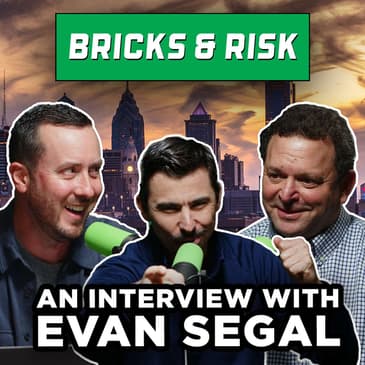

As Sean & Tim continue to introduce and interview superstars within their networks, we are grateful to have spoken with Evan Segal from Segal Financial. On this Bricks & Risk ep, we unearth Evan's journey from 20 years in Corporate America to self-funding/starting his own commercial lending company; all while being a dedicated husband and dad. Why does email marketing work for him? Why does it pay to "learn patience and trust your instincts" in business? Listen-to and/or watch this lifelong Philadelphian drop valuable nuggets for our podcast community!
Our goal with Bricks & Risk is that you walk away with 1 or 2 valuable nuggets that help build YOUR business. Our audience grows through word of mouth, so if you would please take a moment of your time and give us a review on the platform you’re on, that would be fantastic!
Please also help spread the B&R word by sharing your favorite episode with a friend. You can find all B&R episodes on Spotify, Apple Music, YouTube, and anywhere else you get your podcast content. We greatly appreciate your time and trust.
Until next time, keep learning and keep growing!
📲 Contact Info 📲
→ Sean Mooney, Mooney Insurance Brokers: www.mooneybrokers.com/
→ Tim Garrity, The Tim Garrity Team: www.timgarrityteam.com/
💥 Watch us on YouTube 💥
→ YouTube, Bricks & Risk Podcast, @bricksandrisk: www.youtube.com/@BricksandRisk/?sub_confirmation=1
💥 Follow us on Social Media 💥
→ Instagram, Bricks & Risk Podcast, @bricksandrisk: https://www.instagram.com/bricksandrisk/
→ Instagram, Sean Mooney, @sean.moonee: https://www.instagram.com/sean.moonee/@sean.moonee
→ Instagram, Tim Garrity, @realestateinphl: https://www.instagram.com/realestateinphl/
→ Facebook: https://www.facebook.com/bricksandrisk
→ LinkedIn: https://www.linkedin.com/company/bricksandrisk
[00:00:00] I sit on several boards of directors, some nonprofits who help people in various ways. And I got used to hearing people that have issues with daycares and people. I sit on a board where we make microloans to people that are having trouble with getting pregnant. You know, we do lend money for in vitro fertilization. And so you're talking to people. It's hard to shut it off when you're volunteering as a nonprofit.
[00:00:28] And people are calling you for those issues. But then your next phone calls a business person. I don't have a different persona for those different channels. It blends into each other. Right. You know, if you're a helpful, nice person and you care about people, then every call is that way. Every call. The guy that's hammering me for a lower rate on his mortgage versus the person that's having trouble and needs money for a medical procedure.
[00:00:54] Welcome to the podcast dedicated to real estate, insurance and building your business. Join us as we take you along our own business building journeys with additional wisdom from our network of local and national experts. Welcome to Bricks and Risk.
[00:01:21] Hey, everyone. Welcome to another episode of Bricks and Risk. I'm Tim Garrity. And I'm Sean Mooney. Today, Sean, we have another local guest, another in-person interview. We have Evan Siegel, president and CEO at Siegel Financial. How are you doing today, Evan? I'm great. How are you guys? Welcome. Thanks for coming in. We appreciate it. So some background on Evan. He's got 20 years of commercial lending experience and then he opened Siegel Financial in 2014.
[00:01:50] It's a distinguished commercial advisory form based in Bluebell, PA. So not too far from here. Siegel Financial specializes in providing financing solutions and consulting for business owners and real estate investors in the greater Philadelphia area. With a decade at the helm, Evan has solidified his reputation as a trusted advisor for individuals navigating the complexities of purchasing or refinancing commercial and residential real estate investments. A couple of tidbits.
[00:02:19] He's a lifelong Philadelphian, a wife and two kids, and he enjoys spending time with family, sports, music, and hanging out the Jersey Shore. All right. So you've worked for other companies, 20 years of experience before you started your own shop. So what was it about that journey of working for other people, learning commercial financing that made you want to start your own commercial lending company?
[00:02:47] Well, thank you. And thanks for having me on, you guys. I really appreciate it. Yeah. I was a banker my whole career. I started off with a hard money lender, bought American business credit and ballot Kinwood. Interesting. We made loans to people that couldn't get bank financing. We charged 15% and five points on our deals. Oh. And you would think people were, would shut the door and hang up on you, but there was a healthy market for people to get financing, even at those crazy interest rates.
[00:03:18] Yeah. And the margin. Yeah. A little bit. They paid, um, healthy commissions. There were a lot of young people running around making good money on selling these high interest loans, but we were, um, really helping people that couldn't get financing. These were a lot of business owners that were cash businesses or auto repair shops, your nail salons, restaurants, and banks just weren't lending to them.
[00:03:42] So there, there needed to be an outlet. So we, we were there to fill those gaps and to lend money out. And we were aggressively doing so. Um, but in a fair way, we're fair and reasonable. Um, people were thanking us and we got out and beat the bushes to go sit in people's offices, take loan applications.
[00:04:00] There were borrowers that were immigrants or had trouble getting conventional financing, a language barrier. So we provided a really valuable service to help people, um, fill out a loan application, get it to the right lender, get an approval and then fund the loan. And that, uh, I did for 10 years and, um, developed a way to, uh, become a really good listener because you had people with all sorts of dialects and all sorts of backgrounds trying to get financing.
[00:04:27] And we had to be there to kind of, you know, right size the application into a way that it can get approved. There was real estate aspects to it. We had to go out and drive and take pictures. And this was, uh, you know, before technology.
[00:04:41] Yeah. Like make sure the asset is what it is. That's right. So you understand like what's going on, what you're lending on basically. Right. So we were, our boss was adamant on visiting each property in person there. You know, no pictures and texting is like, you got in your car and drove out. Polaroids. Yes. I was there. Here's the property. It said like happy birthday. Already like templated on like the bottom white part.
[00:05:03] Yeah. So, uh, one of my, I was a sales manager. One of my loan officers was taking a Polaroid in Baltimore and, um, a person on the street drove up, uh, walked over and knocked the Polaroid out of her hand. Cause they thought she was an investigator.
[00:05:17] Yeah. Oh my God. We were in some hairy neighborhoods from time to time. Um, but I learned a lot and it was a lot of fun cause we were, we were really helping people. And then unfortunately that company got shut down because, um, there was, uh, you know, predatory lending was an issue back then and we couldn't sell our paper anymore. So, um, after 10 years, um, the company stopped working and I went on to more conventional lending sources like banking.
[00:05:45] So I went to PNC bank, I got really credit trained there and became like a buttoned up, you know, corporate guy and worked in the banking market for 10 years in Philadelphia. But then we hit the recession, you know, in 2009, a lot of us lost our positions and I had just, um, gotten married and had a, we're pregnant with our first child and I was let go by GE capital.
[00:06:10] GE was the biggest, the big company and who thought they would ever not operate anymore, but they shut down their real estate lending business. And I was forced to, you know, take some time off and figure out what's next. And the mistake I made then was not doing what I do now. I, but I was in a bit of a panic and who knew, you know, jobs were scarce, but I didn't feel confident. Young child, wife, there's that impression.
[00:06:33] Right. To start a loan brokerage in the middle of a recession was a pretty bad idea. And I don't think my family was really supporting that. Yeah. So, uh, I went back into banking and, um, you know, kind of wasn't happy in the corporate world and always thinking, you know, this might happen again sometime. Right. And as I get older, I don't want to be vulnerable like that. So I started putting in position, a plan to open up Segal Financial. And that's where I am now. It's a commercial loan brokerage.
[00:07:00] I arrange financing for businesses and real estate investors, but not only people that can't get financing, also people that have wonderful assets and wonderful business plans, but they don't want to go out to market themselves. Right. They'd rather outsource it to someone like me who can, who has deep relationships with different types of lenders. They want an advisor.
[00:07:19] So advise, you know, go to market, um, utilize the relationships that I built through the years to come up with attractive terms and then bring it back to my clients and say, here's three different offers. You know, what do you like? What do you not like about those? And negotiate a term until everybody's happy. Yeah. And then I'm, it's a contingency fee that I get paid if I'm successful and where it's shaking hands at a settlement table.
[00:07:41] So it's really a win-win situation. And for 10 years now, you know, we keep growing because we have a lot of friends in the community. I only pretty much handle the Philly metro area, PA, New Jersey. Yep. And, um, do things right, be honest and transparent about what we do. And luckily the market's been pretty good in the Philadelphia area with all the redevelopment that's going on. Um, there's a lot of action and there's activity in the market.
[00:08:07] And as banks get funny from time to time, as they do, people keep calling. And now the banks call because they say, we really like these clients, but we can't approve their loan for one reason or another. And it's not even them. It's really us. Right. So take them to someone else for now and we can provide a bridge loan, a private lender deal, or just find another bank that's more being more aggressive right now. Yeah.
[00:08:29] And put my stamp of approval on the deal, take it out to lenders that I know and trust. And then my clients seem to want to get my advice on, on how to go to the next level with these deals. So, um, appreciate the opportunity to talk to you guys. Yeah. We work together with you guys in the market and all you out there, you know, I'm here to help and try to keep a, um, a healthy profile, not do the wrong thing. I'm not a pig with fees, you know, everything's fair and reasonable.
[00:08:57] And it's, I'm always auditioning for my next deal. So I, my goal is that someone's going to say, you know what, you got to call Evan. He really did me right. He helped us a lot and he's worth the expense, you know, cause people think, you know, why do I pay a broker? I can go to the bank myself. You know, it's hard. It's really hard. Some people are good at it, but, um, more often than not, people call back and say, you know, uh, I thought we could do this on our own, but we really need your help. Cause we're not getting the answers that we were hoping for from the people we've been calling.
[00:09:25] We sing your praises all the time. Yep. How's that? In telling people that they need someone like yourself to go out and package the deal to get the best terms. You guys have a similar setup. Yeah. Because he's a commercial finance broker and he has relationships with different lenders for, you know, uh, different clients. Correct. And you're an insurance broker. Yep. You're not an all state or a state farm where it's like one flavor of ice cream. You got 30 flavors. Yep.
[00:09:52] So it's like, you guys have very similar setups. So that's a really good point. Um, a couple of takeaways from what you just said that I thought was interesting. Um, one, I liked the fact that you started, you started in more of like a creative financing role. So it wasn't mainstream banking. Like these are the people that were having trouble getting a loan from a mainstream bank. And it wasn't because there's anything wrong with them. It was because they just didn't, they couldn't prove on paper that they were worthy of credit.
[00:10:23] And for you, you're like, Hey, if this is a cash business, like let's say it's a pizza shop and they don't take credit cards. Like this is how they run their business. How are they really supposed to prove that to a bank? They say, Hey, I need a hundred thousand. I need new pizza ovens. You know, I want to put some tables in here. I want to paint at one new signage. And they're like, we can't do it. We don't even know how much you can have made $10 last year. Like, we don't know that. So I love that you started with a company where you were really helping the people that was hard for them to get help. So that probably taught you a lot.
[00:10:52] And what was also great is that then you're like, then you pivoted, you know, that opportunity ended and you're like, all right, let me get like a mainstream gig. Like, let me do traditional banking where, where I got to wear a shirt and a tie and a suit and look presentable and schmooze and do all the things that we've all had to do at different points of our lives.
[00:11:12] And then you learn the mainstream part of banking. And to Sean's point, like we've worked together a few times because a few years ago we started investing in commercial real estate ourselves, like our development group. And remember the first, the first building we ever got American street, like we haven't done any, we did some flips. So we're like, okay, like we're kind of getting it. We got hard money for those, but we need like commercial.
[00:11:36] We want to get mainstream commercial financing for this building because it's occupied. It's in really good shape. And literally I remember we were like talking and Ryan and Andrew were like, do you know anyone? I was like, yeah, Evan and I met a while ago. We've always stayed in touch. I've dropped his name to a few people. I was like, let's call Evan. And then I remember it was either Ryan and or Andrew talked to you like, yo, he's great. Like he's got options. He's, he's really asking for the things that we need to show him so we can give us an honest opinion.
[00:12:04] Cause it, you know, if you looked at our stuff and you're like, I just don't think I can place this anywhere. Like you would have let us know. You're like, no, I think, I think based on this, that, and the other thing, we can find the right spot for you. And you use one of your relationships for us to get financing on that deal. So it's just highly valuable. Yep. It was. And that's, that's how it works is just a lot of networking and relationship building. The fact that I've lived and worked here my whole career, I think helps.
[00:12:31] Um, people like, I'll go come out and visit you. You know, I'm not going to sit in my office and just, you know, email stuff around. I think when I was taught how to land in the first place, it was the smell test and the look test. Like you can't rely on someone's photograph. Like you got to see the building down the block, you know? So we would get in trouble if we didn't, my first job, like if we took a picture of the subject property, but we didn't take a street scene, we were at risk.
[00:13:00] Like there was probably, you know, maybe two doors down, there was a graffiti property or broken windows, but, and you got to share that part of the story because you know what, there's going to, they're going to pay for an appraisal and the appraiser is going to point those items out. And then if you didn't, you didn't share that information at the beginning and the guy pays three grand for commercial appraisal. And then they see that there was a blown out shell, two doors down. You need to disclose that. And the client and the bank passes on the deal.
[00:13:25] Yeah. And you lost that guy's $3,000 and he's not getting the money back. Right. So I never wanted to be in a position where I'm spending people's money and then their deal gets declined and then they'll point their finger at me. So I can shoulder some blame if it's my fault, but if I'm intentionally, and I see loan officers do this all the time in the market, they're not giving the full story even to their own management because they're so hung up on selling that deal and getting that commission. They want to get you in and they're like crossing fingers.
[00:13:51] Yeah. I hope they don't see this blown out shell two doors down, but that is something that's going to cause them the deal. Same with environmental issues. Like you walk around a property and there's clearly an underground tank somewhere. There's pipes coming out of the ground, but you don't disclose that to your team and hope that they don't notice it. It goes on. It's just, you're going to get hurt in the end. Please don't see those pipes. Please don't see those pipes.
[00:14:13] This is exactly what's going on in insurance right now. Yeah. It's literally the underwriting on, on properties, residential commercial right now is so strict, um, that we're competing against. And I'm sure it runs parallel to what you do, but I, I do the deal to try to get that client in the best possible position. And I have to like walk away from deals because I know that it's going to blow up on the backend. Yeah.
[00:14:43] Old roof. There's, there's steps that are crumbling. You know, I know that they're going to get hit with an inspection. So I'd rather pass and tell the client like, Hey, if you get a new roof in the next year or two, let's, let's reconvene. Let's talk. And we might be able to do something, but for now just stay where you're at or, you know, I just can't help. And I'm sure that you come across that too, is you see a building that, you know, that the bank's going to blow it up on the backend.
[00:15:13] And for you, it's, it's not worth you to put your name on that and having an egg on your face when that client comes back to you.
[00:15:23] Right. Setting proper expectations. And also certain lenders have different tolerance for different type of issues with the property. So everyone wants the lowest rate and the best deal terms. But if you can pay a premium to use a lender, that's not as sticky on certain points, then I have to make that argument to the client. Say, look, you know, I have three different lenders for this. There's the low interest one. There's a medium interest one.
[00:15:49] And there's the high interest one, but the high interest one doesn't care about your income. It doesn't pair with the cashflow. The reason it's high is they're willing to take more risk. They'll take the risk. It's going to be a lower loan to value. They'll work quickly. They'll close quickly. Well, I don't, I don't, you know, but it's a double digit interest rate.
[00:16:04] And I'm like, I know you want 6%, but we can't go to a conventional bank. Are you going to face all these underwriting issues? Well, I want that rate. I'm like, trust me, it's not, I know you want that, but we're not going to get to the finish line with big bank, you know, in the corner here. That's just going to overly analyze the transaction.
[00:16:23] Yeah. So I have to make a compelling case why someone should forego the low interest lender to save time and cost in the application process and to use a lender that's going to be more flexible.
[00:16:35] And it's the battle every day. That's what I'm doing with my clients is, is right-sizing their expectations and then showing them that maybe it's worth getting bridge financing to give you, buy you some time to do what you need to do, to lease up the property, to get better tenants, to get long-term leases. Then, you know, talk to 10 banks and get, you know, 10 declines. Like it just, it doesn't make sense.
[00:17:01] So my growth area where I got better was to be more firm with my clients. When I first started, I was a yes man to everything. Like I just didn't, I just wanted clients. Yeah. You're just like, sure, I can do that. I can. And then someone goes, you know, I'm sorry. Yeah. You know, it's like, you know, just ask for forgiveness kind of thing. Like that kind of. I thought I can get this done, but I can't. Now it's like, I know we're not going to get this done in the way you want it. We have to, these are, these are your options.
[00:17:27] Or I'm not going to take the deal like that. So luckily we're in a position that I can walk away from business. If I feel like I'm not on the same page with the customer or they're not listening to reason and not being realistic, or they're not willing to be honest with me or the bank. And we have carriers insurance companies that we write and it's the same exact thing. So we'll carriers that will a go out and be like, Nope, we're done.
[00:17:51] Cancellation sent boom. Others that'll say, Hey, we'll give you 30 or 60 days to like improve this or fix this, or, you know, at least. Uh, get an estimate or, um, a work order that you're committing to getting this done. And then other carriers, Hey, we'll give you a year, right? Get it all done in a year. Every new we'll review. And so we're juggling those same types of, so this one might be more, right?
[00:18:17] The one that's going to give you a year to get all of these things done, but it's going to cost you a little bit, but you're going to get through closing. You'll have the coverage in place and you don't have to worry about X, Y, and Z and give yourself some space. And so we kind of juggle with that because just like you said, I want that 6% rate. Oh, I want the best premium.
[00:18:39] I said, well, the best premium comes with the most stringent inspection process. And so it's very similar to kind of those. So have you gotten better at being forceful with your clients as you've advanced in your career to be able to push back? A hundred percent. Well, here, let me hit one point. So this brings up a really good point. Cause again, as, as we do this podcast and we have guests on and Sean and I talk about topics, it really brings out the foundation of what you and I believe in for building a business, which is relationships.
[00:19:08] And we know you're the same way. I just did a, I called it an agent workshop with like some agents at the brokerage I'm with now, some agents at other brokerages that aren't affiliated with us because of Copper Hill. I used to train and mentor agents all the time. And one thing I did with them is I would do an annual plan. Okay. What does 2025 look like for you? Like numbers. And then I would help them with like a marketing strategy to get to those numbers.
[00:19:34] So one, one, I'm a simple guy, as you know, when I like to just keep things simple, I said, look, there's kind of like two lanes for a business building. You have like the lead gen lane and the referral lane. And the lead gen lane is a little bit more cold. It's like people you don't know, you know, you're doing a video and you're throwing it out there, like in social media. It's like a lot of people are going to see that. You don't even know who they are, but you're trying to build rapport with people you don't know. Buying leads, cold calling.
[00:19:59] Yeah. Buying leads, cold calling, knocking on doors, sending postcards to people you don't know, hoping that someone, you know, catches it and calls you or emails you. And then you have the referral lane. And I think as the three of us have been doing our career for like a few decades now and knowing that we're relationship focused, you try and put a lot of your effort into the referral lane.
[00:20:19] And when you do that, it brings out all the stuff you just said. It's like setting expectations up front. You know, if someone, if someone comes to you and has a need and you see a few hurdles or roadblocks, like tell them right there, hey, I want to help you. But this one or three or five things could be pretty significant hurdles for us. So in the event I can't, maybe I can give you to someone else or maybe we just won't be able to work together.
[00:20:47] So it's like expectation setting. And then as you work with them through the process, it's about customer service because once they get to the closing table with you, if it works out, they're going to just be like 10 times more happy. Like, thank you so much. Like you told me what I needed to know up front. You walked me through it and now I have my end result. But even if they don't do business with you, like you see someone and you see all these, all these issues, you're like, I don't know if I can place that anywhere or you either, or even me.
[00:21:15] You just say, look, I just don't think I'm going to be able to help you in the way you want to be helped. So maybe talk to this guy or this girl, or just see if you know anyone else there in the market. Or maybe if you get a cosigner, like there's lots of things you can do to just say, I can maybe help you if the situation changed, or maybe these people can help you too. And they will always remember that because even if you can't do a deal with them, you still help them get to their next step.
[00:21:41] And you had said it before, like you got a client not too long ago, and you're like the referral source. You're like, I don't even know who that is. And what it was, was you probably helped someone just get to their next step. And then someone asked them, hey, do you know anyone in insurance? They're like, yeah, call Sean. And then you get to help their friend or their family member. I just sent one to Holden. Yeah. One of my clients. What's up, Matt?
[00:22:07] He was doing a business, and I'm like, this really doesn't fit. I said, so then I texted him, like, hey, is this something you could, you know, do? And he's like, oh, absolutely. Nice. And so like, that's the beauty of you and you is like, our networks is like, more times than not, if people are coming to us, we can either help or we're finding them the right avenue in terms of where to get them to be in the best position. And a lot of times, they're going to remember that, whether you do the deal or not.
[00:22:37] It's like, oh, I remember Tim because Tim helped me. Yep. It's true. Luckily, we're at the point in our careers where we're starting to see the good work we did eight, ten years ago. Absolutely. In fact. Yeah. And my favorite thing is, you know, I started Segal Financial ten years ago, and I started to have an email database. That's like right around when we met. That's right.
[00:22:59] And so I started sending emails out ten years ago, and every now and then, I'll get a reply email from an email I sent nine years ago from a guy who I never heard of before and didn't think was paying attention anymore, never called me once. Right. But they had a need. And they remembered they had saved my email from whenever when and said, hey, I remember you helped this guy on a different transaction. That's awesome. I have another client now that needs your help.
[00:23:29] Yeah. And this is someone that maybe I gave up on, on prospecting, or I didn't take to lunch or coffee annually because, you know, you can't do that for everyone. No, you can't. No. But it was the consistency, I guess, of messaging or doing the right thing in the market, having success stories. Yep. That someone says, you know what, Evan's on my short list of two or three people that I would call if I'm having trouble getting financing. Yeah. Or I finally have a commercial deal, and I know he does a lot of work in the market. People seem to think he does okay.
[00:23:58] You know, he gives good advice. Yeah, that's awesome. That's the reward. That's what keeps me going every day is you get those calls from those people that you didn't think were paying attention anymore. And they're like, yo, I've been getting your emails for 17 and a half years. They haven't unsubscribed yet, which is nice. Yeah, exactly. I did that. I don't know if I told the story. I sent out postcards one time, and it was... Of your mustache? Yeah. Me and the mustache. It was just a big mustache, and it said, from Sean Mooney. We can ensure you.
[00:24:28] But I sent out postcards one time, and I didn't think you threw thousands of postcards in the mail, you know? And a guy reached out to me, and I remember, you know, talking to him. I said, where did you get our information? And he's like, your postcards that you mailed out. And I was like, we haven't sent postcards in, like, two years. That's awesome. And he's like, I held on to it and put it in my desk. Yeah. People do that, man. And so I... I remember.
[00:24:57] So I knew that, like, when it came time, or I needed to make a change, I had your information. I was like, all right. Now have you always had the mustache? Yeah, I know. Now he goes on and off. He looks different every week. Okay. I pretty much look the same. All right. So here's... People on their toes. Here's a quick one. Yeah. So in your LinkedIn bio, I remember you were like, how did you know that? I was like, it's called LinkedIn. Yeah. You know, it's pretty easy. You just open it up. I thought it was his MySpace account. That's true. It was his LinkedIn.
[00:25:26] You know, there's an archive for that. So one of the things on your LinkedIn bio said you're a resourceful problem solver. And I think, you know, obviously we're speaking to that nature right now. When someone has an issue, it's like, even if you don't have the solution, let me get you to someone that has the solution. So what is it about problem solving that helps you, you know, in business, grow your own company so that people keep coming back? Well, people have a lot of problems. That's very true.
[00:25:55] They often, because I want one area that out where I was weak and have improved is asking more questions, spending more time on the phone, letting conversations run its course instead of kind of rushing people off. I felt like earlier in my career, if I didn't feel like someone was as much of a prospect that maybe I would just kind of move on because I'm busy and I want to, you know, talk to the next prospect.
[00:26:23] But I've learned, I think, you know, particularly during COVID and after that people really needed to vent and to tell stories and they have real concerns and real emotional issues and problems. And I felt like it was important just to let people vent and listen. And, you know, sometimes it gets too personal and you can't spend a half hour listening to someone's personal problems. We're kind of like therapists. Yeah.
[00:26:50] But it seemed to always strengthen relationships now and which has led to business, you know, and selfishly, that's great. But it also was nice to be able just to have people call you when they have issues and they need your advice. And I sit on several boards of directors, some nonprofits who help people in various ways. And I got used to hearing people that have issues with like daycares and people.
[00:27:19] I sit on a board where we make micro loans to people that are having trouble with getting pregnant. You know, we do lend money for in vitro fertilization. And so you're talking to people. It's hard to shut it off when you're, um, when you're volunteering as a nonprofit and people are calling you for those issues, but then your next phone calls a business person. Right. Um, I don't have a different persona for those different channels. It blends into each other. Right.
[00:27:48] You know, you're, if you're a helpful, nice person and you're, you care about people, then every call is that way. It's not, I don't know how the, the guy that that's hammering me for a low rate on his mortgage versus the person that's having trouble and needs money for a medical procedure. Right. Um, it's being a good listener and being helpful in the market. And if you're a good resource for anyone that needs help with anything, then I feel like
[00:28:12] that guy's going to send you a referral because, um, you helped his cousin out with a, um, a major personal issue. Um, now you got to compartmentalize some things because there's only 10 hours in the business days, theoretically. And, you know, I'm with my wife and kids at night and it's hard to, you know, ignore texts and it's hard to turn it off. It's hard to turn it off. And, you know, but you have realtors at 10 o'clock at night that are calling me for pre-approvals and such. And me calling you at like 10 30 PM.
[00:28:42] I don't do that. That was no, but it's like, so I've made the decision that if I'm sitting on the couch watching TV and someone calls me and has a question, like I'll probably just respond. Let me just get this real quick. Yeah. Same thing. It's maybe that's wrong. And, um, I've taken some coaching and training to say that, that that is wrong. Yeah. Like yesterday I was with a trainer that said you, they, they wanted me to completely shut off all notifications on my phone going forward. And if someone really needs me and it's an emergency that, you know, they'll call three
[00:29:10] times instead of texting, but like that your text notification should be off to avoid interruptions in your business day and in your life. And that's not fair. You have to set boundaries. I struggle with that. Yeah. That's hard. I have a 14 year old and a 12 year old and a wife that likes to be responded to on a readily basis. But I, the guy had a point. He just said, you can't set yourself up to be interrupted. And then you're, especially if you're at dinner, you're focusing on a client and then someone
[00:29:39] texts you about something that's going to bother you or annoy you or take your mind off that you're not being present with them. Right. You're there. That's not fair. And it's, it's selling your client short or whoever you're having dinner with. So, uh, that's a struggle. I think we all face with, with phones and social media. Oh my gosh. Um, but in terms of problem solving, is that how we got into this? Yeah. I, that's why I choose to have this career because it's a challenge. Somebody calls up with an interesting real estate transaction or they want to start a business, but they have no idea how to get it going.
[00:30:09] Um, that's why I'm doing this. It's, I can make money and have fun and make a difference for people at the same time. Yeah. I love it. If the passion comes through and, um, that's only helped, you know, you lay it out on the line. I do some videos on LinkedIn, as we talked about before, just to let people know what kind of person I am. And then if I run into them, this is who you're getting. Yeah. It builds trust. And yeah. So, um, thanks for bringing that up because that's seems to be what it's all about is
[00:30:38] just to be a problem solver, someone who people can call. You need an insurance guy, you need a commercial realtor. You know, I got guys in my network that can help. Totally. Hey everyone. This is Tim, your favorite bricks and risk co-host. But don't tell Sean. I hope you're enjoying this episode and I'll get right back to it in a moment. Our audience grows through word of mouth. So if you would please take a moment of your time and give us a review on the platform you're on, that would be fantastic.
[00:31:06] Please also help spread the BNR word by sharing your favorite episode with a friend. We greatly appreciate your time and trust. Now back to the show. While we have you here, I'd love for you to, cause you're a great resource on this, but can you talk a little bit about the underwriting process when you engage with someone and kind of what that looks like?
[00:31:33] Because I think just for informational purposes, I think that there's a lot of people out there that could really benefit from the services that you offer and other people that do like what you do. Sure. Most of my transactions come in from realtors who have a client under contract to buy a commercial building, an investment property, and it's something other than their primary residence.
[00:31:59] A lot of my referrals come from residential realtors who stumble across a commercial opportunity and they're not used to the financing. They're used to the residential financing. They're used to a pre-approval in a half hour. They're used to a 30 year fixed rate. Well, commercial loans are different. You're dealing with mainly five year fixed rates. You're dealing with 20 or 25 year amortizations. You're dealing with an underwriting that's focused primarily on the business asset itself
[00:32:24] and the cashflow of the apartment building or the strip center or the commercial space, whatever it is. All numbers. And it's less about the individual's personal tax return. So that shift is new to a lot of people that are in the process, the buyer, the realtor that's involved. So I'm looking at the cashflow of the building itself and the length of the lease. The most important document to me is a rent roll and an income statement for the property.
[00:32:53] So the loan amounts set purely by the net operating income of the asset. You know, it's, yes, there's a typical 25% down on a commercial situation, but that's only if the cashflow can get you there. So that's, you know, well, this guy makes a million dollars in W2 income, but the cashflow of the building only supports like a 65% loan to value. That's what the term sheet's going to say. It's nice that he's got a million dollar income, but the first hurdle is the cashflow
[00:33:23] of the building itself. Now, some banks will go push the limit because they know the guy makes that kind of money and his global cashflow will support it. But that's a bank to bank underwriting decision. It's almost like an underwriting exemption if they feel like there are other factors that play into it. And right now, every bank that's doing investment property wants a deposit relationship. And that's a big shift, like a significant deposit relationship. If they're going to do a million dollar loan, they want a deposit relationship of upwards
[00:33:51] of a hundred, $150,000 to support that mortgage that's on the property. And what developer in the world wants to park $100,000 in a bank at any moment? Checking their savings account with like no returns. You're not saying verification. You're saying, hey, we want the loan. Hey, open a bank account and give me a hundred grand. That's right. And before that was an ask that was a nice to have. Requirement in the term sheets. You want us to finance your project.
[00:34:19] We need some skin in the game from you that you're going to be with us and do your banking with us. That's right. They want to increase their deposits, basically. That's right. It's really important right now. And there's some banks that are less stringent on that. And that's where an advisor comes into play. Evan, I need a bank that's not going to require deposits like that because we just don't have them. And, you know, so there are banks that aren't so worried about that. But others, it's front and center. Like they've done so many investment deals over the past two or three years.
[00:34:48] Say, look, we got to put the brakes on. You know, we've done so many, but we'll still do it if this client wants to be our bank, a customer of ours and more than they're just taking our money to buy a building. Wow. We want, you know, a cash management relationship. We want our wealth manager to have an opportunity to talk to him or her about investments. They want to make more money. Right. So. And lend more money. And I understand that. And that's where my experience as a banker comes in is I've sat in those meetings. Yeah. Yeah.
[00:35:15] You know, the bank meetings when they're when they're strategizing on clients and how to, you know, they have buckets to fill. It's not just the loan. And sometimes that loan bucket's full and the deposit bucket needs work. Yeah. So that's how they do it. Hey, they're only getting a loan if they give us some deposits as well. Yeah. So banks don't advertise that, but that's that's what's happening. And sometimes the client doesn't even know that they've agreed to move deposits over until they're at settlement and they're being asked to open an account and and and fund an account with some proceeds of the loan.
[00:35:45] And then guys like, you know, especially with those like three partners in a transaction and only the one guy was like handling the term sheet and dealing with me. And then his other partners are realizing that, you know, my partner agreed to move $100,000 into this bank to get this mortgage. Tommy, what did you do, man? And then can I just pause right here? I I I'm just like taking this information in. Yeah.
[00:36:10] And this LinkedIn post that we were talking about the other day, why it's so important to work with an advisor. It's so important because you you as the advisor know what's ahead of the deal. You can let people know up front. Hey, this is new. This is what some of these letters. I'm not saying they will want that, but they might. Yeah. But if I go to the bank and they're like, oh, we can do the loan and they set it up now,
[00:36:37] you're like two weeks into the process and they drop that on you. Yeah. Guess what? After you paid for the appraisal, you're writing them a check for five thousand dollars. You sign the deal. You're like moving pieces around. You're moving money around. Everyone's getting excited. Oh, we're going to sell. Oh, we're going to buy. And then it's like, well, I don't know if we can do this. Yeah. And like, so you just earned your fee by by way of like not exiting on an appraisal fee.
[00:37:03] I mean, like, yeah, I think everyone out there needs to understand that. Yeah. And I think it's the value that working with a professional advisor brings to the table is just so understated. Well, there's there's a bunch of things, you know, a term. Everyone's focused on rate, but like prepayment penalty structure. Yeah. That'll see, you know, to have someone focusing on that and the front end so that it's not a major problem. You're not getting screwed 10 years. So some banks will have prepayment penalties.
[00:37:33] Typically, it's like five, four, three, two, one structure, 5% year one, 4% year two if you prepay. Yeah. But some banks, it's only in effect if they refinance with a competitor. It can be waived on the sale of a property or if they use their own cash to pay it down. It's not an issue. But sometimes you just need to bring it up and have them. Hey, can you change your commitment letter to say that this prepayment penalty is only in effect if we refinance elsewhere? Not in every circumstance. And the bankers like, yeah, we don't we'll do that.
[00:38:02] But if you didn't bring that up, then you're stuck in a year from now. You want to sell the building and you get a four percent of a million dollar prepayment penalty. That's a lot of money. Then the guy's really mad. How come you didn't point this out to me at the beginning? My banker certainly didn't bring it up. But watchdog over here. I'm looking at this stuff. And that's why people want to bring me on because what's hidden in the bank terms that are going to bite me in the ass someday. Yeah. So we try to get ahead of all that. We say it as we structure a deal.
[00:38:31] We do business as we are putting ourselves in your seat. Right. And I think that what you're saying is you your approach of when you deal with a client is the same. It's like if Evan was doing that deal. If it was my dad's deal or something, you know, it's a family, you know, I'm not going to put you in harm's way. Right. Because it's my reputation. And you know what? Someone will go on Google reviews and say, this guy took me for a ride. He took my money. He didn't produce.
[00:39:02] I can't live with that. No. You know, social media and people in the market. Like we all know each other. Like we're all for better, for worse. We're all Philadelphians. And we're going to be at holiday parties soon. I don't want to be, you know, that guy. You know, stay away from him. He blew my deal. Yeah. And right now I'm seeing that happen. And there's a kind of phenomenon where residential lenders are trying to do more commercial deals.
[00:39:26] While the refinance market kind of petered out, we have a lot of loan officers that are just doing house loans that are starting to try to get into the commercial market as a means to support some other income that maybe they lost while rates went up. Yeah. And I have clients that are coming back to me. They said, look, this other company quoted me, a mortgage company quoted me in a commercial deal. I'm like, I don't think they do commercial. And they're like, well, they're saying that they do. The commercial space is a smaller percentage of the building. So we think we can get it done.
[00:39:55] And then three weeks go by, they call back and say, you know what? They just told me they can't get it done because the commercial space is too big. And I'm not, that's not my business. It's a rental. Like that. Why didn't they tell you that in the beginning? Yeah. Well, the rate was so good and I wanted a 30 year fix. Well, it's just, you know, they shouldn't have told you that. Hopefully I can save the day, but that's where I struggle with some guys out there trying to do more than their company has the abilities to, or they just don't have the experience.
[00:40:24] And they're trying to hold onto a deal that maybe they shouldn't hold onto. So that's okay. Like I would make those mistakes earlier in my career, but the reputation risk is bad. And you lost a customer and the company you work for is going to lose some credibility in the market because they had a loan officer making promises that they couldn't deliver upon. Well, it's interesting the point that you just made about that. So one question we like to ask is, is what's your biggest struggle?
[00:40:50] And for you, you would put that, that many people discount the importance of a great commercial loan broker and they think they can just do it themselves. So like you're talking about like the benefits of working, but it also can be a struggle. Why, why would, why has that been a struggle for you where someone is really not valuing you in what you do? Well, that's it. Someone's telling you, you're not worth the fee. You're not, your, your value is not there for me. I can do this on my own.
[00:41:19] Why do I need you to take me to a bank? Well, there's 200 banks in the, getting smaller by the way, because mergers and acquisitions are picking up, but there's, there's the big banks. The ones on the corner are not the ones that are doing investment property deals very well, but they're not going to say no either. They're not going to admit their weaknesses. All these people have jobs, like loan officers have jobs they're trying to keep. They're trying to impress their bosses. They need to show activity. I was in those shoes. Like I get it.
[00:41:50] I admit I propped deals up on my pipeline to, to, to have activity. Cause Monday morning there's a sales meeting and the boss is going to know what you're working on. And if you voluntarily kill your own deal, because you know, in the back of your mind, like this isn't going to ever happen. And you know, when was the last time this big bank did a small restaurant deal? Probably never outside of their SBA program. But this guy is in the commercial group and he's trying to prop this deal up thinking, waiting for more paperwork, waiting for more paperwork, but it's a dead deal.
[00:42:18] Well, you know, why didn't you tell the customer in the first place? Why, why drag this along further? Yeah. Well, cause selfishly they're trying to maintain their pipeline a little bit. So, um, we spun down this path, but why it's frustrating is sometimes it's too late when they realize that they should have used me. Should have stuck with me. Yeah. That to just, you know what you were, you know, I'll get you on the next deal, but yeah, it was a disaster. That sucked. Like it did.
[00:42:45] And yeah, I say this and you talk about this in insurance too, like someone, uh, finds a company online or a big company. Cause they've got brands and Superbowl ads and they go to them and like, Oh sure, we can do that. And then they're getting it done. And you said they even like, they'll give them their new policy and then they'll come out, they'll send someone out. And they're like, we can't insure you. We're going to have to pull that back. And they're like, I spent all that time, all that money. And you said we were good. Like I'm making a payment to you and now you want to yank it back.
[00:43:14] And it's like, because when you fall into that, I want to say big company, you fall into this like zone of just like trying to get more deals. You don't know whether or not they have your best interests at heart. If someone comes to you, like we're talking about with the relationships, with the referral lane and they say, Evan, do you see any problems with this? Or Evan, tell me why I should pay your fee. And you're explaining. It's like, look, a million things can go wrong in this transaction.
[00:43:44] You're working with me so that I lower your stress and I do all the heavy lifting for all those issues that I'm telling you right now will probably come up. At least some of them. Whereas the other person, unfortunately, is just like, sure, we can do it. No problem. Here's the application. $500 fee. Let's get the appraisal order. That should scare people. Yeah. When they say, oh yeah, no problem. Like, we'll get this done. And then they start collecting money and like, oh, we can't wait to work with you. They get follow up emails.
[00:44:13] They're like, oh, hold on a second. And then they're like, wait, no one. No one told me that. They're like, yeah, well, now we're going to have to do this. Or like, I need all this paperwork. You got to pay more money or you may not be able to get the loan. And honestly, it's like it really it's the customer service. It's the person that's helping you like you with with your brokerage and you with your commercial financing brokerage.
[00:44:36] And even me from like a real estate standpoint, there's freaking five thousand licensees that are realtors running around Philadelphia saying they can help anyone and everyone. But sometimes people come to me like, hey, I want to buy a house. And I ask about like, let's say a pre-approval. Have you talked to a lender yet? They said, I haven't. And they're almost thinking like, well, you just want me to go get a pre-approval so that, you know, I'm like a slam dunk.
[00:44:59] And I'm like, I want you to get a pre-approval so that you understand what the financing is going to look like in the event we go look at that house you already sent me. That is five hundred thousand dollars. What if you can only afford four hundred or what if you can afford six and you really want that? You're just letting people know. I want you to take the step for you so that you feel comfortable. And then once you do that, then when we go out, you feel good. You know, we're all on the same page. You know, I got your best interests at heart.
[00:45:27] And this process is going to go smoother because someone calls me and says, hey, I'm going to look at this house like today at like four o'clock, like this afternoon. I know Bill and, you know, Bill, I'm just like, sure. Yeah, I'll schedule it right now. I'll see you there. We show up and they're like, yeah, I'm like self-employed. I've never bought a house before. You know, I had a bankruptcy like three years ago. And there's nothing wrong with like that stuff happens to people. But that's not good for now. They waste the time out of their day.
[00:45:54] And they were so excited to go see this house that now they probably can't buy. And the right people will tell them the right things so that they know what to do to be prepared to keep the stress low and the customer service high. Well, I'm glad you brought that up because a lot of realtors have been calling me to kind of figure out, you know, are these clients financeable or not? Because you're not in a position. They're not going to disclose their financials to you. Right. They have to the finance guy. Yeah.
[00:46:20] And I'm not going to disclose information to the realtor because everything I do is confidential. But I can give you a sense of, hey, this is going to need we need a little bit more time to find them the right deal or I don't see any issues. You can go make an offer and I'll put out a pre-approval on my Segal Financial letterhead. It's been accepted in the marketplace. And every now and then I'll get a call from a realtor saying, who are you? You know, why should I believe Segal Financial? Never heard of that. Yeah.
[00:46:47] So I'll say, call me and I'll tell you my process and why, you know, my background and why I know this is a deal that's going to get approved, you know, because a bank's going to take 10 days to turn around a term sheet if they're going to really take a look at it. And some will turn out a term sheet in a day. But I don't know if I trust those lenders if they're going to quickly put out a term sheet like that. But I'm not going to verify a client unless I know their credit. I know their income. I know. Give them the smell test. Yeah.
[00:47:17] And just have a conversation with them about it. But where I'm earning my fee, I believe, is the relationship I have with the lender. And they know I'm a broker. They know, you know, they're probably going to talk to more than one bank about the transaction. So they kind of go at it. They make a healthy offer. You know, they're going to, hey, we want this to work. We like this client. We want to win the deal. What do we have to do to make it work?
[00:47:45] And then I'm there and there's going to be a hiccup in a transaction. Always. Something during the two months that we're working on the deal. Someone's going to throw us a curveball. And to have me, knowing the banker, and look, they're not going to give me everything I want all the time. But I can have a conversation with someone I've done business with for 10 years. And, you know, have a rational conversation and a solution. Hey, let's do it this way. Maybe we can tweak this. I know they don't want to do this phase two or whatever.
[00:48:15] But, you know, here's why. But we can manage the cost by only doing it this. You know, just talking it through. But some of my clients. People that want to do the same thing you want to do. You just want to help. They can't help themselves. They're people that like to yell and scream. Right. They don't know how to handle themselves. They want to call the banker and scream them. They want to call up and down the chain of command at the banks. Give me your supervisor. They're screaming. Right. But if you're a banker, I don't want to do business with this guy. Like, forget it. I'm not going to be yelled at every day. Yeah.
[00:48:41] But I can act as a buffer to a real estate investor who some of them are tough cookies to deal with. They like it their way. They're type A personalities. No banker is going to tell them how to run their business. So I'll just relax. You know, I know what you're trying to get to. Let me handle it the way that's worked for me. This is my job. Let me do that. Let me do that. Don't put your foot in your mouth with the banker. Right. You know, or just something that's going to turn them off. Yeah. Totally. And look, and the other thing I'll admit, I'm not perfect.
[00:49:10] Like I've had deals that I've made mistakes on, you know, I'm not claiming to be this perfect guy. You don't make mistakes. It's right. And I'll stand up and I'll fix it if I can. I've refunded fees if I felt like I didn't earn it. The guy's not happy. I'm not going to sit there and say too bad. You know, I'll try to make it work. You know, I don't want anyone feeling out of pocket or they made a big mistake or I screw them over. You know, very rarely has that happened.
[00:49:37] But there's been instances where people, for whatever reason, just weren't happy. And I'll take my lumps and I'll admit if I made a mistake. But after all this time, it's becoming more rare because the transparency, you know, I'm out there. Here's what it is. And I'll even take the blame for some of the stuff that the banks and blame myself. I'm not going to put it on the bank all the time. I'll take responsibility. Ultimately, you hired me to get this done. Something happened. I'm not going to point fingers, but I'll take responsibility. That's awesome.
[00:50:08] All right. So your quote that you gave us, because we're quote guys, the quote that you gave us was, it's the climb. Why did that one stick out to you? Like, what about that? Well, it's, you know, life's a journey and it's been ups and downs. But looking back, I want to be proud of what I've accomplished and the challenges that I've been dealt with, have had to deal with, with being laid off in my career.
[00:50:35] Working for banks, feeling like I was underappreciated, you know, having people that I report to that I didn't necessarily respect or felt that they were smarter than me, but I had to take lumps because I was in the corporate environment. And you bite your tongue. But the battling, the everyday waking up, you know, tying the shoes and facing a life without a salary, you know, that I have to eat what I kill or kill what I eat or whatever. You're going to have a slow month or two. It happens.
[00:51:04] It's a fight. And the climb part, you know, my kids are 14 and 12. My daughter told me in the car yesterday, and Savvy, if you're out there listening, you'll remember saying this. She wrote about me in one of her classes of someone that inspires her because she said she really appreciates, and she knows a lot of families and sees a lot of dads and, you know, her friends and all that. She's like, you just seem to be so ambitious. That's great. You work really hard. I love that.
[00:51:34] You really care. You know, you seem to care and you want to do well. And, you know, we don't live in a big mansion. We don't take crazy vacations all the time. But we make a living and we work hard and family is really important. And I walk them to the bus every morning and I go to all their activities. And I've found a way to build in a career that gives me the flexibility that I can do that family stuff, but also, you know, do pretty well, you know, in a tough market.
[00:52:02] You know, we have competition and market conditions can really put a hamper on activity. But every day, like I enjoy waking up and battling, you know, so climbing that mountain and getting to a finish line of looking back on my career and saying, you know what, I did it kind of my way. I could go work for a couple of banks have called me. You know, we need a guy like you. And it's like, you know, I got to keep going on this path. It feels right.
[00:52:32] And, you know, so I enjoy that battle and I'm going to miss it when it's gone, when my kids are in college and they don't want to hear from me as much anymore. But my father is 86 and he still works and he's out pounding the pavement, doing deals and working hard. And that's my goal. I'm not going to retire and move to Florida. I want to keep helping people. That's what makes me happy and turns me on. So, dude, that's phenomenal. Thanks for asking. Yeah.
[00:52:58] So before we close this one out, why don't you tell the listeners and watchers out there where they can learn more about you and everything you got going on? Yeah. So Segal Financial dot com is my website. And but call me 215-704-2080. Evan at Segal Financial dot com. Google me. You know, you'll find me.
[00:53:21] And really, it's just about if you're looking for financing, if you have an offer from a bank, but, you know, you can't interpret the term sheet or you don't. Is this a good deal or not? Just call me. You know, I would spend a couple hours on the phone with anybody. No charge. Just to have a conversation to get to know somebody. And then if it's something that you wanted to take to the next level, I put together a one page engagement agreement just so everyone's clear on what what I'm going to be doing for them and what the costs are going to be.
[00:53:48] But frankly, pretty affordable for the amount of time and effort I put into a transaction. And the success rate has been very good. Lots of references. And I'd love to help anybody that's, you know, maybe struggling with a decision about financing or really just a brainstorm. Hey, I'm thinking about leaving corporate and starting my own company or starting a franchise or, you know, my kids into I had a woman who has four kids and they're all in travel sports.
[00:54:17] She's like, I'm tired of paying these fees. I want to open my own indoor batting cage facility. Wow. Can I do this? Do I have any chance of doing this? So I knew what she was talking about because I live the same thing. Yeah. And we funded a couple of those things. And so, you know, you have to have a certain amount of money. You have to have a property that makes sense. And the fun part is, is then I can bring guys like you in to handle the real estate and the insurance stuff. Like, you know, so that's why this works.
[00:54:43] But if you want to kick around on an idea, you know, you can call a bank, but if you call someone who's independent, they can just give you my opinion on can you do this or not? That's what I do best. And if we form a relationship and you eventually want to use me for financing, then that's great too. So great. I'm going to get the t-shirt made. It's going to be hashtag start with Evan. I like it.
[00:55:08] Because I feel like some people go down this road of the bank and it just goes in a direction that they're not benefiting themselves. We're going to have a lot of merch with all these t-shirts you want to make. It's going to be a sudden. We got our first hats yesterday, finally. It only took like, you know, 14 and a half years, but we got one. Bricks and risk hat. Yeah.
[00:55:30] But I feel like if people just start with you, they're just going to be on such a better plane to the likelihood that the deal gets done and the likelihood that their deal is going to be a very competitive deal. Love it. Awesome. Thank you. Great. Appreciate it. Great episode. Well, thank you everyone for tuning in again to another episode of Bricks and Risk. See you soon. Thanks, everybody. Thank you for joining us on another episode of Bricks and Risk.
[00:56:00] Our goal is that you walk away with one or two valuable nuggets, and we greatly appreciate you sharing your time with us today. You can find all B&R episodes on Spotify, Apple Music, YouTube, and anywhere else you get your podcast content. Until next time, keep learning and keep growing.