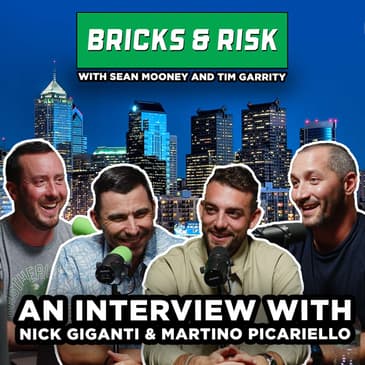
With years of boots-on-the-ground real estate experience, both residential and commercial (aka resi-mercial), Nick Giganti & Martino Picariello break down what it takes to start and grow a book of business. From knocking on doors, to learning how to value their own time, these guys know the investment real estate game in Philly. Sean & Tim ask some poignant questions about their own personal experiences as agents, as well as investors themselves. Tune in to learn more about real estate investment and the future of Philadelphia!
Our goal with Bricks & Risk is that you walk away with 1 or 2 valuable nuggets that help build YOUR business. Our audience grows through word of mouth, so if you would please take a moment of your time and give us a review on the platform you’re on, that would be fantastic!
Please also help spread the B&R word by sharing your favorite episode with a friend. You can find all B&R episodes on Spotify, Apple Music, YouTube, and anywhere else you get your podcast content. We greatly appreciate your time and trust.
Until next time, keep learning and keep growing!
📲 Contact Info 📲
→ Sean Mooney, Mooney Insurance Brokers: www.mooneybrokers.com/
→ Tim Garrity, The Tim Garrity Team: www.timgarrityteam.com/
💥 Watch us on YouTube 💥
→ YouTube, Bricks & Risk Podcast, @bricksandrisk: www.youtube.com/@BricksandRisk/?sub_confirmation=1
💥 Follow us on Social Media 💥
→ Instagram, Bricks & Risk Podcast, @bricksandrisk: https://www.instagram.com/bricksandrisk/
→ Instagram, Sean Mooney, @sean.moonee: https://www.instagram.com/sean.moonee/@sean.moonee
→ Instagram, Tim Garrity, @realestateinphl: https://www.instagram.com/realestateinphl/
→ Facebook: https://www.facebook.com/bricksandrisk
→ LinkedIn: https://www.linkedin.com/company/bricksandrisk
[00:00:00] 90% of agents don't know what they're doing, don't know how to talk to people, don't know how to communicate. Don't pick up the phone. Don't pick up the phone. Don't call you back. So I'm so happy this happened. Over promise under deliver. Over promise. Dude, the list goes on. Going to chat GPT and it won't stop going. Like for real. That's like the shout outs for this episode. The shout outs for this thing is going to be... Right, right, right, right, right. So anyway, I'm like just even in my three years, I couldn't imagine being in for as long as you have just dealing with the commercial especially.
[00:00:28] So personally, I'm like it's kicking a lot of people out of this business. Yeah. In three to five years, I think things are going to pick up business as usual, but we're going to have a higher standard now. We're going to be looked at as professionals like accountants, like attorneys and you know, start finally making the money we deserve. And I think there's gonna be less of us. So it'll be, you know what I mean? Just more professional. Quality will rise, quantity will drop and it's already happening.
[00:00:55] Welcome to the podcast dedicated to real estate, insurance and building your business. Join us as we take you along our own business building journeys with additional wisdom from our network of local and national experts. Welcome to Bricks and Risk. Hey, everyone. Welcome to another episode of Bricks and Risk. I'm Tim Garrity. And I'm Sean Mooney.
[00:01:25] Today, Sean, we have our first duo guests. We got four of us at the roundtable today. First. We have Nick Giganti and Martino Piccariello. Perfect. Nick Giganti is the president of Hunter's Commercial Real Estate and Martino is an investment and development specialist. How are you doing today, guys? Doing great. Fantastic. Thank you for having us. Yeah, man. Thanks for being here. So let's talk a little bit about them and their business.
[00:01:51] So Hunter's Commercial specializes in transactional and consulting services for property owners in Philadelphia and its surrounding areas. It's led by President Nick Giganti, who boasts over a decade of experience collaborating with both local and national real estate investors and developers. And they pride themselves on comprehensive market knowledge, unwavering work ethic and extensive client database.
[00:02:16] Hunter Commercial's commitment to prioritizing their clients' interests above all else has been integral to their continued success. When someone chooses to list their property with Hunter's Commercial, rest assured they will receive unparalleled service tailored to help them achieve their goals. All right. So you guys both started out with a focus on residential real estate, aka realtors, just like me. Yeah. And now have a focus on commercial real estate.
[00:02:44] So that was like a pretty cool pivot. Like how'd that come to be? Why did you guys shift? Yeah. And I could kind of give you a little bit of a background. So it first started and I'm going to kind of go back. Go ahead. Way back. Yeah, way back. So when I first got into real estate, I was living in the Point Breeze area. Yep. I was way ahead of the curve. I was kind of like a pioneer down there. What year was this?
[00:03:12] I bought my first house and it was my first house and I moved down there in 09. Oh, yeah. So it was like, yeah, before he was down there, you know, building. All the listeners, so they know what was the purchase price in 09 in Point Breeze? So I bought a two story townhome that was totally renovated. Okay. And I overpaid and I bought it for $170,000. That sounds about right. Yeah.
[00:03:36] You could get, you know, sub $100,000 for like a decent home that just needed like a little bit of work back then. Oh, yeah. There was a thing. Yeah. There were shells. I remember looking at shells on like Manton Street that were overpriced at $30,000. You know, it's like, I'm not buying that. You're like, never. Who would do that? Yeah. That's way overpriced. Well, do you remember Charles Dallin, a good friend of the show? Chuck D. What's up, man? He bought on Memphis Street. Yeah.
[00:04:06] In what? Like 0405 maybe? I was good. I mean, it might've been like 0304. I don't think he paid $40,000 for it. I think it was like 30. Yeah, first time was the same thing. Yeah. Same thing. Well, Philly was a deal and a half. Yeah. So get into, you know, real estate, start doing deals, the regular bullshit, you know, working with homeowners and buyers, just doing like the regular stuff. Yep.
[00:04:31] Um, and what started to happen was I'm looking around Point Breeze, I'm seeing all these lots and it's like, who owns this? Who owns that? And basically what I started to do was just researching every lot. Public record. Every lot. LLC searches. All this stuff. Databasing everything. That was like the one thing. And that was one thing I mentored, you know, Martino about getting into is just database. Your CRM is like your book.
[00:05:00] That's your book. Right. So I was almost like a stockbroker in essence, because then I started talking to guys that were building and I'm like, can I sell your property? No, I got a guy. You've got it for me. I got to let him sell it. You're like, I'll wait until he screws up and then I'll take it on myself. I'm like, I'm just going to be. Here's my number. I'm going to just be chirping his ear. He's going to go to me anyway. You know, but like to take it a step further, where my brain goes with this is like you talk to him. He says, no, no, no, no, no, no, no, no, no, no, no, no, no, no.
[00:05:28] And you're saying to yourself, the next question I'm following up with is like, oh, did you know about that vacant lot over here on this street? Yeah. Well, typically I'm not even going to tell him that because then I don't know this guy. But right off the bat, it's like, all right, well, what are you looking for? Do you have anything else you want to sell? And you just go down the line of questions. Listen, once I sell this, I mean, I want to buy. This is what I build. So this is what I'm looking for. Yeah. Perfect. It's lead gen. You're building up your database.
[00:05:57] Dude, just door knocked. That's all I did. Door knocked and just take down numbers. So then when I got the lot, you know what I mean? Or that open piece of ground. Yeah. Then it was boom, pick up the phone, just start calling. Mm hmm. Hey, John, you want this lot? No. Boom. Next person. And just started putting the, you know, the pieces together. So that was kind of like how I built the business. Yeah. And then, you know, obviously the business grew. I started a team.
[00:06:25] But we always kind of were like that resumersial. We were always looking for like land acquisition, multifamily, you know, multifamily stuff. Because investors will do both. They'll do a single family new build, like five in a row or one. They'll do rehabs. They're like, no, if you buy this, you could do mixed use. You could do 10 units. Correct. You could do 50 units in this factory. Like it all, it all ties into the people with money who want to put money in real estate. Correct. And then once you start to understand construction numbers and the zoning code. Right.
[00:06:53] Then you could start to like, all right, this makes sense if it's at this price and blah, blah, blah. And you're underwriting it. So we always kind of had a background for that. And then fast forward, it was about two years ago, Jim Roach, an agent that, you know. You guys started together. You knew him. How long did you know Jim? Yeah. So Jim and I were at Coldwell. Yeah. Back in the day. You know Jim. Yeah. And Jim actually got in a little after me.
[00:07:23] And I actually mentored Jim as he got into the business. Nice. And I will say Jim was really great on just investing his money back into the business. Of being, you know. Scaling it. Scaling it. Scaling it. Yeah. On my end, that was more like make money and I like investing in real estate. That's my passion. So his team started to really grow. Yep.
[00:07:47] And, you know, we started and I didn't really have this want to grow this massive team. Right. Right. But it just, you know, Jim was a friend of mine. We always hung out and it was just like a late night beer. We just, you know, I had discussions. He's like, dude, I need like other senior leadership to kind of help me with what's going on because like I'm being. Like I can't do it myself. I can't do it myself. So we kind of came to an agreement, merged our teams. That was in January of 2023. Nice.
[00:08:16] And then from there, it was like I built this brand of hunters. It's like, you know, that was like seven years in the making. Right. Jim had his brand. It's like, why are we going to just throw this away? Right. Basically. And the fact is we're doing so many commercial deals that we have the credentials at this point to say that we're, you know, an actual commercial team. You know what I mean? So Jim. So just so I'm clear.
[00:08:46] So Jim focused a little bit more on like the residential clients, people buying homes, selling homes, maybe building five or 10. And then you, because you started out grinding and hustling your neighborhood, finding lots, finding a building, finding a big lot where someone could build something beyond residential. Like, that's how you build your business. And when you started working together, like, well, it's kind of like two businesses, even though we're partners. Correct. And I wouldn't say that Jim basically had a very similar.
[00:09:14] Oh, so he was doing the same thing. It's like controlling the deal from the beginning to the end. That's what we were both doing very well. But then once we combined our teams, it was like, well, we're doing a lot of commercial to the point where we should have basically a division for this. You know what I mean? And essentially creating two businesses under one. Wow. So, or another. Well, it's one with two specialties, really. Specialties. Correct. It's like, let's specialize in this.
[00:09:43] Because let's face it, there's a lot of commercial people that own commercial buildings. And ultimately, a lot of times they want to work with people that are solely doing commercial. Right. So it's like, that's what our division is starting to focus on. That's what it is, what we focus on now. Now, it's kind of like niching ourselves into that segment of the market. So if a lead comes in, it's commercial, it goes here. If a lead comes in, it's residential, it goes here. But then you're still tied together on the back end. Correct. Awesome.
[00:10:11] And we are underneath the rarity umbrella. Right. That kind of fuels us. They do all of our marketing. Parent company. And then it's got a couple little subsidiaries underneath. Correct. And we're basically division subsidiary, that sort of thing. But it's been honestly awesome right now. Yeah. It's been great. I mean, the market could be better. Let's face it. Sure. I mean, commercial is definitely going through like an anemic point in time right now. Financing is tough. The financing is tough.
[00:10:40] It's like, you know, we got banged with a bunch of different factors. It was like higher interest rates, higher construction costs. Right. Tighter guidelines now. Tighter. Yeah. Like the regulations don't ever pull back. You know what I mean? Cost of just the construction materials jacked up, you know, is inflation. So we're kind of like running through all these things, these like hurdles. But what we're finding is that, you know, just the way we kind of go about business,
[00:11:10] we're very, you know, and Martino can speak a little bit more about that. But it's really just like focusing on the client, very client facing. We're ready to work. We do a lot of grinding. You know, there's a lot of these agents that have been in the business, especially I feel like in the commercial side of things where they've gotten comfortable. Yeah. These guys. They want to listen. They want to put their legs up. That kind of thing. There's guys out there that I'll call the listing and make pretend I'm a buyer. Right, right. Just so that they just fucking answer the phone.
[00:11:40] And they don't even call you back. And I'm like, what is this owner paying this guy? It's a different world, you know? And you're cut from the residential cloth, which is cool because I feel like we come from more of a cooperative business model. Like residential real estate has got good paperwork. It did have a very formalized cooperative model. It's starting to break apart from that. It's actually starting to go a little bit the way of commercial. Yeah. Commercial's always been like that. A little bit more Wild West. Yes. Everyone's like looking out for themselves.
[00:12:10] But our mentality being realtors, being in residential real estate was like, get to know the other agents, like build rapport, customer service, dot eyes, cross T's, like pick up your phone, return messages. Wow. Crazy, right? Not in a week. Yeah. No idea. Well, I was good. All right. So how'd you guys meet? Like, Martina, how'd you meet Nick? Nick. So I'm at a golf outing at the Philmont Country Club. It was a top producers event run by John Butchner. Shout out, John. Great guy. Yeah. Wolf of Broad Street. Yeah. Yeah.
[00:12:40] And I meet Josh. What's up, man? I meet Joe Cleary. Awesome agent. Amazing mentor to me as well. I really wouldn't be where I am today without Joe Cleary. So shout out to Joe. Shout out, Joe. Shout out. South Philly Joe. Joe goes, yeah, I'm on this team. Throws me his card. Where you at? Just like that. Yeah. Where you at? That sounds about right. Where you at? I'm like, and I'll be very open. You must live on Two Street. Exactly. He's a Gerard Estates guy. Nice. Okay. Yeah. Yep. Got it. Well, he's gotten to Gerard Estates.
[00:13:09] I don't know where he's at. He's graduated. Went his way up to those twin homes. Correct. And he does have a twin home with parking. Beautiful. I love it. Beautiful home. But anyway, Joe connects me with Nick at that event. I was with Maxwell Realty at the time. Maxwell, yeah. Yeah, yeah. We talked about that. Correct. Correct. Very old school brokerage, you know. Shout out to Nancy. Nope. No, no. Sorry. You know why. Yeah, yeah, yeah. So I'm just not, I mean, trust me, I wanted to be, so it's funny.
[00:13:38] I kind of, my uncle was in real estate, connected me with her. My dad owned real estate and, you know, I'm just not a family business. Yeah, you feel your way through. That's how we figure this out. And he had trust in her, my uncle. So I was like, I'm going to put my faith in her. I did. Nice. And, you know, of course, you learn quickly that he had 10 other agents he was working with throughout his career. This was just one of them. Right. You know, literally could have connected me with anybody. You got to find the right fit. It was great. Honestly, it was the best experience I could have got because I realized what, you know, the other side looks like. Yep. So I was very fortunate. We're at the Skull Fouting. Joe introduces me to Nick on the 11th hole.
[00:14:07] We're doing tequila shots with Green Tree Mortgage. And Nick goes, yeah, man. That's about right. That sounds like a real estate event. Exactly. That's it. If you're ever wondering how real estate events go with shots and mortgage lenders buying them for you. And title companies. It's a ton of fun. We actually have one this afternoon, but that's a whole different thing. Not golf outing, but we're on a boat. Shout out Mike Reverso, moving mortgage, having us out. And anyway, I meet him on the hole. He's like, dude, let's just link up for lunch. Got lunch about two, three weeks later. Really told me.
[00:14:37] He's like, dude, we have a lot of leads coming in. And our business is at a point where we know we need guys like yourself, like-minded individuals like you in. And I was like, give me a little more time. He gave me like four more months to realize it wasn't the right fit. Got lunch again. And I was like, yeah, let's do it. This is the time. So I mean, honestly, when he told me pretty much everything he just spoke about in the first 10 minutes, I was hooked. I wanted to build a business where I was brokering deals. I wanted to build a business where I was really just changing neighborhoods and making greater impact than just serving one family.
[00:15:05] You know, so mentored by him and Joe for the first, I guess, year and a half. And then we merged in with the Jim Rote real estate team, became Rarity and Hunters. And it's just been an absolute ride since. How long have you guys been working together? Two and a half, three years? Two and a half, three years. But we had a lot of commonalities. So I think we all know that people watching, if you ever just got into business with someone, you just know that feeling. And I had that. So lucky to have that right away. And if I didn't get that through Nick, who knows where I'd be today? Right.
[00:15:33] It's like when you start a podcast, you kind of know right away. Chapters. We knew. Chapters. We just knew. Yep. Isn't that awesome? Yeah, that's how we connected. All right. All right. So I got a question for you, Nick. So I find it very admirable that you're like, all right, I'm investing in this neighborhood that technically not a lot of people are doing right now. So you saw it. You saw that it was located very strategically, like undergraduate hospital, close to the subway. You know, it's row housing.
[00:16:03] This is how Philadelphia is built. And I used to call them like the missing teeth blocks. Like you go to a block, there'd be like three houses and then one missing and then one house and six missing. And then you would just find that. So you saw that. But what was it about the door knocking and the data? Is there like something from like growing up and working or are you just like you're just competitive?
[00:16:28] Like what is it that got you like off your couch to be like, this is the way I want to build my book of business, as you said? Yeah. So no, it wasn't anything. You know, I grew up in a very blue collar family. My father was a union electrician. My mother was a nurse. My mom was a nurse, too. Oh, there you go. Nice. Nice. But yeah, very blue collar. You know, I worked corporate America for until I got into real estate when I was 27.
[00:16:58] I absolutely hated it. I really did. It was a lot of like behind the screen type work that, you know, I just I was like, I can't do this. But what really fueled me was like, I if I don't pay my mortgage, I'm losing my house. Right. Like that's, you know what I mean? Yeah, that's the reality. And no one's coming to save me. I'll get some deals. I'm not I'm not eating. Correct. I don't live here anymore. Yeah. But I always have like, you know, some business acumen.
[00:17:25] Even when I was younger, you know, they would have the yard sales. I would have a whole bake sale. I would, you know, a couple nights before be baking cookies. I'd have a refreshment stand. Love it. What was it called? It was just a refreshment stand. Mix cookies. Snacks. Mix cookies. Mix snacks. Mix snacks. Do you know what the original name of our podcast was going to be? What? Oh, here we go. The Tim and Sean show. The Tim and... Yeah. That was your other idea.
[00:17:54] So he was the bricks and risk genius. And he, that was the first thing that came out of his mouth. I was like, that's it. He's like, no, no, no. Like, what about, and then I'm like, what about brokers building businesses? Like, I was way more logical. You're like, no. Bricks and risk. I was like, dude, that's it. We're done. Yeah. He was like, really? It does have a nice... Yeah, it's kind of nice... Keep it simple is always the motto with any titles. Keep it as simple as you can. Totally simple. That's why I do appreciate just the show with, you know, the names. Simple. But it's also not scalable, I feel like. You know, you're not going to reach everybody. Who is these guys? I don't know who these guys are. All right.
[00:18:24] So bacon cookies. Yeah. So I always had like... Going to the Yards and Elves. Then in college, it was like, yeah, in college, me and my buddy were, you know, we would throw parties in Manhattan, we'd rent out lofts and then we had people... Oh, so like legit of us. Jet parties, yeah. Yeah. We did that for years and that was very lucrative. We would basically set it up, get the DJs, get everybody, rent the space. And you get to go party for free. And then we'd party with these people. It was awesome. That's like Kyle Kelly printing t-shirts in college.
[00:18:54] You guys know Kyle Kelly. I did that. I printed t-shirts, sold those. I lifeguarded on Coney Island. So every year we'd like make our t-shirts and then I'd sell them. And we'd also... I could go into it. You're a total of a nigger, man. Hustler. I mean... Entrepreneur. Literally. How can I work hard, make money, control my destiny? I think that is one thing that I will say, especially growing up in Brooklyn, New York. It's like you're born to... Like you see what wealth gets you because there are a lot of rich people, but like everybody's
[00:19:24] on their hustle, man. It's like, how can I... It's a cutthroat city. It's probably the most competitive city in the world. Yeah. I mean, be honest. Absolutely. And that's really what fueled it. It was just like, all I got to do is like basically figure out who are the buyers, figure out... How to make the product, how to service the client, whatever you're doing. How to get the product and then make the connection. Build the Rolodex. Build the Rolodex and then just work it. And then put my, you know, percent in the middle. That's cool. And a lot of them weren't even listings.
[00:19:53] It was just brokering deals. You know what I mean? Yeah. So, and that was the one thing that I will say, like I taught a lot of agents because agents... I can't tell you how many of these young agents would do stuff for free. Yeah. And it would be like, listen, man, like... Your time is worth something. Your time's worth... Like, don't be uncomfortable talking to someone and saying, listen, here's a deal. I got to get two and a half percent on this. I'm just letting you know, this guy's not paying me anything. And they're fine for doing that.
[00:20:23] Because they know they're going to make... You're bringing the deal. Exactly. And they're making money. They want you to make money. Commercial, again, harder. Now we're getting back. Now we're getting to that. Yeah. But they also want the next deal. That's how their mind takes. Right? Yeah. You need to create that scarcity with your clients. You need to create... I didn't create that at first. And Nick will tell you firsthand.
[00:20:50] I was really just trying to build a book of business based on good reviews and good service. If I can have people, word of mouth, tell people about me. Build that credibility. That's all I need. So I wasn't worried about the money. I was like, let me just get some deals under my belt. And I know a lot of agents that are doing that. If you're watching, stop. Yeah. Like seriously, start putting your values first because you're going to get in a very bad habit of that as time goes along. And I always had a servant mentality. Honestly, I never really thought I was an entrepreneur. Honestly, God. Always like a server. Exactly.
[00:21:19] How can I make the business work better? How can I be a team player? That's how I've always been. Not like I want to be the entrepreneur and direct people. So this has been a very interesting three, four years for me. And I love that I got into this business because it's taught me so much about the other side of the world. You can't just serve others. You need to really serve yourself and make sure you're taking care of number one. Yeah. Or else you're not good enough to take care of the ones you love. You're not. Period. It's true. It's learning a lot. It's so interesting. So I love this residential commercial. I mean, I know it's not your world. What'd you call it? Resomercial. Resomercial. Yeah. I know.
[00:21:49] You've heard enough about real estate now just through this podcast that you might as well be licensed at this point. Yeah, might as well. You know? Yeah. Just get out there and start showing houses. No. I'll buy from you. To their point, one of my mentors, Dave Noons, back in the day, he always used to say, it's not a hobby. I would always say that. Like, drill it into my head. Like, it's your time. You know? Doctor goes in to have surgery for an hour. He's getting paid for that hour. You know what I mean? Yeah. It's kind of no different. So. Yeah.
[00:22:17] And now that we're going into this whole market with the changes, you really do have to be like. Yeah. I mean. And know what your value is. Yeah. Exactly. You brought up a really good point, which was like, you know, teaching Martino. It's like, hey, that's your right to ask for that commission. And for whatever reason, they don't want to do it or they want to take you down to the bottom of the ninth and then they try and pull it out from under you. Like, you can't be accepting of that. You may have to take a hit every now and again. Okay. We talked two and a half up front. They bumped their head a couple of times along the way. You get to them.
[00:22:47] They're like, well, we do like two. And you're kind of like, Jesus Christ. But then you're like, look, I want to make good on this relationship. They want to see how committed I am. So maybe I got to make a little less to prove. All right. I'll do it for two. But on the next one, we're doing two and a half. Yeah. And then having that approach lets people know you're serious. And if they say, no, we're not doing two and a half next time, be like, cool, we'll do this one and I'll see you later, pal. Exactly. Like, we're not going to work together. You cannot keep Jason business. You got to know your value and create a scarcity kind of mindset. Like, all right, this guy's time is very rare. Let's get let's get him while he's here in front of you.
[00:23:16] Yeah, I love that. All right. So here's a here's a good shift because you brought something up about, you know, you're starting on residential real estate. Most of the commissions were out there. They're on the MLS. You bring a buyer. It's two and a half, three percent on average is what you see in Philadelphia. Then you start shifting into the off market commercial world where if you got the deal, you got the inventory, you're controlling a little bit better. Sometimes if you got the commercial deal and someone else brings a buyer, you're like, I'm not paying. I'm not paying you.
[00:23:44] Like, get your client to pay you by my deal. So commercial, it's been very common forever to do business that way. Residential has always been a little bit more structured, mostly because of the National Association of Realtors. You know, the local MLS just had guidelines. It was good structure. But now that structure is going away. So knowing that you start out as a realtor and you're more focused on commercial now, like what can you give to like realtors out there to let them know, like what you've
[00:24:13] dealt with to deal with the way it's going to be. And that's a good point, because I think that is the most critical thing that we're doing that differentiates ourselves from some of these other commercial brokers. The reason why these guys aren't picking up their phone, you know, the people that we talked about is because they want to double pop everything. They want to cooperate. They don't want to cooperate. We're totally fine. I'd rather cooperate. Yeah, separate it.
[00:24:42] If I don't have a buyer. Right. Like share the love. Like we are not that type of team. You know what I mean? It's my reputation with other brokers in the city has always been great. I like working with other people. So that being said, typically it just comes down to the net to the seller. So if somebody is at, you know, a certain price, there might not be any commission in there. There's nothing left. There's nothing left.
[00:25:11] But we'll be transparent about that. Majority of the listings that we're getting, we have co-op broker fees broken out into the, you know. You want that demand. You want those agents with those buyers. Actually, just to that point, I'm currently in talks with a seller right now and he's really pushing back on just even 2% for a buyer's comp that we can advertise. And I'm just, I'm not, literally I'm not taking the listing unless we have something. And I told him that point blank. Like just for that reason alone, we want to collaborate and speed this process up and also keep it very ethic.
[00:25:40] A lot of times when you're in the middle, you're going to do a disservice to one of the people on the deal. Like, right? Like the sellers either going to get less than they, right? And you don't want to be that guy. Keep it separate. Keep it clean. And yeah. Just to add into that point. 10 people that want in on this. Yep.
[00:26:08] It's going to more than, I mean, make up for what you're. 1,000%. Right? Absolutely. And that's why it's kind of unfortunate that this whole thing kind of came out with NAR because when you look at it, it was like the attorneys made, they're going to make like $650 million. It's a control thing. And then what are the plaintiffs actually make? I think I'm hearing like $10 a household. It's like, it's, it's, it sounds about right. It sounds about right. But it's, it, at the end of the day, it's, it, the system worked and there's a
[00:26:35] might've been other reasons why, you know, that the lawsuit went through, but the system worked. I mean, you're, you're as a seller, you're compensating somebody to bring you an offer. Right. And in the residential side of the world, you know, now I talk to sellers and I, should I not pay? I heard about this new rule where I don't have to pay the buyer's program. If the buyer's got to come out of pocket, they got to come out of pocket in cash.
[00:27:02] You're just squeezing the amount of people that would even want to look at this. Cause who's really qualified to do that? Yeah. Now they have to come down with their down payment. Now they have to come out of their pocket with hard cash to pay their agent. At the end of the day, I, I just tell people, it's like if Mercedes Benz made you put up the whole $120,000 when you went to the dealership, how many Mercedes Benz would they be selling? But everybody finances it.
[00:27:29] Basically the rules of you paying the buyer's agent as the seller allows the buyer to amortize that commission over 30 years. And then you'll probably get a higher price by you saying, no, I don't want to pay. They're just going to literally lop that off the top. Totally. So it's like, it, if people just looked at it that way, it, that's much easier. It'd be much easier. The process worked. The system worked. Yeah. And I'm relatively new. I'm only, this is my fourth year I'm going into it. Right.
[00:27:59] Like you're a young boy, but I'm a young boy. There is some bad agents out there though, man. Like 90% of agents don't know what they're doing. Don't know how to talk to people. Don't know how to communicate. Don't pick up the phone. Don't pick up the phone. Don't know him call you back. So I'm so happy this happened. Overpromise, underdeliver. Overpromise. Dude, the list goes on. Going to chat GPT and it won't stop going. Like for real. That's like the shout outs on this episode. The shout outs for this thing. It's going to be. We'll get started.
[00:28:29] We're going. Anyway, I'm like, just even in my three years, I couldn't imagine being in for as long as you have just dealing with the commercial, especially. So personally, I'm like, it's kicking a lot of people out of this business. So in three to five years, I think things are going to pick up. It's not business as usual, but we're going to have a higher standard now. We're going to be looked at as professionals, like accountants, like attorneys and, you know, start finally making the money we deserve. And I think there's gonna be less of us. So it'll be, you know what I mean? Just more professional. Quality will rise. Quantity will drop. And it's already happening. Totally.
[00:28:57] Like, here's the example that I've always made is, you know, there's over like technically like one and a half million realtors right now nationwide. Okay. Like when we first got in the business, I got in 2010. What year did you start? 2011. All right. So you're 2011. 2011. So in 2008, when things were crashing, there was somewhere like 1.2, 1.3 million realtors nationwide. Okay. 2012 went down to 800. Okay. So it thinned out by a ton. Like 40%. Yeah. And then what happened? The market took off.
[00:29:25] So the amount of people with the low barrier of entry to get into real estate took off. And all these brokerages are growing and these new brokerages are showing up. And we've got all these eight, like growth, growth, growth. Yeah. We're in a spot right now with not only that, you know, real estate in general is a little tight right now. Like the city residential and the city's a little bit tighter than residential. And like, let's say the inner suburbs where there's not enough supply and it's just crazy demand. And there's places in the city where there's, there's months and months of inventory and
[00:29:55] there's just not enough demand. So it all depends. Yeah. But honestly, it's, we're getting to a point now where the people who got in for the wrong reasons, like let's say, unfortunately it was on a dream. Hey, I want to be an entrepreneur. I want to do well. And they just either didn't have what it took or didn't get the right advice to do that are unfortunately going to get out. And the example I've made, which brought me to this point is like, you know, one of our like good friends or past clients. It's like, look, you don't have to use your cousin Tommy anymore because cousin Tommy has license.
[00:30:25] Cousin Tommy's gone and I'm right here now. So you don't have two choices anymore. You got one and it's right. And I've been doing this for 15 years. You know, you've been doing it for almost just as long. How do you categorize that person in the CRM? Is it like Tommy, no more relatives? It's cousin Tommy, not going to make it. Not going to work. Hey, just do a reminder. Send him a card. And again, like, I don't, I don't want to say that to be rude.
[00:30:54] I don't want to say, Hey, like you didn't have what it took. It's just, you got in for the wrong reasons. You weren't, it didn't work for you. Like I think the high majority of people want structure. They want to work for someone else. They want to be told what to do. And that is what the high majority of people want to do. They want to work. Tell me what to do. I'll work my, my butt off. You know, I'll rise in the ranks. I'll have 401k. Okay. I'll be done when I'm 60 and then I can play golf for like 15 years. And there's nothing wrong with that. Pretty good. It sounds like a great life.
[00:31:24] You know, I have my family or I got my weekends off. Like everyone's cool. But then there's people like the four people here at this table who say like, yeah, like that's nice. But isn't there like something else or isn't there something different that if I just put in that same level of work and passion and know that most people can't do it, like I can have everything I want. Like I can have flexibility in my family life. Kind of. Yeah. I can have sky's the limit income.
[00:31:52] You know, I can invest in stuff like I can work on a Saturday, but I can take Thursday and Friday off. Like we can do, we can wake up when we want. We can do what we want. But we know the focus is you got to show up every day. And if you don't show up every day, you're going to lose market share. So that's the difference between, I think, like an entrepreneur and just someone who wants a gig. Hey everyone. This is Tim, your favorite bricks and risk co-host. But don't tell Sean.
[00:32:20] I hope you're enjoying this episode and I'll get right back to it in a moment. Our audience grows through word of mouth. So if you would please take a moment of your time and give us a review on the platform you're on, that would be fantastic. Please also help spread the BNR word by sharing your favorite episode with a friend. We greatly appreciate your time and trust. Now, back to the show. All right.
[00:32:49] So we're talking about like real estate investing. So I believe do both of you guys invest yourself? I know you invest. You invest a lot more than me. Yeah. I mean, and I've actually kind of taken off. I had, you know, a couple of kids. Yeah. Congrats, man. Great kids. Amazing kids. How old are your kiddos now? Uh, my son just turned five and I have a four year old, three year old daughter is about to turn four. So it's 13 months apart. Boy and a girl. Boy and a girl. American dream. American dream. Good for you.
[00:33:18] Son's got a cannon too. Does he? Son's got a cannon. Football, baseball, both? Baseball, man. Okay. And he, it's funny cause I'm a lefty and he's actually a lefty too, but he does, you know, some things right handed, but. Lefty with a cannon. Well, he's throwing righty. He's throwing righty. Okay. But I bought him a baseball bat for his birthday and he's like naturally just switch hitting right now. And I'm like, try not to get too excited. Yeah.
[00:33:45] I'm like, if you could be throwing it, he throws really accurate and has a good, like really good arm for a kid who just turned five and he's switch hitting. I'm like, all right, this is. That's cool. This could be good. This could be good. Get him on the NIL, you know? Yeah. Start Socko with some money now. Yeah. Pay for college. Pay for college. But, um, but yeah, so it's like, I always, you know, another thing I would like preach
[00:34:11] to some of these agents is there's one thing about making money, but it's like, how do you earn wealth? Right. Wealth. Right. And again, growing up in New York city, there was, you know, my great grandmother passed away. This is years ago, you know, multi-unit building in, in Brooklyn, in, uh, Carroll gardens that they, you know, my parents could have bought for $250,000. That's like a $3 million property.
[00:34:37] You know, it's like, I saw what certain, um, people that I knew and shout out to, uh, Brian Rivera's, uh, grandfather. Brian Rivera. What's up, man? Your time's on Saturday. He's still recovering. Oh my. So his grandfather was actually not that he was in like a direct mentor, but I, I kind of looked up to the guy. He was, he was from Puerto Rico. He was an immigrant, came to America, was working in a hardware store, guy that owned the hardware store. He owned the building.
[00:35:07] Yep. One of those like stories where it's like, just take over the hardware store. So major chances. Do you want it? The building, the guy ends up buying, you know, three, four buildings on Montague street, a couple other buildings, you know, just a, an immigrant from Puerto Rico. And then a mass, massive amounts of wealth. And it was like, that's what I want to do. So when I got to Philly, it was like, it was like so much more like, uh, opportunity
[00:35:36] because like New York, dude, like no one's doing anything down here. What was wrong with people? Look at Point Breeze. Yeah. I'm like, I can buy a house. The missing teeth. Look at these hockey guys. I'm like, I can buy stuff for 30 G's down here. Like, you know, so it was just like, all right. Once I started making doing the real estate, then it was like, pick up a couple things. Just a little bit here and there. I'm not, I just want at least one a year, one or two year, one or two year. Low and slow. Yeah. Low and slow by the right things.
[00:36:03] So that, I mean, for me, I want to retire at 55. That's my goal. 55 will still be working probably, but at least it's like on your terms on my terms. So that's, that's my goal. I'm looking at one right now. You were telling me. Yeah. And I just put an offer in on something today. So we're starting this next, like right now. I'm like, yeah, can I, can I, can I, can I, can I, can I, can I, can I, that's how we do it. You see his head go down and he's texting. That's what he's doing. But I think the fact he's diversifying and stuff also a great, you know, mentor for me, you know, seeing that he's doing it.
[00:36:32] So I love that. And it made me want to get into investing as well. Just got my first land development. So we bought the land, found, found a partner. Yeah. Point Breeze. Congratulations. Around the corner, but the land was more than his house. I swear. Yeah. Very close, if not more. But yeah, so I'm, that's my first one. How many do you have right now? Doors. I got, I'd have to, um, he's got a lot of doors. Nah, that's not that much when you talk to like a little over 20. That's phenomenal, man. It's like, it's not too bad. Fantastic. Yeah.
[00:37:01] His approach is just, I want to take that approach, but it's so hard in this market to make sense of everything. So we're doing one with, um, we're going to build it, sell it, and then 1031 into more land, build it, sell it 1031 to more land and try to accumulate wealth that way. So that way, when we're done the 10 unit project in 10 years, we sell that one out. Hopefully we'll have like, you know, the snowball effect of all the 1031s and then get killed on the back end. At least we learned a lot. We did connections. We built the city up. We protected our partner's investments.
[00:37:28] And we're obviously, you know, I think at the end of the day, it's all about growth. You know, we're having fun growing. So it's fun. It's interesting. So it's like, sometimes I make the correlation between like, you know, you buy residential real estate, you buy a home, you're going to live in it. And you're like, most of the time people are coming into like, you know, seven, 10 years. You know, if you're like just starting a family, let's say you're like, I'm going to be here for like 20 years minimum. I want my kids to be in the same school district, whatever it is, go off to college, have the house that they grew up in. Like, that's kind of, that's kind of like the approach.
[00:37:57] So when people buy their homes, it's more emotional because they're like, look, I can see my life ahead of me. And if I just make this commitment, if I overpay, I can stick, I can stick with it long enough. The commitment to own the real estate and do well financially. When you invest in real estate, it is 100% about the buy, the acquisition. If you overpay on the acquisition, chances are your risk of failure goes up dramatically. Now, can you get around it with like time and commitment? Of course you can.
[00:38:27] But when we work with investor clients, when we do things ourselves, because I do development, you know, if it doesn't make, if the numbers don't make sense up front, you just got to be like, I just can't do it. And people are like, what do you mean? You can't pay like, can't pay an extra 3%. You can't pay an extra 20 grand. And you're like, look, if I do that, then I make no money. So why am I buying this? And it's like, we flip homes. We usually do like four to five a year and flipping homes, it's same thing.
[00:38:54] Like we're in this market right now where we compete against the first time home buyer that says, I'll live in a piece of crap and I'll just fix it up over the years. Like I wanted that ready to go rehabbed house that you bought, but it's too expensive or like the rates are too high or there's not enough of them, like whatever it is. So then we compete with the homeowners for these fixer uppers city or the suburbs, suburbs, it's like even crazier. And you can't overpay. You like, we walk away from a couple of deals a month.
[00:39:24] Like we make offers. We look at probably like a property once every week or two weeks and we'll do four, maybe five flips this year. Like think about that. So it's like, if you are disciplined as an investor, like you're getting into this, you're like, Hey, how do I make this work? It really is on the buy. If I'm doing my numbers, right. So you're walking through a hundred homes a year, roughly, you know, two homes a week, 50 weeks. No, probably more like one a week. So yeah, probably 40 or 50. And so you're only, and this is just a lesson for the viewers. Like you're only going to pick up five to 10% of them.
[00:39:53] You're not picking up every day you walk through. And I try to tell people that all the time. Like, let's just go out and see stuff. You have no idea how educational it can be. And just, Oh, I feel bad. I'm wasting your time. Go out there and find some stuff. You know what I mean? Then I have a lot more fun doing it, but just for any investor out there, I think that's great that you said that. Well, dude, it's funny. So last year, I think almost everything we did was off market because last year was pretty tight. This year we're 50, 50. I think we got two off and we got two on, but the two that were on after we made our offer, they didn't work out until a few months later because they had time.
[00:40:23] I can't sell it, you know? And then they lower and they lower. And then to get to this point, like you come up like 10 grand. We're like, we'll come up five grand. Yeah. And they're like, done. So it's like, that's like, you never burn bridges. You always try to keep the open line until you see it close. Yep. It's like the underlying theme of this podcast, which we're talking about more regularly now is relationships, like being straight up with people. Even if I only do one deal with that home seller or that agent, it's like, you're just honest. Like, I can't buy it.
[00:40:51] You know, this isn't a get, this isn't cat and mouse. Like we're not playing a game here. I can't buy it. And they're like, okay, well we can't sell to you. That's fine. Yeah. I need to move on. And so do you. Yeah. And then if, if, if the minds change, if, you know, expectations or plans change, let me know. And we're right here. We're still the same deal. Right. And when you can do that, it's like, you can, you can find the success. I think when you were talking earlier about the difference between a residential, uh,
[00:41:16] realtor and a commercial broker, uh, I got me thinking like, is it because the residential real estate person is going to be doing deals with those real estate people? Again. And the commercial people, like, I'm not, I'm probably not going to see this person again. You know what I mean? In terms of coughing up a commission or wanting to double down on it. Is it, is that like play into it at all? You think? Yeah.
[00:41:41] I think I, in regards to you're saying, um, like picking up the, like, uh, cooperating with other brokers. I, I, I guess it's just because that's how like the residential, you know, industry was set. Formula. It was built to cooperate. Exactly. Exactly. And then it's on the, and I do think it's more because residential, I may sell a house
[00:42:07] to one buyer and they're buying, they move into the house and I'm not getting business from them for another 20 years when they call me up and say, Hey, we want to sell the house on the commercial side though. And that's why I always liked commercial. You might buy another one next week. It's, it's this repetitive and it's awesome because it, if it works the right way, it's a symbiotic relationship. I'm making money. You're making money by me making money and getting you deals. You're making money and you're happy.
[00:42:35] So it's kind of like we're growing together. Yeah. You know, um, business transaction. We want more business transactions. Correct. And I think that's why on the commercial side, they feel like they don't have to. Yeah. Because I got this warehouse. Well, I sell it to whatever Joe Schmo who's bought 10 of them. Yeah. So I'm not going to tell anybody about it. I'm going to list it and then I'm going to sell it to this guy. And when Tim calls me, I'll just make pretend he doesn't have a buyer for it. Yeah.
[00:43:02] You know, because I don't want to give Tim any money out of my pocket. Why would I do that? Exactly. He doesn't deserve it. But I do think it's like at the end of the day, it's, you're right. It's relationships and it's being like honest and transparent. Like, I feel like that there's just so many scumbags in this world. Yeah. We get such a bad rap for being in that bucket of like, you know, car salesman and whatnot. Not a lot of trust. It's not a lot of trust.
[00:43:28] And if you could just like be honest with people, honest with your colleagues, you know what I mean? Be transparent. People respect that. It's a win-win. People like that. It's a win-win. And it's like, and if your clients aren't like that, not a fit for me. I like people that are straightforward. You know what I mean? Like you said, tell me if you don't like the deal. Right. You know, don't tell me you like the deal. And then you're ghosting me. Yeah, exactly. And then it's like, what's going on here? And getting people all riled up. Yeah. Or it's like, what do you want to sell for? This is your number.
[00:43:56] And then the number, you know, it's like, but I think with any business, it's like, that should be the backbone, man. Dude, to your point, I think what's, what I have found different with commercial, like I said, when you buy residential, it's a little bit more emotional. Like someone's buying a house for their family. It's like, they're like seeing their life ahead of them. When you're selling a building to someone who like wants to convert it or build on the land or split it up or just rehab it, like whatever they're looking to do, it's all numbers.
[00:44:24] So therefore it becomes a little bit more black and white, a little bit more cutthroat. And commercial never really had the cooperation model that residential had. They didn't have like the same structure, the same rules that we had. So it was, I always call it the wild west commercials, the wild west. And you know, uh, residential is like private school. So it's just like, okay, what am I doing now? Like, you know what I mean? It's just, it's like real, like formal, it's real structured. And the lawsuit made it seem like we were the biggest criminals on earth.
[00:44:54] But unfortunately the lawsuit is about money to the attorneys who were making the case. Because like you said, the people who actually got some money barely got anything. It's going to, it might cover their next couple of lattes. Like, give me a break. That's what it's over. You want a couple extra cups of coffee? So. And they think that they're really like doing a service to the seller. You know what I mean? Because it's. Or no, it was more to the buyer. I'm sorry. Because they were saying, yeah, exactly.
[00:45:19] That, uh, they didn't know of like what they were paying, but at the end of the day, yeah, I think it was just. A money grip. Right. Unfortunately. Um, all right. Here's a question like from the investment sense. So, um, with the stuff that you would find and you would sell or like you're representing clients, like have you ever taken like an equity position? You're like, Hey, I want to be a part of this deal. How do we work together? Has that ever come up? It's funny because we've, uh, pitched that out.
[00:45:47] We've like, uh, brokered a couple of joint venture deals and that, and that sort of thing. Um, we haven't, I personally haven't successfully done that yet. Um, I've had some, uh, some clients say, yeah, we'd be open to that. I haven't done it. I would love to, you know, I'm always open for that. Um, but yeah, I have not. Hasn't been a party. Yeah. Not yet. Yeah. We've had a few conversations before prior to us, like really getting into it.
[00:46:14] And what I found is that most investors would prefer not to do it. Cause they're like, what do you really bring into the table aside from the deal? Yeah. Um, if you can offer more than the deal, it's like, well, I'm bringing the deal, but here's what I can do. Like, Hey, I gotta, I got a real estate license. I can help you out on the backend. And they're like, well, anyone can do that. So it's like, you got to find the right relationship where they're like, you know what? I want your boots on the ground or I want your local expertise. I want you invested in this just like I am.
[00:46:44] Cause maybe they're from New York, maybe they're from California or Texas. Yeah. It's like, and then it's also like, who do you want to be? You know, there's a lot of guys that I just want to sell the property to great clients, but would I want to get in cahoots with them on the backend? Probably not. Right. You know? So, um, there's definitely, definitely several that I would. Um, but yeah. So if the opportunity came up, I would be 1000% open to it, you know? Well, here's a good one.
[00:47:09] So, uh, Mr. Mooney over here, he's Mr. Glass half empty and I'm Mr. Glass half full. Okay. So I'm too nice and he can be a little bit more critical. Um, and we can say that because we've known each other for a long time. Um, what's your outlook on Philly? So you're from New York, you move here, you live here, you live in the area, you invest in the city, you sell in the city. What's your outlook on Philly? Yeah. Yeah.
[00:47:35] So when I first got here and when I went to temple, that's what brought me to Philadelphia. There was a lot of like compare, you know, comparing Philly and New York. I'm sorry, but you really can't compare New York to any city. Yeah. It's like, um, apples and pineapples probably. Yep. Um, but now I've been here for 22 years, which is crazy to me for all those years. But, um, put on one of these. Yeah. I mean, I guess I'm last week, I would take that off. Yeah, seriously.
[00:48:04] But, um, uh, you know, I've really grown to, to love Philly. You know, it's, it's a, it's a small city. It's a small, big city, you know, um, it's definitely dear to my heart. Uh, and what I really think is what I always look at Philly. It's like, I sometimes think that we are our own worst enemy. We are. Yeah. It's like Mr. Mooney over here. Last half empty. You know, suck. The team sucks. The city sucks.
[00:48:34] Last week, like the cheesesteak. Everything I think of perpetually comes true. So, so there must be some. Might as well prep myself. You're manifesting it. Yeah. Might as well prep yourself. It is. No, Sirianni is manifesting my thoughts. That's what's going on. You're the reason why they lost on one of that. Thanks, dude. Mooney's fault. Thanks, bro. If only he had thought better thoughts. Clean up your mind. Keep it on the ground. Just kick the ball.
[00:49:03] Just kick the ball, Nick. Right. But, so, you know, it was like, you look at like the history of Philly, the census, populations being lost every 10 years. They put the 10 year tax abatement in. I think it was 1998. All of a sudden, the population starts rising. Great policy. Right. Great policy. Great policy. Get people in. All these people talking about the tax abatements losing money for the city.
[00:49:32] There are whole neighborhoods. You know. Poor Breeze. You were selling those lots. Yeah. It's like such short sightedness. Because it's like, do you understand that there's no taxes for 10 years? But then after the 10 years. They're paying high taxes. Yeah. They're assessed values high now. Yeah. You have all of Graduate Hospital. All of Pharamount. You know, and it's like, you're planting the garden. Do you understand how it works? And they, and then of course we hit COVID. We were rolling. Rolling. Rolling.
[00:50:01] The city was on fire. Totally. Of course we hit COVID. And then they mess with the 10 year tax payment. Then interest rates go up. You know, for people that don't know the 10 year tax payment in Philadelphia is now cut in half. Yep. So it's like, you know, there's just, there's like a lot of headwinds. And then the regulation, the LNI, I can't tell you how many developers that were building a shit ton of product in Philadelphia are like, I don't want to, I don't want out. They don't respect it.
[00:50:30] Like they take it personally. Yeah. Yeah. They don't want us. I'm going out to the burbs. I can build a house in four months, five months. I hate to tell you the burbs are tight too. Well, the burbs are tight, but like if you're building ground up. Exactly. It's, you know, but from the people we've talked to, things are getting better in the back office for LNI, which is good. Yeah. But overall my outlook to get to the answer to your question, um, with such an influx of multifamily buildings.
[00:50:59] I mean, we literally have four times the inventory that we have on a rolling 20 years hitting the market than we've had. Right. But we're actually ranked top in the country for absorption of those units. Right. We're, we're, we're absorbing moving here. Yeah. We're absorbing two times our trailing 20 years in, in multifamily, in those units. Facts, yo. Yeah. Facts. So what I'm thinking is we are going to have this kind of like second level kind of commercial
[00:51:28] boom because you're talking, I mean, in Northern Liberties alone, I think it's like 7,000 units are hitting. I mean, look at this neighborhood. Yeah. Yeah. We're developing right down the street. There you go. Ridge Avenue, all that. It's crazy. So what happened? A thousand units have been built. Yeah. So what happens is all these people move in. Then it's like, where are they eating? Where are they going out to, you know, to the bar or where they want to go to venues? The grocery store, the pharmacy, the gas station. It's everything. So it's like, you're going to probably see a next level.
[00:51:56] All these units got to be, have to be absorbed. Everything's got to stabilize. Right. Obviously multifamily buildings really tapered back. And once those stabilize and people understand what's going on, I think there's just going to be, yeah, it's going to, I think Philly, as long as it doesn't, in its own way. Right. Is going to be poised for, to be like, you know, a great city. I mean, it's already a great city. It's got great history. You look at the location. Sure. And 50 minutes an hour. We're in a pop culture moment right now.
[00:52:26] It's like Casey is going to run for like president of the universe. It's like, I was watching the game there and I'm like, dude, could he be in one more commercial or one more pregame discussion? He's like walking through the parking lot. Did you say Casey? Kelsey. Kelsey. Kelsey. Kelsey. Kelsey. I'm sorry. Did I say Casey? Sorry about that. Casey. It's my accent. Kelsey. So Kelsey is like all over the place. I opened up the Walmart thing and he was in there. I'm like, what are you doing here?
[00:52:53] It was like his name on like a barbecue set or something. He's hanging out with Martha Stewart and Snoop Dogg. It was like a hot take. It was, are we overdosing on Kelsey? And I'm like, yeah, we are. Take a break. If you could grow bricks and risk to a certain point, you can maybe get to $100 million. You got to get him on now. He was like, you're not even going to sniff me for less than 50, Kat. We could broker that deal. I would broker that deal. Yes. Yes.
[00:53:23] Please do. Fun fact. The guy who shot their first episode was these guys. Get out. Get out of here. Yep. That's awesome. Yeah, that's true. That is true. Do you know the Casey's? Check that. It wasn't, it wasn't their first episode. Oh. But Terry did it. One of their episodes. Terry did it. What's up, Terry? We directed one of their episodes. Okay. Okay. Pretty cool. Pretty awesome. Yeah. Yeah.
[00:53:52] But I'll say this and just to simplify it all for the viewers is like, if you look at the cycle, you know, of just real estate every 10 to 15 years, we're going to go through these cycles. Right. Oh, eight. Oh, nine. 10. 11. Um, 13, 14, 15, 16, 17, 18, 19. Right. We're right around here right now. So that's what I'm seeing. But I'm also seeing a lot soften up now. Yeah. Calling a lot of commercial brokers and they're like, yeah, the seller's ready to fucking make a move here. Right. It's great. Um, so for me, these past like six, seven months have been awesome because I'm working
[00:54:20] on my business a lot, but still trading, you know, still able to find some right deals. And of course I'm building my own project. I'm getting my property management company off the ground. And to your point, if I'm going to ever acquire anything with a partner, that's my value is I know the city, I can manage this building. That's it. Right. Um, to your, to the point of the cycle and all that, it's just been like, now that we're getting right back into the, I'm like so excited. And we've been talking about this for 18 months. Um, and it's all about being, you know, big picture.
[00:54:49] I think we talked about that in our initial coffee meeting. It's always a big picture. You can get so dialed in and focused on this past month, but it's like, look at the overall view and tell me really kind of plan for what's about to come, which once again, it's coming. It's just a matter of time. That second boomer commercial. I love how you guys have different takes on, on the outlook for Philly and the market. What's your take? Um, my take, uh, we're all going down. He's like, we don't have enough weird shirts. We're out of them.
[00:55:19] It will never be out of shirts. You did buy them all. I think. Yeah. It might've looked like Charlie Sheen. I know. It's what it is. It's the Charlie Sheen. Um, or Frank Costanza. Two different takes. And I think that's going to really run well for you guys with your new podcast. Yeah. Let's talk about that. Do it. Let's get into it. Yeah. Name the handle. Um, and what you guys are going to be doing and talking about. I'm excited to share this and appreciate the opportunity to bring this up. We'll talk with the hunters.
[00:55:47] Um, it's about entrepreneurship mindset and relationships like you guys have here. And we're just trying to understand people's journeys. Yeah. Always commonalities. There's a common thread in the journeys. I think so far in the 10 episodes that we've shot, the viewers are, I'm excited for the viewers to see this, but it's just consistency. Truly. If you're consistent in what you do, it's not about how you came out in the first period or the first half. It's all about, you're going to continue that in the second half of the game. Yep. Right now we're in that second half of the game. So point being is like motivation, obviously, hopefully that can be an aspect of it, but also
[00:56:16] just seeing these journeys and trying to get a how to for the viewers and listeners. And my favorite part is connecting with our guests. We have some incredible guests from, you know, number one architects in the city. Number one attorneys in the world. We've had Miss Pennsylvania on 2020, 2023. We just have this Rolodex and, you know, relationships that we're just excited to share with everyone else. So if you're looking for, you know, another podcast similar to bricks and wrists where we're very authentic and we're very open about what we're going through, challenges and wins.
[00:56:46] It's real talk with the hunters. We're dropping our first episode on the 29th. So stay tuned. Awesome. Yeah. Nick, anything you want to add? Yeah. I think it's, it's awesome. The conversations we're having are awesome. And, um, you know, as an entrepreneur and a lot of us know, it's like that first step, you know, we're trying to encourage people that are watching it to, to see what other people have gone through. Cause there's always that kind of like, you know, you have to have trust in yourself.
[00:57:13] You have to have the confidence in that first step when you walk away from that salaried position where you're spending a ton of money on like, you know, working to get your business up, uh, up and running. Um, you know, it's, it's a little bit of encouragement, you know, for the people that are looking or viewing it. I think for you guys, like your viewers, listeners, they're going to see it as like thinking about it. And then they hear these voices say, this is what I did. And they're like, Oh, I can do that. Exactly. Absolutely. Yeah.
[00:57:42] It helps people to, to be like, well, if this guy, that's the same thing that I'm thinking, I should just do it. I got this idea. And hopefully, you know, we can influence people to, to start businesses. Cause as we all know it, it's one of the most rewarding things. It isn't being in commercial real estate. We can service them, you know, like, yeah, you guys want to get this started. Let's find your space. Let's get you started. And it's about co-creating opportunities for your people. Not I win, you lose. It's like we're co-creating something special and really selfishly.
[00:58:12] That's what I love most about what we do and why we have the podcast. Yeah. Selfishly. So here's a good podcast stat for you. And it was told to us on one of our interviews, one of our episodes. Interesting. I love stats. That's only 1% of all the millions of podcasts that there are out there have 50 episodes or more. Wow. The other 99% have less than 50 episodes. Now again, it's like a fairly broad stat. I've looked it up on Google and it says different things, but the guy who told us is, has the
[00:58:40] number one insurance podcast in the country called the insurance guys. He was a friend of Sean's. He came on. He was phenomenal. They have over a million downloads. They've been doing for like five years. Really quick. Talk about simple names, right? Yeah. The insurance guys. Keeping it simple. Insurance guys. What do you guys do? Yeah. We're insurance guys. Yeah. Like we play football. Yeah. Sorry. Sorry. Right, right, right. Yeah. But, uh, so I thought that stat was great because it plays into your consistency. So we've been doing this now as this episode airs for close to a year.
[00:59:08] We started, I believe in November. Yeah. We didn't drop our first episode until March. Mm-hmm. And we just released our 38th today. On the road. So we are 12 away from that. 12 away. Tell me if I'm correct. Do you have them already ready to go? They're already ready to go. We haven't done 50 yet. We're like, right? We're like 48 or somewhere around. That's awesome. So we're like 49, 50. Yeah. That's awesome. I said shirts off of finals. But he didn't like it. He didn't like it. Tarb's optional for the 50th.
[00:59:38] He won like scorpion bowls and like Hawaiian shirts. Come on, dude. Kelsey will be here for the 50th. Casey. Casey. Casey. Yeah. But no. And the funny thing is if you look around, like, because when the stat gets thrown out, it's like, really? And then you start to look around. So like you have podcasts that you're like, oh, check this podcast. I really like it. They're done. They do it for a year or two. Yeah. And it's done. And some of them are just so good. It's hard. It's hard to maintain. And it's because it's a lot of work.
[01:00:06] To be consistent, you really have to like dedicate yourself to like, this is what we want to do. We're going to keep doing it. Continue to do it. And I think that a lot of people get in. Like our time blocking episode. Like our time blocking episode. Time blocking. I think people get into it for the wrong reason as to like, I'm going to do this. And they have this expectation. Like, I'm going to beat a million downloads after like 30 episodes. And it's like. It's not worth it that way. That way. Because they're chasing an outcome. They're chasing a result. They're chasing something that doesn't matter.
[01:00:36] Very well put. I fucking love just being here. I don't want this to end right now. Yeah. Like this is fun as shit for me. The editing. And I got a lot more questions. So we can take this long. I was going to say, take them. I take all the time in the world. But we got guys like that who can just, you know, take off the hard stuff. Not how can I do this? But who can help me do this? Yeah. So that's your point. Very good. All right. So we, we asked some questions like when people book with us and some of the questions we ask, one of them is, what do you love most about what you do? And you guys had said relationships. Yeah. Which again, near and dear to our hearts.
[01:01:06] Yeah. Why was that the one thing that came up? I mean, you're hustling, you're making money, you're growing your family, like you're buying your house, you're buying land. Like that's exciting. Why, why is relationships so important to you in what you do? I just think that's how, you know, that's how I was raised. It was like, you know, my family, friends, again, you know, talking about Brian that, you know, like all my friends from growing up are like brothers. So it, I always cherished relationships.
[01:01:35] And I think it was one of those things that, yeah, just the business, like meeting other people. I love talking to other people and seeing what are your, you know, what are your hobbies? What do you do? You know, and cultural backgrounds, again, growing up in New York city, like I was always interested. Oh, you're from India or you're from like, you know, it's like, oh, we watch cricket out here, you know, it's like, and I think that actually helped me with sales too, because I could jive with anybody, you know, tell me you're from Jamaica.
[01:02:03] Like I'll have something to talk to you about. Right. But that, yeah, that at the end of the day, I think it was just how I was raised. And I just love meeting people and shooting the shit and getting to know people. You know what I mean? So I would say same as Nick, just genuinely a curious person, like genuinely, like why are you doing that? You know, genuinely asking you. And also like to your point, like we're investing, we're, we're buying land, doing this. Can't do any of that without relationships. I don't think like to get the land for the right number, you got to make sure you're friends
[01:02:32] with the right people and you got to make sure you can get your build costs there. So making friends with everyone, I think the reason I like it is because it allows you to do more. The more relationships you have, you're like, wow, I've, I've kept relationship capital. Yep. I have a manager. I have a floor guy. I have a whatever. And I love being a super connector of people. So if maybe two people that wouldn't have met, I can, like you said, be right in the middle of that and, you know, really push two people's missions forward without even, I don't even want to cut to that. That's just, that makes me feel great when I know it. Exactly.
[01:03:00] And then they will always, and this isn't why I do it, but they will always think of you. Always. That's the beauty of the podcast too, is we, uh, I love the different voices. I love the different personalities and perspectives and like all the different things that we get to hear from just people that go about things differently. We have with the show. Remember we did one episode, I'm not going to name it, but after the episode I was done, I was like, bro, that was a little polarizing. And you're like, we're going to meet different people. Yeah.
[01:03:29] Like not everyone's going to like look at this medium the same way. People are going to say what they want. I don't want the uniform character to come. I don't want the person to fit a character then for us to have them come in. It's like, I don't want that. It's not about us. It's about them. Tips for our listeners and washers. And you guys said, you have to be around to be around. I feel about this for him. That's something he would have said.
[01:03:58] That sounds very New York. I'm going to let him answer this one. It's funny because when I talk to a lot of the young agents, it's like, that's part of our business. You know what I mean? It's like, you're not getting business because you got to be around to be around. Right. You got to call people. If I'm in my car, I'm talking to people and it might not be tied to, are you buying this property? What's going on? Just conversations. Just conversations. I'm just thinking about you. Because again, a lot of my clients, I genuinely like them.
[01:04:28] I like them and I like hanging out with them. There wouldn't be clients if you didn't like them. Correct. You know? So it's like, yeah, what's going on? How's life? You know what I mean? And then of course it delves into business. So yeah, I'm looking for this. Always try to help each other out. That's it for agents, top of mind, top of mind. You got to be around to be around. I love it. Yeah. Awesome. And then your quote is badass. It's life's not about how hard you hit.
[01:04:54] It's about how hard you can get hit and keep moving forward, which I believe is rocky. I was about to say that's how much you can take. That's how winning is done. Oh, I love it. So I had a speech freshman year and they said, like I bloody my eye up. I took my shirt off. That's what I did. Public speaking. 101. It was for credits. Yeah, your boy punched you in the face. No, no. I actually, I didn't get punched. It's for class. We had to pick a speech and I'm like looking through, you know, great speeches. And my dad's the biggest Rocky fan.
[01:05:23] And he, yeah, I called him up one night. I'm like, I'm looking through all these speeches. Nothing's good. He's like, watch Rocky six. And I was like, shit. All right. And I watched it. Never heard that before. I'm in college at this point. I've never seen Rocky six. What is six? Is that? That's the newer. It's when his kids. That's Balboa. That's when his kids like, yeah, that's who he's telling the quote to. Consistency. Tommy gun. Tommy gun's five. That was five. And then they fought at the end. Underneath the L. If you haven't watched it, watch it. Right, right. And all the cops are just watching. Right in Kensington.
[01:05:52] I got my body on Rocky. Exactly. But that was, that was a quote that I actually made a, or I presented to my entire class. It stuck with me. I was actually going to get that tattooed on me at one point in my life. Why stop now? Go ahead. It reminded me because I. Let's go to the tattoo shop. I know tattoo people. Let's go. There's one right down the street. Let's do a live feed. Let's do it. Let's do it. Let's get him over here. That's how we. Bring him into it right now. I know a guy. But I remember reading that.
[01:06:22] And at the time I had such a big ego. I'm a freshman in college. I'm the shit. And you know, things really weren't going my way my freshman year. Like I thought they were. We had expectations that weren't met. Hockey wise. I was going for sports. Really stuck with me throughout my entire life. You know, just. Dude, it's not going to go your way. Just get the fuck back up. Right. Just get up. Keep moving forward. I think it's great because. If that's ever going to happen, it's going to happen being in business, being an entrepreneur, real estate and insurance.
[01:06:49] I mean, they're cutthroat businesses and we lose deals all the time. We lose clients, you know, partnerships. There's all sorts of things that go wrong in business and in the industries we're in. But hey, you can either go crawl in a corner, as I said before, and wonder why. Or you can dust yourself off, pick yourself up and keep moving forward. Get a cute dog for cheap now. They're real easy. The Amish Farms up in Lancaster. 400 bucks for a cutie named Gemma. Good point.
[01:07:17] But just to that point, it changed my relationship with pain. You know, pain is progress in my mind. So the harder I get hit, I'm almost like, fuck yeah. Give me another one. You know what I mean? Give me another opportunity to learn something. So we can move on from that. Funny background that Martino never, I like to always bring up is he played hockey and he was a good hockey player. So I'm told. Scrappy sport right there. Yeah. So it's pretty funny. So, you know, Martino's just starts on our team and he like crushes a call and he's like, set the appointment or something.
[01:07:46] I'm like, yeah, like do a chest bump. He gets up. And he fucking locked me. He like caught my chin and I was like, whoa, like kind of saw stars. And I'm like, dude, all right, I'm not, I'm not too good of a form. We're fist bumping. Yeah, we're fist bumping. Sorry about that. Sorry, you're okay? He just kind of was like, you know, two months in the business. Sizing you up. I've changed a lot since then. I've changed a lot. If I'm booking an appointment, I'm on to the next.
[01:08:15] But at the time it was like sex. It was like, dude, I just got laid. Right. Let's go. I mean, dude, you're going to have to fail in order to succeed. Like if you think you can get away with not getting egg on your face, not falling, not getting knocked down, you know, not failing. It's like, what are you really learning? If everything, you might as well be in corporate America where everything is fine. You wake up, you got a job. You got all that security. Majority of people, I think, do think that way. Yeah. It's, it's tough. It's a tough, uh, tough way to go.
[01:08:43] You have to be able to get through the downtimes. Absolutely. I mean, I think that's in life too. Yeah. Ultimately, it's like, I hate to say it, God willing, my parents live forever, but you're going to go through deaths of your parents. Exactly. Like, and it's like, if you can't handle the bad times, then, you know, it's, yeah, it's just something you got to be able to do, especially as an entrepreneur. Awesome. Well, where we shut it down, why don't you guys let our audience know, listeners and watchers, where they can kind of find out more about you and everything that got going on.
[01:09:13] Yeah. Yeah. Yeah. Um, you could, uh, hit us up on Instagram on, uh, Hunter's real estate, um, direct. I mean, uh, what else? Email Nick at rarity, real estate.com. Rarity, re.com. Rarity.com. Yeah. I would say, uh, reach out to Tim and he'll connect us. Yeah. But, uh, you know, Hunter's commercial may put the link down in the, yeah, Hunter's commercial's got a really, we got great content coming out, especially with the podcast and wealth of knowledge coming.
[01:09:40] So I think the Instagram page will be the best place and you can find our emails and numbers right through there. So awesome. Absolutely. Well, that's all we have for this one, folks. So thank you for tuning in again to another episode of bricks and risk. See you soon. Thank you for joining us on another episode of bricks and risk. Our goal is that you walk away with one or two valuable nuggets, and we greatly appreciate you sharing your time with us today.
[01:10:07] You can find all BNR episodes on Spotify, Apple music, YouTube, and anywhere else you get your podcast content until next time. Keep learning and keep growing.