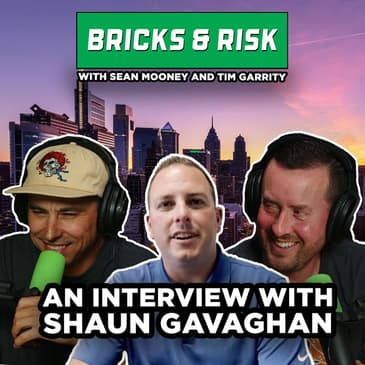
Shaun Gavaghan is a shining example of a scrappy entrepreneur. He's a problem-solver, a risk-taker, and a hard worker. From starting his insurance business from scratch (with 3 children and a stay-at-home spouse) to refinancing his car to help with start-up costs, he does what it takes to keep moving forward with his vision. This one is super-educational, but also packs plenty of laugh-out-loud moments; Shaun G's a George Carlin fan and has a great sense of humor. Sean M. & Tim ask some tough questions in this B&R ep, and we hope you enjoy listening/watching as much as we enjoyed recording it!
Our goal with Bricks & Risk is that you walk away with 1 or 2 valuable nuggets that help build YOUR business. Our audience grows through word of mouth, so if you would please take a moment of your time and give us a review on the platform you’re on, that would be fantastic!
Please also help spread the B&R word by sharing your favorite episode with a friend. You can find all B&R episodes on Spotify, Apple Music, YouTube, and anywhere else you get your podcast content. We greatly appreciate your time and trust.
Until next time, keep learning and keep growing!
📲 Contact Info 📲
→ Sean Mooney, Mooney Insurance Brokers: www.mooneybrokers.com/
→ Tim Garrity, The Tim Garrity Team: www.timgarrityteam.com/
💥 Watch us on YouTube 💥
→ YouTube, Bricks & Risk Podcast, @bricksandrisk: www.youtube.com/@BricksandRisk/?sub_confirmation=1
💥 Follow us on Social Media 💥
→ Instagram, Bricks & Risk Podcast, @bricksandrisk: https://www.instagram.com/bricksandrisk/
→ Instagram, Sean Mooney, @sean.moonee: https://www.instagram.com/sean.moonee/@sean.moonee
→ Instagram, Tim Garrity, @realestateinphl: https://www.instagram.com/realestateinphl/
→ Facebook: https://www.facebook.com/bricksandrisk
→ LinkedIn: https://www.linkedin.com/company/bricksandrisk
[00:00:00] One of your biggest struggles you'd mention is getting out of your own way. So very honest of you, why has that always been a struggle? I mean, I think that anybody that goes into business for themselves is to some degree, a certain type of person has a certain type of confidence, a certain, you know, I can do this particular task better than anybody else. Swagger. No, it's confidence. Swagger, false bravado, whatever it might be. It's, you know, because
[00:00:30] Look, and here's the question, like, or here's like, you might be able to do this thing better than the next person in your office. But is the delta between how you do it and how they do it worth you doing? Right? Is it is it more efficient? Is it better for the business for you to hand that off? Even if there's a slight drop so that you can do some better job on something else?
[00:01:00] Welcome to the podcast dedicated to real estate insurance and building your business. Join us as we take you along our own business building journeys with additional wisdom from our network of local and national experts. Welcome to Bricks and Risk. Hey, everyone. Welcome to another episode of Bricks and Risk. I'm Timmy Garrity.
[00:01:30] And I'm Sean Mooney. You should have gone with Shawnee, but we'll skip over that. All along the Shawnee River. Skip over that one again. Well, I'll have to ask our guests. We have a great guy on local, greater Philadelphia, and I should say business owner, Sean Gavigan with Gavigan Family Insurance. How are you doing today, Sean? Sean. Good, fellas. How are you? Welcome on in. Doing great. Thanks for coming on the show. Real quick, did anyone call you Shawnee growing up?
[00:01:57] Yeah. Yeah, I knew it. And people probably call it him. He just never admits it. So we'll just go with that. Sean P. Sean. Sean. Sean P. Sean. Le Sean. Le Sean. Sean. So Sean owns an independent insurance agency offering personal and commercial lines of insurance. Being independent, having a wide variety of carriers allows Gavigan Family Insurance to get their clients the pricing they deserve.
[00:02:25] Sean believes that a great customer experience comes down to three things. He's a hockey, baseball, and dance dad. He's a shower beer enthusiast, which I can't wait to talk about that one. And also, he put himself as the second best insurance agent ever. Dylan, can you fact check that one? Yeah, yeah, yeah.
[00:02:55] So he was number one. Is that the world? You have to ask Mooney. You have to ask Mooney that one. Right, right, right. Is that in the world? I already know it's not him. I don't want to meet this first. I didn't want to reach too far coming out of the gate. Oh, I love it, man. Coming in hot. Awesome. All right. So how did you get into insurance and kind of go through some of your journey? How'd you get into it? How long have you been doing this? Now you own your own shop. Like, what's that journey like?
[00:03:22] So I graduated from Temple in 2002 as an education major. Go Al's. All I wanted to be was a social studies teacher in high school. No way. Yeah. So I subbed for a year. First, obviously, first summer out of college. It went on a few interviews to no avail. Went in and subbed for a whole school year.
[00:03:48] I tutored homebound kids that were either sick or like thrown out of school for, you know, suspended for some length of time. So some interesting stuff there. Coached baseball. I was landscaping, working in a bar. I was doing, you know, painting. I was doing all sorts of random stuff to get by. Second summer of interviews came and went. And no dice. So I got into insurance by accident. I actually had a phone call one day.
[00:04:18] I'll skip the long part of the story. But I was told. What's the four threes? I was told that I would basically not get a teaching job in the one district that I wanted to get a job in specifically because I graduated with a 3-3-4 and a 3-5 was the prerequisite. So that's a phenomenal GPA on its own. I thought so. You know, I mean, for, you know, so anyway, it's an education major. So it's a great guy. Yeah, he is. Brighter than us. I don't want to tell you what my GPA was.
[00:04:47] I think mine was higher. My mom was like, I don't think college is right for you. Yeah. You're like, cool. I'll go sling insurance. Thanks, mom. So anyway, I was commiserating with a buddy and he's like, why don't you come work in New York Life? And I'm like, I don't want to sell insurance. Well, you have to do something to hold you over until you find a teaching job, right? So yeah, you know what? Let's do it. So when interviewed, obviously, you know, starting salary was zero, you know, so as long
[00:05:16] as you're not an idiot, they hire you. Right. So I went there and I was there about six months. Question came up with an age change with my own car insurance. So I called my agent who was a nationwide agent. And I said, I know the age change works this way with life insurance. You know, is my rate going to go down again at my like when I turned 25, I guess it was. And he's like, no, you know, he's my one of my old bosses was kind of an abrasive guy. So he's like, how do you know anything about life insurance? You're a teacher.
[00:05:45] I said, well, I'm in insurance now. You know, I just got into it. Long story. He said, you want to learn anything about life insurance? You come talk to me. So I drive to his office at Tyson and Roland, which he's no longer there. But I went there and he spent about 15 minutes talking about life insurance in the next two and a half hours explaining why I should come work with him. So it was a compelling argument. He's like, look, you're going to sell more life insurance as icing on the cake. Right.
[00:06:13] Where you are as a 24, I guess I was 24. He's like, the only people that are going to buy life insurance from you are your friends. And it's going to be 10 bucks a month and you're not going to make any money. Nobody else is going to trust you for a while. If you come sell auto and homeowners insurance and sell life insurance, you know, as, as icing, you'll still sell more than you would on your own. So story checked out. So I agreed to it and went to work with him before that even came up before I actually
[00:06:42] even started with him because I had to get the PNC license. Another opportunity came up with another nationwide agent that he had seen at a recent meeting. And the other agent said, listen, I have this relationship with a credit union, which is American heritage. He said, you know, I have a relationship there where they get a discount from nationwide through the nationwide affinity program. They just need, they want somebody on site at their main office on red line road full time. He's like, and I don't have somebody.
[00:07:11] So why don't we split this kid that you found? We'll throw them in there. We'll split the business that he writes out of there. And so that's what we did. I went in there February of 04 and, you know, worked six days a week for, for nine years. And wow. Great second, 2013, you know, after some bumps and bruises and some good times, I decided to roll off onto my own and make a run at it. That's some grinding, man.
[00:07:37] So, so you're sticking with this routine for almost a decade. And was it at that point where you're like, okay, like I'm, I'm pretty good at this, you know, social studies career long gone, you know, at this point, what was it about starting your own insurance brokerage that kind of hit you at that point? Was it, was it the money? Were you doing some math? Were you like, I'm sick of working for these people? Like, what was it that kind of pushed you over the line? So it was a number of things.
[00:08:09] You know, I, I learned a lot from, from my, my two bosses that I worked for both great guys and, and but like any business relationship, some, sometimes that, you know, the, the, the train just runs out of track for a variety of reasons. Money obviously is always in play. It wasn't the a hundred percent, you know, driving factor. I did want some more autonomy in, in the way I did business, the way I marketed the markets
[00:08:38] I had access to. And I could see that that wasn't going to come to fruition in the, in the position that I was in. I also knew I was going to, you know, my kids were getting older and I wanted more time off. I didn't want to have to explain why I needed time. And so it was, it was a combination of, of freedom in a few ways. Plus I knew there was the potential to make more money and be in the driver's seat.
[00:09:03] You know, there's, there's a, you know, studies show, you know, that, that, you know, when you look at, at military situations, you know, guys in the back from, from what I read tend to suffer PTSD worse than the guys making decisions because you're relying on the fact that somebody else is making the decision that your life depends on and, and that wears on people. And in business, it's no different in, in, in that regard. You know, that sometimes you're like, I think this guy knows what he's doing. You know, could we be doing better?
[00:09:33] Could we, you know, could, so that, that, that always kind of, you know, cause I always had ideas and it was, you know, there was only so much you could do where I was. We TSD is a very familiar thing going on in the insurance industry right now. Uh, in real estate too, bro. Yeah. Sean is the number two insurance agent of all time. Can you talk to us about, where, where are you ranked? You know, I'm at least in the top. You're in the top million.
[00:10:02] You're like fortune 500. You're somewhere in the, you're in the top 500. Sean, um, getting contracts early on. I've talked on the podcast previously. Um, I got laughed out the door by most carriers. Can you tell us about getting started and how you were able to get contracts with these carriers to get off the ground and get going with the agency? Yeah.
[00:10:30] So my, uh, a buddy of mine, you know, who was one of the guys that kind of convinced me to do this. Uh, you know, he, he introduced me to a woman that was working. There was a sales manager for Liberty Mutual and, you know, Sean, I don't know if you remember and Tim, you might in, in 2000, I would say like 10, nine, 10 through like, um, 13 Liberty Mutual was like smoking.
[00:10:59] I mean, they were writing everything that was, that was coming down the street. Uh, so, you know, my buddy said to the sales manager woman, he said, listen, buddy's writing, you know, a lot of business with nationwide. If he's writing with nationwide right now, he would crush it with Liberty. So I got in touch with this woman and, uh, she said, listen, you know, I'll give you an appointment. Mike speaks highly of you. Uh, it's, it's a, it's an affiliate appointment where, you know, you go to, in my case, Mutual
[00:11:26] of Omaha, uh, and you get appointed with them as a, as a, you know, financial advisor, life agent. And then as a, as an agent with them, it gives you access to Liberty Mutual for personal lines. Yeah. Uh, so I, I did that and, and now I had one and that's when I was like, okay, this is, this is happening. And, um, I started probably like you did, Sean, going on carrier sites at night, filling out
[00:11:52] the, all the fields that become an agent, you know, you get a call the next day from somebody and they're like, or, or the next week, you know, and they're like, uh, how big's your book of business? Like, uh, it's hovering right around zero. Right. You know, and they're like, okay, give us a call in two years or give us a call when you hit X, you know, and, and I got lucky where I called another carrier and a sales manager, you know, came out to my office and we had a storefront. So he'd entertain the idea.
[00:12:20] Uh, his dad was a sales manager for years for another regional carrier and had some great relationships with guys that he appointed as scratch agents over time. And so this guy, the son had kind of a soft spot for the scratch agent and gave me an appointment, um, with, uh, with Grange. And then I got appointed with progressive who will appoint pretty much anybody. And off I went with those three for the first nine months. And then, uh, I wrote a lot of business in that time.
[00:12:50] So then things changed a little bit because when I started to call some of these other companies, uh, you know, at that point we had, we had one company that came to us because I had my, my buddy that originally referred me to Liberty told somebody from travelers, Hey, this guy's writing a lot of business. You should go talk to him. Got appointed with them. Um, I had, I had one company I talked to, I forget who it was. And this lady, she asked me how much business I had written. And I told her, and she was like, huh? Yeah. Okay. She didn't believe it.
[00:13:19] And she, you know, basically kind of laughed and hung up and that was that. And, um, so yeah, it was tough early on, but then once, once the ball got rolling, you know, and, and, and I had the right carriers, which was important to Sean, as you know, I mean, it's, it's like, if you, you know, there are certain ones that like that anybody could get, you know, I got MetLife in 2014 in February, and that was a, a, a key partner
[00:13:43] for us for, for some time, um, that changed a couple of years ago, but, uh, when they sold, but that was huge. Cause they, they had the right package, this grant protect. What's that? That fit your clients and their needs. And it, it just, it was priced right. It, it, it, it provided an unbelievable amount of coverage and, uh, it really allowed us to provide a lot more value.
[00:14:09] And that, you know, also allowed me to go out and make some, you know, real estate connections and, and, uh, kind of start to branch out and, and, and start marketing this thing. Do you remember what you, the conversation was with your wife when you said, um, leaving my job and I want to go start my own agency. I do. Uh, would you like to share or was that, yeah, you know, I mean, look, you know, my, my, maybe not all the curse words, just something. Yeah.
[00:14:35] Uh, my, my wife and I had been together with, uh, with the exception of 11 months, we've been together for 9,000 years now for, uh, since the day I turned 16. Wow. Your high school sweethearts. Yeah. Yeah. It's good for you, man. So, um, and my longest girlfriend before that was also her when I was 15 and she was 14. So the, uh, you know, so that, that said, you know, cause at the time, I mean, and still
[00:15:04] like my wife doesn't work outside the home. I mean, she wrangles three kids and, and, and, and as if they're schools every day and, and, uh, so she's plenty busy, but she, uh, she, she wasn't working. And so it was like, look, dude, if you're going to go and do this on your own, like, I believe that you think it'll, it'll work. And, you know, she stopped me one night cause this went on for, for probably two months, this whole exploratory thinking.
[00:15:32] And the one night she stops me and I'm like, she's like, what are you doing? So what do you mean? She's like, look at you. And I'm wandering around the house with a beer in one hand and a calculator in the other. And I had papers all over with math scribbled all over the place. And she's like, this is nuts. Like you said, the math checks out, right? I said, it does. She's like, then do it. What are you waiting for? Oh, nice. You're like, she's like, where are you going with that beer? You're like to the shower, obviously. What are you doing with that? Where else would I be going?
[00:16:00] Why did you get rid of the calculator and have a funnel? Right. Weird. That's so that's awesome. So it sounds like, again, you know, I started insurance, or excuse me, I started a real estate brokerage from scratch about 10 years ago. It was with two other partners. The partnership split. And when the partnership split, we had the sunset, the brand. But now some of the people from my past brokerage have joined me on my team at my new brokerage.
[00:16:29] So similar to you, you know, Sean and I have been in those positions in our lives where we've worked for other people like, you know, steady income, steady job. I didn't have any kids at the time. Did you have any kids yet when you were making this decision or were you just married? Yeah. No, I had all three of my work. Oh, wow. Wow. No pressure. So I bought a house in Holland here in July of 2011. Wow.
[00:16:58] My youngest, Owen, was born in April of 12. And then this whole conversation started around like September of 12. Okay. And then it progressed pretty quickly. And then January 2nd of 13, I opened up. Wow. So was one of your strategies, did you have like some money socked away? Were you just like, honey, we just got to go lean and mean for like six to 12 months?
[00:17:23] Like, what was it like jumping into business for yourself with, again, no income and expenses out the ass and three children? This must have been semi-stressful on you and your family. Like, how did you go about that? Yeah. So that's an enormous understatement, as you know. There was no money saved.
[00:17:46] There was no, there was no, I had a Ford Escape that was paid off that I went to my credit union where I worked. Refinance. I took a, yeah, I used it as collateral to borrow like, it was like nine grand or something. Nice. Good move, man. I used that to pay my like first month in security deposit at the office. I drove down to the, like a Tiger direct store in Delaware and all my computer stuff and phones.
[00:18:15] And the first, you know, first couple of weeks I was in, I was in my office with this glass table that I still have. And with a laptop and a cell phone, just getting after it. And then, and then I got my, you know, my desk, an actual computer or two and some phones and you know, off, off we went and I was by myself for the first three months. But, and then my sister came, she was working.
[00:18:44] I had gotten her part-time job in the agency, one of the agencies that I came from. Okay. And she was getting them paperless, just scanning, you know, old files in it. And then in March, she came over with me part-time, you know, for a year. And then she graduated from Temple and went to work at, she's on the fundraising side at Children's Hospital and she does all the event planning and unbelievable work she does. But anyway, the yeah.
[00:19:10] So I, I went off on my own and, and just kind of, kind of made it happen. And when my sister was done, my Aunt Karen came in and took her place. Aunt Karen's still here somehow. That's great. And yeah, we have an agreement loose that I can't fire her and she can't quit. So we're just kind of stuck with each other. Shout out to Aunt Karen. Aunt Karen. Aunt Karen. Everybody loves Aunt Karen. Most of our clients call her Aunt Karen too. That's great. Girls, managers, everybody. Where's Aunt Karen? Yeah. Oh man.
[00:19:39] That's, I mean, here's, here's a big takeaway. We, we always try and one thing Sean and I say on every episode, we, we want people to listen because we want you to walk away with around one or two valuable nuggets. Like someone else is out there listening or watching this right now in the same spot that you were in and it might not even be insurance. It could be real estate. It could just be entrepreneurial. It could be anything.
[00:20:03] And it's like, not only does it take guts to, to do that on your own. You did that with a family on your back, which is super admirable. And you're like, how do I do this? Okay. I got a car and it's paid off, but it's an asset and I take care of it. Who's willing to give me some, a line of credit, let's call it a loan on this asset so I can go pay my rent and do this. I mean, what a great story. What a great nugget for people.
[00:20:32] It's nuts. I mean, you know, it, it, it, and it got so hard. Um, and it wasn't six to 12 months. It was like, ironically, it was like six months in, I was flying high. Like I was writing a ton of business and great. And then Liberty mutual slowed down on, they, they took a massive increase on new business in July of that summer, uh, that first year. So the second six month period was tough.
[00:21:01] So I was like, all right, cause I'm surviving on just new business commissions. There's no renewal yet. Yeah. So I said to my wife, I'm like, we just have to limp through to February when my first round of renewal commission start coming, which obviously the tail end of that is, is Christmas, you know? And so it just, it got rough. And then the next year came, now you have renewals, right? And they're coming in, you know, coming in and there's increases. So now you have like service work starting to pile up. So it was, it was rough for a couple of years.
[00:21:30] And I always say, thank God I didn't know how hard it was going to be. Cause I probably wouldn't have done it. I knew it was going to be hard, but, um, you know, and I'll have guys as I'm sure Sean does also that'll kids that'll ask you, you know, how did you like, what's the process like? And I'm like, honestly, dude, I have no idea. I mean, I, I was like one step at a time. Like I was told you need this. Okay. I'm going to go get an agency name through the state of Pennsylvania. I'm going to get an agency license on, you know, 65 bucks or whatever. Right. And like, what's the next thing? Oh, you need appointments. Okay.
[00:21:58] What do I, you know, on the long, you know, and like, just kind of piecemeal it together until like, you know, like flying the plane as you're, as you're building it, as they say. Yeah. Can you go dive deep on the, um, tiger direct deals in Delaware? Delaware. Yeah. Like what kind of savings are we talking about? Tax free shopping. Yep. Yep. Savings right there. I think we should do a road trip down there. I saved $7 and 13 cents alone by going to Delaware.
[00:22:28] You and I are going to rent a Ford Escort. We're going to put a camera on the dash. We're going to drive to Delaware and we're going to record it. And then we're going to put that B roll in this, in this video. Yeah. I bought a remote control helicopter too. That was my splurge. There you go. You're like, did you show your wife at the time? Because I imagine you're like going to office supplies and you have no income and you bought a helicopter. Helicopter. Seems kind of weird.
[00:22:56] And then like, you're like, honey, I'm on my lunch break. Please leave me alone so I can fly this thing and enjoy a few moments of life before I have to go back in and slave away. John, you've done a lot of work over your career with real estate people. This podcast, we speak a lot to an audience of real estate professionals. Can you tell us some of the strategies that you've kind of developed over the years in
[00:23:24] terms of working with real estate agents and kind of why that was one of your go-to markets to kind of partner with? So the, you know, I kind of came across, you know, we had, obviously we had a couple of realtors that referred us business over the years. And then when I got off on my own, I kind of latched onto a couple because, you know, I knew that they could provide, you know, a steady stream of decent business.
[00:23:52] Where, you know, where it got better is when I started to realize selfishly from our point of view, instead of just kind of throwing numbers out there to somebody that may or may not be interested because, you know, you're doing a lot of cold calling early on and, hey, I quoted your insurance three years ago. Couldn't help at the time. I told you if I could ever help, I'd give you a call back. Some things have changed, you know, unless you have any major objection, let's take another look. Like you throw a proposal out to that family and it's like, yeah, this seems pretty good, but like, you know, my renewals and whatever.
[00:24:22] And, you know, we'll see what that says when it comes out. Real estate is a hard backstop, right? There's a closing date. This couple has to buy insurance by this date. And they also have a lender up their butt, you know, to get it done. So it's a much easier plus, especially with the first time home buyers, you know, it's like, hey, look, you have your own car. You have your own car. You're with progressive. You're with Geico. Why don't we wrap all this together? Get you an umbrella, right? Life insurance.
[00:24:51] And, you know, you go make some babies and we'll talk later. Was that part of the instruction? Yeah. Yeah. Well, it's in the fine print. Right. So the, where I saw at first, and this, you know, this could be a whole other conversation, but, you know, as a younger agent, I was like, I was very price oriented, you know? And it was like, when I was at Nationwide, I was just like, because I didn't see the value
[00:25:18] fully in what we as good insurance agents do yet. So, you know, you didn't have, you know, major claim situations that I had dealt with. I didn't have, you know, horror stories of people that I had heard about, like, hey, can you talk to my buddy? This, this happened and this insurance doesn't sound like it's up to par. As you start to accumulate, accumulate those experiences and those stories that you hear, your outlook changes.
[00:25:48] So when I, what I, what I really kind of changed gears is, you know, seeing referrals come in, doing good for people, having those people go back to their realtor or their mortgage guy and say, hey, I really appreciate you hooking us up with, uh, with Gavigan family insurance. This happened. And like, they came through huge for us all of a sudden, like that premium dollar isn't as big of a deal.
[00:26:17] So that, you know, when my mindset changed, everything else kind of changed, you know, with it. Hey everyone, this is Tim, your favorite bricks and risk co-host, but don't tell Sean. I hope you're enjoying this episode and I'll get right back to it in a moment. Our audience grows through word of mouth. So if you would please take a moment of your time and give us a review on the platform you're on, that would be fantastic.
[00:26:42] Please also help spread the BNR word by sharing your favorite episode with a friend. We greatly appreciate your time and trust. Now back to the show. All right. So, um, Sean and I recently did an episode. So we do episodes with successful people such as yourself. You know, they're more like the guest interview episodes, but then we also do topical episodes.
[00:27:09] Well, where we'll talk about something in business, in life, something we can relate to that we can expound upon. And we just did an episode recently. Remember the one we did about brands and branding? Yeah. So your brand, I love, I mean, one, we, we have three Irish, Irish rooted people in the conversation right now. So, oh, and deal. I'm sorry. We have four. The guy who works our studio, his last name is McGonagall. And that's definitely not Italian. He's in. And he's in.
[00:27:39] So your brand, a couple of things I had questions on. So you decided to go with your name. So again, sometimes people go with their, their family name for their business. Other times they call it ABC real estate because they want to be first in the phone book, like old school back in the day. So one, you chose to use your name, which is admirable. And then two, you chose to go with the shamrock. So obviously you're paying homage to your Irish roots. Why did you decide to go with those two things when creating your brand?
[00:28:10] So that was met with a lot of resistance, by the way, not, not, not that anybody else's opinion. I mean, I obviously value other people's opinions, but I can see how much, but, but the, you know, I did have people like, dude, that's not a good idea. Don't do that. Don't do that. You know, the shamrock, you might, some people might see that and go, ah, you know, but number one, I feel like most people in this area had at least a little bit of Irish in them. Yeah, that's true.
[00:28:38] If not, they, they, you know, they want to, at least one day. Right. Right. They all drink on St. Paddy's day. So they like it. So I, I, I feel like everybody in some way, whether it's, you know, via their heritage or if it's just like a symbol of luck, people feel, you know, a good feeling when they look at, at a shamrock. Right. It's not, it just gives you something good. But as far as my name, I just like at nationwide, it was always like the last name of the agent agency.
[00:29:07] So I just kind of thought that that's how it should be. That's the move. Like I'll go with my name. That was it. You know, I mean, that's what everybody else was doing and that's what it's to make sense. And, you know, so that's what we did. The shamrock I created with my, my brother-in-law is a pretty talented artist and, and, and drew this and then somehow got it digitized. And, you know, we tweaked the, the, the stem under the shamrock and, you know, I ended
[00:29:37] up getting that trademarked because I, I, I make, you know, we get pens made and I drop bundles of pens at every establishment. Right. I haven't done it in a while, but I used to take pens everywhere. I had, I had a guy, Tom Slattery, peace, huh? Uh, unbelievable guy. And he used to run this Gale school up at Notre Dame high school in, in above Trenton. Yep.
[00:30:04] So he, the one day I walk into a local establishment and Tom's sitting there and Hey, what's going on? Time goes, Oh, I just talked to you, uh, your buddy that, that, that makes your pens. I said, Oh yeah. He's like, yeah, I'm going to get something made for the Gale school. So that's great. He goes, uh, yeah. He asked me about the shamrock. I said, I didn't know what to use. And he's like, your buddy said, why don't you just use Sean's I'll just call her the G in, you know? And he's like, so that's what we're doing. And I'm like, all right, well, that's, that's okay for you.
[00:30:31] But I'm thinking in my head, that's a problem. Right. Cause you know, I said, who's to say somebody is not like, you know, Canon landscaping. He's like, I like that shamrock so much that I'm going to trademark it. Right. I'm going to have a good family insurance to tell them they can't use it. Right. I had a young, uh, intern guy in here and I was like, dude, you got to figure out, you know, so he comes in the office and he's like, listen, it's a $50 fee to find out if you can trademark it or if somebody else already has something close enough that you're not allowed. Right.
[00:31:00] So for 50 bucks, we find out either way that we either can trademark it or nobody else can either. So you definitely don't want that Irish contractor who's installing toilets to use your shamrock. That's true. So, and my last name starts with a G too. So he doesn't want me ripping it off and calling it Garrett, Garretty real estate. You know, I, Mooney insurance is, is ours. And I did the name, but I don't think I would do it.
[00:31:27] If I had to go back in time, I would have probably done something different. Yeah. You said that before. Yeah. Why is it for you? Why do you think using your name is something that you would not repeat if you did it again in some way, shape or form? Um, I don't know if I could really pin down exactly why. Uh, I just think that, um, I've always, I mean, I've said this a bunch of times, but the, the separation of the agency to me and myself. Gotcha.
[00:31:55] I wanted it to kind of be. Yeah. Because when it's your name, your, your name as a person, as well as the business becomes synonymous. Yeah. And therefore it's hard to separate. Yeah. Whereas like, you know, the, the real estate brokers that I started, uh, from scratch was called Copper Hill real estate. And it meant absolutely nothing. It meant that myself, my brother, Ryan, and my friend, Andrew went to Ryan's roof deck with a 30 pack of tall boys and started crushing beers and throwing out names.
[00:32:25] And my brother, Ryan threw out Copper Hill and we all looked at each other like, what was that one again? He's like, what about Copper Hill real estate? We're like, dude, that's a good name. What is it? It's nothing. It's nothing. It's a couple of, it's a couple of words match, match together because we were crushing beers and it sounded cool. And we bid on it and we said, let's, let's do it. It was really, it was kind of like you, like I was very logical when we were trying to name the company.
[00:32:54] I'm like, how do we incorporate like Philly or like the city or the metro area, like greater Philadelphia? Like, how do we put something together that says we're a real estate brokerage in and around Philadelphia? And we were talking about it. Oh, what about this? What about that? And then my brother, Ryan was just like too generic. Why does it have to mean anything? Why don't we just put together a name that we like that can stand on its own? And we're like, okay, genius.
[00:33:23] What do you have in mind? He's like, I got some elements here. I got copper. I got iron. He's like, you know, I got oak, oak. I got bridge. I got hill. So we're like, blah, blah, blah, blah, blah, blah. We're throwing two words together. And then, and then he said Copper Hill and we're like, dude, that's a good name. Yeah. It's like the brainchild for bricks and risk. Pretty much. Yeah. I don't come up with any names. So my brother came up with the name for my brokerage business. And then Sean came up with the name for the podcast and he came up with the name and I
[00:33:52] even had to convince him, dude, let's go with that. He's like, I don't know. I was like, what do you don't know? I'm like bricks for real estate risk for insurance. Makes sense. Tim was like, let's name it the corporate talk show for real estate and insurance podcast. With Timothy Garrity and Shawnee Mooney. Yeah. Kind of rolls off the tongue. Pretty easily. Love that shirt, by the way. This was. Oh yeah. The backseat of my truck this morning. Yeah.
[00:34:21] Make sure he's washing his hands when you go down to the Tocconi Bridge. That's right. Make sure he's got that hand stone. Dude, speaking of that, like when we used to take, so I grew up in Abington, like I told you, so grew up in the suburbs. Make sure you reference it for the people in New Zealand. Yes. So that they can understand. Any listeners or watchers, if you're unfamiliar, where Philadelphia is located in Pennsylvania, it's in the southeastern corner. Where we go to hang out and have fun when the weather's nice is the South Jersey Shore. We don't go to the Central Jersey Shore. We don't go to the North Jersey Shore.
[00:34:51] Most of us go to the South Jersey Shore, which is basically like Philadelphia's playground. And when I was driving from the house I grew up in, in the suburbs, over to the bridge to cross over into Jersey and go south, we would always cut through Northeast Philadelphia. And there'd be pretzel vendors everywhere. You know, the brown bags, three in a bag, three for a dollar. Every time. My parents, you know, four kids, they get two bags and we'd be rolling down. We'd just be eating pretzels on the way down.
[00:35:17] And then I remember probably in like my teenage, maybe my college years, like some story came out and they're like, yeah, I don't know if that's very sanitary. No, no, there was a video. It was a video. Oh, that's what it was. Yeah. The guy who was selling the pretzels who went over the telephone pole and he was relieving himself. And then he was coming back over to sell pretzels. Hey, I broke off three. There you go. You're like, oh, right. Yeah. Sean. Beforehand sanitizer.
[00:35:45] Sean, it's a very difficult market in the industry right now for insurance. I've heard. What are you doing? Tell us what it's been for you in this hard market and kind of what some things you are doing right now to deal with it. Well, I think. He's like, I still have that helicopter. Yeah. Let's start. So.
[00:36:15] So all my free time, when my day is slow, I fly that puppy around. That same 30 packets all boys. I mean, I think a reset of expectations of your growth is, you know, like sometimes it's two steps back and, you know, so right now it's, it's just kind of like a refocus. You know, sometimes things get put on the back burner when, you know, when the getting's
[00:36:42] good, you know, there are things that like little projects that you want to get to, whether it's marketing or bringing in a new technology. And so we've kind of focused on some of that. It's given me a chance to talk to some people about some things that, you know, we've written some or talked about some big, you know, life insurance cases with people, some buy, sell stuff and things that we've, you know, kind of, I wouldn't say like shoot away, but opportunities that have presented themselves that I haven't really aggressively gone after
[00:37:11] in the past because it's like, I'm running a hundred miles an hour down this road. I don't, I can't look at anything else. Now I'm like, you know what, let's take a look. So, you know, it's, it's, uh, you just have to wait, you know, I mean, I know a lot of people, you know, Sean, you and I have talked about this. There are a lot of agents that are out there still writing a good bit of business. They're going to be rewriting it in a year or two. If it doesn't fly out the window.
[00:37:39] I mean, it's the stuff that is presenting itself to you right now is a lot of times an unrealistic comparison shopper, uh, that you might be able to temporarily make happy. But when another round of increases comes down the road or something else, uh, it's not necessarily people that see the value. Like most of our clients are existing clients, you know, they'll call or email text, whatever it is. And I get on the phone with them like, Hey, here's what's going on.
[00:38:08] Like, Oh man, I didn't, you know, I don't go too far down the rabbit hole, but I do talk about, you know, the, the, the conditions that caused the hard market, you know, kind of surface level. But the, I do mention reinsurance because that lends to the underwriting guidelines that have changed, you know, because it's not only, you know, the, the, the rate increases up. That's only part of it. It's, it's the, the cancellations, the changing of and slimming of appetites.
[00:38:37] And that's largely due to, you know, reinsurers because these companies are, these primary insurers are getting pressure from reinsurers, um, to get business off the books. Otherwise their reinsurance rates are going to go up. So, because that that's, you're telling people, look, the rate increases what it is. There's not a lot we can do. We can talk about that in a minute. Shopping is the natural reaction, the knee jerk reaction to a price increase.
[00:39:05] But here's why that might not necessarily be a good idea. A could be a waste of, you know, it's mostly our time, but both of our times, because they have to answer some questions, but, um, you don't want to, you know, I have a buddy of mine that, you know, we, we moved them from one company to another to save 1500 bucks. You're like, all right, that's nothing to sneeze at. Let's do it. They went out and inspected and he had to do 2,500 in, in repairs to keep the policies of force.
[00:39:34] And that's, that's a pretty common story. That was before all the craziness. So it was stuff that, you know, he called me, he's like, dude, this is like, it's all stuff I knew I had to do, but like. Didn't want to do it today. Get a kid at LaSalle, right. Not cheap. And, and he's, he's like, I didn't expect to do all this right now. Like, sorry. You know, it's so, you know, you don't want to put people in that space. So you try to tell people like, here's the risk and I'm willing to run with it.
[00:40:01] If you want me to, I'll do whatever you're the boss, but here's what can happen. Here's what we've seen. And usually people, you know, I'll say, you know what? You guys know best. I'll, I'll, I'll, I'll go with your direction. Is this the worst market you've ever seen? Oh yeah. Yeah. You know what's interesting? It's like, Sean, just going through all that. We, we did an episode. I'm not sure if you've listened or heard to any of our past episodes, but there was one where we really dove into insurance where I was kind of like firing questions at, at
[00:40:31] this Sean at Mooney. And, um, a lot of the things that came up during that conversation were really like related to what you just said, meaning when people's premiums go up, like I feel like the general public consumers who need insurance, you need insurance. If you own a car or lease a car, you're going to need insurance. If you own a house, even if you rent a house in, in most areas, you need insurance. Um, you know, there's health insurance, there's life insurance. Insurance is just a part of our lives. We also feel like we can get insurance anywhere.
[00:41:01] You can just go anywhere you want and get insurance. So as soon as your, um, monthly bill goes up, which is what most people look at, you got auto debit, whatever it is. You see that number go up. The knee jerk reaction is to call your insurance person, your, your trusted insurance contact and say, Hey, what is this? Like, what's the deal? Then you try and explain, Hey, this is what's going on in the market right now. You've had to do this as well as, as well as the Sean. And then it's almost like the customer doesn't believe you.
[00:41:31] They're like, wait, what? Let me go check it out. And what you just said really rang true with me because I, you know, I have a house in the burbs recently. I had a water issue coming from like the windows at the top of my house poured into the bottom and started coming through the drywall, like in my home office. And I called Sean. I was like, yo dude, like, what am I supposed to do with this? He's like, honestly, with that amount of work, just go figure it out.
[00:41:57] Like, you know, contractors, you're in the business, like, just go get it repaired. If you put a claim in with me, here's what could happen. You could lose your insurance. And I'm like, really? And this was not, this was like six months, eight months ago. This wasn't even that long ago. And he's like, yeah, man. And again, I trust Sean because we've been working together forever. I've known the students since I was 10. And I'm like, yeah, I guess I just got to go figure it out. But I have trust with him.
[00:42:26] I can't even imagine how many people that still trust you. Maybe they don't know you as well as I know him. And they're just like, nah, I don't believe you, Sean. I'm just going to go. I'm going to call three insurance carriers. Like you said, they're going to save me 1500 bucks or you can place it with someone else. They're like, yeah, well, you got to spend 2500 right now to get that 1500, which kind of doesn't make any sense. And it's, you know, there's also the total cost of risk idea, right?
[00:42:51] So if you don't have somebody in your corner that not only you can trust, but is also trustworthy, right? Because there's a difference, right? I mean, you might think that you can trust somebody and then you do and you're like, oh, man, that was horrible advice. There are a lot of agencies out there that don't give advice that look that, you know, I mean, and look, our business has been commoditized over the years, you know, say 15% in 15 minutes is the worst thing that's ever happened.
[00:43:20] Not just to insurance agents, but to the general public, because the people that they jump at that are the same ones out there going, ah, it's bullshit. Insurance is a scam. Doesn't cover anything when you need it. Nope. Not what you bought. It doesn't. Right. And that's, that's reality. And, and they have a lot of marketing dollars that they put behind that, that narrative. And it's, we have to, we have to compete against it.
[00:43:46] You compete against it, not in price, but in saying, listen, you know, what happens when you say you call me and go, Hey, off the record, this happened over the weekend. My kid did this. What do I do? You think you're calling a service center at a 1-800 number and asking whoever answers the phone in whatever country that question? No. No. Right. So when, when, when that happens and I tell you, here's what you do, and this is going to save you a couple thousand dollars, right?
[00:44:13] Over time or what, you know, that all of a sudden that 1500 bucks isn't, it's nothing. Right. You know, and, and, you know, you know, Sean's the number one insurance. So we'd like to hear from him as well. With everything going on, there's no time that has been more important where you need a confidant. You need someone to be able to lean on with all of your insurance.
[00:44:42] You, you know, numerous people come to us and say, Oh, I just got insurance with this company. They came out to inspection. Just send me a cancellation letter. Yeah. Like imagine that scenario where you're like, I don't, I don't know who I, I bought this policy online and I don't have someone to reach out to. Now what do I do? See, we're getting those calls because now they want to work with someone. We want someone local. Someone local. That's going to like be on their side.
[00:45:10] Now that 15% doesn't quite matter. Right. It's true. So my recommendation to everyone is get with someone that's really going to work with you and have your best interest at heart. I had a lady call the other day. Relationships, man. I had a lady call the other day and she, it was a request. Trudy got the call. Hey, I want to talk to the number one agent in the office. Right? Right. So.
[00:45:40] Like we already know. I wasn't in the office. Like I get back the next day and I'm like, Trudy, what does she want? And I know she's got 10 rental properties. She's got an auto, a home, bro. So I call her back and I say, um, just getting some preliminary information. You're like, this is numero uno. How may I help you? Yeah. This is number one.
[00:46:05] Um, she says, oh, I've been with this company and I've got all, all my properties with them. You know, I said, what's the problem? And she says, oh, uh, I'm buying a new property. And normally these policies cost, I don't know, $2,500. And now this new one is going to be $3,300. Yeah. I said, okay. I said, is, is that, is that the problem?
[00:46:34] And she said, yeah. And I said, well, what, what's your history been with this company? And she's like, well, one of my properties, there was a fire, but it wasn't a big fire. And there was another property that had some, a roof claim. And I said, listen, I said, without getting any further into this story, I said, stay where you're at and take that policy for $3,500. She goes, you're rejecting me.
[00:47:05] You don't want my business. You're like, correct. I said, ma'am, I've been doing this long enough. Yeah. And given your circumstance, I know exactly where you need to be. And it's not with me. Yeah. The free advice is hold on to what you got. And if it costs more money, thank, just thank your lucky stars that you have insurance based on what you told me. Yeah. And so now not am I only consulting for my clients when they come to me with an issue, but now I'm consulting the leads.
[00:47:35] Yeah. You're called leads. But I'm, I'm consulting them to make sure that those people that I don't even have a business relationship with are in the best possible position. Yeah. I mean, it's such, it's such good advice. All right. Let me shift a little bit. This is an awesome conversation. One of the questions we ask is everyone has struggles in business. So one of your biggest struggles you'd mentioned is getting out of your own way. So very honest of you.
[00:48:04] Why has that always been a struggle? I mean, I think that anybody that goes into business for themselves is to some degree, a certain type of person has a certain type of confidence, a certain, you know, I can do this particular task better than anybody else. Swagger. No, it's confidence. Swagger, false bravado, whatever it might be. You know, because look, and here's the question, right?
[00:48:33] Or here's like, you might be able to do this thing better than the next person in your office. But is the delta between how you do it and how they do it worth you doing it, right? Is it more efficient? Is it better for the business for you to hand that off, even if there's a slight drop, so that you can do a better job on something else? Yeah. Because sometimes it's like, here's this, this needs to be done like this.
[00:49:03] You know what? Never mind. I'll just do it. And now you're stuck doing work that you shouldn't be doing. You know, communication in any business is what pays the bills. And the, you know, whether you're communicating with clients, with referral sources, with prospects, that's where, that's where the money is. You know, and not everybody has the ability to do that.
[00:49:28] And, you know, pushing paper around, data entry, you know, that stuff is, is not what a business owner should be doing. But I, I do it, you know, and, and sometimes it's like you have to relinquish control so that you can level up and make the next step. And that is like, that's extremely difficult. Interesting. And stepping out of the role, like, you know, you've always done it.
[00:49:53] You've always been the person tasked with or responsible for doing a certain thing. And relinquishing, handing that over, it is a difficult thing to do. It's hard to let go of things. You want it done your way. You've always done it your way. Like, I'll do it twice as fast. Yeah. And there won't be any mistakes because I'm perfect. Yeah. And, and that would be, that would be true for you. I think the key for a business owner is having that person do that.
[00:50:23] And eventually I think success in the business is having that person eventually get to a point where they are doing it better than you. Better than you. That's a win. Yeah. Yeah. If you, if you believe in delegation, that's where it should go for sure. Um, and then the, the, the, yeah. Michael Gerber. Yeah. Sean, this Sean did. I'm just going to call you Mooney and Gavigan. Mooney read it. Yeah. It's easier. Um, I, I own it. Did not read it. I don't read many books.
[00:50:53] I consume more audio video. I'm not as intelligent as Mr. Mooney over here. Sean. It's a simple idea that like, you know, the, the, the entrepreneur is the, uh, one of the three, it's the, uh, technician, the, um, manager and the, like, uh, I forget what he called the third one, but it was basically like the grower, the entrepreneur, the driver. Right.
[00:51:20] So there's like, you know, the guy that does all the work, the guy that wants to grow this thing bigger. And the third guy that's like, hold on, we need to do this controllably and sustainably. And all three of those people are contained within the typical entrepreneur. Yep. And until you, as long as you're first of all, the technician, the one actually doing all the stuff, you can't, you, you can only get so far. And I know, and he made an interesting point in the book.
[00:51:46] He goes, if you stepped away from your business and your business stops, you don't have a business. You have a job. And by the way, your boss is a madman, you know? So, and it's true. Cause like when you think, you know, and, uh, it's tough. Yeah, it is, man. Um, all right. Last thing we do is we talk about quotes. You gave us three quick quotes. You said, have fun, life's short and never underestimate the power of stupid people.
[00:52:15] In large groups, which was by a comedian. You're like, you know, I don't. Should I? I mean, I feel like it's, if you, if you, if you think about it for a second, that, that you might be able to like, think of who would, would say something like that. George Carlin? What was that guy you liked, uh, in college? What was his name? Oh, um. George Carlin. Was it George Carlin? Yeah. Ah. My boy. Yes.
[00:52:43] Um, I'm blanking on the name. You're, you're asking me about right now, but he's, he's the best. He is the best. He is the best. It'll, it'll come to me. I thought it was got that guy. Steve, was it Steven Wright? The guy who talked like. It wasn't Steven Wright, but Steven Wright's classic. And George Carlin's also classic. What was his name? Was it Bob or Dave or something? It'll come. Yeah. Robert Schimmel. Schimmel. Amazing. Robert Schimmel was a fantastic guy. He was a stern guy. Had some HBO specials. If you've never heard of Robert Schimmel, he's fantastic.
[00:53:13] He's filthy, but he's very funny. Yeah. Um, how did you come up with like, why did those three stand out when we asked you the question? I just, you know, as, as you get older, I mean, you know, you guys can appreciate it. Like, you know, with kids and, and like life is short. I mean, you know, we're all starting to hear stories of, you know, guys our age having heart attacks and you know, it's, it's, it's like, you know, life's short. You gotta, you gotta enjoy it, you know, and, um, you know, do you ever enjoy life before
[00:53:42] like a baseball or hockey game in a parking lot? I've been known to. I've been known to. That's where you, there, there's definitely opportunity for fun. You mean driving down there and just parking your car? You're like, Ooh, what a great spot or wonderful or kids. If you drive by any local hockey rink, anywhere from, I'd say like 9am on, there will be a circle of dad's drinking beer. Any given time. Like literally a hundred percent certainty.
[00:54:11] Oh, I love it. Awesome, man. Yeah. I agree with that. It's like, you get, we're, we're in our mid forties and, um, yeah, you know, people, people are raised, they, they lose their parents, lose grandparents, you know, sometimes they lose, we lose one of our friends at this age. And yeah, you're right, man. Life is short. We all work our asses off to make life as enjoyable as possible. But if that's all you got, you're not enjoying life. So I really, truly believe that having fun, doing what you're doing matters.
[00:54:42] Understanding that, that time is finite, you know, it's not going to be here forever. But again, like you said, laughing at yourself and the lines of good comedians like George Carlin, I mean, Hey, if you can't laugh, it's you're not going through life the right way. So, um, really appreciate all your time today, Sean. Thanks for, thanks for giving us time out of your busy day. Before we shut it down, why don't you tell our listeners and our watchers where they can learn more about you and everything you got going on?
[00:55:10] Oh, so we have a website that needs upgrading. I like that. It was decent, man. Don't sell yourself short. Just contact a website developer for, to fix your website, but don't use him to, um, do your website. That's going to change. Um, the, uh, yeah, I mean, we're on, you know, Gavin and family insurance. We're on Instagram and Facebook and, uh, you know, that's yeah. Cool, man. We appreciate it. So that's all we have for this one, folks.
[00:55:38] Thank you for tuning in again to another episode of bricks and risk. See you soon. Thank you for joining us on another episode of bricks and risk. Our goal is that you walk away with one or two valuable nuggets, and we greatly appreciate you sharing your time with us today. You can find all BNR episodes on Spotify, Apple music, YouTube, and anywhere else you get your podcast content until next time.
[00:56:06] Keep learning and keep growing.