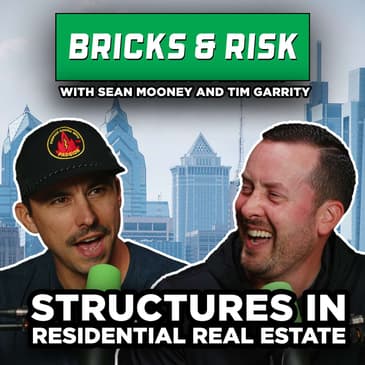
As an agent in residential real estate today, you have choices as to how you want to structure your business: solo agent, team member/leader, or brokerage owner. If you're just getting started, you'd likely start as either a solo agent or team member. If you're seasoned and productive, you could graduate to a team leader or brokerage owner. Because there are so many different ways to do it today, it's good to understand a few things upfront. What are your goals with your real estate career? Why do you want to grow? Are you better off alone or with a partner? In this ep, Sean & Tim dive into the pros and cons of all the directions you can go as an agent!
Our goal with Bricks & Risk is that you walk away with 1 or 2 valuable nuggets that help build YOUR business. Our audience grows through word of mouth, so if you would please take a moment of your time and give us a review on the platform you’re on, that would be fantastic!
Please also help spread the B&R word by sharing your favorite episode with a friend. You can find all B&R episodes on Spotify, Apple Music, YouTube, and anywhere else you get your podcast content. We greatly appreciate your time and trust.
Until next time, keep learning and keep growing!
📲 Contact Info 📲
→ Sean Mooney, Mooney Insurance Brokers: www.mooneybrokers.com/
→ Tim Garrity, The Tim Garrity Team: www.timgarrityteam.com/
💥 Watch us on YouTube 💥
→ YouTube, Bricks & Risk Podcast, @bricksandrisk: www.youtube.com/@BricksandRisk/?sub_confirmation=1
💥 Follow us on Social Media 💥
→ Instagram, Bricks & Risk Podcast, @bricksandrisk: https://www.instagram.com/bricksandrisk/
→ Instagram, Sean Mooney, @sean.moonee: https://www.instagram.com/sean.moonee/@sean.moonee
→ Instagram, Tim Garrity, @realestateinphl: https://www.instagram.com/realestateinphl/
→ Facebook: https://www.facebook.com/bricksandrisk
→ LinkedIn: https://www.linkedin.com/company/bricksandrisk
[00:00:00] When I started my own brokerage, there were so many people that went to me like, you're absolutely out of your mind.
[00:00:05] How are you going to compete with all these multi-billion dollar entities? The first example I always gave was I just said on one of our past episodes, well, as a solo agent in my last brokerage, I paid my broker X amount of dollars. And if I have my own brokerage and I have a couple partners now, I pay Y, which is less.
[00:00:27] Not only that, I now have my own company with my own brand, with my own culture, with my own staff or no staff. And I can run it as forward thinking or close minded as I want. So it just gave me and my partners, Ryan and Andrew, a lot of freedom to kind of do what we wanted, but also realize the upside of having our own company.
[00:00:52] Yeah.
[00:00:59] Welcome to the podcast dedicated to real estate insurance and building your business. Join us as we take you along our own business building journeys with additional wisdom from our network of local and national experts. Welcome to Bricks and Risk.
[00:01:21] Hey, everyone. Welcome to another episode of Bricks and Risk. I'm Timmy Garrity.
[00:01:28] And I'm Phil Dunahue.
[00:01:30] Hey, Phil.
[00:01:31] How we doing?
[00:01:31] Good. How's the talk show going?
[00:01:33] It was better in the 80s.
[00:01:36] When are Dylan and I going to be honest guests?
[00:01:38] I got you queued up for January.
[00:01:43] What are we talking about today?
[00:01:45] Today we're talking about real estate. We're going to zone in on a real estate and we're going to like...
[00:01:51] really dive into teams and solo people operators and some different ways to set them up.
[00:02:00] It's like we're almost diving into like the structure.
[00:02:03] Structure.
[00:02:03] So these are your options.
[00:02:04] Yeah.
[00:02:05] And one of our past episodes, we did go over a little bit of that.
[00:02:08] Like I was talking about, you can be a solo agent, you can be a team leader, a team member, you could be a brokerage.
[00:02:13] But today we're really going to dive into some nitty gritty.
[00:02:17] Yep.
[00:02:18] And now that we've had a lot of guests on, you've had a lot of great conversations with people.
[00:02:23] You've probably learned a lot of things along the way.
[00:02:25] I think it's going to be really great.
[00:02:28] All right.
[00:02:29] So the first one is really...
[00:02:31] Yeah, let's break them out to like define these different ways that they're structured.
[00:02:36] Let's talk about solo agent.
[00:02:37] Yeah.
[00:02:38] Solo agent, in my opinion, is probably...
[00:02:42] It was the most common way to go in real estate up until about the last, let's say, 10 years.
[00:02:48] Yeah.
[00:02:48] For decades, right?
[00:02:49] Yeah.
[00:02:49] Like this is just the way...
[00:02:50] This is what people did.
[00:02:51] It's like you got your license in the 70s, 80s, even the 2000s.
[00:02:56] You would get a real estate license.
[00:02:58] You would hang your license at a brokerage.
[00:03:01] Could be a big brokerage.
[00:03:03] Could be a small brokerage.
[00:03:04] Independent franchise.
[00:03:05] Doesn't matter.
[00:03:06] And you would go out and service clients, buyers, sellers, tenants, landlords, investors,
[00:03:11] whatever you're doing.
[00:03:12] This is all residential real estate we're talking about.
[00:03:14] So that was the traditional model.
[00:03:17] Then when teams came on the scene, if you were new in real estate, residential real estate,
[00:03:23] you could be a solo agent.
[00:03:25] You're pretty much like a team of one.
[00:03:26] Maybe you have an assistant.
[00:03:27] Maybe you don't.
[00:03:29] Or you could be a team member on someone's teams.
[00:03:32] Because a lot of real estate teams, they want new people on their team.
[00:03:37] They want them to come into their ecosystem and they want to groom them from day one.
[00:03:42] They don't want them to go out as a solo agent for like a year or five years and then
[00:03:46] join their team.
[00:03:47] Because they're like, no, you're going to get jaded.
[00:03:48] You're not going to experience this the right way.
[00:03:50] You're going to grow too slow.
[00:03:52] Whatever it is.
[00:03:52] Yeah.
[00:03:53] And we talked about that specifically with Ryan Stawas.
[00:03:57] Yeah.
[00:03:58] Absolutely.
[00:03:59] He has his team, building his team, bringing new people in.
[00:04:01] Yep.
[00:04:02] I think, so as a solo agent, I personally believe that is the best way to start in residential
[00:04:10] real estate.
[00:04:11] Even today, a lot of people would disagree with me.
[00:04:14] The reason I feel like that is the best way to start is that you're creating your own,
[00:04:20] not only personal brand.
[00:04:21] It could even just be, hey, I just want to be Tim Garrity realtor.
[00:04:24] Or you can create a brand.
[00:04:26] The brand I created in the beginning was Philly Urban Living.
[00:04:29] That was the name of my blog, my website, everything I was involved in.
[00:04:33] But you're creating your own brand day one.
[00:04:37] And then you're also starting your own book of business is the way I call it from day one.
[00:04:44] All focused on you, your name, who you are in residential real estate.
[00:04:48] Right.
[00:04:49] If you start as a team member, let's say.
[00:04:52] Let me stop you there.
[00:04:53] Yes.
[00:04:54] Solo.
[00:04:54] Let's do it.
[00:04:55] Solo.
[00:04:56] You say it's the best way to start.
[00:04:58] It's what I would recommend.
[00:05:00] Right.
[00:05:04] To the right person.
[00:05:08] Actually, it's what I would recommend for everyone.
[00:05:10] Everyone.
[00:05:10] And if I felt you out and they said, this is the way I want to do it, I'd say, then this
[00:05:16] is probably the direction of your career is you'll just get stuck.
[00:05:22] Yeah.
[00:05:22] And you won't be able to get off the wheel.
[00:05:24] Yeah.
[00:05:24] You won't be able to get off the hamster wheel, as I call it.
[00:05:26] And the reason I bring that up is because, you know, different people, different personalities,
[00:05:30] you know that there's different players, right?
[00:05:33] Different real estate professionals.
[00:05:39] And getting out of the gate as a solo operator, I would agree to you a certain extent, it's the
[00:05:48] best thing for them, but it's also the most difficult.
[00:05:52] It is.
[00:05:53] Right?
[00:05:53] Right.
[00:05:54] It's difficult.
[00:05:54] Well, here's why it's difficult.
[00:05:57] If you come in as a team member, day one, you have a, it could be even a team of three
[00:06:02] or a team of 50.
[00:06:03] It doesn't matter.
[00:06:03] You have your own little culture, your own little group, your own little support system.
[00:06:08] Yeah.
[00:06:08] Day one.
[00:06:09] Right.
[00:06:09] If you come in as a solo agent, small brokerage, independent brokerage, or a large franchise
[00:06:14] brokerage, you're kind of like, who's going to help me?
[00:06:18] Because everyone is basically 1099 and I'm their competition.
[00:06:23] Yeah.
[00:06:23] So who's going to help me?
[00:06:25] What I will say is that today, if you know where to look, if you understand, I would actually
[00:06:33] say, if you're a solo agent, I'd probably start at a large brokerage to start.
[00:06:39] I started at smaller independent brokerage to start, but I was 30.
[00:06:41] I was a little bit more seasoned, a little bit more confident.
[00:06:43] If you're like just getting into real estate, you're fresh out of college, you're in college
[00:06:47] or like a couple of different jobs, first couple of years and you're like, I'm getting into
[00:06:52] real estate.
[00:06:52] I'm 26 years old.
[00:06:53] I'd say go work for a big brokerage.
[00:06:55] Reason being the big brokerage has an ecosystem now.
[00:06:58] Yeah.
[00:06:58] They have training.
[00:06:59] Yeah.
[00:07:00] They have YouTube.
[00:07:01] They have mentors.
[00:07:03] They have opportunities for open houses.
[00:07:05] They have training for building your brand.
[00:07:07] Like they have all this now.
[00:07:09] That didn't really exist like 20 years ago.
[00:07:12] And if it did, it was a little bit more basic.
[00:07:14] It was a little bit more like, this is how you do a postcard.
[00:07:16] Yeah.
[00:07:16] Like, this is how you make a call.
[00:07:19] Like, let's role play.
[00:07:20] Let's do this.
[00:07:21] There's nothing wrong with role playing and there's nothing wrong with postcards.
[00:07:24] It's just a different avenue for your business.
[00:07:28] And you really, again, got to commit to something.
[00:07:29] Well, I feel now is too, it's like a different, when you say a different level, it's like the
[00:07:33] technology component of being a real estate or real estate person.
[00:07:38] Yeah.
[00:07:39] That really lends itself to you needing to know.
[00:07:45] You know, when that training comes in, it's like, how are you doing this?
[00:07:49] How are you doing that?
[00:07:49] And I, from what you're saying is that inside of those big box brands, inside of those teams,
[00:07:57] you're kind of given that direction when you're starting out.
[00:08:01] Yep.
[00:08:01] But in addition to that, we also know, like BAM, there's other avenues to get that information,
[00:08:11] like how to's and training tutorials.
[00:08:15] What's up, Eric?
[00:08:15] Um, so they do exist outside of that, um, from a team perspective.
[00:08:21] Yeah.
[00:08:22] And the thing is too, and the reason I would also say solo is a good way to go.
[00:08:27] You're going to have to have a little bit of direction.
[00:08:30] And I think like, let's say you get in, you're 25, you're 30 years old.
[00:08:34] Let's say it was me and I was doing it all over again.
[00:08:35] And I probably would have started somewhere large just so I had opportunities to see what
[00:08:41] they had to say that was best for me so that I could either say like, yes, let me try that.
[00:08:46] And if I don't like it, I won't do it.
[00:08:48] Or you're telling me all this, but I want to go learn about a different lane, more the relationship
[00:08:53] lane, let's call it.
[00:08:54] So is it training or is it deals or is it both?
[00:08:58] Because if I'm new and I'm more training and I'm starting out as much as I want to like
[00:09:04] get out there, shake trees, network, find people, market myself.
[00:09:11] I also would like to have some deals come my way.
[00:09:17] Yeah.
[00:09:18] And I think you've talked about it before is sitting in open houses and doing different
[00:09:21] things.
[00:09:22] Can you speak to that a little bit about what opportunities from just purely sales side and
[00:09:28] opportunities and at bats that you're going to get when you are inside that big brand,
[00:09:34] big box?
[00:09:35] Yeah.
[00:09:35] The reason I feel like a lot of people start as a team member when they're brand new now,
[00:09:40] as opposed to a solo agent is really because they think they're going to get access to deals,
[00:09:45] which they do.
[00:09:47] Leads, yeah.
[00:09:47] Leads.
[00:09:48] You might get cold leads from the team.
[00:09:50] You might get leads because they have five open houses to choose from every weekend.
[00:09:54] Not common, but it happens.
[00:09:56] Or like, hey, we're going to do this bootcamp.
[00:09:58] Or like, hey, you know, I want to, we're all going to pull our resources together and then
[00:10:02] we're all going to make calls together.
[00:10:04] And therefore it's like, eat what you kill.
[00:10:05] Like they're just throwing opportunities in front of you.
[00:10:08] Yeah.
[00:10:08] But a lot of that is built, in my opinion, off traditional cold lead generation models.
[00:10:16] And this is where, this is why the solo path, if you're going down the cold path or the warm
[00:10:21] path, let's call it, the cold path is more like you're talking to people, you're marketing
[00:10:25] to people, you're meeting people you don't know.
[00:10:28] But they cause a day.
[00:10:29] Yeah.
[00:10:29] It's, it's a numbers game.
[00:10:30] You believe in the numbers.
[00:10:32] Let's meet as many people as I can that I don't know.
[00:10:35] Some of them will turn into conversations.
[00:10:37] A portion of that will turn into clients and a portion of that will turn into close transactions.
[00:10:41] So it's numbers.
[00:10:42] But if you start solo and let's say you're at a big brokerage and you go through some of
[00:10:49] their training, you're like, I don't think like that.
[00:10:51] What I would tell you to do one, you're going to have a better split.
[00:10:54] Usually if you're solo, then if you're a team member, you got a little bit,
[00:10:57] like, even if you're doing the deals, like you're going to pay more of your money because
[00:11:01] the team's got to get fed and then the brokerage has to get fed.
[00:11:03] So you got to pay two people when you're on a team, your team leader or leaders, as well
[00:11:08] as the brokerage.
[00:11:08] So you make less per deal, but they're like, oh, I'm making less, but I always have deals.
[00:11:13] And you're just learning in a way that works for the team.
[00:11:16] It's the team's brand, it's the brokerage brand before you.
[00:11:19] If you're solo, what I would tell you is like, hey, if you're going to pay the team an extra
[00:11:22] 10,000 a year, let's call it, if you think you're going to close X amount of deals,
[00:11:26] like hire a coach, hire that coach.
[00:11:30] That's going to learn about you and what you like and where you want to go and why you
[00:11:37] want to do that and how slow or how fast you want to go.
[00:11:41] And finding that coach, spending that money there, you're investing in yourself.
[00:11:47] You're investing in your personal brand, your own education day one.
[00:11:52] Whereas if you join a team and you're like, hey, I made 50 grand my first year.
[00:11:55] That's great.
[00:11:55] You know, I made 15 grand my first year, but I probably learned so much more my first
[00:12:01] year because a lot of it was like trial and error.
[00:12:03] And it's like also the fact that I learned that it's like I worked a ton in my first year
[00:12:07] and I only made $15,000.
[00:12:09] So it's like that taught me a lot.
[00:12:11] If I just got fed and I made 50, it was like, oh, this is going exactly the way I wanted
[00:12:14] to go.
[00:12:14] I think we need to like make that a point.
[00:12:17] Right.
[00:12:18] And I think that from the outside, it's an extremely important detail that may get overlooked.
[00:12:26] Yeah.
[00:12:27] So, and if we're just talking dollars and cents and you have $10,000 set aside and you have
[00:12:36] the ability to join a team and that $10,000 goes to the team for whatever cost may be associated
[00:12:44] with being inside the team.
[00:12:48] That's, that $10,000 is going to help the team.
[00:12:54] Well, and here's to like, if you-
[00:12:56] Hold on.
[00:12:56] Okay, go ahead.
[00:12:57] $10,000 to the team to make the team better.
[00:13:01] Right.
[00:13:01] And they could spin it as this is going to lead to more deals.
[00:13:05] We're going to, more training, more marketing, right?
[00:13:09] Or you have $10,000 set aside that you're investing in yourself.
[00:13:14] Yep.
[00:13:15] To make yourself better and hiring that coach to, to, to make you a better real estate professional.
[00:13:23] Right.
[00:13:24] There's a distinct difference with where that money's going towards.
[00:13:29] Yep.
[00:13:30] And the, the net outcome, right?
[00:13:33] So this money goes in here to the team that's making the team better and you're part of the
[00:13:38] team.
[00:13:38] So you will have better opportunities and that's an advantage.
[00:13:42] But again, long-term that $10,000, $10,000 spent with a coach to, to really dial, get you
[00:13:49] dialed in to what's going to make you work the best and long-term make you the best professional
[00:13:58] possible.
[00:13:59] I mean, it's a distinct difference in investing yourself.
[00:14:02] Well, and here's one big difference about, let's call it that 10 grand.
[00:14:06] That's the example we've been using.
[00:14:08] When you pay that extra 10 grand to the team because you have a lower split and the team
[00:14:12] has to make some money, you're only paying it when you close deals.
[00:14:16] If you start day one as a solo agent, even if you had a big brokerage, let's say you go
[00:14:20] through their training for like a couple months and you're like, okay, like I want to go hire
[00:14:24] a coach and you haven't closed any business yet.
[00:14:26] Maybe you've closed the deal.
[00:14:27] Maybe you got lucky.
[00:14:28] Maybe you haven't.
[00:14:30] Now you're like, now I have to spend 800 to a thousand a month to hopefully have a good
[00:14:37] coach to hopefully learn how to do this right and go down that path.
[00:14:42] So it's a financial investment in yourself that you have to make with no promise of getting it back.
[00:14:49] Whereas the team is, it's easier.
[00:14:50] It's instant gratification.
[00:14:51] You walk into the team.
[00:14:52] You're financing that.
[00:14:53] Yeah.
[00:14:53] You walk into the team day one, there's culture, there's activity.
[00:14:56] We go into the office three days a week, come in the office, we go out to lunch, we hang out,
[00:15:00] we go to happy hour.
[00:15:01] Like you're, you're in this culture, in this little ecosystem with like a lot of camaraderie
[00:15:05] and there's a lot of value in that.
[00:15:07] Yeah.
[00:15:09] Unfortunately, that's more to the benefit of the team and the brokerage than it is to you
[00:15:12] as the agent.
[00:15:13] And I know a lot of podcasts talk about like start as a team member, like you'll get business,
[00:15:18] like you'll get good at it.
[00:15:19] Yeah.
[00:15:19] But are you learning the way you really want to learn?
[00:15:23] Or are you just like, okay, I'm making some money.
[00:15:25] I've done some deals.
[00:15:27] And, and again, you're going to learn what's best for the team in those first couple of
[00:15:32] years, which may not be what's best for you.
[00:15:35] It reminds me of an early on episode when we were talking about it and we, the, the topic
[00:15:42] was like coming to a new town and having to start from scratch or rather than being a
[00:15:49] salesperson or a real estate person coming back to somewhere where you live.
[00:15:53] Yeah.
[00:15:53] Right.
[00:15:54] And I said that it's going to be better for you to live somewhere else because you have
[00:16:01] to learn.
[00:16:02] You're forced to figure it out.
[00:16:03] You have to train yourself.
[00:16:04] You're not relying on hitting the low hanging fruit.
[00:16:08] Right.
[00:16:09] Because that's really not making you better.
[00:16:11] Yep.
[00:16:11] It's just, you know, you're getting deals and it's easy, but, but you're not developing
[00:16:17] the strategies to succeed in this profession.
[00:16:21] Yeah.
[00:16:22] No, I agree.
[00:16:23] Let's go over some of the pros and cons real quick of solo.
[00:16:25] Yeah.
[00:16:26] A couple of the pros.
[00:16:27] You have no boss or team members.
[00:16:28] So no one's telling you what to do or how you should structure your day, which is a pro.
[00:16:32] You call the shots.
[00:16:34] Yep.
[00:16:34] And you can make a lot of money.
[00:16:36] You can make more money being solo than you can being a team member.
[00:16:39] Yep.
[00:16:39] Because if all things equally close the same amount of business, you're going to walk away
[00:16:42] with more dollars.
[00:16:44] Some of the cons, no one to bounce things off of and hard to scale because you're not,
[00:16:51] you're not really sure what you're doing.
[00:16:53] Like, when do I hire an assistant?
[00:16:54] Do I ever hire an assistant?
[00:16:56] Do I need a marketing person?
[00:16:57] That's the question I had was, so teams weren't really relevant, you know, 10 years ago, right?
[00:17:04] What were those solo operators?
[00:17:06] How did they exist and how did they do so many deals if there wasn't a team put around
[00:17:14] them?
[00:17:15] What happened?
[00:17:16] Again, I've only been in residential real estate for 15 years, but I've seen a big shift
[00:17:20] in 15 years.
[00:17:21] 15 years ago when I got in, it was the brokerage that you worked for was very important.
[00:17:26] Oh, you want to work for this brokerage because of this reason or this office because of this
[00:17:31] reason.
[00:17:32] And then there was, you know, because it was back then, it's like they still had floor
[00:17:35] time.
[00:17:36] You're like, oh, I get to go into the office every Saturday for four hours and any call
[00:17:42] that comes in, I answer, that's my lead.
[00:17:45] So the brokerage was feeding you opportunities.
[00:17:48] What happened over time as the model changed and other brokerages, it was probably more in
[00:17:55] the pioneering of like Keller Williams, where they would say, we want to give more money
[00:17:58] back to the agent, we want to give them a higher split.
[00:18:01] They would put more on the agent.
[00:18:04] They would say, we don't do floor time.
[00:18:06] You want leads?
[00:18:08] Go buy them.
[00:18:09] You want to make more money?
[00:18:11] Go start a team.
[00:18:12] Like they would put the ownership on the agent and then the agents would turn into their own
[00:18:18] little ecosystem, which is how teams came to be.
[00:18:21] So it used to be the brokerage was more responsible for like lead gen training, this and that, but
[00:18:27] they would take a lot more.
[00:18:28] That's why it used to be like a 50, 50 split.
[00:18:31] If you started in real estate, you would keep 50.
[00:18:33] The house would keep 50.
[00:18:35] Now it's like a lot of the brokerages is like, it's like 80, 20.
[00:18:38] Yeah.
[00:18:38] Like you keep 80, we only keep 20, but they put a lot more on you.
[00:18:42] So now is the agent.
[00:18:43] But they're also not spending as much to go market.
[00:18:46] And they get rid of the responsibility.
[00:18:48] Yeah.
[00:18:49] Like if you're not successful, that's on you.
[00:18:50] That's not on me.
[00:18:51] Yeah.
[00:18:51] So it's really interesting.
[00:18:53] All right.
[00:18:54] So let's talk about like teams.
[00:18:58] So the team model took off because it allowed people to build their own business without
[00:19:05] physically starting a brokerage.
[00:19:07] It was an advantage.
[00:19:08] It's almost like they get some tools and some support and some knowledge and some training
[00:19:15] to have their own like LLC or their own S corp as a team.
[00:19:20] And then again, all the money goes back to them.
[00:19:24] Now they have to spend for marketing.
[00:19:25] They have to spend for this or that and the other thing, but they have people helping them.
[00:19:29] It's almost like if I had to like put it and you can do it better.
[00:19:34] Like if you start an all state office, let's say versus Moody Insurance Brokers, the all
[00:19:39] state office is giving you some things to like have a headstart.
[00:19:42] Yep.
[00:19:42] Maybe a book of business.
[00:19:43] They're giving you that or like they're giving money.
[00:19:46] Yeah.
[00:19:46] Your marketing material.
[00:19:48] Yep.
[00:19:48] You know, they, they save you time.
[00:19:49] Yep.
[00:19:50] So having a team under a brokerage saves you time.
[00:19:54] Some of it's done by them and some of it's done by you.
[00:19:57] So I think teams started proliferating because one, they could kind of have their own brand,
[00:20:01] their own identity within the brokerage, but the brokerage took some of the work, some
[00:20:06] of the accounting, the payroll, the marketing, the training, you know, the auditing.
[00:20:10] Like these were all things that we did at Copper Hill ourselves.
[00:20:15] And it took a ton of time and it took staff.
[00:20:16] Like you need people to do those things.
[00:20:19] But you need to be a successful agent to start a team, correct?
[00:20:22] You do and you don't.
[00:20:24] You could be a successful leader and just know how to lead and you can pay for it.
[00:20:31] Maybe you're great at marketing.
[00:20:32] Maybe you're great at content.
[00:20:34] Maybe you're just inspirational and people just want to follow you.
[00:20:37] And you were never that great of an agent, but you know how to bring opportunities through
[00:20:42] the door.
[00:20:43] And then you're like, let them service the leads.
[00:20:45] Let them call.
[00:20:46] I'll tell them the script.
[00:20:47] Like, cause this is what I learned or this is what my coach is telling me or my training
[00:20:51] tells me.
[00:20:52] And then I'll just lead them to success.
[00:20:55] And I get little rips of everything they do.
[00:20:57] You know what?
[00:20:57] It's funny.
[00:20:58] It's almost like, I think like, what if you had, um, an Instagram channel that was like
[00:21:04] super popular and you're, you're almost like viral in a sense.
[00:21:09] You mean like Brexit risk?
[00:21:10] Yeah.
[00:21:11] Um, very similar.
[00:21:13] Um, but then you got all these leads coming in.
[00:21:16] You really wouldn't need to be a good realtor, uh, to, to transact the business.
[00:21:21] You wouldn't need to go find it.
[00:21:22] It's kind of coming to you.
[00:21:23] You could really then, it wouldn't matter.
[00:21:26] You know, you'd have the, uh, the business coming in and then you could just hand off,
[00:21:30] uh, the leads to your team.
[00:21:33] Hey everyone.
[00:21:34] This is Tim, your favorite bricks and risk co-host, but don't tell Sean.
[00:21:39] I hope you're enjoying this episode and I'll get right back to it in a moment.
[00:21:43] Our audience grows through word of mouth.
[00:21:46] So if you would please take a moment of your time and give us a review on the platform
[00:21:50] you're on, that would be fantastic.
[00:21:53] Please also help spread the BNR word by sharing your favorite episode with a friend.
[00:21:58] We greatly appreciate your time and trust.
[00:22:01] Now back to the show.
[00:22:07] Yeah.
[00:22:08] So it's like some teams have formed out of necessity.
[00:22:10] So like, let's talk about, uh, Mike McCann.
[00:22:13] What's up, Mike?
[00:22:14] Hey Mike.
[00:22:14] One of the best episodes we've done interviews.
[00:22:18] Mike's team grew because there weren't enough hours in the day.
[00:22:21] Yeah.
[00:22:21] He was just out there hustling, meeting people, giving great customer service.
[00:22:25] And then he would get referrals.
[00:22:26] Plus he was like marketing himself properly.
[00:22:29] And then he always had his own administrative help, his own operational support so that he
[00:22:34] could grow as an agent.
[00:22:35] And then what happened over time, he's like, if I don't put someone under me to service these
[00:22:40] people, that business is going to go to someone else.
[00:22:43] There's just not enough hour and hours during the week to service all of these inbound calls.
[00:22:49] So he drummed up all the business himself and then built his team because he couldn't
[00:22:55] service all of them.
[00:22:56] Yeah.
[00:22:56] There's other people that start teams because they're, like I said, they're excellent marketers.
[00:23:00] Maybe they're influencers.
[00:23:01] Yeah.
[00:23:02] Whether it's on social media, YouTube, a website, a TV show, a radio show, whatever,
[00:23:06] you're influential.
[00:23:07] Yeah.
[00:23:07] If you're an influencer, people might follow you because they're just, they're into what
[00:23:13] you're preaching, what you're teaching, what you're willing to share and what you want
[00:23:17] to show them. And those type of people can grow teams and never really even be that good
[00:23:22] of an agent. So that's just a different way. And there's nothing wrong with that at all.
[00:23:26] There's people who get into real estate, you know, back in the day, let's call it like in
[00:23:30] the nineties, early two thousands, they realized they weren't that great of a real estate agent,
[00:23:35] but they were, they could manage people.
[00:23:37] Yeah.
[00:23:38] So I'm going to be the office manager. I'm going to get a salary. I'm not going to practice
[00:23:41] anymore. I've practiced as an agent. So I know the game.
[00:23:45] Yeah.
[00:23:45] And then I'm going to make sure my troops are either inspired that they understand things,
[00:23:50] I answer their questions. You know, I give them one-on-one time. I give them group training.
[00:23:54] I put opportunities in front of them. As some of those big franchises grew 20, 30 years ago,
[00:24:01] that's how they would grow. They'd find the people who wanted to be like the office manager.
[00:24:04] They couldn't even practice. It'd be like, you can't, you can't work with buyers and sales
[00:24:08] anymore. Your job is to collect a salary from this company and lead the agents in the office.
[00:24:14] So that's like an example of, again, when the brokerage was more important to the agent's
[00:24:19] success that they had, that was the structure of the office. That was why it was 50, 50 or 60, 40.
[00:24:24] There's an attorney I know downtown and he claims to be like the worst litigator ever,
[00:24:31] but he's super successful. He knows like how to build the office. He knows like what to look for
[00:24:37] in, you know, good attorneys, connections. He knows how to drive business.
[00:24:42] He's a good manager.
[00:24:43] Yeah.
[00:24:43] He's not good with clients.
[00:24:44] So same kind of thing.
[00:24:45] Yeah.
[00:24:46] All right. So some of the pros and cons of a team. So some of the pros are, you know,
[00:24:51] you get the culture and the camaraderie. You get shared leads, expenses, and staff,
[00:24:55] which could be huge, especially if you're brand new. And you can grow as big or even bigger
[00:25:01] than a brokerage without all the headaches of the brokerage. So there's, there's advantages to
[00:25:08] starting a team. Some of the cons, I think one of the biggest cons of starting a team is you're
[00:25:13] probably going to have to shift brokerages every three, five, seven years because you're just going
[00:25:18] to have to go exert your leverage. Oh, we did 10 million five years ago in volume. Now we're doing
[00:25:24] 30 million today. And we want to go up to a hundred million five years from now. Like you're going
[00:25:31] to go out and exert your, say like, look, here's my history and here's where I'm going and why.
[00:25:36] So that the brokerages want you on their team. Sometimes they're even writing checks. Like big
[00:25:40] brokerages have written checks in the last like three to five years to bring agents or teams to
[00:25:46] their brokerage to say like, look, we're growing. This team just joined us because we're the best
[00:25:51] brokerage ever. Like that's helping that brokerage grow. So one downside is as much as, you know,
[00:25:57] you're maybe getting more as a team by shifting, you got to go figure it all out again. Cause I
[00:26:02] heard a new brokerage, it's just like all your email stuff is different. All your shared stuff
[00:26:05] is different. Your marketing is that you need new signs. You need, you know, new mentors,
[00:26:09] like whatever it is. Um, so that's a downside. Um, team members and employees can take away from
[00:26:15] your income. So if you're a team member, again, the team leader or leaders have to get paid as well
[00:26:20] as the brokerage. It might be giving away more of your commission. Um, and then also like scaling is hard.
[00:26:26] So that's a downside. Like you might start a team and think like, this is my path. Yeah. But then
[00:26:31] you start doing it. You're like, this is really tough. Yeah. How do I do this? It's, this isn't
[00:26:35] going, I had five team members. Now I'm back down to one. Then I have 18 members and back down to
[00:26:40] three. And then I have 15 and I'm back down to five. Like scaling, you know, as well as I know,
[00:26:46] scaling in business is hard. And that's, that's a downside to having a team.
[00:26:49] Well, the team too, the one point I wanted to make was with the teams, I guess that's really good
[00:26:55] for the brokerage. Yeah, it is. Because you're really tying those members of the team to the
[00:27:04] brokerage, right? So if I'm a brokerage, I'd rather have teams for a variety of reasons than a
[00:27:13] bunch of solo. Well, with a team, you know, usually dealing with like one or a couple team leaders,
[00:27:19] co-team leaders, and they account for a lot of your volume. Yeah. So maybe you only have like one or
[00:27:24] two people that are accounting for like 25% of your volume. Right. So the brokerage likes that.
[00:27:29] Plus they put a lot of the responsibility on the team leaders. Right. And they're like,
[00:27:33] ah, the reason you're getting that split, the reason you have that nice corner office
[00:27:37] is because I gave that to you, but the leads are on you. The oversight's on you. I'm not going to do
[00:27:43] much, you know, I'll help you out here and there, but they don't do what the brokerages did 20 years
[00:27:47] ago or 30 years ago where they did everything. Now they do a lot less. It's the reason there's so
[00:27:51] many different brokerage options today because they're just structuring their company differently.
[00:27:56] That usually is more team forward. Yeah. So yeah. So team leaders like it because they can have their
[00:28:02] own business and brokerages like it because it's less for them to do. Yeah. They control a lot of
[00:28:05] volume. All right. So let's go to the last one, a brokerage. When I started my own brokerage,
[00:28:13] there were so many people that went to me and like, you're absolutely out of your mind. Insane.
[00:28:18] How are you going to compete with all these multi-billion dollar entities? And the way I,
[00:28:24] the first example I always gave was I just said on one of our past episodes,
[00:28:30] well, as a solo agent, my last brokerage, I paid my broker X amount of dollars. And if I have my own
[00:28:37] brokers and I have a couple of partners now, I pay Y, which is less. Not only that, I now have my own
[00:28:42] company with my own brand, with my own culture, with my own staff or no staff, and I can run it as
[00:28:51] forward thinking or close minded as I want. So it just gave, it gave me and my partners, Ryan and
[00:28:58] Andrew, a lot of freedom to kind of do what we wanted, but also realize the upside of having our own
[00:29:05] company. Now, what did we trade for that? We really, well, we traded our time for sure.
[00:29:12] And obviously putting that money out in the beginning, it's almost going back to the solo
[00:29:16] example. Like you put that money out for that coach, there's no, there's no guarantee you're
[00:29:19] going to get it back. If that coach stinks or what if you get out of real estate? You might not
[00:29:23] get it back. So a brokerage is hard, but it was, it was, it was a really good way for us
[00:29:30] to want to build an asset. And that's, that's kind of why we did it. It was like all the benefits of a
[00:29:37] team while still being in charge. So is that, uh, what year did that start?
[00:29:43] Uh, the brokerage started in 2014.
[00:29:46] So if you, uh, had the opportunity to do it again today, like there was no,
[00:29:55] Copper Hill never existed. Yep. Right. And so you're, you know, a couple of years into your
[00:30:01] real estate career. Do you think today in 2024 that, um, you would go that route? Like, how would
[00:30:11] you kind of like do your thing in 2024? Like hindsight? Yeah. Like if you were to go back,
[00:30:19] um, when you started and kind of just fast forwarded to this year, um, and had the, you know,
[00:30:28] people and ability and everything having lined up, would you have done or would you do that?
[00:30:36] Or are the opportunities in the way that these brokerages are structured that much different
[00:30:42] that, you know, you would do it this way?
[00:30:45] Honestly, looking back, like hindsight is always 2020, but looking back, if I knew now what I knew
[00:30:52] again, back then, I would have probably started a team.
[00:30:56] Team.
[00:30:56] But again, that's, you know, teams in 2024 are way different than they were in 2014.
[00:31:03] So back then the smarter option for us. Yeah.
[00:31:07] Was in building a brokerage. Right.
[00:31:09] It gave us financial advantages. It gave us branding advantages. It gave us lots of advantages.
[00:31:14] Yeah. Um, and we, we developed different companies from there. Like we developed a,
[00:31:20] we started a development company where we flip homes and buy buildings. Yeah.
[00:31:23] Started a joint venture at a title company where we could realize income from having that relationship.
[00:31:30] And back then you couldn't really do those things if you were a team. Now teams hold a lot of leverage,
[00:31:37] a lot of power. So you can do those things. And just, I feel like just people are more educated now,
[00:31:44] like in the structure of teams and like the legalities, like the ease of starting businesses now,
[00:31:50] like starting an LLC, starting an S corp. It wasn't that easy 10, 15 years ago.
[00:31:55] Yeah. Like there was just more legwork. It was like super expensive. Now things are just,
[00:31:59] the technology is better quicker. Quicker. So yeah. I mean, having a team today,
[00:32:04] would I have just started one back then? I probably would have. Um, but I'm so glad I did what I did.
[00:32:11] Well, you would need to take the team model of today to go back there and then do it then. So
[00:32:14] like apples and oranges. Yeah.
[00:32:16] Yeah. So I would probably look at it as like, if I started going down that path then and stuck with
[00:32:23] that, it may have been a little bit of a better path, maybe a little bit, but I wouldn't know
[00:32:29] most of the stuff I know today if I did that. Yeah.
[00:32:32] Because again, I'd be working for like most likely a larger brokerage. Yeah.
[00:32:36] I'm only going to learn so much about the inner workings, about branding, about all sorts of things.
[00:32:41] So when the partnership ended at Copper Hill and me starting my own residential real estate team
[00:32:46] at Real, the Tim Garrity team, um, I just have so much knowledge now by going through that journey.
[00:32:53] So I would never take that part of my journey away. Yeah, sure. Like it was, it was huge.
[00:32:57] Just from, yeah, it was a good question. Um, all right. So some of the pros,
[00:33:02] let's look at some of the pros of, uh, having your own brokerage. Number one is freedom. It's
[00:33:07] your company. It's your role, which is huge. It's a great way to wake up every day. It can also be
[00:33:13] a con, but I will say it's, it's a pretty awesome way to run your business and not really have to
[00:33:20] answer to anyone. Um, what I also like about the brokers is you can go real lean like we did in the
[00:33:27] beginning. You can go big. You can say, all right, let's go get 10,000 square feet day one and just grow
[00:33:32] like this massive office with like 500 people. That's what we want to do. Yeah. Uh, or you can just go
[00:33:37] status quo. Like you can just say, yeah, I'm just going to go low and slow. I'm not going to go
[00:33:40] cheap. I'm not going to go expensive. I'm going to go right in the middle. Um, so again, that's a
[00:33:46] pro you have choices. No one's telling you how to do it. And you have to do it this way. Exactly.
[00:33:51] Yeah. And then I'd say the subsidiary opportunities are probably one of the biggest pros. You can really
[00:33:57] structure partnerships and other opportunities and not have to ask for permission. Yeah. Like you can
[00:34:03] do whatever you want. If you're at a big brokerage in your team, there's some things that are going to
[00:34:08] be a conflict to that big brokerage, to their liability, to their business model. Maybe they
[00:34:14] have mortgage, maybe they're, they have title. Maybe they don't want you to do development.
[00:34:19] Cause they're like, that's a liability to us. I actually just talked to an insurance guy who,
[00:34:23] um, I think he worked for a carrier. Okay. And so he was like, you know, corporate carrier gig,
[00:34:31] maybe a marketing rep or something like that. And, uh, he took a new job, which was totally
[00:34:37] different, uh, with a different carrier doing a different, um, product. So like totally
[00:34:43] different silo. Right. And, and he reached out because he said, I'm trying to do this different,
[00:34:51] uh, commercial insurance marketing campaign, but I can't do it because, uh, I can't do it in the
[00:34:58] state of Kentucky. So now I'm reaching out to other agents outside of Kentucky and I'm like,
[00:35:05] it doesn't even make sense. Why? Because like a non-compete or something was so strict.
[00:35:11] Yeah. But everything had to be, you know, signed off by the, the mothership.
[00:35:16] Well, you had asked me one time, you're like, what are like, you know, is that like a disadvantage?
[00:35:20] Like, is the broker's really going to tell you how to run your business? The answer is yes.
[00:35:23] Oh yeah. And mostly because it wants to maintain their brand in a certain way and they want to keep
[00:35:30] their liability down. Yeah. So in order for them, if they just say, go do whatever you want, this is
[00:35:36] the wild, wild West, like take what, eat what you kill and do whatever. And you make some wrong moves,
[00:35:42] it could blow back on them. And therefore they're going to be like, we don't want that. It's not
[00:35:46] worth it. We don't want that to happen anymore. So they will tell you what you can and can't do
[00:35:50] for sure. Some of the, some of the cons, the closest one out, it's a ton of work.
[00:35:56] Ton.
[00:35:57] I mean, I went through this for almost 10 years.
[00:36:01] Yeah.
[00:36:02] It is so much work and I had two partners and it was still a ton of work. You're doing it again,
[00:36:08] yourself. It's, you just have to do so much work.
[00:36:14] So how much of your time was doing real estate when you were at your peak with Copper Hill?
[00:36:20] I think what changed is our first about four to five years, we were still eating what we killed.
[00:36:27] Doing deals.
[00:36:27] So we're just like, let's just go do deals and then we'll grow the company when we have spare time.
[00:36:32] Right.
[00:36:33] And people would just come in naturally, which they did. It was great.
[00:36:37] We transitioned from working in the business to working on the business.
[00:36:41] Yep.
[00:36:41] Then we salaried ourselves.
[00:36:43] Yeah.
[00:36:43] And we said, Hey, we've got to practice less. We got to build the business more.
[00:36:48] And again, like hindsight is 20, 20. I would have structured that differently.
[00:36:55] Yeah.
[00:36:55] I think we just said, I, we can do this. Let's go do these things.
[00:36:59] A lot of that was COVID because COVID changed a lot.
[00:37:01] Yeah.
[00:37:02] Um, but I don't want to make an excuse. It was really, I think we tried to grow it a little
[00:37:09] too quickly. And we thought if we were working on the business for most of our time, it would just
[00:37:13] grow to this level.
[00:37:15] Yeah.
[00:37:15] Which we realized was extremely difficult. So I would say like a ton of work is, is the biggest
[00:37:23] time. It takes so much time.
[00:37:25] Yep.
[00:37:26] Um, virtual brokerages are a big model today in residential real estate.
[00:37:31] Right. EXP and real. I'm associated with real just so everyone knows.
[00:37:35] Full disclosure.
[00:37:36] Full disclosure.
[00:37:37] Dylan, get that on the...
[00:37:38] Yeah.
[00:37:39] I'm associated with real broker.
[00:37:40] I'm not a lawyer.
[00:37:42] And I'm not an attorney. We've already talked about that before. 1995 style scrolling.
[00:37:47] Um, the virtual model really has taken advantage of technology. They realize the office is way
[00:37:55] less important today than it was even five years ago, 10 years ago, 15 years ago. So they've taken
[00:38:02] that out of their playbook. Yeah.
[00:38:04] They technology, zoom technology, zoom training, uh, zoom events, you know, like we don't need to put
[00:38:11] all these offices and staff and all these marketing people in place all over each state and every
[00:38:17] state of the country. We can have a centralized core of staff, support, marketing, training,
[00:38:24] accounting, you know, payroll. So teams thrive in that because teams take a lot of work on
[00:38:32] themselves. So if they go with more of a virtual model, the reason that's becoming so popular is
[00:38:37] it just gives them a leaner, more efficient ecosystem to work within to run their team, which
[00:38:43] puts more money in their pocket, which allows them to have more control. Well, it's also giving
[00:38:47] specific agents that want that type of setup. Exactly. That opportunity. It's like they can
[00:38:55] almost have their own brokerage. It feels like without starting their own brokerage. Yeah.
[00:39:00] And the, you know, the virtual models offer that it's why they're becoming so popular.
[00:39:05] And then the last con I would say of, you know, owning a brokerage is agents are going to come and go.
[00:39:10] But again, if you have an office and you have staff and you have a marketing budget and your agents come
[00:39:16] and go, like the hard times are harder. If you're a team, let's say, and agents come and go, your
[00:39:23] brokerage is shouldering the staff, some of that burden, the office, whatever it is. Like, so the
[00:39:29] shared expenses, I think of the team model make that less of a concern.
[00:39:34] Well, I think with a brokerage too, is you, you have your current structure of agents for your
[00:39:40] brokerage and, you know, maybe you go sign a lease for this big space or you're signed into this,
[00:39:47] which we did sign into this marketing program or whatever it may be. And then that big team leaves
[00:39:55] the brokerage. Right. I've experienced that. Yeah. I can, I mean, it can really turn here,
[00:40:02] get you all twisted because you're like, Oh, we're projected out as this. We're locked into this.
[00:40:07] Oh my God, this, everything just changed. It's like the highs are high and the lows are low. Yeah.
[00:40:12] So it's, again, you have to, it was just the episode on commitment. Like you have to just be
[00:40:17] so committed through the, through the valleys. You're going to have these peaks, but you're going
[00:40:21] to have these, these big valleys where it's like, you're losing money or like we're losing volume.
[00:40:28] Where it's like, we're meeting with people. No one wants to do anything. We're recruiting.
[00:40:33] You're almost like, you're almost forcing it a little bit. Yeah. Which is hard. Yeah. You know,
[00:40:38] you can run it much more lean or efficient these days with a team and especially with a virtual
[00:40:42] model in my opinion. Yeah. Where it's just, you can really pivot and adapt. If people come and go,
[00:40:48] it's not as big of a deal. Yeah. And he can still run it any which way you want. Yeah.
[00:40:53] So why don't you close this out? All right. Anyone who enjoys our content here and wants to
[00:41:00] reach out to the show, you can email us at bricksandrisk at gmail.com. You can go leave a
[00:41:07] review on Apple, Spotify. They're very helpful and we'll get you a review read on the show and
[00:41:18] DMs. Instagram. Yep. We've read, we've read some DMs. And LinkedIn. We got a nice community
[00:41:25] in LinkedIn. So if you're on there and you use that for work business, shout us out,
[00:41:30] check it out. We post videos. Yeah. Our LinkedIn page is under bricks and risk.
[00:41:35] Bricks and risks. Awesome. Well, that's all we have for this one, folks. Thank you for tuning in
[00:41:41] again to another episode of bricks and risk. See you soon. Thank you for joining us on another
[00:41:48] episode of bricks and risk. Our goal is that you walk away with one or two valuable nuggets.
[00:41:54] And we greatly appreciate you sharing your time with us today. You can find all BNR episodes on
[00:42:01] Spotify, Apple music, YouTube, and anywhere else you get your podcast content until next time.
[00:42:08] Keep learning and keep growing.