
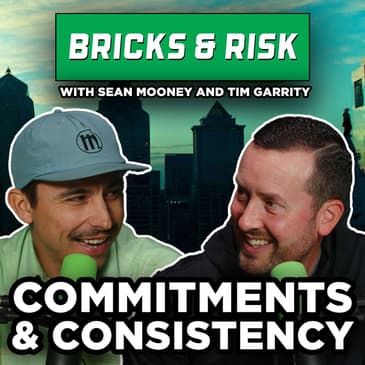
Being committed in business may quite possibly be the most important key to success. Reason being, if you never give up, you'll continue to grow in different ways: income, personally, client base, company size, etc. But, the second you take your foot off the gas and start slumping back in your chair is the moment where it can be lost. Dig into this one, as Sean & Tim talk about the ways they have been consistent in their businesses and lives, and continue to follow that mantra today!
Our goal with Bricks & Risk is that you walk away with 1 or 2 valuable nuggets that help build YOUR business. Our audience grows through word of mouth, so if you would please take a moment of your time and give us a review on the platform you’re on, that would be fantastic!
Please also help spread the B&R word by sharing your favorite episode with a friend. You can find all B&R episodes on Spotify, Apple Music, YouTube, and anywhere else you get your podcast content. We greatly appreciate your time and trust.
Until next time, keep learning and keep growing!
📲 Contact Info 📲
→ Sean Mooney, Mooney Insurance Brokers: www.mooneybrokers.com/
→ Tim Garrity, The Tim Garrity Team: www.timgarrityteam.com/
💥 Watch us on YouTube 💥
→ YouTube, Bricks & Risk Podcast, @bricksandrisk: www.youtube.com/@BricksandRisk/?sub_confirmation=1
💥 Follow us on Social Media 💥
→ Instagram, Bricks & Risk Podcast, @bricksandrisk: https://www.instagram.com/bricksandrisk/
→ Instagram, Sean Mooney, @sean.moonee: https://www.instagram.com/sean.moonee/@sean.moonee
→ Instagram, Tim Garrity, @realestateinphl: https://www.instagram.com/realestateinphl/
→ Facebook: https://www.facebook.com/bricksandrisk
→ LinkedIn: https://www.linkedin.com/company/bricksandrisk
[00:00:00] If I want to consistently make good money in real estate and do this for the rest of my life, you have to be thinking like the marathon runner, not the person sprinting in the Olympics. Now again, if you're a professional sprinter or sprinting in the Olympics, there's a ton of time and work that goes into it just for that 10 second race, let's call it.
[00:00:20] But if you want to do something like insurance, like real estate for the rest of your career, you have to look at it that everything I do day in, day out, week in, week out, month in, month out, quarterly, annually is for that long term gain.
[00:00:39] And part of the reason we talk about relationships so much is relationships are commitments personally and professionally and a lot of times the personal professional just come together over time because that's just how you handle yourself. That's how you look at life.
[00:00:59] Welcome to the podcast dedicated to real estate insurance and building your business.
[00:01:05] Join us as we take you along our own business building journeys with additional wisdom from our network of local and national experts. Welcome to Bricks and Risk.
[00:01:21] Hey everyone, welcome to another episode of Bricks and Risk.
[00:01:26] I'm Timothy Michael James Garrity the first.
[00:01:30] And I'm Sean Mooney.
[00:01:31] James was my confirmation name.
[00:01:34] Oh, you did confirmation?
[00:01:35] In case you were wondering.
[00:01:36] I had to repeat confirmation.
[00:01:37] I failed the first time.
[00:01:39] They're like, that's not a saint.
[00:01:40] We don't want that name.
[00:01:41] Fun fact.
[00:01:42] I also did not graduate from our DARE program in grade school.
[00:01:46] From what?
[00:01:48] The DARE program.
[00:01:49] So like the cops come to your school and they, yeah, I failed.
[00:01:53] Like literally legitimately failed.
[00:01:54] How do you fail DARE when you're like 10?
[00:01:56] I don't remember all the details.
[00:01:57] I just remember everybody got a certificate except me.
[00:01:59] They're like, congratulations on your completion except Sean.
[00:02:03] That's the only one.
[00:02:04] Yeah, I was the only one in the class that didn't get a certificate.
[00:02:07] That explains a lot.
[00:02:09] And here we are.
[00:02:10] All right.
[00:02:11] What are we getting into today?
[00:02:13] Today we are going to talk about being committed.
[00:02:17] Ooh, like relationships?
[00:02:21] Like this podcast and how we are committed to the podcast and podcasting.
[00:02:27] Yes.
[00:02:28] And we will podcast together until death do us part.
[00:02:34] Until we die.
[00:02:35] That's the rule.
[00:02:36] All right, dude, let's actually, that's a really good thing.
[00:02:40] I know we have, we have bullets, not the death do us part.
[00:02:43] We have bullets here.
[00:02:44] I know I came up with that on my own.
[00:02:46] I know you did.
[00:02:48] Um, let's talk about commitment from a podcast standpoint.
[00:02:54] Cause again, we could start there.
[00:02:56] We, you know, both married.
[00:02:58] We're both parents.
[00:03:00] We run businesses and we started a podcast about a year ago, a little less than a year
[00:03:06] ago is the first time we got in the studio.
[00:03:08] Yeah.
[00:03:08] We build up our content for the first, you know, five to six months to get good and also
[00:03:15] bank a lot of content.
[00:03:16] So we felt confident about moving forward and saying, Hey, if we need to take a month off
[00:03:21] or like, you know, if we're, if we're not coming up with guests or topics as fast as we
[00:03:26] would like to, we always have a few months to fall back on.
[00:03:28] Right.
[00:03:28] Let's talk about commitment from a podcasting standpoint.
[00:03:31] Like, give me your take on the, on the commitment involved.
[00:03:34] Uh, on a lot of different levels, uh, commitment is absolutely necessary.
[00:03:40] Besides the bands that, that we bought for each other just to say, yeah, we're committed.
[00:03:45] Right.
[00:03:45] Okay.
[00:03:47] Um, listen, you, when you get into this, you have to have a commitment mindset.
[00:03:54] Totally.
[00:03:55] You, you need to, and it can't be, I'm going to commit for a month.
[00:03:59] A month or two or three.
[00:04:01] Yep.
[00:04:02] Because the podcast platform doesn't allow you to see real results in, in a short period
[00:04:11] of time.
[00:04:11] You can't mail it in.
[00:04:12] So as a platform, it requires, it's actually the perfect platform when speaking about being
[00:04:20] committed.
[00:04:20] It's true.
[00:04:21] Because number one, you're not going to see tremendous gains immediately.
[00:04:26] Mm-hmm.
[00:04:26] So you need to be committed to kind of push through that.
[00:04:30] And there also is a requirement of being committed on a schedule.
[00:04:35] Yep.
[00:04:36] We have to schedule our times.
[00:04:40] We have to do it on a weekly, monthly basis.
[00:04:44] Yep.
[00:04:45] And staying consistent.
[00:04:46] So I think all of those different ingredients really come together when we're talking about
[00:04:53] being committed for the podcast.
[00:04:58] All right.
[00:04:59] So here's, that's really awesome.
[00:05:00] I appreciate you going through all that.
[00:05:02] Here's another way to look at it.
[00:05:04] So with commitment in general, commitment helps you stick to your goals during the good
[00:05:10] times as well as the bad times.
[00:05:13] Yeah.
[00:05:14] Which again, applies to our businesses.
[00:05:15] Again, relationships, marriage, parenthood, like this is hard.
[00:05:19] There's ups and downs.
[00:05:19] There's peaks and valleys as I like to call it.
[00:05:22] But in podcasting, here's an interesting thing about podcasting.
[00:05:26] Like you can DIY it.
[00:05:28] You can spend very little money and just say, we're just going to set up a camera.
[00:05:32] We're going to get cheap mics.
[00:05:33] Don't even need a camera.
[00:05:34] We're going to do technically.
[00:05:36] Yeah.
[00:05:36] We're going to set up our phone.
[00:05:38] Yep.
[00:05:38] We don't even need mics.
[00:05:40] Nope.
[00:05:40] And we're just going to clip it together.
[00:05:43] There's plenty of tech apps, AI.
[00:05:45] There's all sorts of things that you just throw the podcast content into and it spits
[00:05:49] out a bunch of stuff.
[00:05:51] That's a good one where you can basically buy an AI bot to host a podcast for you.
[00:05:57] I believe that.
[00:05:58] Yeah.
[00:05:59] And yet, the way we do it-
[00:06:02] A little different.
[00:06:03] It's different.
[00:06:03] And again, we talk to, we have guests, we're networking for our businesses.
[00:06:08] We have family, we have friends.
[00:06:10] We talk, people are like, it's really good.
[00:06:12] What's the one thing, the one compliment that you have gotten, which is the same that I've
[00:06:16] gotten since we started that consistently comes to both you and I?
[00:06:22] My hats.
[00:06:23] I mean-
[00:06:25] A lot of compliments on my hats.
[00:06:27] No.
[00:06:27] Aside from the hats and the shirts.
[00:06:29] Like, look at, what is this shirt today?
[00:06:31] We got like red, red thread.
[00:06:35] Do you know where I got this?
[00:06:36] I'm going to say you either got it from a Western store in Northern Texas or the thrift
[00:06:43] store three blocks down the road.
[00:06:46] Salvation Army in Maniunk.
[00:06:48] Nice.
[00:06:49] No, there's a good one around here.
[00:06:50] Yeah.
[00:06:50] Pretty big store.
[00:06:51] Yeah.
[00:06:52] Nice.
[00:06:52] Either that or Spikes Consignment on Broad Street.
[00:06:55] I don't know that one.
[00:06:57] Yeah, it's a good one.
[00:06:58] Nice.
[00:06:58] All right.
[00:06:59] So what's the one thing you have heard about us putting this podcast together?
[00:07:04] What's the one big compliment?
[00:07:06] Well, you're putting me on the spot because if I say the wrong answer, that's probably
[00:07:09] not good.
[00:07:09] I'll pick you back up.
[00:07:10] Um, but, uh, one that I hear over and over again is the, uh, professional look that we
[00:07:19] have as a finished product when we produce and push out our content.
[00:07:24] The production quality.
[00:07:25] Yep.
[00:07:25] That's a lot of people have said that.
[00:07:27] Dill, our man.
[00:07:29] Thank you for everything.
[00:07:30] Dill McGonagall.
[00:07:31] What's a handle?
[00:07:31] We gotta get a handle.
[00:07:32] We gotta get people.
[00:07:33] We gotta get all the raving fans.
[00:07:36] Dill, do us a favor.
[00:07:37] Sure.
[00:07:37] Throw your handle for whatever you want.
[00:07:40] Instagram.
[00:07:42] He's like, if you like X, uh, sir slash booking agent slash throw it down there.
[00:07:48] So people can check you out because he's our boy.
[00:07:51] Um, young junk also helps us young junk.
[00:07:54] Big shout out to Terry.
[00:07:55] They do a wonderful job.
[00:07:56] You guys crush it.
[00:07:57] I think because you and I committed to the quality of the pockets, you and I can spit
[00:08:04] it and talk about things for 30 minutes, three hours.
[00:08:08] I can wrap bars.
[00:08:10] Yeah, we can.
[00:08:11] But we could do that and do it on an iPhone.
[00:08:15] Yeah.
[00:08:16] Not a droid.
[00:08:17] If you did on a droid, you know, it probably wouldn't even work.
[00:08:20] You'd probably need another phone just to like back it up.
[00:08:21] Probably have like a hundred million followers instead of 10 million followers.
[00:08:25] Yeah.
[00:08:27] But us committing to that quality up front is the biggest compliment that I get.
[00:08:32] You know, friends listen, family listens, people in business, you know, people I'm connected
[00:08:37] with on social media.
[00:08:38] You know, I'm getting followers from like different parts of the country.
[00:08:41] I know are coming through the podcast when people compliment us and say, New Zealand.
[00:08:47] Well, I know you discovered New Zealand.
[00:08:49] I haven't seen that yet.
[00:08:50] No, the people tells you where they listen from.
[00:08:53] I don't look at that as much as you do.
[00:08:55] I'll send you the screenshots.
[00:08:57] Cool.
[00:08:58] That'll help folks.
[00:09:00] I get a lot of people that say the production quality.
[00:09:04] That's why I was right.
[00:09:05] Is very, yeah, it is exactly.
[00:09:06] Yeah.
[00:09:07] Is very good.
[00:09:08] And up front we said, let's find a studio.
[00:09:14] One for efficiency.
[00:09:15] So we're both busy guys.
[00:09:17] Yeah.
[00:09:17] In business and in life.
[00:09:19] Let's find a studio where we show up prepared.
[00:09:22] We knock out our content.
[00:09:24] We leave.
[00:09:25] And then the only other job we have after that is really in the marketing of the content.
[00:09:30] So we create the topics, you know, schedule the guests, whatever we're doing up front.
[00:09:34] We finish.
[00:09:36] We complete the content.
[00:09:37] Then we market it.
[00:09:39] If we did not have a studio, if we didn't have deal, if we didn't have Terry at young junk, we would be doing so much more work.
[00:09:48] We wouldn't be doing it.
[00:09:49] We would be quite honest.
[00:09:51] I wouldn't be doing it.
[00:09:51] I would.
[00:09:52] I don't think I would be doing it.
[00:09:53] It's all they do all the heavy lifting.
[00:09:54] They do all the heavy lifting.
[00:09:55] And this is also why it looks the way it does, but also in the consistency of how often we can do it.
[00:10:02] Yeah.
[00:10:02] Because if we were doing all that, like literally we would not be able to release one a week.
[00:10:08] And even if we did, we wouldn't be able to market it.
[00:10:11] They allow us to be committed.
[00:10:13] They help with our commitment 100% in scheduling, making sure we're in here, making sure that we have product content coming out consistently.
[00:10:24] And the high level of production they offer.
[00:10:28] So I, a hundred percent, there's no way that you and I could just sit at your kitchen table and do this or even get a space.
[00:10:40] So they do allow us, they help us to be committed to this, to get the content out.
[00:10:46] A hundred percent.
[00:10:47] So here's another thing about commitment.
[00:10:49] And this is kind of what we're talking about now.
[00:10:51] It's nice that we've like related to the podcast, but then we can relate it to businesses.
[00:10:55] Commitment helps you stay consistent.
[00:10:57] So it provides drive, determination to overcome obstacles and persevere.
[00:11:04] So let's relate it to our businesses.
[00:11:07] So in real estate, when I started in real estate, again, I was 30.
[00:11:11] I've mentioned this before.
[00:11:12] I was in corporate America before then had a great job.
[00:11:15] It didn't work out for lots of different reasons.
[00:11:18] When I made the decision at 30, when I was married, I owned a home.
[00:11:23] I had student loan debt.
[00:11:24] I had a car, you know, I had credit cards.
[00:11:27] I have all these things.
[00:11:29] When I got into real estate at 30 and I had to basically like, you know, persuade Maria
[00:11:35] to say, this is a good idea.
[00:11:38] Um, even though we had all those other commitments is I basically said, look up front.
[00:11:44] I know I have at least 18 months to figure this out.
[00:11:48] If after 18 months for whatever reason, it's not, you know, it's going to take me longer
[00:11:53] than I think.
[00:11:54] I'm just not making enough income.
[00:11:56] I don't see light at the end of the tunnel.
[00:11:58] Then I will go back into corporate America.
[00:12:01] But I basically said, as long as you give me those 18 months, honey, which I appreciate,
[00:12:06] I'm going to see this thing through.
[00:12:08] And I think if I see this thing through, I kind of feel like I'm going to be doing this
[00:12:11] for the rest of my life.
[00:12:13] But my commitment upfront personally, aside from getting Maria on board was I want to
[00:12:20] do this for the rest of my life.
[00:12:23] One of my main driving factors for that was in corporate America, I had to learn the hard
[00:12:28] way that if someone tells you to jump and you don't say how high, you may not have a
[00:12:33] job anymore.
[00:12:34] And if you don't have a job, maybe you got to go start back or maybe you got to work for
[00:12:37] a company you don't want to be with, or you have a position that you don't want to
[00:12:40] do and you're not passionate about it.
[00:12:42] So it was almost like, I think the philosophy of that was someone else was controlling my
[00:12:46] destiny.
[00:12:47] And then once I lost my job at Pulte homes, which I'm forever grateful to them for teaching
[00:12:52] me so much, that was my opportunity to control my destiny.
[00:12:56] So my commitment to real estate, even though I said like 18 months, mentally, I'm like, I
[00:13:04] don't care what it takes.
[00:13:05] I'm going to see this thing through and I'm going to do well.
[00:13:10] And I'm going to do that on my terms, not anyone else's.
[00:13:15] And again, have there been peaks and valleys?
[00:13:17] Yeah.
[00:13:17] I just had a huge valley recently with my partnership ending at Copper Hill and having to figure things
[00:13:24] out again.
[00:13:24] What does that look like?
[00:13:26] You know, who's coming with me?
[00:13:28] Like all that stuff.
[00:13:29] And, but it doesn't, my commitment has never wavered to residential real estate.
[00:13:34] That's what I want to continue to do for the rest of my life in different capacities.
[00:13:40] It's, uh, you, I don't know how you do it without being committed.
[00:13:46] Yeah.
[00:13:46] Like if you go into a scenario where it's like a defining change, how do you go in with one
[00:13:57] foot in and one foot out?
[00:13:58] Yeah.
[00:14:00] It, it almost requires commitment to be, let's just say to be successful.
[00:14:07] Yeah.
[00:14:08] Because anytime you have a change like that, there's always going to be those bumps along
[00:14:16] the way.
[00:14:17] And if you're not committed, you know, you make the change and you have these certain expectations
[00:14:23] that you're going to be here at a certain point and then the bumps happen and you're not there.
[00:14:31] It's easy to turn around and do something else.
[00:14:36] Yeah, absolutely.
[00:14:38] So success really demands a level of commitment, you know, much more than anything else.
[00:14:45] There's another point that I wrote down in our notes.
[00:14:48] We do have notes folks.
[00:14:50] So just so you know, we're not shooting from the hip on everything.
[00:14:52] I was watching Dylan.
[00:14:54] Dylan's making hand signals and he just tells me what to say.
[00:14:59] Go.
[00:14:59] You're on.
[00:15:00] And then we just, you know, we don't have his audio on.
[00:15:03] I have the Bluetooth earpiece too, that he's got the feed going.
[00:15:07] It's like, it's like the movie casino with all of our favorite people and the guys counting
[00:15:12] cards and he's got the little, the sensor, a little tapper on his leg.
[00:15:16] His boy's telling him what the dealer showing.
[00:15:18] So they can cheat.
[00:15:20] And then they got the cattle prod.
[00:15:22] Love that movie.
[00:15:24] Anyway.
[00:15:24] Um, so commitment is binding oneself to a course of action, a promise, a pledge, or a firm
[00:15:33] agreement.
[00:15:33] It requires seriousness of disposition, sincerity of decision and a steadfastness toward its
[00:15:42] completion.
[00:15:43] Now you're the English major.
[00:15:45] Correct.
[00:15:47] As much as I understand that you're going to understand it on a higher level.
[00:15:52] Obviously.
[00:15:53] Because you're better.
[00:15:54] Yeah.
[00:15:55] You're the better man as we know.
[00:15:56] No, we didn't get that poll last time.
[00:15:58] We'll have to put that poll up.
[00:16:00] The one that said who's the better man.
[00:16:02] Yeah.
[00:16:02] Sean or Tim.
[00:16:03] And I think it was like 97% said Sean and the other three, 3% said not applicable.
[00:16:09] That was like when I ran for student council in high school.
[00:16:11] And I, you did.
[00:16:12] Oh yeah.
[00:16:13] Me and Dan and Steve.
[00:16:16] And we actually won, but the school did not.
[00:16:20] They're like, no, as much as you won.
[00:16:22] Um, we're going to have to, uh, impeach you.
[00:16:26] Yeah.
[00:16:26] Before we recognize your, the winner.
[00:16:30] You're going to, uh, go ahead and turn that down, uh, on the PA system in front of the entire school.
[00:16:37] No, they didn't even let us know.
[00:16:37] The funny thing was, uh, I, I ran into the, I ran into the woman and I kind of caught her off guard.
[00:16:44] Um, and I was like, oh my gosh, we lost.
[00:16:47] And she's like, yeah.
[00:16:48] And I was like, how many votes did we lose by?
[00:16:50] And she's like, like, wasn't expecting it.
[00:16:52] She's like, uh, four.
[00:16:55] I'm like, four, four votes for real.
[00:17:00] And then there was a petition.
[00:17:01] Someone started a petition.
[00:17:03] Are you serious?
[00:17:04] Yeah.
[00:17:04] So damn, you were that bad.
[00:17:06] Yeah.
[00:17:09] So no, no, there was a petition.
[00:17:10] So one of the kids in our class was like wised up in freshman year of college.
[00:17:14] Let me tell you, dude.
[00:17:15] No.
[00:17:15] So they, the, the one kid, um, was like, that can't be right.
[00:17:19] So he went around poll in the homerooms.
[00:17:21] Uh huh.
[00:17:21] He's like, Hey, who'd you vote for?
[00:17:23] And he would like, jot it down.
[00:17:24] And like, he came up with like six classrooms and he's like, this isn't even close.
[00:17:30] Unless the people were lying when they were given the information.
[00:17:32] Sure.
[00:17:33] Um, and then he like put a petition together to like have us, this is their, these are their
[00:17:38] positions.
[00:17:39] And then they wanted to recount as funny.
[00:17:42] I mean, I really don't blame them.
[00:17:44] I mean, I wouldn't want me.
[00:17:46] Okay.
[00:17:46] Senior Sean.
[00:17:47] What did you really do?
[00:17:49] Like we can get into that too.
[00:17:51] Yeah.
[00:17:51] You wore like a pin or like a sash or something that said you were like important.
[00:17:55] Anyway, I think, I think we still have some of the banners that we like painted those big
[00:17:59] banners, like vote for us.
[00:18:01] Yeah.
[00:18:01] And the one was like, um, a woman body.
[00:18:05] Was it a PC voice?
[00:18:06] Well, yeah, yeah.
[00:18:07] Some of them, but it was one was a woman bodybuilder.
[00:18:10] Um, we, we cut out and blew it up and then we put Steve's head on the bodybuilder, woman
[00:18:15] bodybuilder and was like, if you don't vote for us.
[00:18:19] And we had a name is like, we'll hunt you down and find you like hanging all over the
[00:18:25] school.
[00:18:26] Dear Lord.
[00:18:27] Anyway.
[00:18:28] Um, all right.
[00:18:29] So, so think about that, like a promise, a pledge, a firm agreement.
[00:18:33] Like, like how do you take that?
[00:18:36] Uh, on a philosophical level or a business level.
[00:18:41] It's a definition of commitment, right?
[00:18:45] It's a pledge.
[00:18:46] You're going to agree either with yourself or with another party that this is the course
[00:18:52] of action that we're going to take.
[00:18:53] Yep.
[00:18:55] And this is the goal that we're striving for.
[00:18:59] Like it's the blueprints, the it's, you know, it's like a football team, right?
[00:19:03] Like it's like unwavering.
[00:19:04] You can't as hard as it gets, you just, you have to stick with it.
[00:19:09] Like, that's what commitment is.
[00:19:10] It's like, if you're committing to this, then we deal with it together.
[00:19:14] Even if you're solo, I have to deal with it.
[00:19:17] I have to carry the weight on my shoulders.
[00:19:19] Like what was, what was the one quote from the Bob Berg episode with the coach where he
[00:19:24] said like, when you lose, you had said, it was like, when you win, you make it like
[00:19:30] all about your team.
[00:19:31] Yeah.
[00:19:32] You guys did it.
[00:19:32] When you lose, you take that loss on your back, on your shoulders.
[00:19:37] This was my fault.
[00:19:39] This was my mistake.
[00:19:40] Yeah.
[00:19:41] And that's, that's leadership.
[00:19:42] Um, and that sort of thing, but sports is a good analogy, right?
[00:19:47] So like you started the season, right?
[00:19:50] And your goal is to win the championship.
[00:19:51] Yep.
[00:19:53] And you come out in the first two weeks you lose.
[00:19:55] Yeah.
[00:19:56] You, you don't deviate from what the team had committed to in the beginning of the season.
[00:20:02] Yeah.
[00:20:02] It's a really good analogy.
[00:20:03] You have to fight through those losses, um, and continue to try and improve because your
[00:20:12] goal in the end is to win the championship.
[00:20:14] I think that that kind of like sums up how your, uh, your take would be and your mindset
[00:20:23] in shooting towards that goal.
[00:20:26] Hey everyone.
[00:20:26] This is Tim, your favorite bricks and risk cohost, but don't tell Sean.
[00:20:31] I hope you're enjoying this episode and I'll get right back to it in a moment.
[00:20:35] Our audience grows through word of mouth.
[00:20:38] So if you would please take a moment of your time and give us a review on the platform you're
[00:20:43] on, that would be fantastic.
[00:20:45] Please also help spread the BNR word by sharing your favorite episode with a friend.
[00:20:50] We greatly appreciate your time and trust.
[00:20:53] Now back to the show.
[00:21:00] One thing I've always said to a lot of people in residential real estate.
[00:21:03] So like when agents would come into our brokerage, again, there was like usually like
[00:21:08] an orientation, there was one-on-one mentoring, there was annual planning.
[00:21:11] Like there's all these levels where we get to sit down one-on-one, sometimes in a group
[00:21:15] setting and really talk about, you know, what they're doing, like what the plan is,
[00:21:20] like, like getting this done.
[00:21:23] And one thing I would always say to people who are new, even if you were only doing the
[00:21:27] business for like two years and you've had mild success, you're like, why is it mild?
[00:21:30] Like, I don't understand.
[00:21:31] One thing I would say is it's a marathon, not a sprint.
[00:21:34] Like it was always a very good analogy because it's not about short-term gains.
[00:21:41] The short-term gains will happen.
[00:21:43] Yeah.
[00:21:44] But if you don't commit to a long-term plan, those short-term gains will vanish.
[00:21:51] You'll have a couple, you'll get lucky, you know, a client walks into an open house,
[00:21:57] your cousin wants to buy a million dollar home.
[00:22:00] Like there's all these things that can happen.
[00:22:03] It'll just happen.
[00:22:04] It's like circumstance.
[00:22:05] It's coincidence.
[00:22:06] There's lots of reasons.
[00:22:07] Maybe it was marketing too.
[00:22:08] But if you don't look at it like a marathon, like if I want to consistently make good money
[00:22:15] in real estate and do this for the rest of my life, you have to be thinking like the marathon runner,
[00:22:21] not the person sprinting in the Olympics.
[00:22:24] Now, again, if you're a professional sprinter or sprinting in the Olympics, like there's a ton of time
[00:22:29] and work that goes into it just for that, you know, 10 second race, let's call it.
[00:22:33] But if you want to do something like insurance, like real estate for the rest of your career, you have to look at it that everything I do day in, day out, week in, week out, month in, month out, quarterly, annually is for that long-term gain.
[00:22:52] And part of the reason we talk about relationships so much is relationships are commitments personally and professionally.
[00:23:00] And a lot of times the personal and professional just come together over time because that's just how you handle yourself.
[00:23:06] That's how you look at life.
[00:23:07] And, you know, we have friends from when we were little kids.
[00:23:11] We have friends that we met in high school, as you were just talking about.
[00:23:14] We have friends that we met in college, in the business world.
[00:23:17] And again, if you're committed to the important people in your life, you will be friends until you're not here anymore.
[00:23:26] Like marriage is a commitment.
[00:23:28] Like all these things are commitments because you have that belief.
[00:23:34] Like I am, I don't care how hard this friendship gets.
[00:23:37] I don't care how hard this client gets.
[00:23:39] I don't care how hard this industry gets.
[00:23:42] I'm going to plow through and I'm going to pivot and adapt and change where I need to, to get into where that current environment is.
[00:23:52] But you're never, you're never wavering.
[00:23:55] You're never saying like, I just can't do this anymore.
[00:23:57] I can't do it.
[00:23:59] Because if you do that, the commitment is gone.
[00:24:02] And then once that's gone, you may not have a business or a career anymore.
[00:24:05] You probably have to do something else, which there's nothing wrong with that.
[00:24:10] Yeah.
[00:24:10] Yeah.
[00:24:10] It's, it would have to be a pivot at that point.
[00:24:13] Right.
[00:24:14] And finding something that you enjoy or love or like something that brings you, you know, some sort of different level of satisfaction.
[00:24:21] Yep.
[00:24:21] And doing that.
[00:24:22] Yeah, absolutely.
[00:24:23] So one other thing I wanted to talk about too, and this is very philosophical episode besides that weird example you made of that student council poster with a woman bodybuilder and your boy's head on it.
[00:24:35] Steve.
[00:24:36] Steve.
[00:24:36] That's a little strange.
[00:24:37] Yeah.
[00:24:37] But, um, let's talk about, um, it's actually Frank's brother.
[00:24:44] Is it?
[00:24:44] Yeah.
[00:24:45] Oh, that's cool.
[00:24:46] Frank.
[00:24:46] What's up, Frank?
[00:24:47] I just met you the other, the other week.
[00:24:49] Great guy.
[00:24:50] Um, so let's talk about, do you think commitment is a self-fulfilling prophecy?
[00:24:58] That's like super philosophical.
[00:24:59] Yes, it is.
[00:25:00] It is.
[00:25:01] All right.
[00:25:01] Tell me why.
[00:25:02] Well, it doesn't allow for the alternative.
[00:25:05] It's true.
[00:25:06] That's a really good way to put it.
[00:25:08] I mean, it's so easy.
[00:25:09] See you later folks.
[00:25:10] Episode's over.
[00:25:11] Thanks for tuning in.
[00:25:13] Right?
[00:25:14] If you're committed to the goal, either a, you're going to be working towards that goal or you're going to hit the goal.
[00:25:21] It's true.
[00:25:22] It doesn't allow for you.
[00:25:24] Then if you stop, then you're not committed.
[00:25:27] Yeah.
[00:25:27] It's like the Chinese handcuffs.
[00:25:30] Like you're, you're stuck.
[00:25:32] Yeah.
[00:25:32] You know where to go.
[00:25:33] Sure.
[00:25:33] It's true.
[00:25:34] Um, one thing I, one reason, again, trying to not be too philosophical, but like a proverb using the hand.
[00:25:42] Very wise.
[00:25:44] Um, is you have the courage.
[00:25:48] So I think when you commit, let's keep it on the business sense now, because we're talking about real estate.
[00:25:53] We're talking insurance.
[00:25:53] It's the same thing.
[00:25:54] Like when you got into insurance, you weren't making a lot of money up front.
[00:25:57] Well, the rips are so low.
[00:25:59] They're so low.
[00:25:59] And you had to put in your time.
[00:26:01] It's like, and that's why people really don't do what I did.
[00:26:08] Right.
[00:26:08] Because the, the commissions, you know, are, are 10% on a $2,000 account.
[00:26:15] Like, unless you go in thinking like, all right, this is a five year build.
[00:26:21] Yep.
[00:26:21] Where, where are you?
[00:26:23] Yeah.
[00:26:23] You can't write enough accounts to be like, after year one, like, oh, I got this.
[00:26:28] I'm made in the shade.
[00:26:29] Yeah.
[00:26:29] It just doesn't happen.
[00:26:31] Yeah.
[00:26:31] And so as much as the podcast is the vehicle that requires that commitment, insurance is the exact same thing.
[00:26:38] As is real estate.
[00:26:39] Real estate is a little different because you could hit a banger.
[00:26:43] Could.
[00:26:43] One year and make enough commission to be one year's worth of commission.
[00:26:49] Unlikely, but you could.
[00:26:50] Unlikely.
[00:26:52] And that's not going to sustain, you know.
[00:26:53] You work in Beverly Hills.
[00:26:54] Yeah.
[00:26:56] Which we are going to have.
[00:27:01] Mauricio.
[00:27:02] No, not Mauricio.
[00:27:03] Maybe he'll come on.
[00:27:05] Altman.
[00:27:06] Yeah.
[00:27:06] We'll get you.
[00:27:07] We'll have Josh.
[00:27:08] Josh will be appearing shortly.
[00:27:12] But it's, if you want that real estate career to be successful, you need to be dedicated to that.
[00:27:22] You need to be doing it day in, day out.
[00:27:24] It's not.
[00:27:26] I mean, is there any business that's.
[00:27:29] Well, yeah.
[00:27:30] I mean, here's the thing.
[00:27:30] I'm going to give two quick examples that relate to both you and I that hopefully will hit this point home.
[00:27:35] So, again, when I got into corporate America, it was kind of linear.
[00:27:40] Like I was making money, getting better, you know, my bonus grew or I got a raise or whatever.
[00:27:47] Yeah.
[00:27:47] And then I even got to a point at Pulte where they were like, we want to take you to the next level, but you got to move.
[00:27:52] Yeah.
[00:27:53] And that was one of the reasons why it didn't work out.
[00:27:56] So, it's like, it's linear.
[00:27:58] Then when I made the decision, okay, honey, I'm going to get into real estate for our family and, you know, I have no idea how much I'm going to make.
[00:28:09] And my first year in real estate, I love telling this story.
[00:28:11] I was 30 years old.
[00:28:12] I made $15,000 and I was working 50 to 60 hours a week.
[00:28:16] So, again, that's not linear.
[00:28:19] Like that was my commitment to what I was doing.
[00:28:23] I was okay.
[00:28:23] I didn't like that I made $15,000.
[00:28:26] That's like, I'm not, I'm like going into debt.
[00:28:28] Won't even pay the beer tab.
[00:28:30] Yeah, exactly.
[00:28:31] My second year, I tripled that.
[00:28:33] So, again, I made about 45.
[00:28:34] And it's like, it's still like less than half of what I was making two years prior.
[00:28:41] So, it's like, again, you have to do that with you.
[00:28:45] You were making money working for someone else in insurance.
[00:28:48] As soon as you started your business, you lost money year one.
[00:28:52] And then you said year two, you probably broke even.
[00:28:55] Maybe you made a couple G's.
[00:28:56] That's after putting the money in.
[00:28:58] After the putting the money in.
[00:28:59] So, then like we've both had those instances professionally because we were committed to building businesses.
[00:29:09] Like we said, all right, if we're going to do this, like if you're going to do an insurance and I'm going to do it in real estate, like this is what we have to do.
[00:29:18] Like the Zach Torres episode, you have to sacrifice.
[00:29:22] Yeah.
[00:29:22] You have to learn to sacrifice.
[00:29:24] Bradley, Bradley's episode when we were talking about insurance guys.
[00:29:29] It's like a slingshot.
[00:29:30] Sometimes you got to propel yourself backward in order to go forward.
[00:29:36] You know, two steps back, one step forward.
[00:29:39] There's lots of sayings.
[00:29:40] There's lots of examples where people say you have to go back to go forward sometimes.
[00:29:45] And that's true.
[00:29:46] And we're both examples of that.
[00:29:49] Like we've realized success in our industries as entrepreneurs primarily because we were committed to the cause.
[00:29:57] Like that was us having the courage to basically venture into the unknown.
[00:30:02] We had no, you had no idea.
[00:30:04] Like you got in, you started making calls to carriers and they're like laughing at you and you're like, why don't they want my business?
[00:30:09] Or did I make the right decision?
[00:30:10] Yeah.
[00:30:11] Like what did I do?
[00:30:12] It doesn't feel right.
[00:30:13] And then I started like Brown McKinney was like six person brokerage in like brewery town.
[00:30:18] And like, I'm not learning anything about like how to market as an agent.
[00:30:23] Like, but that's not what I went there for.
[00:30:25] I was like, I'm going to teach myself how to market.
[00:30:27] I want to learn why are they working with investor clients?
[00:30:29] Like why are their clients flipping homes?
[00:30:31] Why are their clients buying and fixing and holding?
[00:30:34] Like, why are they converting buildings?
[00:30:36] Why are they buying land?
[00:30:37] Why are they doing those things?
[00:30:40] And that was the value I saw in Brown McKinney.
[00:30:42] But I was like, I'm not going to make any money off of learning.
[00:30:45] Like I'm just, I'm upping my game so that when I'm ready to do it now, 15 years later, I flip homes.
[00:30:52] I buy building.
[00:30:53] I look at land.
[00:30:54] Like that's a part of my business because I've earned that right.
[00:30:57] It took a long time to figure that out.
[00:31:00] But because I was committed to that part of my business day one, it really has worked out.
[00:31:04] It's a learning process.
[00:31:06] And your hope is that along the way you gain knowledge, implement that knowledge and grow, grow a business, grow your income and lead to better things down the road.
[00:31:21] Holy man.
[00:31:22] Here's one thing I had in here too.
[00:31:23] Another note that it was like, when you go through the unknown, it's allowing you to learn.
[00:31:29] Learning is going to lead to capabilities you never knew you were qualified to do.
[00:31:35] Like us, like creating businesses, marketing the businesses, creating brands, like all this stuff.
[00:31:39] We didn't know if we could do that.
[00:31:40] You commit to it.
[00:31:41] You, you literally don't know how to do it.
[00:31:44] Something comes up and you're like, I got to figure this out.
[00:31:47] Right.
[00:31:47] You're forced to figuring it out.
[00:31:49] There's no other option.
[00:31:50] Right.
[00:31:51] I mean, literally we have it every single week in our office.
[00:31:55] Yeah.
[00:31:56] Every week.
[00:31:57] Figuring something out.
[00:31:58] I mean, I say I'm a professional problem solver.
[00:32:01] Yep.
[00:32:02] It's, it's literally what it is.
[00:32:05] And some of the stuff that you, that comes up is like, oh, I've dealt with this before.
[00:32:10] And some of the stuff is, oh my God, I have no idea.
[00:32:14] Let's just start dissecting this to figure out.
[00:32:18] Yeah.
[00:32:18] Okay.
[00:32:19] Okay.
[00:32:19] We know.
[00:32:20] And, and, and I always tell Trudy in the office, it's about deconstructing the problem.
[00:32:25] I, here's what's in front of us.
[00:32:26] I know how, I know what I want as the end result.
[00:32:30] Yep.
[00:32:31] Okay.
[00:32:31] Now let's figure out.
[00:32:32] Let's break it.
[00:32:33] Let's break it apart.
[00:32:34] You said deconstruct it.
[00:32:35] Let's put the pieces together.
[00:32:36] Where is this thing getting messed up?
[00:32:38] Or where are we not doing what we're supposed to do?
[00:32:39] Or are we not spending enough money or blah, blah, blah.
[00:32:41] Well, it's instead of like, hey, we need to do this, this, and this to get here.
[00:32:46] It's okay.
[00:32:47] We're here.
[00:32:48] Or that's where we want to get to.
[00:32:49] Like now, how do they fit in to go backwards?
[00:32:53] Yeah.
[00:32:54] Well, and then so when the learning leads to capabilities, once you, once you get those
[00:32:59] capabilities, you learn, that's what leads to confidence.
[00:33:04] And success.
[00:33:04] And success.
[00:33:05] Because once you're confident, like once I was confident in residential real estate,
[00:33:10] you could throw anything at me and I could like find the answer or figure it out myself.
[00:33:16] When I, when I was running Copper Hills, the broker of record, I was basically the one in
[00:33:21] charge of figuring things out.
[00:33:23] Like someone will come with one of their deals.
[00:33:26] One of the 30, 50 agents we had at the time would say, hey, like this is what they're threatening
[00:33:30] lawsuit or like they said that this doesn't matter or they read the contract this way
[00:33:35] and we're reading it this way.
[00:33:36] Like, what do I do?
[00:33:37] Yeah.
[00:33:37] And it's like a lot of the time it's the same thing.
[00:33:40] It's like, okay, let's, let's go backward.
[00:33:42] How did it get to that?
[00:33:44] Like, why did, why are they angry?
[00:33:47] Why are they upset?
[00:33:49] Why are both sides arguing?
[00:33:51] Well, it all started with, but, but okay.
[00:33:54] All right.
[00:33:54] Well, that's, that's important.
[00:33:55] And then it went to, okay, now that, that makes sense.
[00:33:59] And then it would either turn into one or two things for me at being the broker record.
[00:34:03] I can either troubleshoot the problem, say, I think this is how you would approach it to
[00:34:07] see if you can find a compromise, a win-win.
[00:34:11] If that doesn't work, you should tell your client now, hey, I'm going to see if I can
[00:34:16] get it to work.
[00:34:16] If I can't get it to work, set their expectation.
[00:34:19] Now I'm going to recommend you speak to an attorney because the only thing that we're disputing
[00:34:24] about right now is a contract and I'm not an attorney.
[00:34:29] So I would like always say, it's like, we can always fall back on an attorney.
[00:34:33] People are like, oh, they're not going to want to pay an attorney.
[00:34:34] Well, they might not want to get this deal done then.
[00:34:37] Yeah.
[00:34:38] Maybe they want to lose a deposit.
[00:34:39] Yeah.
[00:34:39] Maybe they want to lose the house, whatever it is.
[00:34:43] But then you're letting that agent know, here's the alternative.
[00:34:47] So as much as they're going in with fear, I don't want to throw that word around because
[00:34:50] that costs money and makes people scared.
[00:34:52] You're trying to solve their problem.
[00:34:54] So it's like, it's that confidence comes over time because you've given advice or you've
[00:35:02] troubleshot something and it worked out.
[00:35:04] Yeah.
[00:35:04] And you're like, oh, deconstructing it worked and we saw success.
[00:35:09] And it breeds confidence to do it again, to take on that next issue that may arise down
[00:35:17] the road with your business.
[00:35:18] A hundred percent, man.
[00:35:19] All right.
[00:35:20] All right.
[00:35:21] Let's wrap it up.
[00:35:22] You want to wrap it up with the Mooney part?
[00:35:25] Good folks out there.
[00:35:28] Responsible listeners.
[00:35:30] You want to reach out to the show.
[00:35:32] Shoot us a note.
[00:35:34] Email bricks and risk at gmail.com.
[00:35:37] Anytime with anything.
[00:35:40] For real?
[00:35:41] All right.
[00:35:41] Sure.
[00:35:43] GIFs, memes.
[00:35:45] I mean, now I feel like you're going to go in like fake email.
[00:35:48] Yeah, I might.
[00:35:50] Just to get a rise out of me and be like, did you see that email?
[00:35:54] Go into Instagram.
[00:35:56] Climb into Tim's DM.
[00:36:00] Shoot them something funny.
[00:36:02] Make them laugh.
[00:36:03] At bricks and risk.
[00:36:06] And Tim yours, where can people drop your.
[00:36:09] At real estate and PHL is my personal.
[00:36:12] You're.
[00:36:13] Spell it for the audience because they're going to get confused if you don't.
[00:36:16] At Sean, S-E-A-N dot capital M capital O capital O capital N E E.
[00:36:24] All caps, no trick spelling.
[00:36:26] Love it.
[00:36:27] And then again, if you want to leave us a written review,
[00:36:29] Apple Podcasts is the spot.
[00:36:31] A great way.
[00:36:32] And then we'll share on the show.
[00:36:33] And if you like Spotify, that's where I listen to all my content.
[00:36:36] I just go right up.
[00:36:36] I rate it and five stars would be awesome.
[00:36:40] Thanks folks.
[00:36:41] All right.
[00:36:42] That's all we have for this one, folks.
[00:36:43] Thank you for tuning in again to another episode of bricks and risk.
[00:36:47] See you soon.
[00:36:49] Thank you for joining us on another episode of bricks and risk.
[00:36:54] Our goal is that you walk away with one or two valuable nuggets.
[00:36:57] And we greatly appreciate you sharing your time with us today.
[00:37:00] You can find all BNR episodes on Spotify, Apple music, YouTube, and anywhere else you get your podcast content.
[00:37:10] Until next time, keep learning and keep growing.
[00:37:13] We'll see you soon.
[00:37:14] We'll see you soon.