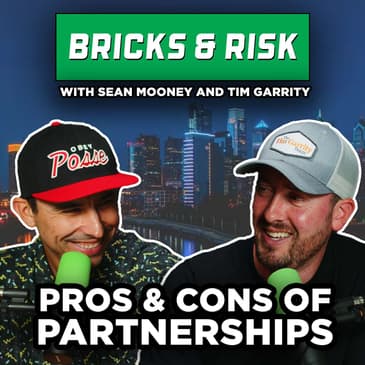

In business, you can go it alone or link arms with others. You can have one partner, ten partners, or no partners; there's no right or wrong way to go through your business journey. Before diving into the "partnership or solo" decision, it's helpful to hear the pros, as well as the cons, from those who have done it. Things like decision-making support and shared profits can sometimes be good or bad, it just depends on who you ask. As always, Sean & Tim share their own business experiences on this B&R ep, as well as those from experts; lean into this one!
Our goal with Bricks & Risk is that you walk away with 1 or 2 valuable nuggets that help build YOUR business. Our audience grows through word of mouth, so if you would please take a moment of your time and give us a review on the platform you’re on, that would be fantastic!
Please also help spread the B&R word by sharing your favorite episode with a friend. You can find all B&R episodes on Spotify, Apple Music, YouTube, and anywhere else you get your podcast content. We greatly appreciate your time and trust.
Until next time, keep learning + keep growing!
📲 Contact Info 📲
→ Sean Mooney, Mooney Insurance Brokers: www.mooneybrokers.com/
→ Tim Garrity, The Tim Garrity Team: www.timgarrityteam.com/
💥 Watch us on YouTube 💥
→ YouTube, Bricks & Risk Podcast, @bricksandrisk: www.youtube.com/@BricksandRisk/?sub_confirmation=1
💥 Follow us on Social Media 💥
→ Instagram, Bricks & Risk Podcast, @bricksandrisk: https://www.instagram.com/bricksandrisk/
→ Instagram, Sean Mooney, @sean.moonee: https://www.instagram.com/sean.moonee/@sean.moonee
→ Instagram, Tim Garrity, @realestateinphl: https://www.instagram.com/realestateinphl/
→ Facebook: https://www.facebook.com/bricksandrisk
→ LinkedIn: https://www.linkedin.com/company/bricksandrisk
[00:00:00] Here's my quote. This is a Sean P original. Trusting nobody is easier than trying to pick who to trust.
[00:00:11] You made that up?
[00:00:12] Yeah.
[00:00:13] That's pretty damn good.
[00:00:14] It's pretty good, right?
[00:00:14] Hey, Dil, can we quote that and put it on the bottom with a dash that says Sean P?
[00:00:19] Get like one of those memes with me thinking with bubbles coming out of my head.
[00:00:22] That would be awesome.
[00:00:29] Welcome to the podcast dedicated to real estate, insurance, and building your business.
[00:00:35] Join us as we take you along our own business building journeys with additional wisdom from
[00:00:41] our network of local and national experts. Welcome to Bricks and Risk.
[00:00:51] Hey, everyone. Welcome to another episode of Bricks and Risk.
[00:00:56] I'm Timothy Michael Garrity I.
[00:01:01] And I'm Sean Mooney.
[00:01:03] Who the hell are you?
[00:01:04] Sean P.
[00:01:05] Oh, yeah, Sean P. That's right. Awesome.
[00:01:07] All right, Sean P. Before we get started today, we're going to read another listener review.
[00:01:15] Ooh.
[00:01:16] And for those who are watching and listening, the best place you can leave a written review so that
[00:01:23] we can read it on the show is really Apple Podcasts. So I'm going to go ahead and read it.
[00:01:26] So this one comes from Strauss Mortgage. So great podcast for any entrepreneur.
[00:01:33] It's titled.
[00:01:35] So it says,
[00:01:37] Bricks and Risk is a must listen for anyone looking to dive deep into the nuances of business creation
[00:01:43] and growth. The hosts have a knack for navigating complex topics with ease, presenting them in a
[00:01:49] relatable and digestible format. Each episode brims with value and expert guests dissect their own
[00:01:56] success stories, setbacks and strategies relevant to both aspiring and seasoned entrepreneurs.
[00:02:02] The content is curated to inspire, educate and provoke thought, making an essential addition to
[00:02:08] the podcast library of anyone eager to learn and grow in the entrepreneurial space. Support for this
[00:02:13] insightful podcast is well deserved. It's not just a show, but a growing community where shared
[00:02:19] experiences paved the way for collective success. Damn, bro. What a review. Thank you, Strauss Mortgage.
[00:02:27] Listen, listen, are you ready? Are we up? We sitting high now? No, we listen. If you need a mortgage,
[00:02:36] call Strauss. Yeah, that's right. I'm putting, I don't know who Strauss Mortgage is, but we're going to
[00:02:41] find you. I'm going to find you Strauss. We're going to get you some business and the check is in the mail
[00:02:47] for your review. I think I know who it is, but I'm not going to reveal any of my secrets on the show.
[00:02:51] I'm going to go leave it a mystery. I'm going to let you figure it out. And then if you need a clue,
[00:02:56] let me know. I'll give you a couple of breadcrumbs. I am Strauss. I'm coming for you. Nice. I'm going
[00:03:02] to find you. Love it. All right. What are we talking about today? Today we're talking about partnerships,
[00:03:09] partnerships, business versus running a non-partnerships. Yeah. Well, this is great.
[00:03:16] So partnerships in general are, it's a very broad topic in business. You know, someone could talk
[00:03:22] about it. It's like, Hey, I get a partnership with my significant other and they help my business
[00:03:27] or someone could say, Hey, I went into business with someone else, someone I didn't know, and they
[00:03:32] wanted to do the same thing or, or someone kicked up a lot of money for the partnership. And that's why
[00:03:38] we got into business together. So why don't we start with you on this one? Because with Mooney
[00:03:44] Insurance Brokers, you started out solo. You were, you were a team of one day one. Now you have a few
[00:03:50] people on your team. I would say, go back to that time. Why was doing it solo the way, the direction
[00:03:59] you went when you started? Yeah. So at the time it really wasn't, I would say it wasn't a decision to
[00:04:06] be made. Um, so when I was, uh, making the decision to start the agency, it wasn't, uh, even a thought
[00:04:15] at that time to choose. Like it wasn't even an option. Yeah. Um, there was no other party that I
[00:04:25] could find or go to. Uh, I did have many, many conversations with different agency owners, um,
[00:04:33] about, you know, starting the agency and how to get that formulated, how to get it, you know,
[00:04:39] off the ground. Um, but what I will say is that it just wasn't an opportunity for me to
[00:04:47] find that other person, um, to, to go and, you know, do it with.
[00:04:52] How about, all right, so let's fast forward to now. That's the way you started. That's the way you are
[00:04:58] right now, but you got a couple of people working with you. Yeah. Where's your mindset at today?
[00:05:03] Would you be open to a partnership today? Absolutely. Um, not even, uh, today, but like looking, uh,
[00:05:12] back at the way that I did start it, I would have knowing what I know now, I would have definitely
[00:05:20] had put that on the table. Yep. I would have almost gone out and maybe
[00:05:24] like purposefully found some people who may have want to been, been a partner. Yep. Yeah. I think, um,
[00:05:32] I think in doing that, I think that would have been a completely viable option. Yeah. Um, I think
[00:05:40] it's probably looking back would have been my preference at the time. Yeah. Um, and so I
[00:05:47] definitely not to say that I would have definitely gone down the road of making the decision to
[00:05:53] partner with someone because ultimately I think you really need to find the person that you gel with.
[00:06:00] Like you have to be a hundred percent on the same page. Yep. And I think it's rare to find someone
[00:06:07] that is going to commit and give the energy that's needed. Yep. To do it. Um, but I still would have
[00:06:17] liked to, um, have those conversations about, you know, let's call it like interviewing, uh,
[00:06:25] people to partner with. Yeah. Because I think, and we can get into, you know, a variety of reasons
[00:06:30] of why I think that that would have been, um, the way I would have gone about it. It's so funny, dude,
[00:06:35] like how you're saying it, like saying, here's where I started, you know, didn't have the option,
[00:06:40] or at least you weren't focused on that option, which is why you went a little bit more solo.
[00:06:46] And then now today, like looking back and you're like, you know what, maybe I should have considered
[00:06:52] that like for these reasons, like everyone's got, there's reasons to do it and reasons not to do it.
[00:06:58] Yeah. Um, I just think that, uh, even now, even to this day, like if I were to find someone that was,
[00:07:07] and it's hard because at this point in someone's career, you know, I, I, I guess that, um, you would
[00:07:15] really need to find someone that's, I mean, you know, like it's, there's so much you have to give up
[00:07:22] in order to, um, operate a business. And at the time, that's the other thing too, is like
[00:07:33] what I was willing to give up at the time. It's like, who else would have been willing to give up
[00:07:42] a W2, put in some money, put in a sweat equity, uh, work countless hours. And initially, you know,
[00:07:54] you just don't have the money, right. To take like a high, uh, paycheck. So I don't know. It,
[00:08:03] it probably wouldn't have worked at the time to find that right person. Yeah. Um, but I still think
[00:08:09] it's a good exercise to kind of go through it and kind of see what's out there because, you know,
[00:08:14] maybe you do, maybe you find that person that's like just on that same wavelength as to like,
[00:08:20] yeah, that's an unbelievable idea. Let's go do it. It was funny. So like, it reminds me of the Zach
[00:08:26] Torres episode. What's up, Zach? Zach. Where one of his quotes was learn to sacrifice. Yeah. So he's
[00:08:33] been through that and you've been through that. I've been through that. And that really is probably
[00:08:39] one of the most foundational things about starting any business partners or no partners is you have
[00:08:45] to realize there, there is a sack, a sacrificial part to it in order to get it going. Cause if you just
[00:08:52] think nothing in your life changes and you're going to start a business, unfortunately the amount of time,
[00:08:58] effort and money, sometimes not, but time and effort for sure to get a business off the ground
[00:09:05] and get it moving. It's like, there's nothing, there's no other choice but to sacrifice. Yeah.
[00:09:11] Which is interesting. And it's just, I mean, I've had, you know, I've talked to people in all kinds of
[00:09:15] different industries and you know, people for a vast majority of people, there's such an unwillingness
[00:09:22] to make less money. Yeah. Because they, they view it as like a step back. Right. And it's like,
[00:09:31] no, every, every step in my life has to be more, has to be more, has to be more. Yeah. And to go in
[00:09:39] reverse for some people, it just doesn't, it doesn't fit like how they view life and business.
[00:09:48] Yeah. No, the high majority of people can't do what we have done just simply for that fact. Yeah.
[00:09:54] Because you, that is a requirement in order to do it. We were both making way more money. Yeah.
[00:10:00] Before we started businesses. Yeah. So like, that's, that's a fact. Yeah. Like,
[00:10:06] and it took years to even get back to that point of saying, all right, finally making the same money
[00:10:14] I left the job for to get this business off the ground. So some, some people, it might take six
[00:10:22] months. Some people it takes six years. So there is no like equation, linear method, right or wrong way
[00:10:32] to say, this is how long it's going to take. It really just depends on what you're doing.
[00:10:35] Yeah. Um, so as far as like, so for myself, uh, for partnerships, I had the complete opposite
[00:10:43] approach. So when I got into real estate, again, I started solo, so I didn't want to join anyone's
[00:10:48] team. So I probably had more of your mindset when I first got in. Cause a lot of people were joining
[00:10:52] teams when I first got, Hey, I joined this team and I got an open house opportunity every weekend,
[00:10:57] or I joined this team and they give me three cold leads a week that I can run out with. And, and I,
[00:11:03] I get one out of every 10. And then therefore I'm closing a couple of deals a month because I'm on
[00:11:08] this team. I'm making X amount of dollars because I'm on this team. This is what I constantly heard,
[00:11:13] but I went the opposite way. I said, as much as I will do an open house, as much as I'm willing to
[00:11:20] call someone that I don't know, see if they have a real estate need that I can help with.
[00:11:24] It's not the method that I'm falling into. And most of what I saw with teams when I first got in
[00:11:31] was more like, here are all the leads we have. We need people under us to service those leads.
[00:11:39] And then this is our conversion rate. And that conversion rate turns into closed deals,
[00:11:44] which turns into volume, which turns into income, which is how you say we had a good year or bad year.
[00:11:49] So that's what I saw. And it's way different now. Teams are just, they're structured differently.
[00:11:55] You know, technology has really made it easier to be associated with someone because that's really
[00:12:01] all the team is. So when I started out solo, I just said, look, I want to build this off relationships.
[00:12:08] You know, again, kind of the crux of our podcast, what do we talk about a lot in our businesses or
[00:12:14] our lives and everything that we want to share with the audiences, relationships are the foundation
[00:12:21] of everything that we do. So when I got in, I just said, look, if the relationships are mine,
[00:12:26] they come from me. It's my job to either maintain, strengthen and grow new relationships. Like that's
[00:12:34] all going to come from me because I want the relationship with me because when they have a need,
[00:12:39] I service that client.
[00:12:40] And if there was an opportunity, if you found someone that's like, oh my God, this is,
[00:12:44] this is what I do too.
[00:12:46] Exactly.
[00:12:47] Would you have thought like, oh, maybe this is possibility?
[00:12:52] Yeah. I was probably about two years in when I decided to, like my first brokerage wasn't like
[00:12:56] a great fit just because I had a couple needs. I said like, hey, can I, can I get a little bit
[00:13:02] more on my split? And we're like, that's not how we do it here. And I'm like, okay, well, that's fine.
[00:13:06] Yeah.
[00:13:07] Or like, you know, is there something else you can help me with? Well, I don't really have a
[00:13:11] lot of bandwidth. I got some of my greatest foundational stuff from my first brokerage,
[00:13:15] Brown McKinney, which was really in blogging. Like that idea came from Rudy Brown, who was my
[00:13:19] first broker. But then when I joined US Spaces, I get to meet a lot more agents. Like they had like
[00:13:23] 20, 25 agents. And that's when Ryan, my brother, Ryan Garrity got in the business. And that's where I
[00:13:28] met Andrew Janos was at that brokerage. So when I got to that brokerage and I saw this guy
[00:13:33] growing this brokerage, I said, I think I'm going to go back and start my broker classes
[00:13:40] because if I do that, maybe I could do what this guy's doing. And that was Fred Glick. Again,
[00:13:46] great guy, taught me a ton. So then I started taking my classes. You know, some of the classes
[00:13:50] took three, four full days in a row. I'm paying money. I can't practice. You know, I'm like sitting
[00:13:58] in a classroom all day. And then after five years, when I got that broker's license,
[00:14:04] I had Ryan and I had Andrew to your point earlier that said, yeah, we would be interested in that.
[00:14:10] Like they, they were, their eyes were lighting up. Like my eyes were lighting up. So I did have
[00:14:16] two people. One was a relative like in at that spot, right? Just got that license that said,
[00:14:24] we want to do it too. And we also want to do it in that way. Let's grow it organically.
[00:14:31] And I think one of the biggest lessons I can take from that, that I can share with the audience is
[00:14:35] again, a tip is when we started Copper Hill real estate from scratch, we looked at as like, okay,
[00:14:42] we have to kick up 10,000 each for our first year to keep this business afloat. And if we do that,
[00:14:48] how much did we pay our last brokerage in a calendar year to work for them? And it was more
[00:14:55] than $10,000. So we look at, we do the same exact amount of business and we're relationship driven.
[00:15:00] So it should be the same or better. And we shell out that $10,000. Not only are we making more
[00:15:07] money, but we have our own brand. We have our own company. There's opportunities to scale and grow
[00:15:13] and be creative and do all sorts of different things. And that's exactly what happened. So
[00:15:18] it took me, you know, about my first five years to start completely solo, get my feet wet, work for
[00:15:25] two different brokerages. Cause you worked for two different insurance companies in your first 10
[00:15:28] years, like get two different perspectives, get the license and say, all right, I got two people
[00:15:34] right here that are ready, willing, and able to grow this thing with me. And that wasn't an option
[00:15:41] that you had. Yeah. So it sounds like it almost naturally it happened that I just happened to
[00:15:46] have those and you didn't at that moment we were ready to like jump out. Well, for me too, it was a
[00:15:50] timing thing. Like if, if I'm going to do this, I have to do this now. Yeah. So you kind of take
[00:15:58] what's given to you and make the most of it. And that's, you know, yeah, the way I looked at it.
[00:16:04] All right. So let's talk about, so we've talked about some of our experiences with partnerships,
[00:16:08] right? Let's, let's talk about the pros of a partnership. So we've got a couple of points
[00:16:14] here. What's a pro of having a partner to start and grow a business? I mean, the one, the one
[00:16:26] thing that I think of first is you can go faster, quicker, and, and just have more volume. You're at a,
[00:16:38] you're at a different velocity when you have multiple people in your organization.
[00:16:45] Yeah. So like speed.
[00:16:47] Yeah. Speed. You got, in my example, we had three people at the helm of starting this thing. So
[00:16:53] technically we could do three times the amount of work we could, we could go three times faster.
[00:16:59] But you had three networks to tap into. Everything is kind of exponentially driven. So from that
[00:17:07] standpoint, I mean, that, that to me is like the number one answer as to like why, or having a pro
[00:17:16] is, you know, with, with one person there's, there's just, you can only go as fast as that.
[00:17:26] There's only so many hours in the day.
[00:17:27] Yeah.
[00:17:28] And you got three kids.
[00:17:29] Yeah.
[00:17:29] Now you didn't have three kids when you started.
[00:17:31] Right.
[00:17:32] But still.
[00:17:33] No. So, so that's, you know, pro number one, faster, quicker, get going and speed at what
[00:17:41] you can go.
[00:17:42] All right. So one thing, so you were talking about like shared resources. Hey, we got three
[00:17:47] networks, you know, we got three different people, three different skill sets, possibly three
[00:17:51] different lanes. I think another pro is in the example I gave from Copper Hill is financial
[00:17:57] support. So again, if I wanted to do it myself year one and I'm like, Hey, like the bottom of the
[00:18:03] barrel annual expenses are 30 K to get it started, pay rent, you know, have the tech advertise,
[00:18:12] have insurance, you know, all these things you need, educate yourself, all these things you need
[00:18:18] to grow your business. I would have had to take 30 grand out of my bank account in that first year.
[00:18:24] And then I think honestly, if it were me and I was comparing it to what I was paying my last broker,
[00:18:28] it probably would have been more.
[00:18:29] Yeah.
[00:18:30] But when you split it up three ways, that was one of the reasons that really got us going.
[00:18:34] It's like, Hey, it's like, you know, if we only pay 10 grand each, like maybe we were paying him
[00:18:38] like 20, 25 at the time, maybe 30. I can't remember.
[00:18:41] Yeah.
[00:18:41] Um, so I think the financial piece is very important because it's, it's split. Now, again,
[00:18:50] that also plays into the profit. Yeah. So as much as you're not putting as much money out there,
[00:18:57] you're not going to make as much money when the profit rolls in.
[00:19:02] What are your thoughts on that? As far as like being solo? Cause I think you had to put up,
[00:19:07] I think an episode we talked about like 20, 25 grand or so probably in your first year.
[00:19:12] Yep. So I think going back to my other point where I was saying that if you can find the right person,
[00:19:18] you can tandem with another person that is on the same track that you're thinking and you can gel.
[00:19:27] My thinking with that is that you can grow, you can outgrow what you'd be losing. Does that make sense?
[00:19:39] It does make sense.
[00:19:40] So like if in the first year I write a million dollars of business, right? And I own a hundred
[00:19:46] percent of that. I think with two people, you could go further than 2 million.
[00:19:53] Gotcha. Yeah.
[00:19:54] You're saying it's not, it's not equal. It's not one each.
[00:19:58] Right.
[00:19:58] You can maybe go 2.5 or 3.
[00:20:00] Yeah.
[00:20:01] If you had two working in that same period of time, just because that's the percentage of growth
[00:20:05] that it would have been doing. That's a really good point.
[00:20:07] Because everything is calculated for me in my head based on like, you know, a multiple, right?
[00:20:14] Yep.
[00:20:14] So like a million dollars of business, you're going to get X amount of referrals per month. You're
[00:20:20] going to write X amount of business. But when you have two people writing double that amount,
[00:20:25] everything kind of like rose at that additional multiple.
[00:20:30] The compound effect of two people working at once versus one person is just going to be that
[00:20:35] much greater.
[00:20:36] Yeah.
[00:20:36] I mean, compounding is a real thing.
[00:20:38] Yeah.
[00:20:39] No, that's a really good point.
[00:20:40] So I think you're going to outpace what you would be doing on your own if you take it that
[00:20:47] way.
[00:20:47] Here's another perspective from a pro of having a partner or partners is in decision making.
[00:20:55] Yeah.
[00:20:55] So I'll go back. I've had a few different partnerships. I've had a partnership for a real
[00:20:59] estate brokerage, partnership for a development team, partnership in a title company, partnership.
[00:21:05] I was in property management for a couple of years. So I've done a few different things.
[00:21:10] One thing I'll say about the pro of decision making is that, well, one of you have partners,
[00:21:18] I feel like you have to be open-minded. And I was very, very open-minded.
[00:21:22] Yeah. It forces you to be.
[00:21:23] I'm such a people person. It's just the way I'm wired. And I, I probably am too trusting
[00:21:28] at times. Like sometimes people like you're too nice. Like you're too trusting. Like you
[00:21:32] give everyone the benefit of the doubt.
[00:21:33] Do you want to hear my quote?
[00:21:34] Yeah.
[00:21:35] Here's my quote. This is a Sean P original.
[00:21:38] Okay.
[00:21:40] Trusting nobody is easier than trying to pick who to trust.
[00:21:47] You made that up?
[00:21:48] Yeah.
[00:21:49] That's pretty damn good.
[00:21:50] It's pretty good, right?
[00:21:50] Hey, Dil, can we, uh, can we quote that and put it on the bottom with like a dash that
[00:21:54] says Sean P.
[00:21:54] Get like all those memes with like me thinking with bubbles coming out of my head.
[00:21:58] That would be awesome.
[00:22:00] Um.
[00:22:02] Hey everyone. This is Tim, your favorite bricks and risk co-host. But don't tell Sean.
[00:22:08] I hope you're enjoying this episode and I'll get right back to it in a moment.
[00:22:12] Our audience grows through word of mouth. So if you would please take a moment of your time
[00:22:17] and give us a review on the platform you're on, that would be fantastic. Please also help spread
[00:22:23] the BNR word by sharing your favorite episode with a friend. We greatly appreciate your time
[00:22:29] and trust. Now back to the show. So here's the thing, like when you're making decisions. So like,
[00:22:41] again, I'll go back to Copperhead Real Estate. Yeah.
[00:22:43] We started. Yep.
[00:22:45] Where we want our office to be because we needed an office for Pennsylvania State to have a brokerage.
[00:22:51] Right.
[00:22:51] It can be the tiniest office you've ever seen, which it was, or it can be this gargantuan,
[00:22:57] it can be 10,000 square feet if you wanted to. Now obviously we couldn't afford 10,000 square
[00:23:01] feet, nor did we even need it or want it, but we had a tiny, tiny little office.
[00:23:05] Beaver County. You could probably find.
[00:23:07] If we did go to Beaver County, we probably could have found maybe like an old warehouse for like
[00:23:11] a couple of bucks a month. Someone's like, I'm making zero on it now. I'll take your $5.
[00:23:17] Possibly.
[00:23:17] Nothing against Beaver County.
[00:23:18] We love Beaver County.
[00:23:19] Yeah. We love Beaver County. So when we were finding our office space, one thing that worked
[00:23:26] well for us was like, where do we do it and why? One of our biggest drivers is like, okay,
[00:23:30] well we have this budget. So if we have this budget in year one, the office rent can't
[00:23:35] be more than a thousand bucks, which to some people that are like, what, what did you find?
[00:23:40] Well, first of all, this was 2014. So things were cheaper. This was pre crazy inflation.
[00:23:46] And two, we got creative. We found a coworking space and that coworking space ended up being
[00:23:53] such a blessing. So not only did we find our first office space for 800 a month with utilities,
[00:23:59] because in a coworking space, that's, that pays for your electric, that pays for your water,
[00:24:04] that pays for your gas, that pays for your internet. We had a front desk, we had a conference room,
[00:24:08] we had coffee made every day. We had networking events we could go to. All of that was included
[00:24:13] at $800 a month. So we were just getting all these like fringe benefits as well as financial benefits
[00:24:20] for doing that. But we also looked at it like strategically because we're relationship driven
[00:24:26] guys and we were trying to grow our networks. We're like, there's 50 different companies in this
[00:24:32] coworking space. Most of them were startups. Cause at the time, coworking was like fairly new in
[00:24:37] Philadelphia as it was in most parts of the country. And you had all these like scrappy small
[00:24:42] businesses. Some of them were like tech, some were like music, art, nonprofit, other businesses,
[00:24:48] there were attorneys and you would like go to the, like their wine and cheese night and just go shake
[00:24:55] hands and pass out business cards or swap info. And then you're like, yo, are you going to be in
[00:25:00] tomorrow? Yeah. Why don't we meet up in the, in the lounge and we just grab a cup of coffee,
[00:25:04] which was already paid for and talk shop. So dude, did they have chartree boards there with
[00:25:12] charcuterie meat selections? They actually had charcuterie and that's where I learned about
[00:25:18] triple creme brie, which is some of the best cheese in the world. In my opinion, I learned at it.
[00:25:23] I learned about it there and I got a really funny story.
[00:25:25] We'll have to ask Dennis about how my brother Ryan got grossed out by triple creme, but we won't
[00:25:29] go on it on this episode, but it was pretty funny. Um, we could bring Dennis on the show. He's a
[00:25:34] cheese guy. We could, we definitely could. JP sales.
[00:25:42] So, so that like the decision making support to do something, there was no one that I knew of.
[00:25:49] I bet you we were the first, I bet you if I actually researched it to headquarter a residential
[00:25:56] real estate brokerage in the city of Philadelphia at a coworking space. Dylan, can you fact check?
[00:26:01] I want someone to fact check that for me because I bet you it's true. And if not,
[00:26:05] it's like a 90% chance it's true. I'm going to have Dennis fact check your cheese too.
[00:26:09] Cool. I appreciate it. Just Philadelphia. Yeah. See if you can find any residential real
[00:26:14] estate companies that were in coworking spaces, there's probably two for 2014, probably some guy
[00:26:20] somewhere. Could be. So that, but that brings me back to the decision making support. Like,
[00:26:26] because there were three of us were like, what are the pros of doing this? What are the cons of doing
[00:26:29] this? What's the perceived value? Like, is it innovative? People are going to be like, what are
[00:26:33] you nuts? And most people said we were nuts. And then there were some people we'd meet and they're
[00:26:38] like, that's really smart. I bet you it's a lot cheaper. We're like, it is. And we're like,
[00:26:42] and we're a paperless residential brokers are like, what? So what other avenues were you looking
[00:26:46] at though? Like what was on the table? So if you landed on the shared space, which worked out great
[00:26:51] and it fit everything that you were looking to do. Yep. Like what other alternatives were on the table
[00:26:57] that you were discussing at the time or where is there not? Because it's like, all right.
[00:27:00] There were. It'd be like, you know, the thing about like, if you're, if you're a Philadelphian,
[00:27:04] you're from this area or you've been to Philadelphia, you walk down Walnut Street,
[00:27:08] Center City, which is where we started. Yeah. And there's tiny little storefronts. You know,
[00:27:11] you might be able to get 500 square feet, maybe a thousand. Oh yeah. That wasn't, that wasn't that
[00:27:15] the U S spaces. Didn't they have a, yeah, they were, they were on, they were on a chestnut for a while.
[00:27:21] I think that's, they were in a shared space for a little bit. Yeah. So like that was your
[00:27:26] alternative going up in a big building at that point. Wasn't it to just have an office. There
[00:27:32] weren't any spaces that were small enough. Yeah. Like, let's say we want to get a commercial
[00:27:35] space in like a high rise downtown. Most of that was like the minimum was like, yeah, it was big.
[00:27:40] Yeah. But you can find these little spaces downtown that offered that. Plus you could
[00:27:45] go out to a neighborhood. You go out to a Manioc, Roxborough, like Pasadena Square. You
[00:27:50] can go to Fairmount, you can go to Fishtown, Northern Liberties, like any of these spots,
[00:27:54] like Queen Village, Graduate Hospital and find 500,000 square feet for maybe like two G's.
[00:28:00] And at the time we're like, well, that's not a terrible deal, but it's still almost triple
[00:28:06] what we're paying to be at a fantastic location in Center City with all of our utilities included,
[00:28:14] which is another factor and meet all these companies. So I think just having all that is
[00:28:21] literally like the benefits of it. We're like, there's not going to be a better option, but
[00:28:25] not everyone thought that way. Not everyone said like, I can grow my business through the
[00:28:30] co-working model. Yeah.
[00:28:31] So it was, it was new territory. Most people said we were crazy. There were a few that were
[00:28:35] like, that's really smart. That was cool.
[00:28:37] Mikey G might question how you said Paschionk.
[00:28:41] He would. Mike is, is Paschionk. You're from Philly. We, I say Paschionk because I also say
[00:28:47] water. I don't really say water anymore.
[00:28:49] You say what?
[00:28:50] I say water. I say water. I say, give me a glass of water.
[00:28:54] Yeah.
[00:28:55] Yeah.
[00:28:55] My wife's from Colorado.
[00:28:56] We're not friends.
[00:28:57] She's helped me out a little bit. Decision-making.
[00:29:00] We're not friends.
[00:29:02] Pro side, I'd like to weigh in on. It's amazing. I can't imagine having three guys, gals on a
[00:29:12] team and a decision needs to be made. I mean, you can have a decision one, two, no, like,
[00:29:19] nope, we're not doing it. That's the, that's the final decision. Why that's so great is because
[00:29:24] when you are a solo operator.
[00:29:28] Yeah.
[00:29:29] You have to make every single decision.
[00:29:31] By yourself.
[00:29:32] By yourself.
[00:29:33] And it takes a while. It can be a paralyzing.
[00:29:37] Yeah.
[00:29:38] Event.
[00:29:39] Paralysis by analysis.
[00:29:40] Yeah.
[00:29:41] And so what about this? What about this? Because you're like, what do you think, Sean? I don't
[00:29:47] know, Sean. What do you think? That's a pretty good point, Sean.
[00:29:50] Literally.
[00:29:51] Yeah.
[00:29:52] That's, I mean, seriously.
[00:29:53] So, so I'm envious of that situation because I'm kind of of the mindset is like, I don't
[00:30:00] really care. Like I'll weigh in on certain things and I'll like want to do this or want to
[00:30:05] do that. But at the end of the day, if it were a group, I would be like, okay, that's
[00:30:12] what we're doing. Okay. Let's go.
[00:30:13] Like, yeah. So having that is, is like a luxury to me in my mind because it's like, I,
[00:30:23] every, I can't tell you. It could be like a thousand decisions a day.
[00:30:29] Right.
[00:30:29] Like clients and carriers and what should I do?
[00:30:32] What's IT?
[00:30:33] Should I make good on that? Should I, should I not work with them anymore?
[00:30:36] Yeah.
[00:30:37] Should I make less money? Like, should I do this? Well, all right. So let's, let's do
[00:30:43] this as, as nice as that sounds. Let's get into some of the cons.
[00:30:47] Yeah, sure.
[00:30:47] Let's get into some of the moons.
[00:30:49] Yeah.
[00:30:50] The glass, the glass half empty.
[00:30:51] Let's call them the moons.
[00:30:53] This is my specialty.
[00:30:55] So.
[00:30:56] Con.
[00:30:57] Some cons. Here's a con that kind of feeds off of the decision-making pro we were just
[00:31:04] talking about is conflict.
[00:31:06] Yeah.
[00:31:06] This is a very real thing in partnerships. As, as agonizing as it can be to make a decision
[00:31:14] yourself, it's up to you and only you to say, this is the direction. Here's the fork in
[00:31:21] the road. I'm either going right or I'm going left. You don't have to, you don't have to
[00:31:25] ask someone else if we're going right or left. You're just going to pick one. Now you might
[00:31:30] not go the right way, or maybe you got better odds if you have someone else, but the conflict
[00:31:35] part of decision-making in a partnership, I will say can also be paralyzing to the point
[00:31:44] where I'll go back to the brokerage. When we had to make decisions on things,
[00:31:49] we had a rule that basically said, if we can't agree unanimously, then majority rules. So you
[00:31:58] had three partners. If there were two votes, that's the way you were going. I will say out of all the
[00:32:04] voting we did in almost 10 years, probably count on two hands, the amount of major decisions that
[00:32:11] actually required a vote of us physically raising our hands and saying this direction we're going.
[00:32:17] And was the one odd man out pissed off? Yes, they were. I was the odd man out sometimes,
[00:32:23] as was Ryan, as was Andrew. But the decisions were still being made. Not only that, so I think
[00:32:31] there's conflict from a decision-making standpoint. I think conflict can also come into play
[00:32:36] insofar as vision. Where do we want to go with this company? Because out of the four partnerships
[00:32:41] I've named, two of them didn't work out. The brokerage, that isn't an existing partnership
[00:32:47] anymore, and neither is the property management. Those partnerships didn't work out. The other two
[00:32:51] are great. Yeah.
[00:32:54] Most of why those decisions... No, I'm going to say not most. One of the reasons why those
[00:33:00] partnerships did not work out was also, where are we going with this thing? How fast? How are we
[00:33:06] getting there? And minds change all the time. Like I've said in a past episode, people get married.
[00:33:14] People buy a bigger house. People get a nicer car. People have children. People have pets. People want
[00:33:19] to go on vacation more. All these things that change in your personal life are also going to change your
[00:33:26] perspective on the vision. Because a lot of the vision comes down to like, how long is this going
[00:33:31] to take and how much money are we going to make? Yeah. Because like we talked about in the beginning,
[00:33:34] we both took steps back when we started the business and then got to a point where we're making more.
[00:33:38] But then what do you do? You're almost like, should we put some of that money back in the business
[00:33:41] so I can make even more than that? So it's constant like step back to go step forward.
[00:33:46] So what are your thoughts on the conflict part, knowing that you've always been a team of one
[00:33:52] since you've been doing this as far as like the major decisions? Yeah. So there, I mean,
[00:33:57] I said it before is like, there's value in having, you know, multiple people weigh in. Um,
[00:34:04] I can't imagine the scenario where it's a partnership of two, right? That's hard.
[00:34:09] Your gears would be grinding so much. Three was good because there was always, it was easy.
[00:34:15] Someone was always leaning one way or the other. Right. So, um, I can imagine that if it's a
[00:34:20] partnership of two, you're, you're not always going to see things the same way.
[00:34:25] Right. So there's, there's always going to be a potential for conflict there. Um, and yes,
[00:34:31] decision-making for one, uh, does have a benefit of you make the decision, you live with a decision,
[00:34:38] and sometimes you even realize that it is the wrong decision when it's made, but you're forced to like
[00:34:46] live in it. Yeah. And there's really no, you know, you can wallow in it. Right. But like,
[00:34:56] if you decide that decisions are made and moving forward, then that's the practice that you have.
[00:35:02] And that's how you operate the business. And, and it's, you know, that's, that was yesterday.
[00:35:07] Give me your trust quote again. How'd that go?
[00:35:08] So in life, it's easier to trust nobody than to pick and choose who to trust.
[00:35:17] Dude, that's, that's really good. What you just said leads me to a quote that I've always said,
[00:35:23] I know this is not mine, or maybe I've worded it this way, but I always say you have to fail in
[00:35:28] order to succeed. And I keep it very blunt like that because even when you're a solo, uh, business
[00:35:35] owner, you don't have any partners to make decisions with when you make those decisions,
[00:35:40] like you said, that sometimes they don't work out, that is failing. And when you fail, the next time
[00:35:48] you have to make a decision of a similar nature, let's say, let's say it was a marketing decision.
[00:35:54] I'll try this and it didn't work. Then you're that much smarter to say, all right, well, here are the
[00:36:00] reasons why that didn't work. Maybe it was money. Maybe it was time. Maybe it was effort.
[00:36:05] Maybe it was just like, and how quality it was versus quantity. Like there's many reasons why
[00:36:11] marketing doesn't work, but failing is still allowing you to succeed. And maybe the process
[00:36:18] takes a little bit longer because you're making all these decisions. And then therefore you're the
[00:36:23] one who has to realize when they're not working. And you don't have two other people or one other
[00:36:28] person banging on our door, like, yo, we can't do this anymore because we're not getting anywhere.
[00:36:32] It's costing too much money. What have we, what have we brought in customer acquisition costs? We
[00:36:37] were, we were BSing about before, like what's the customer acquisition costs and why are we doing this?
[00:36:45] It's like, you have to do that.
[00:36:48] Yeah. And I think a lot of times too, and I'll, I say it often that sometimes you learn the most from,
[00:36:54] from your errors, from your mistakes. Totally, man.
[00:36:58] So I think that sometimes even those are blessings in disguise.
[00:37:02] Yeah.
[00:37:03] Because you're not going to, you're probably hopefully not going to do it again,
[00:37:08] or you get to think about, you get to critically think, oh, why did I, why did this happen?
[00:37:13] How did this happen?
[00:37:14] Yep.
[00:37:15] And then you're building the road forward with that in mind to, you know, avoid that in the future.
[00:37:22] Yeah. Yeah. Sometimes actually the failures are opportunities because when something's not
[00:37:28] working out, you could say, all right, well, if this didn't work out, like for me,
[00:37:33] when the brokerage partnership ended, okay, well, what's my next opportunity? What am I going to do?
[00:37:39] And it really ended up being a blessing because I went from solo agent to two partners to growing a
[00:37:46] pretty, pretty good size independent brokerage by most people's standards,
[00:37:50] not only in the amount of time that we did, but also just in general to now going back
[00:37:56] to being the sole decision maker and then having like a group of people that still work with me,
[00:38:02] that are still following me. I'm still leading them. I don't need to go to them for,
[00:38:05] for decisions. Do I get ideas? Do we communicate? Do we collaborate? A hundred percent.
[00:38:10] Yeah.
[00:38:10] But the decision maker is me. So I've gone back. I went full,
[00:38:14] I went full circle back to being solo. And I will say like, it actually brings me to another
[00:38:22] con is a con of a partnership is shared profits. Because again, as you're growing something,
[00:38:34] most of the time people like the word growth. So if you start, we started a team of three at the
[00:38:41] brokerage and grew it to, you know, 10 million in volume, let's say in like our first year,
[00:38:45] we took it all the way up to almost a hundred million in less than 10 years that we did one
[00:38:50] year. Like you're almost like, well, how do we get to 200 or how do we get to 500 or how do we get to
[00:38:56] a billion? Like, you know, these aren't the things that we discussed, but when you have shared profits
[00:39:02] and shared decisions, sometimes people are like, I don't want to bring that money home. I want to
[00:39:07] throw it back into the business. I want to pour gasoline on the fire. I want it to
[00:39:12] print more money because of the money I'm investing in it. Whereas sometimes, and I think
[00:39:18] going full circle with this whole thing, one thing I've enjoyed about going back to being the
[00:39:24] sole decision maker is you got to pay yourself first. It's almost like the philosophy that a
[00:39:28] lot of people say with health, like you got to take care of yourself first. If you're going to
[00:39:32] take care of your family, you can't be in poor health and then expect you to be in a right state
[00:39:37] of mind or physically or mentally to then take care of others, whether it's a spouse and children or
[00:39:42] pets or whatever, or grandparents or parents or cousins. Like you have to take care of yourself
[00:39:48] first to a point, and then you'll have the strength or the resources to help others.
[00:39:57] And going back to being the sole decision maker for me has been pretty nice because now I have,
[00:40:03] I have more time to think. I have more resources. I have more direction. Like I'm doing my 2025
[00:40:10] annual planning right now for next year for the Tim Garrity team. And I'm like, okay, it doesn't look
[00:40:16] like here are like four or five streams of income for next year that I want to focus on. And I wouldn't
[00:40:23] be focusing on those if I was still in a partnership, which is interesting. So what are your thoughts on
[00:40:30] that? Yeah. You've been, Hey, you're not sharing your profit. I mean, you have employees.
[00:40:36] I think it's, uh, it goes back to the original point of, you know, yeah, we, we don't share,
[00:40:42] but owning a hundred percent of 50 may not be as good as owning 50% of.
[00:40:50] I mean, Mark Cuban used to say owning a hundred percent of a grape is less than owning 50% of a
[00:40:58] watermelon. So he always made that example. It's like, as much as you feel like you're giving up
[00:41:02] half your company to someone else, what would you rather have half of a watermelon or a whole grape?
[00:41:08] Yeah. And that goes to your point. It might only get this big or it could ever get this big.
[00:41:15] If I'm flying solo, if I have another mind or minds, people that are vested, that are going the same
[00:41:23] direction that can put in half the work, half the money, half the ideas, like maybe it turns into a
[00:41:27] watermelon. Yeah. It's just, uh, also finding that person when it is a partnership, you know, to get on
[00:41:35] the same page as to how big do you want to get? You prefer watermelons over grapes. What do you like
[00:41:40] better? You had to take your pick a bowl of grapes or a nice big slice of watermelon. What would you
[00:41:49] like? I go watermelon. Yeah. Um, share profits. Yeah. It's just, you know, there is also too,
[00:42:03] that all the decisions, all the financial decisions, like I get to like call the shots, you know?
[00:42:08] Yeah. Yep. So there was a benefit for sure. And one last one I wanted to bring up was, um,
[00:42:16] another con of partnership is, is in liability. So again, when you're in a partnership structure,
[00:42:25] there can be personal liability because it's not like if you're just one person and you're,
[00:42:32] you own an LLC or an S corp or something like that, it's really like, that's, that's your shield.
[00:42:37] When there's multiple people involved, again, I'm not an attorney or an accountant. There's,
[00:42:42] there's different levels of risk, which can pose financial problems. So that, that's another aspect
[00:42:51] to a partnership. And then again, you have three different opinions or two different opinions or five
[00:42:56] different opinions on how we handle that. Well, you're, you're attaching yourself, right? So now,
[00:43:02] not only are you responsible for your own decisions and actions, right? But now you're being brought in
[00:43:09] to being attached to these other people, their decisions, you know, posting something stupid
[00:43:15] online. Well, that's you, right? You know, um, financial decisions too. I mean, on the news,
[00:43:21] right? So this person's embezzling this money, right? Right. So there's, there's,
[00:43:27] when you get involved in those partnerships, there's, there's other avenues that you get
[00:43:34] attached to for better or for worse. Amen. So when are you going to get a partner?
[00:43:42] I'm calling them out folks. Yeah. Uh, not that I'm like it, like, it would be more like,
[00:43:48] I'm not itching to do that. It would be, wow. Like I just met this guy and gal and they are just,
[00:43:57] they're talking my language. Right. Right. They, they, they view this industry or they view the,
[00:44:03] an agency the exact same way that I view the agency. Yeah. And, and I think it would be that,
[00:44:12] that like maybe then furthered to a conversation and it's like, okay, well, what would this look
[00:44:18] like? You know what I mean? It would be a, it would be a, a few steps in between to,
[00:44:26] to kind of get to that point. What's also interesting is that, you know, because you started out the way
[00:44:31] you started out at Mooney Insurance Brokers and you're like, I didn't really have anyone that was
[00:44:36] going in that direction or was driven or like that I knew that I felt like I could trust.
[00:44:44] And now that you're 12 years in now that you're 12 years in and you've been going that whole journey,
[00:44:52] you know, by yourself, but I mean, now you have 10 million, you know, podcast fans, you know,
[00:44:59] screaming and banging on your office door, you got that deadbolt locked and they're like,
[00:45:04] can I have your autograph? And you're like, I don't know. I'm 11 million. Okay. 11 million. Gotcha.
[00:45:12] Um, so now that you have all that experience and you're more like, you're more experienced,
[00:45:19] but you're more open-minded. Like you had said, you're like, ah, if I look back on it, like I would
[00:45:23] have done a partnership. Maybe I would have looked harder for a partnership. So now you're probably
[00:45:27] looking much harder than you were before. Cause you're like, Hey, if I come across the right
[00:45:30] person, like I would consider that. Very similar. And what I, what I said previously in naming my
[00:45:39] agency, right? Like I said, I use Mooney Insurance, but now looking back, I probably would have done
[00:45:43] that differently. Yep. Right. Um, same with like a partner, you know, I think, uh, starting with a
[00:45:53] partner, um, could have been the way that I went, you know, if I had to do it again.
[00:46:01] That's interesting. Awesome, man. All right. Well, I'll have to tell the folks what they need to know
[00:46:08] if they want to reach out, support the show. Listen, everyone that rhymed. We know that you're
[00:46:13] enjoying the show today. And if you'd like to drop us a note, it's very simple. Bricks and risk
[00:46:24] at gmail.com. Shoot us an email. Tell us what you like, tell us what you didn't like,
[00:46:30] but let us know. Apple podcast, drop a review. Find us on YouTube. That's the written review.
[00:46:37] Remember Apple podcast for written reviews, right? Spotify's just stars. Oh, they can do. Oh,
[00:46:44] really? Yeah. Get with it, bro. Or drop us a DM on the Instagram. That's what the kids like to do.
[00:46:51] Like Bobby Hort. Bobby Hort. That was the best DM I've ever seen.
[00:46:55] All right. Well, that's all we have for this one, folks. Thank you for tuning in again to another
[00:47:02] episode of Bricks and Risk. See you soon. Thank you for joining us on another episode of Bricks and
[00:47:11] Risk. Our goal is that you walk away with one or two valuable nuggets, and we greatly appreciate you
[00:47:17] sharing your time with us today. You can find all BNR episodes on Spotify, Apple Music, YouTube,
[00:47:25] and anywhere else you get your podcast content. Until next time, keep learning and keep growing.