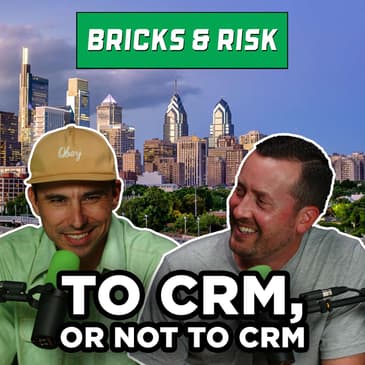
Committing to a CRM (aka Customer Relationship Management) is not only a great way to stay focused and organized in business, statistics will show that it also helps with forecasting and growth! In our 43rd ep, Sean & Tim discuss why CRMs are important, when they may not be necessary, and their own experiences working within different platforms. As the wise Bill Shakespeare once said, "To CRM, or not to CRM; that is the question." He was a man before his time, haha.
Our goal with Bricks & Risk is that you walk away with 1 or 2 valuable nuggets that help build YOUR business. Our audience grows through word of mouth, so if you would please take a moment of your time and give us a review on the platform you’re on, that would be fantastic!
Please also help spread the B&R word by sharing your favorite episode with a friend. You can find all B&R episodes on Spotify, Apple Music, YouTube, and anywhere else you get your podcast content. We greatly appreciate your time and trust.
Until next time, keep learning + keep growing!
📲 Contact Info 📲
→ Sean Mooney, Mooney Insurance Brokers: www.mooneybrokers.com/
→ Tim Garrity, The Tim Garrity Team: www.timgarrityteam.com/
💥 Watch us on YouTube 💥
→ YouTube, Bricks & Risk Podcast, @bricksandrisk: www.youtube.com/@BricksandRisk/?sub_confirmation=1
💥 Follow us on Social Media 💥
→ Instagram, Bricks & Risk Podcast, @bricksandrisk: https://www.instagram.com/bricksandrisk/
→ Instagram, Sean Mooney, @sean.moonee: https://www.instagram.com/sean.moonee/@sean.moonee
→ Instagram, Tim Garrity, @realestateinphl: https://www.instagram.com/realestateinphl/
→ Facebook: https://www.facebook.com/bricksandrisk
→ LinkedIn: https://www.linkedin.com/company/bricksandrisk
[00:00:00] If you're working with a group of salespeople, and Jim has an Excel spreadsheet, and Donna has a Google Doc, and Brenda has a Microsoft Word doc.
[00:00:16] What about Judy?
[00:00:17] Judy? Judy's got something else. How are you supposed to manage that information and connect?
[00:00:30] And speak or reach out to those prospects or clients?
[00:00:35] And then how are you forecasting what is going to be in front of you in the next year?
[00:00:46] Welcome to the podcast dedicated to real estate, insurance and building your business.
[00:00:52] Join us as we take you along our own business building journeys with additional wisdom from our network of local and national experts.
[00:01:02] Welcome to Bricks and Risk.
[00:01:08] Hey everyone, welcome to another episode of Bricks and Risk.
[00:01:13] I'm Timmy G.
[00:01:15] And I'm Sean Mooney.
[00:01:18] I'm not even going to say what you're supposed to say, but we'll go with it.
[00:01:21] So before we jump into this one today, Sean, we're going to read another listener review.
[00:01:28] Great. I can't wait.
[00:01:30] Ready? And they don't make funny on this one.
[00:01:32] I promise.
[00:01:32] Bobby Hort.
[00:01:35] All right.
[00:01:36] So this review comes from Apple Podcasts.
[00:01:39] It's titled Must Listen from Neil O30.
[00:01:45] If you're in the real estate or insurance space, you must listen to this podcast.
[00:01:50] There is some valuable knowledge being dropped by Tim and Sean.
[00:01:54] Keep up the good work.
[00:01:56] Thank you, Neil O30.
[00:01:58] That was awesome.
[00:01:59] You know what I want to do?
[00:02:00] I want to like guess.
[00:02:02] Me and you should guess who Neil O is.
[00:02:05] I know who it is.
[00:02:06] Oh, you do?
[00:02:07] Yeah.
[00:02:07] Well, then I guess you'd win.
[00:02:09] Isn't that, isn't there a rapper, Neil O?
[00:02:12] I don't know.
[00:02:13] Is there?
[00:02:14] Can you double check that?
[00:02:16] Like new music?
[00:02:17] I know you only listen to like old stuff.
[00:02:18] You're still like on CDs in your car.
[00:02:20] I am.
[00:02:21] Vinyl and CDs only.
[00:02:23] Although I do have an iPod in my car.
[00:02:28] I know you do.
[00:02:29] That I is on shuffle.
[00:02:31] I'm like, that just goes to show how resilient iPods are.
[00:02:34] That they still work.
[00:02:35] Dude, that thing will work 100 years from now.
[00:02:37] Well, guess what?
[00:02:38] Maybe that should be your first tip to get an iPhone.
[00:02:41] Why would I do that?
[00:02:42] Because it's that much better.
[00:02:46] All right.
[00:02:46] Why don't you introduce this one?
[00:02:47] Well, today's episode, everyone, is a quote from the late, great Bill Shakespeare.
[00:02:57] Can't see too well.
[00:02:58] Is that Bill Shakespeare over there?
[00:03:00] To CRM or not to CRM?
[00:03:05] That is the question.
[00:03:06] That is the question.
[00:03:08] All right.
[00:03:09] So let's jump into this one.
[00:03:12] So CRM, customer relationship management.
[00:03:15] It's tech that most people use if you're in sales.
[00:03:21] I would say if you're in business, you should probably have one.
[00:03:24] Probably should.
[00:03:25] And we're going to jump into some of like the pros and cons, as well as some stats.
[00:03:30] And we're also going to share some of our own experiences using CRMs.
[00:03:34] Yeah.
[00:03:36] So why don't I start it off with just sharing my own experiences with a CRM?
[00:03:41] Please.
[00:03:42] So when I first got into real estate, so again, 15 years ago, solo agent at an independent
[00:03:47] brokerage, there were only six other agents there, like tiny.
[00:03:51] We didn't get any tech.
[00:03:52] And even if we did, it probably wasn't going to be the high tech.
[00:03:55] And this is kind of before like SaaS, like software as a service.
[00:04:01] Like you said, like download things on your computer, like the software and then use it.
[00:04:06] But now that you just go to any website you want and just sign up to be a member, you need
[00:04:11] a login.
[00:04:12] You can kind of use whatever CRM you want, whether it's industry based or business based
[00:04:16] or whatever.
[00:04:17] So when I started at Brown McKinney, I was using an Excel spreadsheet and I was using
[00:04:24] a calendar and my email.
[00:04:27] Blogger, Craigslist.
[00:04:28] It's all that.
[00:04:30] And that's how I kept track.
[00:04:34] And for me, I'm going to get into why I've used the CRM because I used it very heavily all
[00:04:40] my almost 10 years at Copper Hill.
[00:04:42] Right.
[00:04:42] And right now with the Tim Garrity team only being about three months away from that partnership,
[00:04:49] I'm not using one.
[00:04:50] So I'm going to dive into it.
[00:04:52] But and I would say that there's an easy I'm going to once you finish, I'll give you the
[00:04:56] easy answer.
[00:04:58] OK, well, I'm done talking about my basic approach to CRMs.
[00:05:02] Why don't you give me the easy answer?
[00:05:04] No, no, no.
[00:05:05] You go.
[00:05:06] I want to go on top of you.
[00:05:08] OK, so that's what I Brown McKinney.
[00:05:12] Yep.
[00:05:12] Excel sheet, calendar, email.
[00:05:15] Yep.
[00:05:15] Calendar invite says once a week, follow up with your clients.
[00:05:19] That's how I did it.
[00:05:20] Mm hmm.
[00:05:22] Then even my second brokerage, US Spaces, was there for about three years.
[00:05:27] Pretty much the same system for the most part.
[00:05:30] We didn't really have anything.
[00:05:31] Yep.
[00:05:32] Copper Hill rolls around.
[00:05:33] So it's 2014.
[00:05:36] And we really functioned in our own ways for probably the first two and a half, three years,
[00:05:42] I would say.
[00:05:44] After three years, a friend of ours, actually Brian Corkadillos from Design Blends, he was
[00:05:51] the one who said, have you ever heard of HubSpot?
[00:05:54] And I said, no, like, tell me about it.
[00:05:56] And, you know, Brian's got a really good size organization, had a bunch of people working
[00:06:01] for him.
[00:06:01] He was like, dude, it's a game changer.
[00:06:03] Like, and these are the reasons why.
[00:06:04] And he told me why he liked it.
[00:06:06] So then Andrew, you know, at Copper Hill was more the techie.
[00:06:10] And he went and vetted it and said, I think this is a good system.
[00:06:13] So we went all in.
[00:06:15] It was one of the most expensive CRMs we could invest in at the time.
[00:06:19] Yep.
[00:06:19] But what we liked about it is that the interface was very simple.
[00:06:23] And we liked that it was customizable.
[00:06:26] Because again, some CRMs you get, it's like, here it is.
[00:06:29] Like, this is what it is.
[00:06:31] Work within what we have given you.
[00:06:33] It was our template.
[00:06:33] So work within the template.
[00:06:35] And HubSpot was amazing.
[00:06:37] Like, we did not only keeping track of our clients, our deals as a company, our individual
[00:06:43] deals, but eventually we started doing our email marketing through there.
[00:06:48] We started doing our event management through there.
[00:06:53] You know, after years of history in the CRM, you can look at, like, pipelines and graphs and,
[00:06:58] like, all this stuff and really be like, where did that deal come from?
[00:07:01] How much business did we do three years ago versus today?
[00:07:04] Like, that's what makes a CRM great.
[00:07:07] Because it really just, it puts your business in this, like, easy to view, analyze template.
[00:07:14] And you can make decisions from there.
[00:07:17] You can pivot from there.
[00:07:18] You can keep moving forward from there, whatever you're doing.
[00:07:21] So that was kind of some of my experience.
[00:07:23] What about you?
[00:07:24] So my experience is a journey that I've been on with my business.
[00:07:31] And I'm actually going through a little change and update as I feel like we do every couple
[00:07:41] years.
[00:07:42] You switch CRMs every couple of years?
[00:07:44] No, no.
[00:07:45] No.
[00:07:46] Just what I want to do with it.
[00:07:49] And then, like, you know.
[00:07:51] But I have switched.
[00:07:53] Okay.
[00:07:54] How many CRMs have you used over your, with Mooney Insurance Brokers?
[00:07:57] It's been, what, almost 12 years?
[00:07:58] Yeah.
[00:07:59] How many have you had?
[00:08:01] I really want this answer.
[00:08:03] So I would say probably four different systems.
[00:08:08] Okay.
[00:08:09] That's pretty good.
[00:08:11] But a couple years in each one, figure out if you like it, don't like it.
[00:08:15] Yeah.
[00:08:16] Well, yes and no.
[00:08:18] Here's the rub with all of it, is that the industry insurance is so fractured.
[00:08:25] It's so siloed that I kind of wanted to use this system, and I did, and then I changed,
[00:08:34] and I changed.
[00:08:34] But in the end, it's like, for functionality purposes, you need to find a system that speaks
[00:08:44] to and, like, works with, we have an agency management system.
[00:08:53] Oh, okay.
[00:08:54] Gotcha.
[00:08:54] Tech for your agency.
[00:08:57] Yeah.
[00:08:57] Which is separate than your CRM.
[00:08:59] Right.
[00:09:00] You wanted the two of them to kind of, like, talk to each other type of thing?
[00:09:04] Yep.
[00:09:05] So, yeah.
[00:09:07] Before I was trying to do it where it's like, I got a system over here, that's my CRM, and
[00:09:14] then my management system where all of the policy information gets downloaded, all of the customer
[00:09:21] information is there.
[00:09:23] So it's like your intranet, your, you know, it's like your internal system was not jiving
[00:09:30] with your CRM.
[00:09:31] Correct.
[00:09:32] And so now it's like a two-way sync.
[00:09:35] Okay.
[00:09:36] So, like, if I do something in this system, it's updating this and vice versa.
[00:09:41] After work?
[00:09:42] Yeah.
[00:09:43] So that's kind of what's putting me where I'm at right now.
[00:09:49] How long did that take you to find this one?
[00:09:51] Like, how long have you been there?
[00:09:51] I've always known it was there.
[00:09:53] I just resisted because I'm not thrilled with my agency management system.
[00:09:59] Okay.
[00:09:59] And I thought I would move sometime, but now I'm like...
[00:10:02] You're just in too deep.
[00:10:04] Yeah.
[00:10:05] As Phil Collins once said.
[00:10:07] Yes.
[00:10:08] Yes.
[00:10:08] Phil.
[00:10:09] Or maybe it was Genesis.
[00:10:12] So right now, and then now I'm working with a consultant to kind of like build out not
[00:10:19] only the pipelines, but my automation as well.
[00:10:22] And so that kind of works in tandem with our management system.
[00:10:27] What's the name of your current CRM?
[00:10:30] CRM system is Agency Zoom.
[00:10:33] It's not Obey?
[00:10:34] Not Obey.
[00:10:35] I thought you were promoting your CRM this whole time.
[00:10:37] We've been doing this podcast with these Obey hats.
[00:10:40] No, no.
[00:10:41] On the weekends, I do like pop-ups, like at the King of Prussia Mall, where they'll pay
[00:10:49] me to go out, you know.
[00:10:52] It's like a modeling gig, basically.
[00:10:54] Of sorts.
[00:10:55] Yes.
[00:10:56] Okay.
[00:10:56] So like I'll go out.
[00:10:57] It's like pseudo, like contract modeling.
[00:10:59] Yeah.
[00:11:00] I'll ride my Santa Cruz, do some kickflips, and you know, I get a check on Monday.
[00:11:07] Hey, nothing wrong with that.
[00:11:09] Now I finally know why these hats keep getting worn.
[00:11:11] So that's good to know.
[00:11:12] And the more I wear them, the bigger the check.
[00:11:15] That's, hey, I might start wearing them too.
[00:11:17] Then we can start splitting the profit.
[00:11:19] Might be honest.
[00:11:21] All right.
[00:11:22] So, well, that was super helpful.
[00:11:24] Yeah.
[00:11:24] And it's industry specific to me, right?
[00:11:27] Right.
[00:11:27] So like mine, the problem we have is that all of these carriers that we work, we work with
[00:11:31] like over 50 carriers.
[00:11:33] Yeah.
[00:11:33] And they all have their own systems.
[00:11:35] They all have their own way that they communicate policy information and tags.
[00:11:42] And it's like they all have their own language.
[00:11:45] So then when they send the information in, it actually has to go into a centralized system
[00:11:53] that then gets translated.
[00:11:56] Okay.
[00:11:56] So that my management system can understand what all it is.
[00:12:02] It kind of formats it in a way that makes it all.
[00:12:05] It's catching everything in the different languages and turning it into one language,
[00:12:10] making it look like clean and neat and organized.
[00:12:13] Yeah.
[00:12:14] Gotcha.
[00:12:15] Yep.
[00:12:15] All right.
[00:12:17] So let's talk about like why someone would use a CRM.
[00:12:21] So some of the reasons, you know, it's going to sort.
[00:12:24] That's where I'm going to answer your question.
[00:12:26] Okay.
[00:12:26] After we get.
[00:12:28] You want me to read this part first?
[00:12:30] Are you saying you want to answer my question?
[00:12:31] Go ahead.
[00:12:32] Read that.
[00:12:32] Okay.
[00:12:32] So a CRM is basically going to sort, analyze and prioritize your sales leads.
[00:12:40] So think about it.
[00:12:41] Like for me in real estate, I go out and let's say it's a new buyer client.
[00:12:46] And the first time we're meeting is through the buyer consultation.
[00:12:50] Like we've talked about that before.
[00:12:52] I usually do that through Zoom.
[00:12:53] Sometimes it's in person, very rarely on a phone because I want visuals.
[00:12:56] So we do the buyer consultation.
[00:12:58] I'm going to add that person or people to my CRM.
[00:13:02] Say, okay, Mr.
[00:13:04] and Mrs.
[00:13:04] Smith, a buyer client.
[00:13:06] Here's their price range.
[00:13:07] Here's what they're looking at.
[00:13:08] And it puts them in there.
[00:13:09] So now it's turning into kind of like pipeline management.
[00:13:12] Right.
[00:13:12] Let's call it.
[00:13:15] That's also going to create some focus and accountability for me as an agent.
[00:13:20] Because you can set reminders on there.
[00:13:22] You can understand what your pipeline's like.
[00:13:24] You can see the last time you talked to them.
[00:13:26] What'd you talk about?
[00:13:26] How'd you talk to them?
[00:13:27] You know, phone, email, text in person, like whatever it was.
[00:13:31] You were basically leaving just like this record of everything so that when you go to connect
[00:13:38] with them again, because some clients, they might take a month or two for me and some take
[00:13:42] a few years.
[00:13:43] That's just the way it is.
[00:13:44] It depends what they want, what their urgency is, and also what's the availability of what
[00:13:49] they want.
[00:13:50] If it's not out there, if it's overpriced, the inventory is tight.
[00:13:53] What about if it were a Maple Glen?
[00:13:55] I mean, if it were a Maple Glen, we would have the deal done yesterday because it's probably
[00:13:58] the easiest market I've ever seen to buy a house for a reasonable price.
[00:14:04] But so also with creating that accountability, again, it's like you, all those people coming
[00:14:12] into that system, speaking one language.
[00:14:14] A CRM just keeps you organized.
[00:14:16] Yep.
[00:14:16] And it allows you to see what you got going on with every single person, touch points,
[00:14:20] everything.
[00:14:21] Yep.
[00:14:21] And then some stats real quick.
[00:14:23] So reasons why someone would use a CRM versus not using a CRM.
[00:14:29] Yeah.
[00:14:29] The advantages.
[00:14:30] Yeah.
[00:14:31] So like some stats that I found in general.
[00:14:35] So on average, a CRM will increase your sales around 29% because it's creating efficiencies,
[00:14:41] as I just mentioned.
[00:14:42] It's also going to increase your productivity about 34%.
[00:14:47] And then lastly, it's going to give you accuracy in your forecasting, usually increase of around
[00:14:54] like 42%.
[00:14:56] You got to figure like a third to half more efficient in different ways if you use one versus
[00:15:02] not using.
[00:15:04] Now, what the hell did you want to say?
[00:15:07] So, so the question is, well, the question I was going to answer was why would you use
[00:15:13] it or why would you not use it?
[00:15:15] Yeah.
[00:15:15] Okay.
[00:15:16] And the answer is simple.
[00:15:18] If you have a team that you need all of that information into one portal and speak to those
[00:15:32] customers and clients from a, from a company position.
[00:15:37] Yeah.
[00:15:37] Because you've got multiple people working at your company.
[00:15:40] All different people are inputting things.
[00:15:42] Yep.
[00:15:43] And you need to see the whole thing.
[00:15:45] Yeah.
[00:15:45] Not just what Sean has going on, what Mooney Insurance Brokers has going on.
[00:15:50] Correct.
[00:15:51] Got it.
[00:15:51] Yeah.
[00:15:52] So then that is where it's almost a necessity, right?
[00:15:58] Almost.
[00:15:59] Because then otherwise you'd have the same problem that I would have had where all of
[00:16:04] these carriers are speaking different languages and you're trying to interpret, like if you're
[00:16:10] working with a group of salespeople and Jim has an Excel spreadsheet and Donna has a Google doc and Brenda
[00:16:21] has a Microsoft Word doc.
[00:16:25] What about Judy?
[00:16:26] Judy.
[00:16:28] Judy's got something else.
[00:16:30] How are you supposed to manage that information and connect and speak or reach out to those
[00:16:42] prospects or clients?
[00:16:45] And then how are you forecasting what is going to be in front of you in the next year?
[00:16:50] Well, it's interesting.
[00:16:52] That's a really good point.
[00:16:55] At Copper Hill, yes, we could not have functioned without one because we had anywhere from like
[00:17:00] 30 to 50 agents at a time running around doing all different things.
[00:17:05] Yep.
[00:17:05] And again, if they got listings, we're holding escrow.
[00:17:08] If they got buyers, we still have notes.
[00:17:10] And again, there's like, there's forms, there's documents, there's touch points.
[00:17:13] You know, our transaction team used our CRM system to keep everything moving through the
[00:17:17] pipeline.
[00:17:18] So yes, it would have been impossible to run Copper Hill without it.
[00:17:23] And also Mooney Insurance Brokers, like you saying, hey, I got 50 carriers.
[00:17:26] They all need to go into my management system.
[00:17:29] And then I want my CRM to talk to that.
[00:17:32] Because again, you got different people at your insurance brokerage feeding that.
[00:17:37] So they need to talk.
[00:17:39] You got 50 over here.
[00:17:40] You got a few people over here.
[00:17:41] Like it needs to connect.
[00:17:42] Yep.
[00:17:43] For sure.
[00:17:44] Let me tell you why I don't have one today.
[00:17:48] And I'm actually still running just as efficient as I was before.
[00:17:53] So when the partnership ended at Copper Hill and I started the Tim Garrity team at Real Broker,
[00:18:02] one of my first questions was, how do I keep track of my stuff?
[00:18:06] Like, is it all on me as the team leader, as also a practicing agent?
[00:18:13] Or does Real give me something for that?
[00:18:15] Copper Hill was from scratch.
[00:18:17] So everything we had to do, we had to figure out on our own.
[00:18:20] We picked our own CRM, just like you.
[00:18:22] Same deal.
[00:18:23] So those are apples and apples.
[00:18:25] What I'm learning at Real, it's apples and oranges.
[00:18:28] So Real's setup is that whether you're a solo agent or a team like the Tim Garrity team,
[00:18:35] you are responsible for some, but they are responsible for some as well.
[00:18:40] And what they use, because my team is about 10 people, another team of about six from Copper
[00:18:46] Hill came over to Real as well.
[00:18:48] They're their own team, the Main Street team.
[00:18:49] What's up, Christine?
[00:18:53] Real has a portal where I can see everything.
[00:18:58] I can see my deals and I can see my team member deals.
[00:19:02] So I can see all that.
[00:19:04] So that keeps track of the volume, you know, the production.
[00:19:09] The financials.
[00:19:10] Okay.
[00:19:11] So it keeps track of all that.
[00:19:14] It doesn't have the built-in.
[00:19:16] Okay.
[00:19:17] When's the last time we talked to this person?
[00:19:18] It doesn't have the marketing.
[00:19:20] With where I am right now with my team, it's okay for me as well as my team members to keep
[00:19:27] track of their own clients based on the structure that I have my team under, which is really,
[00:19:32] I'm having bi-weekly sales meetings every two weeks.
[00:19:34] So I am checking on people.
[00:19:36] I offer monthly mentoring.
[00:19:38] You know, I'm constantly still problem solving, putting out fires when they have deals.
[00:19:42] You know, we talk on the phone.
[00:19:43] Hey, how's this one going?
[00:19:44] How's that one going?
[00:19:45] So I'm keeping tabs on my team that way.
[00:19:49] And my team members, as well as myself, are individually responsible for their own customer
[00:19:55] relationship management.
[00:19:57] And I know that other people are using CRMs.
[00:20:00] What I'm using right now, I'm using Google Sheets.
[00:20:03] I'm using Google Contacts.
[00:20:05] And I'm using Google Calendar.
[00:20:06] And that's all I'm using right now.
[00:20:08] Oh, and MailChimp.
[00:20:09] That's my marketing piece.
[00:20:10] So that's really all I'm using to manage my own business right now.
[00:20:16] So when I got to Reel, always being at independent shops, at least there was a platform where some
[00:20:23] of it could be managed.
[00:20:24] They also have their own in-house CRM.
[00:20:27] I just haven't signed up for it yet.
[00:20:29] Like if I want to use it, will it talk to their transaction management system?
[00:20:35] My guess is it will.
[00:20:36] I just haven't even gone down that road yet because I didn't need to.
[00:20:39] Hey, everyone.
[00:20:41] This is Tim, your favorite Bricks and Risk co-host.
[00:20:44] But don't tell Sean.
[00:20:46] I hope you're enjoying this episode.
[00:20:47] And I'll get right back to it in a moment.
[00:20:50] Our audience grows through word of mouth.
[00:20:52] So if you would please take a moment of your time and give us a review on the platform you're on,
[00:20:57] that would be fantastic.
[00:20:59] Please also help spread the BNR word by sharing your favorite episode with a friend.
[00:21:04] We greatly appreciate your time and trust.
[00:21:07] Now, back to the show.
[00:21:14] This is almost kind of like the flip side of like, like, why not?
[00:21:19] Well, here, so to kind of answer that question, you deal with agents that are one-on-one, right?
[00:21:30] And so I'm just going to draw the difference between what you have going on and what we have going on is you have an agent.
[00:21:37] That agent deals with client.
[00:21:40] Yep.
[00:21:40] And it's like a one-on-one interaction.
[00:21:43] And then when that deal closes, it's done.
[00:21:46] So from a financial standpoint, like, there's nothing more needed.
[00:21:51] Right.
[00:21:51] All the paperwork signed, payments are made, done.
[00:21:54] Yep.
[00:21:54] So, like, if that agent wants to drip on them.
[00:21:58] Right.
[00:21:59] They can.
[00:21:59] They can.
[00:22:00] Or they don't have to.
[00:22:01] Or they don't have to.
[00:22:02] Whatever they want.
[00:22:02] Whatever they want to do.
[00:22:04] But with my brokerage, I now have a client that is not done, is not going away.
[00:22:14] True.
[00:22:15] Is not.
[00:22:16] Yeah, that's true.
[00:22:17] That's a different way to look at it, yeah.
[00:22:18] They're constantly with you.
[00:22:20] Correct.
[00:22:21] So every, so a need for everything being centralized is way more.
[00:22:27] Yeah, no, that's a really, that's a really good point.
[00:22:29] Insurance is definitely a different animal.
[00:22:31] Right.
[00:22:31] And so that's my point is, like, if you have.
[00:22:35] I don't know.
[00:22:36] If you're like a grocery store.
[00:22:39] Right.
[00:22:40] That's why I would make the Academy.
[00:22:42] No, like O'Neill's Market in Glenside.
[00:22:45] Have you ever been there?
[00:22:46] Oh, yeah.
[00:22:46] What's up, Jimmy?
[00:22:47] The most, the best sandwiches.
[00:22:50] This is a shout out to O'Neill's Market in Glenside.
[00:22:54] The best.
[00:22:57] Best.
[00:22:58] Food store in America.
[00:23:00] Don't they have, like, an Irish section?
[00:23:01] Yeah, they do.
[00:23:02] They do.
[00:23:03] That's cool.
[00:23:04] That applies to the three of us.
[00:23:06] Prove me wrong.
[00:23:06] You, me.
[00:23:07] Prove me wrong that that's not the best.
[00:23:10] It's pretty sweet.
[00:23:11] I like it.
[00:23:12] Yeah.
[00:23:14] And when his dad used to work there, you could get, like, all the meat cut, however you wanted.
[00:23:19] Oh, that's awesome.
[00:23:20] Like, anything.
[00:23:21] Yeah, that's the best.
[00:23:22] So good.
[00:23:22] So if you're a grocery store, like O'Neill's, you now have customers that frequent your store.
[00:23:32] And you should want to know who they are.
[00:23:34] You should want to drip on them.
[00:23:36] Yeah.
[00:23:36] You should want to be able to communicate with all of them.
[00:23:39] Like, oh, we're closed on, you know, 4th of July.
[00:23:43] That's why I would make the case that anyone with a business that has, let's call it a repeat customer.
[00:23:52] You know, like a customer that isn't a one and done transaction.
[00:23:57] I feel like it's almost an assess.
[00:24:01] Everyone should have some sort of system that they use.
[00:24:06] Call whatever you want.
[00:24:07] I don't care.
[00:24:07] But a system that's collecting information and spitting information out to all of them.
[00:24:14] So it'd be like if someone went to, like, O'Neill's and they're Irish and they're like, yo,
[00:24:19] what can I get at the store for, like, traditional Irish breakfast?
[00:24:22] And they're like, okay, we got the beans.
[00:24:24] Kerrygold.
[00:24:25] You have to have Kerrygold.
[00:24:26] We got Kerrygold butter.
[00:24:28] Do you guys carry black pudding?
[00:24:30] Because I want some of that.
[00:24:32] Blood pudding?
[00:24:32] Do you guys have rashers?
[00:24:35] Rashers.
[00:24:35] Rashers are tight.
[00:24:36] That's like Irish bacon.
[00:24:38] So, yeah, it's like I might have to go in there and be like, how do I get on your client list?
[00:24:43] And how can I start asking for traditional Irish breakfast items?
[00:24:47] Can I give you my email and you just drip on me what Irish food specials are coming down the park?
[00:24:54] Do you guys carry a LucasAid?
[00:24:56] But that was the store.
[00:24:58] Remember, too.
[00:24:59] I don't know if you remember.
[00:25:00] Maybe I'm too old for you.
[00:25:03] We're the same age.
[00:25:05] I know.
[00:25:05] Dylan's much younger.
[00:25:08] Dylan, you probably won't remember this.
[00:25:09] They took the brown paper and put it in the sign in the front store window.
[00:25:14] Okay.
[00:25:14] With, like, cantaloupes.
[00:25:16] Oh, yeah, yeah.
[00:25:17] Four for, like, three dollars.
[00:25:19] Like, scotch tape on the back.
[00:25:20] Yeah.
[00:25:21] It was just, that was what they wrote on.
[00:25:22] Yeah.
[00:25:22] And that was how they wrapped, what, like, their meats, their deli, maybe something like that.
[00:25:26] Yeah.
[00:25:27] That's old school.
[00:25:28] So good.
[00:25:28] Yeah, we were just talking about Wawa the other day.
[00:25:30] Not to go too off track.
[00:25:32] Dog food.
[00:25:32] My older brother and I, he said the same thing.
[00:25:34] He's like, what happened to Wawa?
[00:25:36] I was like, I did two summers at Wawa.
[00:25:39] I worked there.
[00:25:40] Yeah.
[00:25:46] I was like, I'm not sure if I was a person taking your order.
[00:25:47] It wasn't a touchscreen.
[00:25:48] They used to have this carbon copy, John.
[00:25:50] And they would literally have this little, like, crayon thing that they would write on.
[00:25:54] Say, okay, you want an Italian hoagie?
[00:25:56] You know, lettuce, tomato, onion, salt, pepper, oregano.
[00:25:58] They'd do all that shit.
[00:25:59] They'd rip off one, give it to you.
[00:26:01] You'd take it to the register.
[00:26:02] Get it stamped, paid.
[00:26:03] And then you'd bring it back, and then the sandwich would be ready.
[00:26:06] So, like, we did all that.
[00:26:08] What Wawa used to also do...
[00:26:10] Wait, Pat was asking what happened to Wawa?
[00:26:13] Yeah, Pat lived in Harrisburg for, like, over a decade.
[00:26:15] So he's, like, he's out of loop a little bit.
[00:26:17] You and I have never left.
[00:26:19] So, basically, when I worked there, also, when I worked there in the summer,
[00:26:23] you would have to commit to at least one week of the midnight shift.
[00:26:27] Because Wawa's 24-7.
[00:26:29] Yep.
[00:26:29] They, like, make you do it.
[00:26:31] So I would have one week in Ocean City, New Jersey, like, in July,
[00:26:36] where I would work 11 at night to, like, 6 in the morning.
[00:26:39] And let me tell you, the people you meet at Wawa at 3 a.m., at 4 a.m.,
[00:26:47] it's very interesting.
[00:26:49] They're either drunk people or fishermen.
[00:26:50] Right.
[00:26:51] But anyway, like, well, what also happened is Amoroso would deliver, like,
[00:26:57] boxes of fresh rolls every single day.
[00:27:00] So Wawa was always using great bread.
[00:27:03] You know, they were hand-slicing their meats.
[00:27:06] Now, today, you know, they bake Amoroso bread.
[00:27:10] That's what they say they do.
[00:27:13] And most of their meats are probably sliced in a factory and just delivered there.
[00:27:16] So it's different.
[00:27:17] It's not the same.
[00:27:19] Do you think Wawa uses a CRM?
[00:27:23] I'm sure they do.
[00:27:24] I think I've gotten emails from Wawa because I have the rewards app.
[00:27:29] Yeah.
[00:27:30] Yeah.
[00:27:30] Do you have that?
[00:27:30] I do not.
[00:27:31] Do you ever go to Wawa?
[00:27:33] I haven't had Wawa food.
[00:27:36] Like a hokey?
[00:27:38] How long?
[00:27:39] Years.
[00:27:40] How many years?
[00:27:42] If I had to guess, I'd say probably, like, three years.
[00:27:48] Really?
[00:27:49] Yeah.
[00:27:50] Nothing?
[00:27:50] You've never had, like, a shorty or even just, like, regular sandwich?
[00:27:54] No, I kind of just refuse.
[00:27:57] Drop off?
[00:27:57] I refuse to lose.
[00:28:03] The, I'd just rather go, like, I'd rather go, like, next door where there's, like, a sandwich.
[00:28:10] Yeah.
[00:28:11] Well, you could probably get some GF options at Wawa these days because it's so, it's so corporate.
[00:28:19] Well, now I've learned my GF option is, like...
[00:28:24] Mooney's gluten-free, by the way, just so we can...
[00:28:26] If anybody wants to know about my gluten-free diet...
[00:28:28] If you're not with it, you don't know what GF is, it's gluten-free.
[00:28:30] DM Sean Mooney, M-O-O-N-E-E.
[00:28:36] I think it's up to, like, 17 followers on Instagram now, so you're crushing it over the last four or five months.
[00:28:41] I think I went over 20.
[00:28:47] You better put them in your CRM.
[00:28:50] Get them in the CRM.
[00:28:51] Get them in the CRM.
[00:28:52] You got to start capitalizing now.
[00:28:53] So now, I get a cheesesteak.
[00:28:56] Okay.
[00:28:56] And I get it on french fries.
[00:29:00] Oh, yeah.
[00:29:01] So that becomes my sandwich.
[00:29:05] Or if I go to the ale house...
[00:29:06] I was going to say, like, most delis don't make fries, though, so you got to go to, like, almost like a restaurant.
[00:29:11] No.
[00:29:12] Most do.
[00:29:13] Yeah?
[00:29:14] I mean, like...
[00:29:15] Most true delis are, like, chips and...
[00:29:18] Costa Deli in Ambler, Pennsylvania.
[00:29:21] Costa, yep.
[00:29:21] It's a good one.
[00:29:22] Yeah, they probably do it all.
[00:29:24] But high stakes in Verona.
[00:29:26] I haven't been to either yet, but...
[00:29:28] Oh, I heard they're both super tight.
[00:29:31] They both look at me funny when I order, and then they just put the steak.
[00:29:36] But if I go to the ale house with John Casey...
[00:29:39] Yep.
[00:29:39] What's up, Casey?
[00:29:42] I get the beef over french fries, and then I just slather the gravy.
[00:29:48] Oh, that actually sounds pretty awesome.
[00:29:50] Like, right on top.
[00:29:51] Yep.
[00:29:51] So then it's, like, my sandwich.
[00:29:54] All right.
[00:29:54] Cool.
[00:29:54] Well, we're definitely getting off track here.
[00:29:56] So let's get back to it.
[00:29:57] So why not to use a CRM?
[00:29:59] Why not?
[00:30:00] I had just given the example of, I have a transaction management system made available to me.
[00:30:05] I use MailChimp myself for my email marketing, for client follow-up, for drip, as you said.
[00:30:10] I use Google Sheets and Google Calendar to keep track of individual clients, what they
[00:30:14] got going on, when's the last time we spoke.
[00:30:16] I'm almost, like, back to, like, the old system right now.
[00:30:18] And I'm just kind of, like, biding my time to be like, okay, eventually I'm going to cave.
[00:30:26] I'm going to get a system, because it is more efficient, as we talked about.
[00:30:29] Have you ever seen AWeber?
[00:30:32] AWeber?
[00:30:33] No.
[00:30:33] You should look it up.
[00:30:34] What's AWeber?
[00:30:36] AWeber is, like, MailChimp on steroids.
[00:30:40] Okay.
[00:30:40] And they're actually local.
[00:30:42] They're, like, in Lansdale.
[00:30:44] Nice.
[00:30:45] AWeber?
[00:30:46] I could be saying that wrong.
[00:30:48] What kind of frigging name is that?
[00:30:50] Dylan, look it up.
[00:30:51] Yeah, Dylan, can you look up AWeber for us so we can just get a sense of what's going
[00:30:54] on?
[00:30:55] But I will look at it.
[00:30:56] Or maybe it's AWeber.
[00:30:57] I mean, especially if they're local, I want to support every local business I can.
[00:31:01] But they're, like, a local company with, like, an international reach.
[00:31:04] It's like if MailChimp just, like, rolled up and, like, just parked in Maniunk.
[00:31:12] Yeah.
[00:31:13] Oh, yeah.
[00:31:13] I would say AWeber.
[00:31:15] Yeah.
[00:31:15] Interesting.
[00:31:16] It's kind of like DuckDuckGo.
[00:31:18] Yeah.
[00:31:18] You know DuckDuckGo?
[00:31:19] The kids' song?
[00:31:22] No.
[00:31:23] DuckDuckGo is, like, a Google that doesn't track you.
[00:31:26] It's got, like, the same look and it's local.
[00:31:28] It was a Philadelphia startup.
[00:31:29] Aren't they in media?
[00:31:31] Maybe.
[00:31:31] DuckGo.
[00:31:32] We should have them on.
[00:31:33] We should.
[00:31:34] Yeah.
[00:31:35] Okay.
[00:31:36] So this one is a little bit more than MailChimp.
[00:31:41] All right.
[00:31:42] Yeah, I'll take a look at that.
[00:31:44] That's something about Calendly.
[00:31:45] We use that.
[00:31:46] Yeah.
[00:31:46] Good option.
[00:31:47] Just throwing it out there.
[00:31:49] Yeah.
[00:31:49] No, I appreciate it.
[00:31:50] One thing I'll say, too, it will depend on the size of your team.
[00:31:54] Like a Copper Hill, we had a pretty large team.
[00:31:56] Right.
[00:31:56] We wouldn't have survived without it.
[00:31:59] No.
[00:31:59] You just can't.
[00:32:01] Like, there's not enough hours in the day.
[00:32:03] Come on.
[00:32:03] So it depends on the size of the team, complexity of your business for you with your clients
[00:32:07] always, you know, being connected to you years and years and years.
[00:32:12] Like, yes, you need something.
[00:32:13] And then it's also, like, the personality of the operator.
[00:32:16] Like, some people want stuff like uber-efficient.
[00:32:18] Some people want things a little loose.
[00:32:20] You know, they might want CRM for just, you know, keeping track of leads, not necessarily
[00:32:25] like their email marking, their event, you know, formats.
[00:32:28] And then there's also cost.
[00:32:31] So cost is a big part.
[00:32:33] Yeah.
[00:32:33] So some CRMs get away with it for 100 bucks a month.
[00:32:37] And it could be pretty decent.
[00:32:39] Some of them are going to be tens of thousands of dollars a year.
[00:32:41] Well, that one I told you, if someone's looking for, like, a lo-fi CRM that does a lot, like,
[00:32:49] a lot of bang for your buck, that pipe drive is one of the ones I used early on is, like...
[00:32:55] Solid.
[00:32:55] And that was solid, like, you know, six, seven years ago.
[00:33:00] Was that more insurance-focused or was that just a business?
[00:33:02] No.
[00:33:03] Just a business one.
[00:33:04] Like HubSpot.
[00:33:05] Yeah.
[00:33:05] Gotcha.
[00:33:06] Yeah.
[00:33:06] And you can plug into a lot and you can do a lot and the reporting's good and the analytics
[00:33:10] are good.
[00:33:10] Like, there's some good systems out there that don't cost a fortune.
[00:33:15] Like, Salesforce and HubSpot are, like, crazy ridiculous because they give you so much
[00:33:20] and they're more geared towards, you know, Fortune 500 companies probably.
[00:33:26] Yeah, yeah.
[00:33:26] But there's a lot of...
[00:33:29] Monday is another one, I think.
[00:33:32] Yeah, Monday.
[00:33:34] Airtable is another one.
[00:33:37] Isn't that air hockey?
[00:33:38] That's another word for air hockey.
[00:33:39] It's bubble hockey.
[00:33:40] The Russians versus the Americans.
[00:33:43] You remember that one.
[00:33:45] You were our age.
[00:33:46] Bill, do you remember the bubble hockey?
[00:33:48] At the arcade?
[00:33:49] No.
[00:33:49] Do you know what an arcade is?
[00:33:52] I feel like it's like foosball but hockey.
[00:33:55] Yeah.
[00:33:55] I didn't know they called it bubble hockey.
[00:33:57] Yeah, well, it's a big bubble.
[00:33:58] He's like, is Nintendo considered an arcade?
[00:34:03] Nintendo.
[00:34:03] Dude, do you remember the parties, the arcade parties when we were young?
[00:34:07] When someone would rent out an arcade?
[00:34:10] Like the rich?
[00:34:10] Yeah.
[00:34:11] You would go play video games at the arcade for, like, an hour, hour and a half straight
[00:34:15] and it was, like, insane.
[00:34:17] Now they have the trucks that roll up to your house with an arcade in the trailer.
[00:34:21] Oh, like a mobile arcade?
[00:34:23] Yeah.
[00:34:24] Dude, I haven't heard about that.
[00:34:25] That sounds awesome.
[00:34:26] We should just do that.
[00:34:27] We should.
[00:34:28] Yeah.
[00:34:28] Next Saturday.
[00:34:29] Yeah.
[00:34:30] Kate's going to be like, what's going on?
[00:34:31] When we get our truck going, we'll, like, have the ability to, like, do it as an arcade.
[00:34:41] Yes.
[00:34:42] Slash moving truck.
[00:34:43] I love that.
[00:34:44] That'll be Amy Stockburger when we talk to her.
[00:34:47] We'll see what she thinks about that.
[00:34:49] Yeah.
[00:34:50] Maybe we'll, like, she'll be like, oh, that's a great idea.
[00:34:53] I need to add it into my portfolio.
[00:34:55] She's like, you know that's an option with the company I use.
[00:34:58] You want to fit it out.
[00:34:59] You guys like Double Dragon, right?
[00:35:00] Would she have 9,000 rentals in one month or something?
[00:35:04] It's just, I love it.
[00:35:05] I can't wait to talk to her.
[00:35:07] So, and the last reason why you might not is simplicity.
[00:35:11] So, right now my business is way more simple than it was three months ago.
[00:35:16] It just is right now.
[00:35:17] It's going to get more complex.
[00:35:19] But through the transition, because I'm simple, I'm just cobbling systems together,
[00:35:23] and it's enough to not miss a beat, and it's also not breaking the bank,
[00:35:28] and it's not overwhelming me as I transition to the Tim Garrity team.
[00:35:31] So, that's kind of what I'm doing right now.
[00:35:33] It's probably more, I'm sorry not to interrupt, it's probably more,
[00:35:38] not CRM, you can get away with it as a solo agent, if you use a few different systems.
[00:35:42] But whenever you start a team, a company, obviously an insurance brokerage,
[00:35:47] I think it's, you almost can't live without it.
[00:35:49] So, like, if I was Christine, right?
[00:35:51] Like, and I had, I don't know how many agents she works with on her team.
[00:35:54] But she's got six on her team.
[00:35:55] So, six.
[00:35:56] And, like, you wanted to maximize your marketing.
[00:35:59] You wanted to maximize your reach.
[00:36:00] You wanted to maximize, you know, everything that comes with it.
[00:36:06] You want to, like, you want to function your drip, your marketing as a group,
[00:36:09] rather than six individual efforts.
[00:36:11] Yeah.
[00:36:11] And different quality, and different cadence, and different opinions.
[00:36:16] Yeah, because, I mean, real estate is like, you know, a numbers game, right?
[00:36:20] Like, the more people that you can get eyeballs on, right, the better.
[00:36:25] So, I want my client to be aware of, like, what that person's doing, or listing, or working with,
[00:36:35] or what neighborhood.
[00:36:36] Like, the more you have of that, the more reach you're going to have, and the more, you know.
[00:36:41] Yeah.
[00:36:42] Sure.
[00:36:43] The more introductions, and more appointments, and everything else.
[00:36:45] So, I think you're looking to do that and maximize from a team perspective.
[00:36:49] Like, you know.
[00:36:50] I would agree.
[00:36:51] That's probably, would work in your favor.
[00:36:54] All right.
[00:36:55] So, we're getting to the end of this episode.
[00:36:56] You want to talk about the new, the new end of the show?
[00:37:01] Yeah, I just, I don't know if we're going to name this the Wawa episode,
[00:37:05] or the O'Neill's Market in Glenside episode.
[00:37:09] Are we even allowed to do that?
[00:37:11] We'll probably get a letter in the mail or something.
[00:37:13] They're like cease and desist.
[00:37:14] Wawa's going to be like.
[00:37:15] Yeah.
[00:37:16] There'll be a lawsuit online, like, Mooney Garrity versus O'Neill's.
[00:37:22] Stop using our name.
[00:37:23] I would frame it.
[00:37:23] Stop using our name.
[00:37:26] No, but you started the show with a review.
[00:37:30] Yeah.
[00:37:30] And we've been getting a lot of good feedback on Apple Podcasts, YouTube.
[00:37:35] We've gotten some DMs.
[00:37:37] And Instagram people reaching out, asking different questions.
[00:37:40] Making fun of you.
[00:37:41] Making fun of me.
[00:37:42] It's been awesome.
[00:37:43] It's been absolutely awesome.
[00:37:44] It's been great.
[00:37:44] So, if anybody out there would like to reach out to us, show, you can shoot us an email.
[00:37:51] Bricksandrisk at gmail.com.
[00:37:53] If you leave us a written review, Apple Podcasts is a good one.
[00:37:58] YouTube, you can look at those shows, do comments in there.
[00:38:01] Yep.
[00:38:01] And don't forget to subscribe.
[00:38:04] Follow us.
[00:38:05] YouTube, all social media.
[00:38:07] LinkedIn.
[00:38:08] Instagram.
[00:38:09] Instagram.
[00:38:10] Facebook.
[00:38:12] And all the other.
[00:38:13] That's true.
[00:38:14] All the other channels.
[00:38:14] And on LinkedIn, we have the group for Bricks and Risk.
[00:38:18] Yep.
[00:38:18] So you can subscribe to the group.
[00:38:19] We put shorts in there.
[00:38:21] Yeah.
[00:38:21] You know, you and I do our separate posts and stuff like that.
[00:38:23] LinkedIn is probably one of the better social media platforms to follow us for content.
[00:38:27] It is good.
[00:38:28] It gives you a lot.
[00:38:29] We don't kill you.
[00:38:30] You know, we don't like, you know, hit you over the head with a lot of the stuff that we're
[00:38:33] putting out.
[00:38:35] But it's a good place to go to get a taste.
[00:38:37] And, you know, we've had people reach out and shoot us DMs in there.
[00:38:41] So.
[00:38:41] Awesome.
[00:38:42] A lot of different avenues people can get to us.
[00:38:45] Cool.
[00:38:46] All right.
[00:38:46] Well, that's all we have for this one, folks.
[00:38:48] So thank you for tuning in again to another episode of Bricks and Risk.
[00:38:52] See you soon.
[00:38:55] Thank you for joining us on another episode of Bricks and Risk.
[00:38:59] Our goal is that you walk away with one or two valuable nuggets.
[00:39:03] And we greatly appreciate you sharing your time with us today.
[00:39:07] You can find all B&R episodes on Spotify, Apple Music, YouTube, and anywhere else you
[00:39:13] get your podcast content.
[00:39:15] Until next time, keep learning and keep growing.
[00:39:19] All right.