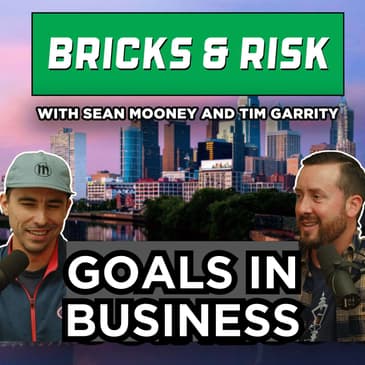
This week's episode dives into the topic of developing goals in business. As a business owner, it's very important to find out what matters most and driving behavior to succeed for those specific goals.
Our goal with Bricks & Risk is that you walk away with 1 or 2 valuable nuggets that help build YOUR business. Our audience grows through word of mouth, so if you would please take a moment of your time and give us a review on the platform you’re on, that would be fantastic!
Please also help spread the B&R word by sharing your favorite episode with a friend. You can find all B&R episodes on Spotify, Apple Music, YouTube, and anywhere else you get your podcast content. We greatly appreciate your time and trust.
Until next time, keep learning + keep growing!
📲 Contact Info 📲
→ Sean Mooney, Mooney Insurance Brokers: www.mooneybrokers.com/
→ Tim Garrity, The Tim Garrity Team: www.timgarrityteam.com/
💥 Watch us on YouTube 💥
→ YouTube, Bricks & Risk Podcast, @bricksandrisk: www.youtube.com/@BricksandRisk/?sub_confirmation=1
💥 Follow us on Social Media 💥
→ Instagram, Bricks & Risk Podcast, @bricksandrisk: https://www.instagram.com/bricksandrisk/
→ Instagram, Sean Mooney, @sean.moonee: https://www.instagram.com/sean.moonee/@sean.moonee
→ Instagram, Tim Garrity, @realestateinphl: https://www.instagram.com/realestateinphl/
→ Facebook: https://www.facebook.com/bricksandrisk
→ LinkedIn: https://www.linkedin.com/company/bricksandrisk
[00:00:00] Let's stick to renting versus owning. When you rent all the money that you give is going towards something else. But again, that might be enriching your life. Maybe you got a really nice rental, you know, there's no maintenance. I don't know how to take care of that.
[00:00:15] Maybe it's an apartment. I don't have to worry about anything. And renting doesn't mean you can't save money. Like you could have cheap rent. You could have rent for 500 a month. Yeah, sure. You can't even put money in the bank and kind of feel like you're getting rich.
[00:00:32] But when you own real estate, when you own it, there's lots of different things that are happening in order to make you wealthy. Welcome to the podcast dedicated to real estate insurance and everything in between.
[00:00:52] Join us as we take you along our own brokerage building journeys with additional wisdom from our network of business experts. Welcome to bricks and risk. Hey, everyone. Welcome to another edition of bricks and risk. I'm Tim Gardy. And I'm Sean Mooney.
[00:01:15] And today's Sean, we're going to talk about really cool topic. I mean, all our topics are pretty cool. Let's be straight up. No bias. We're just smart dudes. We're creative. So today's topic is going to be a little bit more philosophical. What do we do in today?
[00:01:33] What's your goal? And what I mean by that is, you know, people get into business for all different reasons. You know, some people get into business. They want to be rich. Some people want to feel free. Some people, as we talked about before, they don't want to conform.
[00:01:50] So there's all sorts of reasons why people go into the field of business. But then let's also talk about starting your own business because starting your own business is way different than being an employee. We've both done it. You've done it in insurance. 11 years.
[00:02:06] I've done it in real estate. Nine years. So when you first got into it, what would you say was one of the top reasons? Why you? What was your goal? Like why did you start your own business? I think that the main reason was we talk about freedom.
[00:02:30] I think that has to be for me, one of the, it has to be the top reason. And dive deeper. Like what does that mean to you? So when you say freedom, like what does that mean?
[00:02:40] Freedom in the sense that we talked about it earlier on one of the other ones was the ability to cultivate a business in the way and the manner that you want to do it. And starting your own business allows you to do that. Right?
[00:03:04] Because if you're an employee, you're going to be working for someone else. And you're going to be doing it the way they want to be done. Yep. So I think that is one layer of how I would define it.
[00:03:23] I think another way that I would look at it as well is really time. How do you want to build out your time with your business? And as a business owner, you do have the flexibility.
[00:03:47] So really kind of create a schedule that works for you, works for your lifestyle, works for your family. And so that was a big appeal for me as to one of the reasons why I wanted to start my own business. Yeah, I would agree.
[00:04:07] I would say that's, excuse me, that's one of my top reasons too. And I think I look at freedom in a few different ways. One, I look at it from the way of again, we talked about it before wanting to start something from scratch,
[00:04:25] having the wear with all to do it, creativity, the work ethic, you know, the belief that you can. But also with freedom too and here's a really good example. You have three kids. I have one. One is a ton. You have more freedom than I do. Yes, three.
[00:04:44] I wouldn't even know what to do with myself. It's just be completely honest. I'm not even a high-made here today. But let's be honest. Yeah. So having a wife, a daughter and a dog,
[00:04:59] here's one level of freedom that I find to be highly valuable in my own life. And I'm sure New York's and other people is the fact that you can kind of get up when you want. You can tell people you're available first thing or you're available at 10am.
[00:05:16] Or you're available at 1pm. You could also say, hey, honey, I have to do two hours of work on a Saturday so that I can take a half day on Monday. And you're not logging vacation, you're not logging PTO.
[00:05:36] You're not like in your head saying, like I don't only have two weeks. So I want to make sure that what I'm doing falls within those two weeks of PTO. It's you don't ever have to worry about how, you know, how big of a thing it is.
[00:05:54] Someone else is opinion of why you want to start at 10am versus 6am because some days, hey, I'm sending him out to 5th there in the morning. I am an early riser. And I think that level of freedom is to be honest is invaluable.
[00:06:10] I think it's priceless because, you know, just like living in the United States, you have an opportunity to do all sorts of different things. You can believe in whatever you want to believe in. You can do business a million different ways. You pay your taxes.
[00:06:26] You do everything you're supposed to do in this country and you can, you can kind of do what you want. And there's a lot of freedoms here that other parts of the world, you don't have. And like using that back to business,
[00:06:40] starting your own business, I truly feel that you almost have a heightened sense of freedom. Because as much as we talked about before that, like, you feel like, hey, sometimes you're working at 7am to like 10 o'clock at night. And you're doing things on the weekends.
[00:06:59] And you don't, you have that fear of losing a client or missing out. Or it's like, hey, we need that revenue to grow. Or it's like, hey, on my side, it's like, hey, I really want to get that agent that offer.
[00:07:11] Because if I don't give it to him now, then they'll sleep on it. And they won't feel as good about it tomorrow. So, but also just talking about that freedom of having the time, having the schedule that you want. I'm a big time blocker too.
[00:07:31] So, you can time block whenever you want. Sometimes, I'm time blocking something from 5 to 7 o'clock at night. And people are like, that's when I go home and have dinner. And it's like, yeah, but you had to be at work at 8 or 9am.
[00:07:43] Yeah, I didn't have to do that. Or are you time blocking? Like, is it your week? Is it your schedule? Family events here and you're making sure that your week is mapped out? Yeah, I'm a big Google calendar guy that's really how I run my life.
[00:08:02] Business and personal. And yeah, I time block for everything. Yeah. Like, every morning here's a good example. I get up with my daughter at 5 days a week. Pretty much like 7 days a week. It could be honest with you. And I time block for that.
[00:08:14] In the morning, I have, I really have two hours every morning where it's like, you're getting up, you're working out, you're getting your house in order. And then when she wakes up, she's got an alarm. It's like I'm there and I'm focused.
[00:08:27] And I know that she's five days a week. She's got to be at school, you know, a 45. You know, that's where I am in my life right now. So that's something I time block five days a week.
[00:08:36] Other things, like, you know, I have to do a blog post. I have to, you know, I have to take a client out. I still have to practice in real estate. I still help people buy, help people sell.
[00:08:47] I want to be in the trenches with my soldiers, with my agents. And I want to stay fresh. So that's something I have to time block for. This podcast, again, you know, we have to time block to get this done.
[00:08:59] Otherwise our businesses take over or our families take over or both. So if we didn't say this date at this time or this day, the week at this time, we wouldn't be able to do it. Even though we have all that freedom in the world.
[00:09:14] And let's jump onto another part of this. So another goal that people have, this is probably the most common goal I hear in business is money. Money and people want to get rich. I mean, hey, someone asked us, would you like to be rich?
[00:09:34] I'd be like, hell yes. That's part of the reason I'm in business. And then again, working for ourselves, sky's the limit. Yeah. Is rich or as poor as we want? I think it's, uh, it's giving you real thoughts. I just find a comical sometimes when people like,
[00:10:00] I start about the money. Yeah, I really do. Me too. Because at the end of the day, it just, there's a component to your life, your driven, uh, in part, I don't know, to what extent, but the money making money is, is a factor.
[00:10:23] And for me, I think that it was a big part of it, big part of my decision as to when I worked as an employee for someone else, you kind of in a way, saw a ceiling of, this is what I'm going to tap out at.
[00:10:47] Like, almost a couple years ahead. Yeah. So once I'm like two, three years from now, how much better is this really going to be? Yeah. Yeah. I remember that feeling. And my calculation of deciding whether it, whether I would start my own business or not,
[00:11:03] that had a lot to do with it. Because at some point, I remember thinking myself, man, I had a, had a really good year, but I'm really not that far, from where I was last year or the previous year.
[00:11:20] And I'm thinking of myself, but if I had, you know, my own brokerage, that it kind of gets compounded in our sense. Yeah. And so a really good year for myself is going to be exponentially better than a really great year working for someone else.
[00:11:47] So that was definitely a part of my thinking when I was, you know, weighing the options and how does money factor in? And where could I be down the road in five years and 10 years? And I remember, I remember when I left my old office,
[00:12:09] there was a, you know, when I told him that I was, you know, going off, I'm going to do my thing. Yeah. I don't know what to expect, but it was a scary conversation. Yeah. And it was along the lines of like, well,
[00:12:28] it's going to be really hard. And where are you going to, how are you going to be able to grow? And where are you going to get your leads from? And it was a whole like laundry list of like,
[00:12:37] this is why it's not going to work, and this is not why it's not going to work. And I just read and mapped out like the math behind it, you know? Well, if you do this and and that whole time I'm thinking like,
[00:12:52] after three or yeah, first three years might stink right? And I think the first year for us, it was negative, right? So first year I lost money. Yep. Second year for us is like we got to zero. Like, right? Yeah. All right. Yeah. Let's do this.
[00:13:11] Third year made a little bit of money, but then it starts to kind of compound from there. Yeah. And so I always thought, all right, well, I can suck it up for three years. And then your four or five, I'll be way ahead of where I was previously.
[00:13:32] And that is kind of how it worked out. Is the first three years were not good, but you're five, you're six, seven. It just kind of a little bit better, a little bit, yeah, a little bit. You have a residual based business.
[00:13:51] So it's easier to see that as the pot, as the volume grows, the residuals will grow. Yep. And then obviously, as the relationships get stronger, maybe those clients are getting a second vacation home, maybe they're getting life insurance. You know, they have no balls.
[00:14:08] They have more expensive asset now. So the premium goes up. Hey, everyone, this is Tim. Your favorite bricks and risk co-hosts. But don't tell Sean. I hope you're enjoying this episode. And I'll get right back to it in a moment. Our audience grows through word of mouth.
[00:14:26] So if you would please take a moment of your time and give us a review on the platform you're on, that would be fantastic. Please also help spread the B&R word by sharing your favorite episode with a friend. We greatly appreciate your time and trust.
[00:14:41] Now, back to the show. Here's another interesting part of money if we want to talk about it. So there's a difference between money and wealth. And someone once said to me, once I can't remember who it was, but it was pretty general they said,
[00:15:02] you want to get rich, stick with sales. You want to get wealthy, become an owner. And here's a good analogy I'll give. So let's get away from our businesses in real estate. Everyone has to live somewhere. You can live in a rental.
[00:15:21] You can live in something that you own. You can live in your parents' basement. Like everyone's got to live somewhere. Let's stick to renting versus owning. When you rent, all the money that you give is going towards something else. But again, that might be enriching your life.
[00:15:40] Maybe you got a really nice rental. There's no maintenance. I don't know how to take care of that. Maybe it's an apartment. I don't have to worry about anything. And renting, it doesn't mean you can't save money. Like you could have cheap rent.
[00:15:55] You could have rent for 500 a month. Yeah, short place somewhere. Put money in the bank and kind of feel like you're getting rich. But when you own real estate, when you own it, there's lots of different things that are happening in order to make you wealthy.
[00:16:10] So here are a few. One, you're paying down the debt that you owe. So as you pay down as you pay principle, that you're pretty much putting it like an bank account. It's what I call it. You're paying down principle, you owe less.
[00:16:25] There's also the possibility for appreciation of your home. So even if the market is flat, you're still paying down the debt. So you're still building equity. But if you're paying down the debt and the market is going up, events incrementally, then you're building wealth through that appreciation.
[00:16:41] Also, you have tax benefits. So if you rent, you can't write your rent off. You can't do that. If you own, you can write off your interest property taxes. If you own rental properties, I mean there's like repairs. There's all sorts of things.
[00:16:59] I mean, I'm not an accountant, but so there's a difference between being rich and being wealthy. And I think talking about getting into for me a goal of getting into, when I first kind of real says in agent,
[00:17:15] it kind of felt like look, I'm trying to get rich because like the more sales I do, the more money I make, the more I can say that I'm making right now and annual basis and it feels like I'm just...
[00:17:27] So that was your mindset when you initially started in real estate just from Gekko. Yeah, and the thing is too, I don't want to shortchange being an agent and say like you have to own a brokerage to get wealthy.
[00:17:40] That's not true. Even as an agent, you can invest, you can own rental properties. You can do all sorts of things. But basically, when I started, my initial mindset was like, my income is what's driving my momentum, let's call it.
[00:17:59] So I'm getting good at real estate because I'm making more money. But it's like the end of the day, your only as good as your two legs, your back and your brain. And there's only so many hours in the day,
[00:18:10] as you have said before, to sell real estate, to get rich. When I started owning a business, I started owning a real estate brokerage, this is a great story. We got in, you know, we turned on the lights,
[00:18:24] we're on a co-working space, we're around this thing, real lean. And we're automatically thinking, what are the subsidiary opportunities of owning a brokerage? One is title insurance, maybe mortgage, maybe it's development, property management. There's lots of different things.
[00:18:42] The lowest hanging fruit we got in a real estate was title insurance. So we got in and we changed our profiles on LinkedIn. And it was like swarm, like all these people came out of the woodwork. What was your LinkedIn profile? And what did you change it to?
[00:19:00] Well, I was an agent, right, an associate broker at US spaces. The broker's I worked for before Copperhill, right, to becoming the broker of record and an owner at Copperhill real estate. So people could see I own a business now.
[00:19:14] Yeah. It's not like I'm like leading a team, which again is a business in itself or being a successful agent, like I own a brokerage. That's to a on-face value, people are like, well that's a big deal. They're looking to do something here. So it's like all the
[00:19:28] title companies can't wear the woodwork and we talked it like 10. Just because they were coming at us, they're like, why aren't we doing business together? Like if we do title business together legally, now there's a legal way to do it as an illegal way.
[00:19:39] We're always by the book that's how we always run our business, how we continue to run our business and always well. But we're like, how do we legally do this? So they're also the same thing. We can give you X amount of dollars per month
[00:19:51] to go toward marketing, let's say, or like, some of the bills of your business and maybe we'll go, well, now work a little bit, we'll go to an Eagles game, we'll go out to dinner, and introduce you some people. So again, they just wanted to build a
[00:20:03] relationship. That's awesome. The only title company that came to us and said, here's the opportunity, how would you like to own a title company? And that is really the most legal way to build wealth from owning a subsidiary of being a broker-journer, having a
[00:20:22] second opportunity, which is being an owner and a title company, now you're really starting to build some wealth here. Because you get two things working for you at the same time, plus both
[00:20:31] of those things can grow in different ways. It only has to be. Isn't this saying something along the lines of, forget what it was? Millionaires, like the average millionaire has seven streams of revenue. Yeah. Something to that effect. Yeah. And I just know what you're talking about.
[00:20:50] I'll have the exact quote. But it just goes to your point as to, you can go out and you can sell real estate and you can make a ton of money, right? Or you can be an agent. You can buy investment
[00:21:05] properties. You can build a more strategic build a real estate portfolio. You could do classes. You can do real estate consulting. I mean, there's infinite ways for you to not just have the one
[00:21:23] and build revenue and building income based on that. And I think that's what you're saying is, yeah, for you, the bet, you know, those 10 that came to you and said, hey, we want an opportunity
[00:21:37] to work with you. Yeah. Obviously, the best one without knowing the details would be, oh, this firm to own that we're bringing in you in as part of it. Here's another good example. I'm sure
[00:21:53] you can apply this to moody insurance brokers. So you got two things going for you at owning your business. One, you have income now from your residuals from owning the business. You know,
[00:22:03] revenue comes in profit is after that after all the expenses. So you got that going on and maybe that gives you a little bit of a rich feeling. It's like, hey, I'm just increasing my annual income.
[00:22:15] But on top of that, you're building an asset. Yeah. So you're building moody insurance brokers. And what does that mean? It's just like copper, whole real estate. That is worth something to someone more times than not a competitor. And also more times than not someone larger than you.
[00:22:32] Yep. Who wants to grow through acquisitions? So that's the other part of wealth. Meaning it's like, okay, let's go back to the renting versus owning standpoint of real estate. You rent it, you pay someone
[00:22:43] else. Don't really get the tax benefits. You're not paying down a debt. There's nothing really to do except for maybe save some money or live or live well. When you own, you're doing lots of
[00:22:53] different things plus you have that asset. And over time the balance of your loan will go down. The appreciation will go up. So you're just building all of that value to that asset. The
[00:23:05] business is the same way. Like as the volume increases at your company and my company, that creates more revenue. You can get creative with expenses from time to time. And then eventually
[00:23:17] you become a player. And when you become a player, well now that business is an asset in itself, that is a factor of wealth. Meaning okay, it's like I got my income which anyone
[00:23:30] sales can have. But I have this asset that I can leverage in different ways. You could get a line of credit on that asset and go invest in things. You could see if anyone's interested in
[00:23:42] owning a piece of the asset. You could sell equity. You could even say, hey I have an exit strategy. Maybe after 10, 20 years of this, maybe I'd like to just sell it to someone,
[00:23:54] get out entirely and maybe I'll still always have a piece of it. Maybe I'll always have 10% always get a royalty. Whatever it is. So that to me is more the wealth part of owning a business
[00:24:06] of being in business. It's like you're thinking differently. You're being a little bit more strategic those seven streams. These are different streams that you have going on and it really brings us to
[00:24:19] to one of the last points we want to talk about today which is also a big part of being a business and owning a business and that's influence. So what are your thoughts on that? Influence. I would shy away from the term. I mean for me, it's like
[00:24:38] aside from having a podcast with millions of listeners. Yeah exactly. I mean, aside from millions that when we're like tens of millions, I mean it'll just be honest here. Aside from that,
[00:24:52] influence for me isn't really, it's not top of mind. It's not something that I set out to do. It's not something that consumes me. It's just not part of what why you got into this.
[00:25:09] It's not all my radar. It really isn't and I know a lot of people in my business, my industry that I guess do because I see agency owners that are online, social media and building a following and doing courses and doing consultant and working the convention circuit.
[00:25:40] I mean there's a lot of that and a lot of guys that really get wrapped up in that. For me, it's just not, to me it's just not there. Yeah and there's no, not for me.
[00:25:57] I think that's probably so again there's going to be two sides of influence. There's like there's the ego part where it's like I want to feel important. I want to be a leader. I want people
[00:26:07] to look at me that way. Whether there's money involved or not, let's just say, for whatever reason you just want to be looked at as one of the leaders in your market, in your industry,
[00:26:16] whatever it is. That's the ego part, neither your eye have any interest in that. Then there's also the ego part that leads to money where you could be a leader in your field. You're very into your ego to make yourself seem confident, obviously knowledgeable, which you
[00:26:34] probably are. Is that what leveraging that for more sales or or ships or coaching? E books, speaking engagements, all these things. That's the part of influence I would say you and I are
[00:26:52] really not interested in. Let's go to the positive side of influence. It's kind of like this. Like so we wanted to do this for a couple of reasons. One, we felt like we could. We had enough to add. Maybe we don't, but let's say to be determined.
[00:27:11] But us wanting to do this, I think in the back of our minds, we're also like, it's probably helpful on people. That's where I would go with it. And that's really because again,
[00:27:26] you and I love podcasts. We're listeners. So if we're listeners, why do we listen? We listen because we're looking for advice. We're looking for perspective. We're looking for guidance, mentorship, coaching, like all these, and you might just take a little tip of here or a little
[00:27:43] tidbit there. But that's why we listen. So it's like we listen so much that we're just like we have a different thing to add. To that, let's just call it to like to the universe. We could
[00:27:55] just put it out there, put that good energy out there, that advice. There's a reason we're doing these topics is because we feel like we can speak intelligently on them as I mix up my words.
[00:28:07] And we also feel deep down, even who is one person who listen to this and walked away feeling good, that's awesome man. That's a win. That's the positive side of it. So
[00:28:20] and I think going off of that is, if you listen and I'm sure you have like your line up of podcasts that you listen to. I do. I'm a real estate, you know, funky, yeah, junkie. So like the
[00:28:34] top five, three, four, five podcasts that you listen to, I'm almost certain that in each, let's take your favorite one. In each episode that that podcast delivers, you're taking something away from that. Everyone I get, I call them nuggets. Yeah, I want to get
[00:28:54] one or two nuggets. I call them dimes. That idea is a 10. That's a mooneyism. I guess. All right. I got my dimes. That's a good time there. But I think that to kind of your point is like
[00:29:14] part of the reason we decided to do it was we get so much valuable information from these podcasts, the people we listen to even create relationships with some of these people that are in our
[00:29:27] industry or connected to our industry or just out there, talking about business. Yeah. And having this gives us a platform to like you said, maybe someone listens and gain some valuable
[00:29:44] information from what we have to say. So I think in that light, I think influence, I would agree is one of the positives that I would look towards. Yeah, and then also Ken Parlay into what we've
[00:29:58] talked about before in a previous episode, which is relationships, you know, getting relationships out of this. Yeah, I've even listened to podcasts from someone locally that I've had them speak in front of my real
[00:30:10] state team, which you were there for. And and that to me was me being a listener. Now, I'm almost like, when we're at this spot, we're trying to think who can we talk to because we want to,
[00:30:22] we want to let the know how much we appreciate what they have done. We've put out into the world that has helped us that we want to give them an opportunity to be seen again, to be heard in a
[00:30:33] different light, you know, we're just switching chairs. So it's like, if you want to, you want your audience, you want to bring value to your audience. So that person has value to lend and by opening
[00:30:46] a door to your audience, it just kind of multiplies what they can deliver. Yeah, well said. So we're going to end on that note everyone. So thank you for tuning again to Brickson Risk. See
[00:31:00] the next time. Thank you for joining us on another episode of Brickson Risk. Our goal is that you walk away with one or two valuable nuggets and we greatly appreciate you sharing your time with us today.
[00:31:14] You can find all B&R episodes on Spotify, Apple Music, YouTube and anywhere else you get your podcast content. Until next time, keep learning and keep growing.