
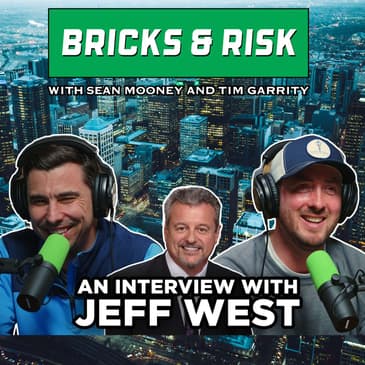
Critically acclaimed author, Jeff West, joins the show this week to talk about winning the sales process. Successful sales people don't win by accident and Jeff shares the secret methodology behind his many years of being a top insurance sales producer. We also discuss his latest book, co-authored with Bob Burg "Streetwise to Saleswise," which uses a business parable to teach the sales system.
Our goal with Bricks & Risk is that you walk away with 1 or 2 valuable nuggets that help build YOUR business. Our audience grows through word of mouth, so if you would please take a moment of your time and give us a review on the platform you’re on, that would be fantastic!
Please also help spread the B&R word by sharing your favorite episode with a friend. You can find all B&R episodes on Spotify, Apple Music, YouTube, and anywhere else you get your podcast content. We greatly appreciate your time and trust.
Until next time, keep learning + keep growing!
Follow or reach out to Jeff with the links below.
Jeff West - Website
Jeff West - LinkedIn
Jeff West - Facebook
Jeff West - X.com
📲 Contact Info 📲
→ Sean Mooney, Mooney Insurance Brokers: www.mooneybrokers.com/
→ Tim Garrity, The Tim Garrity Team: www.timgarrityteam.com/
💥 Watch us on YouTube 💥
→ YouTube, Bricks & Risk Podcast, @bricksandrisk: www.youtube.com/@BricksandRisk/?sub_confirmation=1
💥 Follow us on Social Media 💥
→ Instagram, Bricks & Risk Podcast, @bricksandrisk: https://www.instagram.com/bricksandrisk/
→ Instagram, Sean Mooney, @sean.moonee: https://www.instagram.com/sean.moonee/@sean.moonee
→ Instagram, Tim Garrity, @realestateinphl: https://www.instagram.com/realestateinphl/
→ Facebook: https://www.facebook.com/bricksandrisk
→ LinkedIn: https://www.linkedin.com/company/bricksandrisk
[00:00:00] People naturally, maybe not everybody, but there's certainly a percentage of the population. Naturally, would rather say no to a salesperson than yes. Your so-latch just get the sale closed by getting them to say no.
[00:00:13] And what I was closing question that I'd be teaching, in fact, I even work at industry was, is the question. After you've finished everything, say, well, let me ask you a question, and please feel completely comfortable telling me no.
[00:00:28] Do you see any reason we shouldn't move forward with this? Well, no. So when I say no, they're actually taking that next step. So, that's the episode of Bricks and Risk, Tim Garry. And I'm Sean Mooney.
[00:01:12] Today's Sean, we have an awesome guest on, we have Jeff West, author, award-winning author, best-selling author, speaker and leadership coach. How you doing today, Jeff? Going quiet, well, my friends. Thank you so much for having me on your show today.
[00:01:30] Oh, thank you. Thank you so much for being here. So, little background on Jeff, with over 30 years in sales sales leadership and entrepreneurship experience, Jeff has coached and led sales teams in multiple industries. During his corporate career, he was among the top sales
[00:01:44] performers and leaders in the nation. And for over 20 of those years, Jeff was in the field of sales management with Fortune 500 insurance company, Affleck, Affleck. As an author, Jeff's books include The Unexpected Tour Guide, Asselsman, A Homeless Men and An Incredible Adventure, which came
[00:02:04] out in 2014. Said the lady with the blue hair, seven rules for success and direct sales, wrapped in a wonderful lesson for life, which came out in 2022. And his latest book, Street Wise to Sales Wise, become objection proof and beat the sales blues, came out in 2023,
[00:02:22] and he co-authored that book with the infamous Bob Berg from the GoGiver series, which that's just an unbelievable background. Let me first say that Jeff. That's really one of you know, I've had a very blessed life in many ways. Yes, you totally have. So, and a few more
[00:02:41] quick things. So, Jeff is one numerous awards for his books. He's been a guest on many different podcasts and sales leadership shows. And he is also a member of the GoGiver Success Alliance, which was
[00:02:51] created by Bob Berg. So, one thing you always say, you say you should never try to overcome objections. But if you don't, you may not be able to advance the sale. So, talk a little bit about
[00:03:04] that and why objection handling is such an important part of business. You know, that's such a great question to him. The whole idea in traditional sales training has often been that you're going to
[00:03:19] get certain objections. And so, you would train the salespeople. Okay? If they say this, you say that. They hit it this way, you hit it that way. And before you know it, it's like a ping pong match.
[00:03:29] And nobody's really advancing anything. And when you do that, psychologically what happens, we all make decisions with a combination of logic and emotions. I've got a branding called Pusion Points where I dive pretty deeply into that. But not only really amounts to is inside our
[00:03:47] brain when we have an emotional response to anything, our brain immediately sends an electrical signal into our chest and to our stomach. And we have a somatic marker. We feel something different because of the emotion we're experiencing at the time. When it's a negative emotion, the feelings
[00:04:04] that somatic marker sets off or feelings that you just don't want to be around anymore. You want to push back from it. But when it's a positive emotional experience, it's the exact opposite.
[00:04:14] The somatic marker generates feelings inside of us that we truly enjoy. And so, what I take some fusion points is that it's that combination of positive emotional experience with the logic of what you're trying to get done at the time. It results in a comfortable decision for someone
[00:04:32] to move forward. But in the process of how most salespeople are trained to handle objections, they're trained to create what I call a collision point because the truth is no one wants to be overcome by anything. You think about it, an objection, basically, is very similar. I tell
[00:04:50] everyone it's similar to a political opinion and nobody wants their opinion overcome in any way shape or form these things. And when you have a salesperson who gets an objection and then
[00:05:02] tries to overcome it. Well, if you look at the root words for overcoming, it really comes back to concrete. If you go back far enough, and no one wants to be conquered, they want their opinion
[00:05:13] to be respected value. Even if you're not going to agree with it, that's not what they want. So the whole idea of overcoming objections is really a fallacy and how anyone should do the sales process. Instead, you need to work and learn how to work comfortably within that
[00:05:30] objection so that you and the prospect together find a solution that is perfect for that. And if it's not perfectly, at least it's close enough that the way you handle it makes them comfortable
[00:05:42] and moving forward in your decision process. It kind of sounds like people's default when you talk about those psychological reactions. I love the psychological part of business. It's like a dog collar with a shock. They're default positions. No. You propose this and they
[00:06:07] know. And sales is probably working around that. Can you tell me, massageing that or knowing that it's coming and setting the table? Is that how you propose it with sales? We have to show that's a great way to look at it. In the sales process,
[00:06:29] I always say sometimes salespeople are just taught so many bad habits from the get-go. And they get into the idea, well, let's have a sales presentation. Well, sales presentation is self. I don't care for the term because that gets the salesperson talking way more than
[00:06:43] their listening. Yeah. And so I like the term sales conversation. But it's just like you're just kind of alluded to their shop. If you're having a conversation with someone and you've been doing sales any amount of time, there are certain objections. You know, they're kind of built
[00:06:59] in to the business model of what you're doing. And so once you kind of get a handle on that, then you can actually prepare for that in the actual sales conversation itself. And if you can
[00:07:12] present that potential objection along with the solution. And what it amounts to is when you do it in the actual conversation, there you do it during your discovery section because the better your
[00:07:23] discovery is, the fewer their objections are going to be anyway. And so if you ask great questions during that discovery part, and then you take the time to take your standard objections that
[00:07:36] you're going to get in your field. And you present that in the mix along with the solution to it, at that point because it was coming during what you were having a conversation about,
[00:07:48] that that issue being brought up with the solution is education. But if you wait until that sales conversation is toward the end, then your prospect brings up that it's saying issue, it's no longer education. It's an objection. Now you can still deal comfortably with it. We take
[00:08:05] a process in the book, street wise to sales wise, it does a beautiful job of that. But you can do that. But at that point there's a way that we teach you to do it. That instead of creating an issue where
[00:08:19] you're triggering all of their negative emotions that combine with logic, we're teaching you how to do it in such a way that they actually come out of it, having a stronger bond with you because
[00:08:29] you handled it more like a friend who's trying to help them find a solution to something that's important to them. That's awesome. Yeah, one thing you just said there Jeff that I really resonated with me and I think this probably comes from your background of my background or
[00:08:42] kind of similar in corporate America. I was in corporate America for like a little less than a decade with two very big companies is you use the word listen. And one thing in corporate America that
[00:08:53] they taught me, more or less the last company I worked for before I got in a real state was Pulti Holmes. They were one of the top three largest residential home builders in the United
[00:09:02] States when I worked for them and it was a wildly successful business. Amazing culture training everything and they were very big on listening more and talking less. They taught their sales
[00:09:13] people that I was more in their mortgage side of things and you being with AFLAQ and obviously being in like management and a corporation which is what I was doing too. Like you get all this amazing
[00:09:24] corporate training. So talk a little bit about when you were with AFLAQ and prior to what you're doing today which is more or less, you know, you're coaching your writing amazing books. Like
[00:09:36] what did AFLAQ teach you about listening as far as objection handling? Well, you know, I think all corporate training can at times follow those sport in that arena and although AFLAQ certainly
[00:09:50] did teach sales process where you were asking questions and trying to get you to get the prospect to be able to to vocalize their needs and verbalize it so that you could have a real conversation
[00:10:03] about them. It kind of probably felt just a little bit short and I think we're I learned a lot of my focus about how to ask questions that got going. Once in study that I did,
[00:10:16] that was outside of my corporate structure. And one of my very favorite books I laugh about this because I've told the story so often in January of 2000 I had a sales mentor who was a state
[00:10:28] manager with AFLAQ at the time they gave me two books and he said Jeff won't you to read these books and I said his name was Frank. I said Frank Davies I'm a grown man. I'll decide whether I
[00:10:38] read them but for not and I am going to read those books. There were two of them one was John C Dr. John C Maxwell's 21 air refueling. That's also my notebook. Oh, everybody who's leading a team in
[00:10:53] any industry should devour that book and the second book that he gave was a book that I never heard of and I had never heard of the author and it was some kind of Bob Bird and it was called
[00:11:05] The Three Pearls and it's so funny. I literally I took those two books in January of 2000 and began to apply them in my own business model. Neither of the books were about insurance
[00:11:19] but they had such great lessons and I think it was endless referrals really where I learned how to do that. I learned how to ask the questions that were so focused on the need or the benefit
[00:11:30] to the person that I was visiting with and got them to talking about their issues and what I learned quite frankly guys is I learned that if I asked the right questions, the prospect would say what
[00:11:43] they needed to hear. I didn't have to be the one to say it. You know I could have told them well you know we can do this in this and this is going to help you employ a benefit program. You're going
[00:11:51] to attract better workers. You're going to retain those workers. I could have said all of that but if I asked the right questions and they say it oh it's so much more powerful because as a sales
[00:12:02] person what we all have to kind of realize is it's not necessarily our fault but the general public doesn't look at the words coming out of a sales person's mouth when they don't know
[00:12:14] like or trust us, sales person. They don't necessarily think of it as being the gospel truth but if you ask the right questions and they say it oh there is no doubt that it's true because
[00:12:25] it came out of their mouth. So I learned I developed the questions but I learned how to ask the questions that will get that person I'm having the conversation with to think through their issues
[00:12:35] and what the solutions would be and when I asked those questions and they said two or three things that I knew we could help with then it was very easy for me to put a psychological context with
[00:12:47] it where the positive emotional response was because I was going to be able to help them do something that they're already telling me they want to do and then I had the logic to back it up
[00:12:56] and so I went out with ask those questions. I would say we know I have some really good news for you today too. There's some things you just tell me that you're trying to do
[00:13:05] the weekend actually help you do. For example you said you wanted to blue widget instead of a green widget we've got the best blue widget symbol or I mean you get the idea yeah but if I
[00:13:15] I were to say it as a sales person it might be suspect but if they say it is the gospel truth and it's not really good we're going to put it. Jeff I heard you talk recently about
[00:13:25] the psychological tangling of working with a client and you had them land on a no to close the deal. You remember talking about that? I've been on so many shows lately guys
[00:13:40] I might have to get to the get a little more. I think it was like you were uncomfortable with them saying no to you but the way that you did it was if you're able to get them to a
[00:13:52] greedy or terms by saying no then it was really like you're doing it on your terms but them telling you no. Perfect Sean that's exactly right and how I used to and for decades my life I talked people especially newer salespeople that seem to be
[00:14:14] possibly a little bit uncomfortable and it came time to ask for that order to get the paper or done. I've taught everybody you know people naturally maybe not everybody but they're certainly percentage of the population that naturally would rather say no to a sales person than yes.
[00:14:30] So let's just get the sale closed by getting them to say no and what I was closing question that we teach in fact I even work at industry was is the question after you've finished everything
[00:14:43] saying well let me ask you a question and please feel completely comfortable telling me no do you see any reason we shouldn't move forward with this? Well no. So when they say no they're actually
[00:14:56] taking that next step yeah so say that. And that's the whole psychological nature of people and knowing them and sales letting your guard down you know letting the customer be in control
[00:15:09] I mean at the end of the day why are they even talking to you they have a need there's a need for that blue widget and they're like I know I need a blue widget but I don't know Jeff and Jeff's job
[00:15:19] is to sell me on Jeff because I can get blue rit blue widgets wherever I want and and that also brings me my next one I want to talk a little bit about framing because I know you've talked
[00:15:30] about this before so what is framing in more of a business context and like why is it so important in business but also could be important in your life you know your married life your parenting life
[00:15:41] friendships. Sure you know it's amazing to him how often the same principles that we'll learn that will make us successful in one area of our life do exactly the same in our other areas of
[00:15:53] our life as to basically a frame is just how we see the world you know every experience that we've had up to the ones we're having right now kind of shapes how we see the world and no one else sees
[00:16:06] the world exactly like we do and sometimes that focus may be on what's going well might be on what's going poorly so it's just that's just how we see the world and in the idea of reframing or
[00:16:19] setting that frame a little differently is so important in a sales conversation especially when you get to the point that you're dealing with the objection process which may happen that may happen for you
[00:16:29] because you see at at the very core of of sales at its very best it's exactly what you said earlier it's about it's about finding a person that has a need and then being focused on them being focused
[00:16:46] on how their world gets better once you're part of their working with you and you're part of their existence and so when you can do that we're fortunate we find a person with a need and a
[00:16:57] company with a solution or it may be our solution if we're an entrepreneur but we find that we put the two together and we get paid for being a matchmaker well in the process of your sales
[00:17:07] conversation you have to kind of go into it unless it's a referral from someone who already knows likes and trusts you and they you're borrowing their credibility with that individual you're
[00:17:18] missing with you have to kind of go in there thinking okay they may or may not have a very positive opinionable as sales is like or what sales people are like so from the very first moment you're
[00:17:28] in there your goal is to change that frame slightly and you do that but when you're getting to know them in the rapport section you're going to do you're going to do some of that then because it's going to
[00:17:39] start that personal connection when you have the actual discovery part where you're asking them questions and then you're listening and telling you what they're saying because you know that their needs are what really matter not not what you did nobody's going to buy for
[00:17:53] almost because we have a quota or we have to pay our bills they're going to buy for almost because they need something that we can help them get so excuse me as you ask those questions
[00:18:04] you begin to shift their frame what they think as else person is and then when you get to an actual objection part of that process is after you've you've listened and you've asked the right
[00:18:17] questions about their objection making sure you're getting down to the real issue when you actually offer a solution because of the way you've handled it up to that point with your empathy level
[00:18:27] and the right questions so that you can help them find a solution and you're not you're not telling them they're wrong in their objection by giving them the solution to it immediately you're asking
[00:18:35] so you make sure that you can find something that works well for them you're reframing their their perception as a salesperson or what a salesperson is and then when you offer your solution
[00:18:46] you're just slightly shifting the frame so they can see it from a different perspective and see how a solution may work for them and that and the reframe is completely this that's what makes that work
[00:18:57] in our office we actually did a similar exercise with our service team so our service team at times can get super busy and you know Mrs. Jones called about this bill or that bill
[00:19:13] and we had one day where it was just over the top right my service team was complaining about said caller and I my response was well what if Mrs. Miller's sister just passed away
[00:19:34] right and I got a great way great advice because people don't think about that I got a look back like what do you mean I said well let's just let's just to your point reframe reframe the conversation
[00:19:48] if that conversation started with my sister just passed away today and I'm trying to deal with with these different bills and I'm a little behind I said your approach would be 180 degrees different in dealing with that person so I said why don't we have the approach of
[00:20:09] always taking the one we're dealing with a service perspective why don't we always and I went to the extreme I said why don't we always have the vantage point of Mrs. Miller's sister just died
[00:20:24] so that you start with empathy you know with our clients and and it's going to frame the conversation so much better yeah well it is shown that's some great coaching for your team because without that reframe like that and without that at level of empathy from the beginning
[00:20:44] it's impossible for them to do their job because when you get down to it a lot of companies will preach about their value proposition and it'll be you know this is what the transaction is we're
[00:20:56] giving them this they're giving us a some compensation and that's the transaction but then we do this in this and this on top of it they kind of think of that as their value proposition but that's
[00:21:05] really not what I consider a value proposition a value proposition is totally about how your clients live as different because you're there and it might be a claim time that you're helping them
[00:21:19] with a very difficult issue I used to go work claims in person yeah that that was back before the days when they the hippo rules would put a habit that but I got involved in doing that
[00:21:29] but when you do that you can really focus on them and the truth is our value proposition is an hours at all it doesn't matter how great our company is it doesn't matter how great our service or
[00:21:40] product is it doesn't even matter how great the sales or customer service person is even though I'm sure they're absolutely wonderful it's about how their life is different because we're there so in essence I was it's their value from our proposition and that's what a value proposition is
[00:21:56] and the way you frame it with your team there's on it's it they can't do that unless they are approaching it in such a way that whatever my potential client or whatever my clients going through
[00:22:06] this is about them today how can I make their world better hey everyone this is Tim your favorite bricks and risk co-host but don't tell Sean I hope you're enjoying this episode and I'll get right
[00:22:18] back to it in a moment our audience grows through word of mouth so if you would please take a moment of your time and give us a review on the platform you're on that would be fantastic please
[00:22:29] also help spread the B&R word by sharing your favorite episode with a friend we greatly appreciate your time and trust now back to the show the other claim to fame that I will give myself
[00:22:47] I don't want to give yourself another one pal yeah mine my line that I always use in my team is their perception is reality you know whatever that person's going through whatever that person's
[00:23:01] dealing with that's the truth it doesn't matter if they're wrong let me let me give Jeff some perspective here so we've known each other for about 30 years and Mr. Mooney over here I'm only 36
[00:23:17] Mr. Mooney over here is very much his perspective sometimes can be my glasses half empty and I'm very much my glasses half full which is why this podcast is going so well if I don't
[00:23:29] say so myself because we give two different perspectives not only on business but on life and a lot of times when we talk about things and there isn't a guest on such as yourself
[00:23:42] like we're really like there's a lot of things we see similarities in but again perception is reality and I I wholeheartedly agree that you have to understand not everyone sees it the way you see it
[00:23:53] especially when you get on the horn with them plus sometimes when someone's upset I've had people on my team say this too they're just like what did I do wrong it's like you might not have done anything wrong
[00:24:02] what if they're having an awful day and you just happen to be on the front line of that so it's not always about you and what you did wrong it they could be having a rough day which
[00:24:12] then allows you to be empathetic it allows you to understand not everyone looks at things the way you look at it case in point and also understand that sometimes when someone is not being nice to you
[00:24:24] on the phone three mail at a closing whatever being patient with them and saying what can I do to help be able sometimes allow the problem to come out I'm so sorry I said that to you know having a
[00:24:35] bed day my sister you know my dog or work or you know stress or whatever it is and I mean what do you think about that you agree with that? Absolutely and if you've developed the right connection
[00:24:49] with that person through either the sales process if it's early on in the commerce section where if it's taken care of a customer after the fact if you've developed that because your empathy is showing and you're asking questions and you're creating a connection with them it's a positive
[00:25:04] connection for them even if they're having a credit day then once that connection is there and they start feeling a little bit of that no lack and trust relationship they'll give you permission to
[00:25:15] shift their perspective and you have earned that right at the point and so you can actually make their day better you can even make their their situation better but you're on the product or service
[00:25:26] but you do that because you've earned that right because they're seeing how you are with them and they trust you well. That's great advice. Jeff with all of the sales and the psychology
[00:25:39] that we've kind of gone over I would have had to assume that you were either a psychology major or a business sales major in college is that right? Do I have a right? You are still close I've
[00:25:53] got a bachelor's in music and master's in music composition. Those two degrees are going to get me a cup of coffee and Starbucks. So how did you go from from music into the world of
[00:26:09] business or insurance and go down that side? That's one of my favorite stores because I met one of my heroes when this happened I'm just going to let you guys know that at the time. I was finished
[00:26:22] you got my master's degree. I needed to get a teaching job open somewhere in the area where my wife needed to finish her degree. There were no teaching jobs open at the time and so I ended up getting
[00:26:35] a position in sales almost I say by default but now look back now I think it was divine providence but I had a guy that ran a musical instrument company. I knew him as an acquaintance
[00:26:49] but I didn't really know him as a person. It's got a Jack Emerson used to one of my characters actually my first book he's awesome guy. But he had said come out here spin the week with me
[00:27:00] at spring break ride with me see if you want to do the job or not and so for the entire week guys I lived at his house I hated his table it was it was it was it gave me the exposure to no
[00:27:12] whether or not I wanted to do the job and I did and I did a make a 50% more than I would make teaching and I just never went back to teaching but the reason Jack Emerson is one of my heroes every
[00:27:22] morning. When we'd have breakfast and coffee his kids at that time were first grade and younger he had two kids boy in it all. Becky and Ted. So you didn't get my ass off.
[00:27:34] But every morning that running and it jumped up on his lap and he would give them a hug and a kiss and he said I am I love you so much I am so glad God picked me to be your daddy. Now guys I had
[00:27:47] not been raised like that yeah I hadn't been raised I know my parents love me they worked hard they put food on the table but nobody ever said that it wasn't it it was just I shot to my system
[00:27:59] and guys it not only changed my world when I got two daughters it changed their world I've got grandchildren I've seen it passing down through there I'll get people who've read the unexpected
[00:28:10] tour guide I have somebody's from Australia it's in me something the other day how much it meant yeah and it's just a little thing like that I learned great sales lessons from the guy too but that
[00:28:21] he's like a world outside of sales but he's so much better. Yeah what a great story awesome all right so speaking of stories let's talk about your books and I want to focus on your latest book street wise sales wise become objection proof and beat the sales blues
[00:28:38] and you co-author that with Bob Berg but first tell me a little bit before you and Bob decide to do it together you know your first book was 2014 then twenty two and you did one right after that with Bob like
[00:28:49] what was what brought that out was it the two of you together did you have an idea well that's such a great question Bob and I've actually been friends now for about twenty one
[00:29:00] twenty two years awesome it's so funny I told you how I was recommending and let's refer old's to everybody and then yeah I got a call one day on my office and play no text us when
[00:29:09] I was a regional manager and my administrator says there's some kind of the phone named Bob Berg and I said oh sure I got one of my friends out here pulling my legs because it's just a
[00:29:18] bomb you're fan you know and then I get all the phone and you guys know Bob he's got this positive vocal velocity and he says hi Jeff this is Bob Berg and I said guys and I quote sure it is
[00:29:29] Bella I mean excuse me I told him the story we became friends we've been friends every sense but Bob and Kathy Tagenel started a group called the Gogever Success Alliance and I was one of
[00:29:46] the first members of that and the last book said the lady with the blue hair grew out of that book my co-author on that book was in the zoom and she's feeling very intimidated she was this
[00:29:57] and she's a bond's fifth highest earner in history well she's a million dollars with a whole and her name is Lisa Wilberg great lady great book but she had was in the chat and she had
[00:30:10] blue hair that day she felt very self-conscious about it so she got her turn on the the screen and she said you know I wanted to explain my blue hair so she told why she had it and she said but
[00:30:20] you know what there's a side benefit she's from new hand I'm gonna do my best new hamster accent she said there's a side benefit here when when you got blue hair I came in the grocery store
[00:30:31] and I can say that girl sure looks like she's got a skirt as too short and too tight said the lady with the blue hair stop being so judgmental no it's so for the message I said that would be a
[00:30:46] great book title and you didn't do that and then later she and I explained that we took lessons she talked about seemer cool and we turned into the said the lady with the blue hair but with Bob and I
[00:30:55] think it was both quarter of 2022 and blue hair had just come out and it was an album growth of that group and it was doing well so that was a good promotion for the group as well but Bob sent me
[00:31:09] an email we're always discussing sales issues and he sent me something where to get my opinion before he put it out and so I replied back to his email but the very last sentence in his email was by the
[00:31:21] way saved this because when we do our parable this could be some good information and so I replied though his thing and we never discussed doing a parable ever even though we've been friends for
[00:31:31] so long yeah and so when our Applied Museum of the Alliance are getting us said oh and by the way if you're serious oh heck yeah yeah we're doing this uh huh and he he had some material that it was
[00:31:43] a hot somehow to material called becoming objection proof and it's basically it's a step must up process that when you do that when you get an objection you get you not only do you stay calm and you get
[00:31:56] that prospect on your side because you're really trying to find out what their real issues are when you get through you built a bond in addition they help them in financial solution but he had
[00:32:05] that information and he always wanted to do something whether but he just didn't want to go through the process of turning it into another how to book and so we took that information plus
[00:32:16] like I said Bob and I've been friends forever I've got a ton of sales training too so that this isn't unique co-authorship as far as sales parable goes because oftentimes what you find is
[00:32:27] you've got one person's material and then you got the story spinner which is me in this case what it writes the story but in our case it has so much of both of our training in it not
[00:32:37] yeah I was the lead writer and I spun the tail but it's got so much of Bob and I was telling Bob heck even half the stuff that's me it's because I learned it from you and it's let's
[00:32:46] reparls it doesn't put my spin on it so it was just such a blessing and he is I'll tell you guys too he literally is the same guy behind the scenes as you see in his public persona
[00:32:58] I've never seen a man cell focused on helping others and making a connection brothers and getting paid in return and that's that's just thing but he loves awesome yeah how did you land on the parable style when you when you do the business but that's a little bit
[00:33:13] of this and it's a different take but very unique and but I think it works well but it'd be interested to hear how you kind of came to that style and and how it works for you you know for
[00:33:24] me Sean the my first variable that I remember reading I guess was augmenting it was greatest sales movement in the world and I just thought that there was such a neat story and I found myself over
[00:33:36] the years I can I can read and learn from the how to books I'm working on a book right now called 10X is easier than two X it's a great book and so I can get a lot out of that but the
[00:33:46] ones that I enjoy the most are the business parables or the sales parables whatever you want to call them and it's because the story itself says something that grabs my attention in such a way
[00:33:59] that I it catches my heart and then I'm not only am I learning things but I'm rooting for the character to learn this too wow and that goes back to you know my concept of fusion points
[00:34:11] it's about connecting a positive emotional response with a logical what are you doing and nothing in a how to but does that so well even if you had stories they'll do it some
[00:34:21] though when you write a good sales parable or business parable it has the power to stay with people forever yeah that I mean that's so awesome so I read I read the go-giver fantastic book
[00:34:34] and normally I'm not a big reader I always say on this I'm like Sean's the better man you know he reads more books smarter yeah if I'm kind of like you I was the English major in college and
[00:34:47] when I graduated they said oh great you're gonna wait tables or teaching what's what are you gonna do maybe both but yeah I think what's what was interesting about the go-giver because
[00:34:59] most of what I consume is very it's it is very how to I listen a lot of podcasts it's giving sales advice I watch a lot of business shows I watch Shark Tank I mean you're watching these things
[00:35:08] it's very busy but the one thing about the go-giver that I found interesting from someone who doesn't read like fiction it kind of had like a fiction like sense to it even though it's teaching
[00:35:20] you stuff because your focus is business and when you read that book yeah like you said you kind of are like rooting for people and then like in your mind you're like oh this person's probably
[00:35:30] like this and like the relationship with him and his wife and you're like they're probably like that and like it's just a different way to digest hard to consume information for a lot of people
[00:35:40] because a lot of people you know as much as I love the pragmatic approach to business a lot of people can't consume that it's just like a super-ring it's not exciting I can't relate to it and then when
[00:35:52] you read stuff more in a parable style I agree you really kind of get into you get into the characters you get into the story it makes you want to keep reading more and more you know that
[00:36:02] and nothing is more music to my ears than when someone has red-screen wise to sales while there anything that I've written and they tell me even if I hadn't been in sales even if I hadn't learned
[00:36:15] anything I would love the story and when we get that back in in this case of course we have the audio book on audible and it's Bob and I do in the narration on the audio book and
[00:36:26] in all the formats that you can get them look in it is just it's one of those things that especially on the audible it's like you're sitting in your car in a live selling situation next
[00:36:40] to a mentor who's doing the job and you're learning from them at that time and it just kind of reminds me as you talked earlier about you know having that initial job and you know working
[00:36:51] day to day you know with your boss early on and getting able to see and and deal and and look at those situations and how's he dealing with this or how's he doing with that kind of really
[00:37:04] absolutely absolutely one one question we asked so we always ask our guests a few different business questions you know we like to have more of like standard questions to get a sense of
[00:37:14] what their take is in perception so we asked what's one of your tips to help our listeners you know find success in business and you would said be focused 100% on how your clients world becomes
[00:37:25] better by what you do and then craft phrases that match that mindset focus on their value from your proposition and I know we kind of touched upon that but why why was that the one
[00:37:37] that you decided to share when we asked that question it because in my opinion that's the thing that I learned that catapulted my personal career and I go back to endless referrals with
[00:37:48] Bob but I basically that book got me to understand better than anything else I had read before that it wasn't about me or my company or what we did it was about how that person's life gets
[00:38:01] better that I'm talking to right now how would they're really better if they took the step I'm asking them to take and so what I began to do it not just in a sales conversation but I would even
[00:38:12] do it with a conversation on the phone or face to face about was making up my first initial contact with a company I would focus on that the administrative system assisted that I was dealing
[00:38:24] with how their world was going to get better with a relationship with me you know now in my particular case back then with that like it was easy it was an employee benefit program I knew
[00:38:35] that if that person ever needed us they were going to be really happy with what they got from that like because I was going to help them with the claim I was just going to do all of that and
[00:38:44] so once I understood what Bob was teaching about being focused on the benefit of the other person and I began to put that in my phraseology a gatekeeper that you use the term gatekeeper
[00:38:56] into keyholder when we air in the book but someone that you originally first think of as a sales person is maybe a gatekeeper once I began to focus on the benefit of them it allowed me to reframe
[00:39:07] that even in me so that I looked at them differently and I began to say phrases where that person would understand you know if they help me get in to see the right person their world's going to
[00:39:17] get better if they have an accident or an illness or whatever and I began to communicate that and then all of a sudden they were no longer gatekeepers they were keyholders they were
[00:39:25] interested in helping to get to the right person oh that's okay I love it and another one that we asked to is that we asked for go to quotes and the one that you would put in our questions is
[00:39:38] you can't make a six figure income on minimum wage effort once you dive in that one a little bit because I thought that was great thank you and actually one of my own that's something I began to
[00:39:50] say to new insurance salespeople when I would talk to them when my career took off with that like I had been a district manager for eight years and I would make my quote a one year out
[00:40:00] miss at the next that you know just back and forth I was not in danger of getting fired but I was not going I wasn't being a hero either until I read dental referrals and then I began to apply
[00:40:10] what I learned there two years later I was a regional manager two years after that I was a state manager and I was a state manager for ten years until I retired from from that career and
[00:40:20] it was something that began to say even when I was talking to new agents in the sales schools at the district and it was basically to get them to understand we can teach you all the greatest
[00:40:30] things in the world we absolutely we have things that will work we can teach you a process it's going to make that prospect comfortable moving forward but you still got to get out there and go
[00:40:42] to work you can't you can't expect to make a six figure income if you're prospecting or you're working three or four hours a week and then going home because you've got to go lick your wounds
[00:40:50] a little bit and just won't work that while you've got to get out there and go to work and one of my other quotes it goes along with that as the ones you learn what to do take action
[00:40:59] because even God can't steer apart car you got to go well that's I mean sales in general right I mean what you're willing to put in is what you're gonna get out I mean it's it's just as simple
[00:41:11] as that and if you're willing to bust it try to put 110% effort in it's gonna pay dividends right I love a lot of people that get into a sales position that especially if it's something like insurance or real estate works the investment to get in is
[00:41:30] minimal and there are a lot of direct sales companies out there that there's practically no investment at all it's really it's something they've got to learn quickly as to no okay sales is worth not everything
[00:41:43] is going to go right but if I get good at what I do and I'm really focused on bringing value to the person I'm talking to all I have to do with that one is get out there and go to work
[00:41:53] and build relationships fantastic all right well hey we really thank we really appreciate your time today I mean this is this has been unbelievable I just walked away with a few few initial things
[00:42:05] myself but why don't you tell the audience what's the best way for people to get in touch with you learn more about your books and learn more about what you're doing in business yeah thank you so much
[00:42:15] the best place to go get the book is just got a street wise to sales wise dot com you'll get information about the book if someone wants to just download the first couple chapters to
[00:42:25] make sure something they think they would like they can do that that's awesome and then there links there to buy the book you can go to Amazon you go to any book retailer and get the books
[00:42:34] but if you go to there especially if someone wants the hardcover book we got a special link there that goes direct to Ingram Spark which is the largest the book distributor basically out there
[00:42:45] and they'll get the book much faster it's a deal of Ingram Spark worked out with us and they will get it there so I recommend going there if you're going to get it on the audible or wherever
[00:42:54] start there make sure it's what you want to do and we'll get my web with the links up as well and my web says Jeff see west dot com and I have a newsletter that goes out every two weeks it's just
[00:43:05] sell I mean every two twice a week this just sells coaching and anybody can have that there's no charge it's just something I do because I want to give it and it's Jeff see west dot com slash fusion points
[00:43:19] unleashed fusion points unleashed awesome nice little e-mails series awesome well really appreciate your time today and that'll wrap it up for this one folks so thank you for tuning in again to
[00:43:30] another episode of bricks and risk see you soon thank you for joining us on another episode of bricks and risk our goals that you walk away with one or two valuable nuggets and we greatly appreciate
[00:43:45] you sharing your time with us today you can find all be in our episodes on Spotify Apple Music YouTube and anywhere else you get your podcast content until next time keep learning and keep growing