
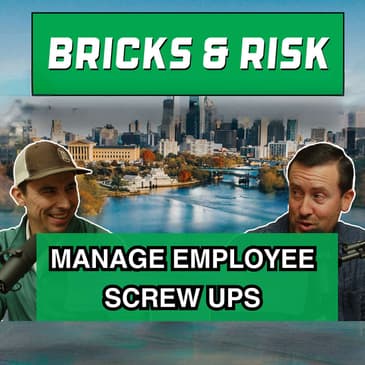

Leading a team is difficult and its inevitable that employees will not be perfect. In this episode we talk about how to manage expectations with employees and how to guide them when mistakes are made. Growth can be ugly at times but if you stick to the plan the results will always be worth it.
Our goal with Bricks & Risk is that you walk away with 1 or 2 valuable nuggets that help build YOUR business. Our audience grows through word of mouth, so if you would please take a moment of your time and give us a review on the platform you’re on, that would be fantastic!
Please also help spread the B&R word by sharing your favorite episode with a friend. You can find all B&R episodes on Spotify, Apple Music, YouTube, and anywhere else you get your podcast content. We greatly appreciate your time and trust.
Until next time, keep learning + keep growing!
#realestatepodcast #realtorpodcast #insurancepodcast #salespodcast #marketingpodcast #bricksandriskpodcast #philadelphiapodcast #phillypodcast #podcast #bricksandrisk #mooneyinsurancebrokers #copperhillrealestate #seanmooney #timgarrity #realestate #realtor #insurance #insuranceagent #philadelphia #philly #phila #phl #greaterphiladelphia #suburbanphiladelphia #buildyourbusiness #buildingbusinesses #businessgrowth
📲 Contact Info 📲
→ Sean Mooney, Mooney Insurance Brokers: www.mooneybrokers.com/
→ Tim Garrity, The Tim Garrity Team: www.timgarrityteam.com/
💥 Watch us on YouTube 💥
→ YouTube, Bricks & Risk Podcast, @bricksandrisk: www.youtube.com/@BricksandRisk/?sub_confirmation=1
💥 Follow us on Social Media 💥
→ Instagram, Bricks & Risk Podcast, @bricksandrisk: https://www.instagram.com/bricksandrisk/
→ Instagram, Sean Mooney, @sean.moonee: https://www.instagram.com/sean.moonee/@sean.moonee
→ Instagram, Tim Garrity, @realestateinphl: https://www.instagram.com/realestateinphl/
→ Facebook: https://www.facebook.com/bricksandrisk
→ LinkedIn: https://www.linkedin.com/company/bricksandrisk
[00:00:00] With my SOM in the beginning, I took that 500 and I put them on a regular email drip campaign. Was there an expectation sending out that list of what you might hear back or what I might get out of it?
[00:00:13] Yeah, like what, like yeah, with just or was it just blanketing these amount of people And just more of a recognition to say, hey, I'm Tim, I'm a real-order this is what I do.
[00:00:26] Hit me up. So in the beginning with my SOM, I did a few different things like email was probably the backbone of my reaching out to them and letting them know that I'm in real estate.
[00:00:37] Like here's what I focus on, here's what I know, you know, here are the people I know. So that's really how I started in the beginning. Welcome to the podcast dedicated to real estate insurance and everything in between.
[00:00:55] Join us as we take you along our own brokerage building journeys with additional wisdom from our network of business experts. Welcome to Bricks and Risk. Hey everyone, welcome to another edition of Bricks and Risk. I'm Tim Gardy, and I'm Sean Mooney, and today's topic Tim.
[00:01:19] Yeah, how do we deal with screw ups? I like that, particularly the employees screw up. Or let's call it mistake. Okay, mistakes. I think this is good for both of us because one you have an employee. Yep, you also have an agent that works with you. Yeah.
[00:01:40] And then from my perspective, I have two employees and multiple agents that work for me. So let's first start off with the employee. I think this is a good one, and I think this is going to relate to a lot of people.
[00:01:55] So we're talking about an employee and screwing up. We chatted about this in a previous episode where I mentioned the quote from Shark Tank, where Barbara Corcoran said 80% is good enough. And I think with that quote, that's where you want to be.
[00:02:17] But you and I both know with employees, chances are your first one or even maybe your second one. You're not going to be in that 80% range and there will be screw ups. So with that being said, let's go over. I have an example.
[00:02:33] So this is the first time we hired our office administrator. And basically her job was to handle daily tasks, handle some transaction work, some organizations, some bills, scheduling, we're doing some events. We had something to do with that as well.
[00:02:52] And we had her for, I think like a little less than the year. And unfortunately after that period of time, we realized like it just wasn't a good fit. But that was doing a multiple screw ups. It wasn't just one.
[00:03:05] So I think one of the hardest things to do when you're hiring people is you don't expect them to screw up at all. Wait a minute. You hire someone and don't expect them to screw up.
[00:03:21] I mean the other way, I'm like, I know you're going to screw up. Okay. Yeah, I like that perspective so give me a little bit on that. So I know that like for your, for your example, real estate.
[00:03:33] If this person has no experience prior experience working and their background isn't real estate, they're going to screw up. They don't know what this transfer this, that the other, they don't know the language, they don't know the procedures.
[00:03:45] So my assumption is that they're going to screw up. Right? Right? No? I mean yes, but I think it's like, are you class half empty or class half full? I'm always half full.
[00:04:00] So when I asked me if I want to be here, I got half a barrel of them like, no, I'm good. Whereas sometimes you got half a barrel and people were like, you'll get me another only got half left. So from Philly, I'm the eternal pessimist.
[00:04:11] Oh, forever. You know, it's 50. Oh, wait. Well, I like all that. It's very helpful that we kind of segue. So let me get back to the example I was talking about with our first office administrator and one year in less than a year in.
[00:04:26] Yeah. So this is like, let's call it six months in. And what wasn't really sticking was kind of some of like the templated things we did in our business. So like paperwork, organization, you know, dotting eyes crossing T.
[00:04:41] So it was really like we want you to handle these things, but like we made it very specific. So I think we did it more in the form of like almost like an employee handbook.
[00:04:49] Like here's what you do a BCD, wrote it out, gave detailed instructions, click here, do this. And then even with all that, it wasn't going well to the point where what was the straw that broke the camera's back was really.
[00:05:06] We weren't going to be in the office one day and she was supposed to be in. One of us ended up going into the office just to check on something and she didn't show. Don't don't don't. So that was like a massive.
[00:05:21] So we're not okay. So that's a mistake. I mean, it let us down the road of like, hey, how many times has this happened? Because we weren't in the office every day. Our jobs don't require us to be in the office every day.
[00:05:33] Most of my job is done on the street, I mean, they're out with clients, out with agents, networking with vendors or business contacts. And we're working out of my home office. I'm super productive out of my home office.
[00:05:44] So that was really what we'll kind of lead to that major major screw up on my opinion. It was really what it was is one of like a lack of trust. And then once that happened, we knew we needed to move on.
[00:05:57] So accountability, not that they messed up. It was more of a performance based more of are we on the same page? And clearly they weren't. Yeah, it was actually it was a lot of little things that led up to that.
[00:06:12] We were already like kind of unhappy with where things were going. But again, I always looked at that. It's like you got to look at it from both sides.
[00:06:18] Like maybe we weren't training good enough or maybe our delivery system with putting everything in text in a handbook isn't the main thing. And text in a handbook isn't the method that worked for her. Like she wasn't absorbing it well that way. Maybe she needed more one-on-one time.
[00:06:32] Maybe she needed like video training. There was lots of different things, but once you tell me a little bit about kind of like your on your side.
[00:06:39] I'm thinking back off of that because we've always tried to build that out for our employees or the people that we have working for us is how do you kind of make it bulletproof? You know, I call it dummy proof.
[00:06:53] But how can a third grader figure this out? How can a third grader build out this form or make this change with go to look at you know? And so the most recent one that we've done is we've done PDFs. We've done like loom videos.
[00:07:15] There's a lot of ours or like websites. It's called loom. Loom. Oh, oh. I'm not familiar with that one. So it's your just video recording your screen. It's like a screen saver. It's like like webinar style. Exactly. Yep.
[00:07:31] So what we'll do is let's say you have a common occurrence like for us it would be like a mortgage change on a homeowner's policy. So what we'll do is we'll go into a carrier and we will record one of us who knows how to do it.
[00:07:50] How to do that and then you're narrating while you're doing it cool. So go here and it's like, you know, your cursors on the page highlighted. So they can literally digest a 30 second video. So instead of coming to us or going to someone else is like, okay.
[00:08:09] Look it up. Here's our loom index library. So you look okay, mortgage change, search thing right on the video and they can watch 30 second one-minute video that's like an explainer video. Yeah. Here's a question on that real quick.
[00:08:27] So with loom, do you store everything on loom or do you kind of take that download it through it in one central database with everything like how do you do it? So we actually got off of looms one of the tools that we used.
[00:08:41] We actually went to Microsoft loom does have an ability to store that inside your, so you build a library of loom. Yep. And I don't know how far you would need to take it when you build that library if you could
[00:08:55] cut off at a certain amount or it allows you go on forever. But the other one because we're in this Microsoft ecosystem, it allows you to, it's called Microsoft screen screen. Okay. So it does the same exact thing and then builds into your Microsoft ecosystem.
[00:09:14] But then those videos and it's pretty cool too because they're searchable inside of your, that's cool. Yeah. You operate most of the Microsoft. Yeah. Okay. So one tool that we've kind of implemented is because we know that like,
[00:09:31] it's hard to remember, okay, I did this three months ago. You know, how do I do this and you know, have that on your memory as to, oh, I know how it is. More, you know, it's a lot easier from from my viewpoint for that employee.
[00:09:47] Search it, watch the video and boom right there. Nice. So that's something that we've tried to incorporate to make it easier. And I think that's what it is. Trying to make it easier for the employee to do these different tasks. All right, that we're asking for.
[00:10:05] So let me interject. So you're 11 years in. Loom is something that you've learned over time is an efficient, probably inexpensive way. Train people. Yeah. So let's talk about your screw ups where where were the employee screw ups that really got you to be like,
[00:10:22] I kind of need a system where I can do it in this way, deliver it in this fashion, organize it, you know, release succinctly, really efficiently. And you had to have built up to that. You don't just have an employee screw up when you start in your business.
[00:10:38] Oh, I need loom. So once you dive in that a little bit. Well, I think during a period of time is we had virtual assistants and we had them working. Not it. You were a VA guy. Yeah.
[00:10:50] And so we didn't have the ability to just have that person come over to my desk. I think that was the impetus of me really trying to get this thing towards having a library of certain requests that are common, like the most utilized right?
[00:11:07] So you take your your top 10, you know, request from your clients and then you build out that way. And then you can always add in like, oh, this person needed this request or, you know, and then you just add in.
[00:11:20] So VA's were really your first experience of like, hey, like they're screwing up on really simple easy things. And part of the problem is that we're not in the same room. Right. So VA just so everyone knows his virtual assistant that we talked about.
[00:11:33] And Sean had some in the beginning. You had a few right? Yeah. During a period of time there was two women that were doing the back office work. And so I think that was the reason, like, oh man, I got to get,
[00:11:48] I got to get, I got to get something that's going to enable them to be more comfortable doing these types of changes. And then also doing them succinctly enough and making sure that they're done properly. I think that was what was driving me to, you know,
[00:12:07] implement these videos. Awesome. And there's even a new one now that I haven't really gotten into, but I have looked at where there's AI, but something where it will watch your screen capture your screen. You talk into it and then it also sort of take screenshots. Yeah.
[00:12:28] So basically it'll run. Instead of doing the video, it'll just take screenshots of when you do these changes like move mouse here. Yeah. And then as you're talking, it'll dictate. And then it'll take, it'll like print out the directions as you're speaking. Wow.
[00:12:43] And then it'll be a file format. And then basically, then you can store it. And then that person has the screen. So you could do video if you want to do video or you just do like the screenshot with the narration in text. Okay.
[00:12:57] And it just kind of built in and then you just build it out. Very cool. So I'll have to check out Lou. Yeah. Lou seems like good one. Yeah. Since you're not in Microsoft. Right. Yeah.
[00:13:08] We've seen a lot of different agents use it for a lot of different things. But it's one that's easy that can. You can just use capture and you sit your faces like a bubble on the screen. So you're like talking. Oh, nice. Yeah.
[00:13:25] So it's kind of like it's got you like in the corner somewhere in the middle where they actually see your body language and mannerisms. A Pistuar. Yeah. I'm not pissed you are. I can get this right. This is the third on this type of piece. I'm a loser.
[00:13:40] I need a lot. So again, another tool that I think might be helpful for some people out there. You should check it out. Very easy to use and you can. Bring team members in. Okay. They can see it. They can edit it.
[00:13:58] You can put like special notes like at the one minute mark and it's pretty good. Hey everyone. This is Tim. Your favorite bricks and risk co-hosts. Don't tell Sean. I hope you're enjoying this episode and I'll get right back to it in a moment.
[00:14:13] Our audience grows through word of mouth. So if you would please take a moment of your time and give us a review on the platform you're on, that would be fantastic. Please also help spread the B&R word by sharing your favorite episode with a friend.
[00:14:28] We greatly appreciate your time and trust. Now back to the show. Let's jump into another part of screw ups because it's not just some employees that we work with. Obviously, clients there. Not always working. Nothing can touch them. They don't do anything wrong. It's all on us.
[00:14:52] When we look at that way, which we have to as business owners, there's the employee then there's also in both of our businesses. We have agents. You have an insurance agent. I have real estate agents, real tours. Let me dive into that a little bit.
[00:15:11] With the agents, one of the biggest things I dealt with early on was, please don't say the wrong thing. Please don't do the wrong thing because in real estate, when you're the broker of record, if an agent screws up, they're coming after you.
[00:15:29] It would be the client or the state or whatever, a complaint. Now I will say, in nine years, we have had no dings against our record, which is fantastic. But there's definitely been little things with agents where there's two ways to look at for my position.
[00:15:48] We just got a cold lead through our website, through social media, through an email news, or something like that. Something just came in. Someone filled out a contact form and here's my need. You give that person out. There's less of a concern with that.
[00:16:00] Then there's also within the last couple years. My self-angir and Ryan have been practicing less as agents, and giving away more of the clients that we have worked with because it's a better use of our agent Simon in his of our time.
[00:16:14] Not to say that we can't help them or do a great job. Obviously we can. And when I help one of those clients, all the commission says with the company instead of a portion of it.
[00:16:23] But as you have said before, you have to learn how to build out your time properly and building our time is also in sharing with leads and clients. I mean, I've had a few things probably the biggest one that sticks out to me.
[00:16:37] And this was from an agent where I didn't give the lead or wasn't one of my clients, but the agent was working with someone transaction closed and we're huge on our Google reviews. Meaning like it's five stars or bust. That's what we focus on.
[00:16:54] You know, we were constantly talking about how important that is to our business. Once the deal closes, we follow up a number of times to say, would you please take a few moments to give us a Google review?
[00:17:04] Because again, that helps us grow and we felt we provided a really good level of service. So with this agent working with this client, the client went on and gave us a really terrible review like it was like two stars. Yeah.
[00:17:19] And it was all about the agent that he worked with. And we're like, so it's like, you can't fault the agent when the agent was kind of new. So they're learning.
[00:17:30] But the fact that this client of his went on to do that to us, like, do you know what I did? I basically said, I'm going to reach out and I'm going to talk to this person and figure out why he went online to do that.
[00:17:46] Instead of just calling or emailing or texting, so I called this client and said, hey, let me do you have a, is it an automated system to get that review? Yes. Yeah. It's multiple touch points to say, like, please do it. Yes. Yeah.
[00:18:01] So I call this person the client and I say, hey, you know, I appreciate you taking the time to review us. But the review was low.
[00:18:11] Can you tell me a little bit more besides what you said here as to why that service wasn't what you expect or what you wanted? And he went on to, you know, 10, 15 minutes about how his poor was unfortunately. And I said, all right, well, a couple things.
[00:18:27] One, I never heard from this agent. So if there's anything I could have done to help this agent because he's new, I would have helped the long way. But I didn't hear anything about your particular transaction.
[00:18:36] I just know if I had heard something, what have stepped in earlier. Yeah. And I'm sorry that I didn't. And I said the second thing I want to say is that if you look at our reviews, they're all, they're all good.
[00:18:47] Like we take a lot of pride in our reviews. So is there any way you would reconsider not having your review be public now that we've spoken and I'm addressing your concerns? And he actually said, I really appreciate you reaching out.
[00:19:06] And while the service wasn't what I wanted, he's like, I can tell that you care about your business. So I'll go ahead and take it down. And I was like, awesome.
[00:19:16] So after I got out of the phone, I was like, man, like, that was one that was a really good feeling.
[00:19:23] Even though it was a screw up by one of our agents, which is going to happen, especially if you run a brokerage and you have a lot of agents going to happen.
[00:19:32] So it felt really good one to have that conversation because that person really understood how much I cared about my business. So the screw up wasn't necessarily like for nothing like it helped.
[00:19:41] And two, it also helped to know that like if you're truly serious about your business and how it looks like all of our reviews or everything, I usually say they're almost like currency. Yeah, because they're so important.
[00:19:52] It's like if we do anything, if we go to eat, get coffee, we want to go stay at a hotel, want travel, like you want to work with someone, you get new tires and auto-shelves.
[00:20:00] You're going to, you're going to Google and be like, you know, reviews and just get a sense of like, okay, if there's two reviews and they have three stars, I might give you a little bit of a pass because you don't care about your review. Or coffee.
[00:20:11] But yeah, but if you got 50 reviews and the three stars like I'm probably not going unfortunately. But this might be a topic for another day, because I would love to go down that rabbit hole. Yeah. And go like deep.
[00:20:23] But number one, I would say that Google reviews, bad ones aren't always a bad thing. Okay. Let me hear that perspective because it okay, so let me put this if you have 50 reviews and you're all five stars.
[00:20:39] Don't you think some people are going to be like, well, well, who are they paying for those reviews and how can you be a business running in business and have a 50 five star reviews? Like it's, this is the moody perspective. No, no, my.
[00:20:53] But there's some artificialness to having all good reviews. That's number one is, is that people I think when you get bad reviews, I think that actually lends more credibility to your good reviews. That's not a bad point.
[00:21:10] So I think by having both someone might say, man, they got 50 reviews and 49 or 5 star. There's some maybe some more trust. Yeah, with that. And then number two is, well, I got three, but two is you got time. Yeah, right.
[00:21:28] Two being, it allows you, let's say that person didn't pick up or didn't respond or anything like that. Yeah, I think it's a great opportunity for you to reply in that review and have that agent reply back in the review. Yeah, that's really valuable. That's really valuable.
[00:21:49] Hey, you know, like I'm a new agent, I realize that I could have delivered better for you and I could have done X, Y, and Z. And, you know, I really appreciate the feedback because that's going to help me become a better agent. They are really owning it.
[00:22:05] Right. And it's publicly visible that you're owning it. Yeah. I like that feedback. And so people are going to see it when they're online and think like, oh, wow, you know what? Just people realize people make mistakes. Right.
[00:22:18] And, and for me, it's always not how the mistake was made but what are the steps after the mistake to recognize it and to try and like address it? Yeah. And then number three when we do our review, deep dive.
[00:22:34] Inside your automated system, there should be a catch. And it's a pre-screen. So if someone did it too, they're not dragging over to the review. Wow. Oh, I dig that. It's a preview because we talked about that for a while. But you're just been in the mail.
[00:22:50] You're spent in spin, spin, spin, spin, hey, review, review, review, review. And then if you get in that drag net, you get one that's like one like these guys are horrible. Yep. It's not going to take them over. All right. So like, and I appreciate all that.
[00:23:04] It's really awesome feedback. Tell me about your agent right now. Has there been a screw up or screw ups that again, you've been more of a one-man show in your own years. We have different businesses. Mine requires more boots on the ground.
[00:23:17] You can do more from an office. Yep. So two, I'll go employee too and because there's one that's pretty timely that we've been dealing with and one from the agent side. So on the employee side, it was recently done where someone made a mistake.
[00:23:38] And it was one of those ones where they reached out, tried to do a good thing and then it just turned into something that was that was bad. And for me, I mean, I don't get upset typically when these things arise because you're upset. Yeah.
[00:23:56] I just think that they're going to happen. And I always think back like, oh, I remember when I was a year or two in the business and you know, messing up with the business and right. So I don't know.
[00:24:09] That's how mine works and kind of like how to deal with a situation like that. And so it's kind of this particular one was from a degree of mess up or how bad the mistake was. It wasn't too bad but it made us look bad. You know?
[00:24:27] And so I just kind of said, you know, how did this happen? And we kind of reviewed it and the important thing for me is just taking ownership of it. You know, okay, the mistake was made. What are the steps to remedy this situation?
[00:24:46] And we talked through it and I made them, you know, deal with it. You know, like this is your mess, mistake. And we talked through it. And I just can't really tell you how to deal with that. And I just think it's just like, you know,
[00:25:18] you're going to be able to handle this. And I want you to negotiate and figure out how to deal with this. It's more, it's kind of a learning curve. I would say because the way that we run our brokerage is a little different than what this person
[00:25:36] dealt with previously and for us it's, you know, walking on underwriter, checking like what fits different appetites and stuff like that and steps were missed. And we had a client sign up and they do it in the same way.
[00:25:55] And they do it inspection after the, everything gets processed. And then it didn't fit our guidelines. So we literally had to like cancel the insurance right after we sign them up. And it looked bad. It looked bad for us. Yeah.
[00:26:11] It made us look, you know, me look bad. The agency looked bad. The agent that was working on this. And I kind of did the same thing as to like, all right, well, how did this happen?
[00:26:22] You know, and kind of went through step by step in terms of the game, middle and kind of how it hand down the end. I made sure that the agent was communicating with the client because it was something that could have been fixed,
[00:26:38] but they didn't want to, they didn't know what front and yeah, you know, felt like they were led down this path of, you know. Yeah. All right. So now that I've shared some of my more stories, yeah, and you have to. Yeah.
[00:26:54] Let's talk about the last bullet, which is really trusting in others to scale. So you and I both know, if we tried to do everything on our own, you're just not going to go anywhere.
[00:27:07] There is there is an actual ceiling to how much you can do without either completely burning out, going insane, just not getting a return on your time anymore. And I think when we deal with team members that screw up,
[00:27:25] it also teaches us not only does it help set our expectation for the next person, but it also teaches us that like things are going to happen, but you need this person or these people to grow. Yeah.
[00:27:39] So for me personally, like knowing that our first office administrator was not ideal that mistakes were made and big mistakes, trust issues. It allowed us to take it to the next stage, which was our next office administrator.
[00:27:57] We made more things clear up front about, you know, how often to be in the office. Like how do you like to learn? You have to show up. Yeah. Yeah. You should be here for work. How do you like to learn? We start incorporating weekly meetings.
[00:28:13] So you get better. It's a learning to, for sure. It is. And another great thing that I love is that you have to fail in order to succeed. So the screwups of your team members, whether to be employees, agents or both, are going to help you succeed.
[00:28:30] They're going to help you get better. They're going to help you see who's a better fit. Better delivery method for teaching. How do I keep my eye on the ball better this time than last time? So is there anything you want to add to that?
[00:28:43] I always say you learn more from mistakes. Yeah. And it doesn't sound right. But what I can tell you is, giving that example with the agent that we worked with, he's never going to make that mistake again. Great.
[00:29:00] And I think that very valuable learning objectives come from mistakes and messups. And I think that as long as you're dealing with them the right way, because they're always going to happen. Yeah. Different mistakes, different people. But you know, I know is that your name that,
[00:29:23] that your name is on the sign, right? So like you're always going to be the one that's ultimately responsible. And you take pride in that. And that's why you want those Google reviews. You want people to know that you do take pride in your business.
[00:29:40] And so I think as long as people are learning from their mistakes, and you're helping kind of coach through that, sometimes those incidents can be, you know, good for your company. Yeah. In terms of growing. Yeah. Well, we're going to end on that one everyone.
[00:30:00] So thank you for tuning in to another episode of Bricks and Risk. Take care. Thank you for joining us on another episode of Bricks and Risk. Our goal is that you walk away with one or two valuable nuggets
[00:30:15] and we greatly appreciate you sharing your time with us today. You can find all B&R episodes on Spotify, Apple Music, YouTube, and anywhere else you get your podcast content. Until next time, keep learning and keep growing.