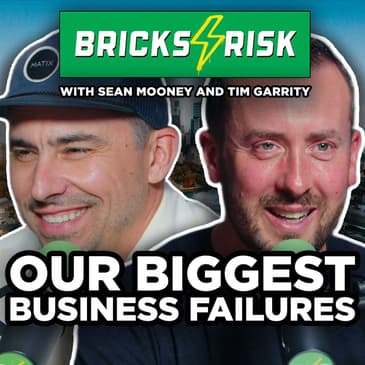

It's official. Sean Mooney's style of dress has officially been named. It's called ... "Moon." Haha. Jokes aside, this Bricks & Risk episode is all about storytelling; but more importantly, sharing stories of our biggest business failures. We love highlighting our wins, and we also love seeing other folks win, but it's easier to learn how people actually win when you hear more about how they've lost. Dive right into this B&R slammer, as Sean & Tim highlight their own biggest career failures!
Big shout-out to our show's loyal and dedicated sponsor: Property Management Redefined. John Sacks and his property management squad love our show and continue to support our mission of helping people through podcasting!
Our goal with Bricks & Risk is that you walk away with 1 or 2 valuable nuggets that can help build your own business. Our audience grows through word of mouth, so if you would please take a moment of your time and give us a review on the platform you’re on, that would be fantastic!
Please also help spread the B&R word by sharing your favorite episode with a friend. You can find all B&R episodes on Spotify, Apple Music, YouTube, and anywhere else you get your podcast content. We greatly appreciate your time and trust.
Until next week, keep learning and keep growing!
** Episode Shout-Outs **
→ Matix, Roads Less Traveled: https://www.matixclothing.com/
→ Episode Sponsor, Property Management Redefined: https://gopmr.com/
📲 Contact Info 📲
→ Sean Mooney, Mooney Insurance Brokers: www.mooneybrokers.com/
→ Tim Garrity, The Tim Garrity Team: www.timgarrityteam.com/
💥 Watch us on YouTube 💥
→ YouTube, Bricks & Risk Podcast, @bricksandrisk: www.youtube.com/@BricksandRisk/?sub_confirmation=1
💥 Follow us on Social Media 💥
→ Instagram, Bricks & Risk Podcast, @bricksandrisk: https://www.instagram.com/bricksandrisk/
→ Instagram, Sean Mooney, @sean.moonee: https://www.instagram.com/sean.moonee/@sean.moonee
→ Instagram, Tim Garrity, @realestateinphl: https://www.instagram.com/realestateinphl/
→ Facebook: https://www.facebook.com/bricksandrisk
→ LinkedIn: https://www.linkedin.com/company/bricksandrisk
Do you know what it kind of was? And try not to make this like too crass. It was kind of just like like F everyone. I basically just said, you know what? I don't need anyone to do this. I don't need anyone's permission. I don't need anyone's corporate brand. I don't need anyone's training. I don't, I don't not that I don't need it. I don't want it. And here's why I don't want it. Because I've had all that and I follow, I dotted the I's and I crossed the T's and I did that for 10 years and I did everything I was told and I did it very well. And they still said there's the door sign. So I think for me, I had this, I had a little bit of a chip on my shoulder, and I said, F everyone, I'm gonna show everyone I know I can do this myself, and I can do it any way I want to do it. Welcome to the podcast dedicated to real estate, insurance, and building your business. Join us as we take you along our own business building journeys with additional wisdom from our network of local and national experts. Welcome to Bricks and Risk.
SPEAKER_01This episode is brought to you by Property Management Redefined. PMR is not just managing properties, we're creating partnerships that build long-term success for property owners. John and his team can be reached at manage at gopmr.com or by phone 267-753-6005. Tim.
SPEAKER_00Yes, John. Who's a good client for PMR? Property management redefined is looking for property owners who value three things accountability, reliability, and a results-driven approach. I want to maximize returns, but still provide client and tenant satisfaction.
SPEAKER_01There's a lot of property managers out there.
SPEAKER_00There are. What does PMR do really well? Biggest thing is they're seamless and they're worry-free. So with that approach in mind, it allows the property owner to put their trust in PMR and know that the results will be there. The other thing I think a property owner is really going to value because they do it so well is that they have a local expert team, boots on the ground, managing your properties and your tenants' expectations every day so that you feel good about your investments.
SPEAKER_01We have millions of listeners out there. Tens of millions. If they want more information, how do they find PMR?
SPEAKER_00Right here, guys. Reach out to John Stax and his team at Property Management Redefine. Take good care of you. Hey everyone. Welcome to another episode of Bricks and Risk. I'm Timmy G. And I'm Sean Mooney. How's it going?
SPEAKER_01It's going great.
SPEAKER_00We're on the third outfit change today. This is uh this looks like 70s surfer. Okay, that's what we're going with today. With a trucker hat. Yeah. 70s. Maddox. You don't think it's 70s surfer? What is this? Is this like uh grandfather uh you know sitting in the chair with a pipe on a Friday evening?
SPEAKER_01Yeah, like you got a pack of Salems here. Oh yeah, dude. And like probably some tar stains in there. Yeah, like just came home from work, sit on the porch. Yeah, clean your clean your pipe out a little bit. Something like that. I don't know. I don't I should ask Claude what my will describe my style. I think that's impossible. If I were to be a stylist, what would my style be? It's called Moon.
SPEAKER_00That's the style. Moon. Would you like to go moon this evening? You're like, okay, I'm gonna give you a very bizarre button-down shirt, some kind of very interesting trucker hat with a rope, flat brimmed, and non-jeans. That would be moon.
SPEAKER_01No Nikes, no jeans. Nope. Ever. Probably some 440s in there, maybe some globes. My uh my goddaughter asked me to be a sponsor for confirmation. Okay. And my first question is like, what can I wear? Yeah. And she's like, Why the what kind of question is that? Why is that? What kind of question is that, Uncle Sean? Well, I have a library of suits and stuff in my basement that I don't get to use all the time. So this would be an opportunity.
SPEAKER_00You know, we have, I'm not really gonna speak about it in detail here, but you know we have an event that we're working toward maybe like toward the end of the year that we talked about recently. Yep. And I would like to be wowed with moon. Not some not some rinky dink mainstream moon. I want like back of the closet, top three outfits I've ever bought. Moon. If you please. Alright, we'll be talking about today. We're gonna work on that. Cool.
SPEAKER_01So today we are going to be talking about today. We're gonna be talking about failures. Yes. Failures in life, more specifically, failures in business. Business is a business show, we're gonna stick to business. Um previous episodes we've talked about how kind of social media has built this, for lack of a better term, um a bubble type of uh disagree. Highlight reel. Yeah. And so I think what gets lost in um doesn't get enough sunlight is failures in business. So you might listen to the show or you might view someone on social media and just be like, oh my god, all they do is win after win after win.
SPEAKER_00Everyone's making all this money, everyone's so successful, like growth, growth, growth. Like they're on a beach with a coconut in their hand. Like, wouldn't that be nice? And and you've said this many times before. Yeah, but you have no idea how they got there. And that's such a valid point because of what you just said, the bubble of what we see and what we don't see.
SPEAKER_01Yeah, perception and reality. What is the reality? So we'll take the opportunity today and spend 30 minutes uh diving into some of the failures that we've had as we've started business and grow our businesses and everything along the way. And so start us off. Tell us about um maybe a couple things, items that you've come up against that you've dealt with in your business that have either been a struggle or a specific failure that you've come across and and dealt with.
SPEAKER_00Yeah, I can I can get it started. So we came up with a couple each, just uh, you know, not make it too long. We're trying to keep these episodes around 30, 35 minutes now for the toppies. Um, so for me, my my first biggest failure that I had that I have written here was too much faith in the corporate America career up front. So when we go back, go back to Timmy G, LaSalle University, marketing major, Go Explorers. And, you know, I'm setting myself up for corporate America, getting a BS degree in marketing, business, you know, four-year college, accredited university, like great business school, you know, uh, tons of great um of advisors in the marketing department, the business department. It's like LaSalle's got everything I need to get a good education, learn a lot, understand what it's like to get out in the corporate world and then go out and execute. So, what we're thinking back then, most people in college, even today, is that you're gonna get a degree and then you're gonna go out and get a job. Most of the time, that job is in corporate America. It's not starting a business yourself. So Although today it's probably a little bit more common than what it was back then. I I would agree that people definitely have more options, more confidence to start things on their own. Maybe they've learned it about learned about it a little bit younger. They've been watching Shark Tank for 10 years or you know, they're not even that.
SPEAKER_01The YouTube videos. The cost to get a business started and the tools and the technology to get started is so vast that what we had tried, you know, year many moons ago, uh, when we were starting, you look at today, you know, wow, it's completely totally different business landscape. It is. And it allows for entrepreneurs to get going a lot quicker at a at a higher uh velocity than than we have.
SPEAKER_00Like either bypassing college altogether or maybe doing like community college, like something reasonable, some basic business classes.
SPEAKER_01My advice to everyone is don't go to college, get a trade, and divert that trade into uh your own business, and you will be a millionaire within 10 years. Correct. That is my personal belief in where things stand today. Uh, you'd be super successful um if you go down that road.
SPEAKER_00Um And if you don't work with your hands, if you don't want to be in the trades, like start thinking about how do I start my own business.
SPEAKER_01Yeah. Or take that money we're gonna spend on um college, hundreds of thousands of dollars, and try to get a loan to maybe buy that business where you don't have to uh some of them you can buy expos like like old guys that own these smaller businesses. Um they're getting out, retiring, sunsetting their businesses and looking for avenues to invest in that sell. And you can, you know, maybe work with him for three or four years, or him or her, and um learn the business and not necessarily have to do um the hands-on stuff, but I just think it's uh provides a great opportunity for some young people that are looking to uh own a business one day.
SPEAKER_00Quick shout out to our boys, Josh Meyer and Shane Foley. They executed with Panorama Motions, they executed on the triple play Atlantic City video for us. Perfect example of two young guys starting their own business, you know, honing their craft, getting good at their and they're not in the trades, they're not using their hands, they're in the video media business. Yeah. And they've built a pretty successful business already in their early and mid-20s. So shout out to those boys. Yeah, it's a great example. Oh, you don't need to um you know, I think the the the common um You're gonna let me get out my failure, or are we gonna talk about do a little dissertation on why kids shouldn't go to college these days?
SPEAKER_01You just talked about Josh for 20 minutes.
SPEAKER_00Okay. All right. Let's get back to corporate America.
SPEAKER_01Corporate America.
SPEAKER_00Um so a marketing major, four-year degree, LaSalle University, BS in business. Um, I get out, and it's right when 9-11 happened. When 9-11 happened, all the corporate jobs were like kind of washed away, especially the entry-level jobs. So I was out there like hustling waiting tables. Yep. After about, I don't know, less than a year of that, I got a job with JP Morgan Chase as a loan officer. Now, while this was like more of a traditional corporate America job, because I'm working for a big corporation, uh, they have a suburban office in Bluebell, and there's an underwriter, there's processors, there's a bullpen of loan officers, and there's a branch manager and an administrative assistant. Traditional corporate office. Yes. Get into the corporate office and start learning the mortgage business, how to understand how mortgages work, how to work with clients, how to advise clients, how to what's a refi versus a purchase, the 30-year versus the 15-year, like helping people through the process of getting financing for their homes. Did that for a couple years. And then through one of my relationships, I was able to get an opportunity to be a manager when I was 24 years old, and that was with Pulti Homes through their mortgage company, Pulti Mortgage. So shout out to Tina Caparo, Dan Caparo, thank you for the opportunity. And uh started Pultimortgage, and this was like straight up corporate America. W-2 salary and bonus. So if I come in, I'm gonna get a guaranteed amount of money as long as I'm like doing okay work. But if I over-deliver, I can make a bonus, additional money on top of my salary in order to get ahead. And that was about uh almost like uh that was almost a six-year period. So during that six-year period, what happened? I got in, I excelled, then they started trying to move me up. They're like, would you like to move to Florida and be a branch manager? I said, no, thank you. Would you like to move to Long Island?
SPEAKER_01What part of Florida?
SPEAKER_00Does it really matter? Gulf side?
SPEAKER_01Yeah.
SPEAKER_00Does matter. I said, no. Do you want to move to Long Island? No, thank you. At the very end of my career, they said, Look, we had 400 people locally. We're down to 40. 90% of the workforce gone after like 18 months of layoffs. Yeah. Okay, everyone I knew was gone from this company besides like a handful of people. I said, Tim, here's your last shot. You either move to DC and be a branch manager, or you're expendable. So, what did that teach me? Having too much faith in corporate America was I'm just gonna keep working my ass off and just get ahead and get ahead and get ahead. And it's not to say you can't do that. You can totally do that. But the company I was aligned with and the position I was in and the industry I was in, what they saw from their superstars, rising stars, whatever you want to call them, is that as they get good, they want to move you around where it suits the corporation best. Tim, as much as we love you and you're great, we understand you want to stay in Philly, we don't need you in Philly. We need you here. So if we need you here, your job is to go there because we're the corporation, you're the employee, you do what we tell you to do. So, me having so much faith in that model, college, loan officer, manager, for almost a 10-year period, I just kept working and kept just saying, like, hey, I'll just get ahead, I'll do better financially, I'll I'll have another management position, whatever. It didn't work. So then when I lost my job when I was 30 and I got into real estate, that I would call that a failure because I spent almost 10 years of my life and going back to getting my master's in order to learn that I didn't want to be in corporate America. Yeah I just didn't want to be there. And now, 16 years into residential real estate, I know for a fact that I never want to be there. But never say never. Never say never. Never say never. So that one of my biggest failures was going all in, working very hard, saying no too much, thinking I was in control, and learning at the end of it, it didn't matter what I was doing or how I was doing it, or in what manner I was under their control. And if I didn't say yes, then I could be let go.
SPEAKER_01So the the personality type, if you were the person that wouldn't mind moving, yeah, or was interested in moving.
SPEAKER_00A lot of people want to move. Yeah. Like, I'd love to live somewhere else. I'd love to experience another town or city or state or whatever.
SPEAKER_01So that model could work for someone that just keeps uh excelling and surpassing goals and going wherever uh the wind takes them.
SPEAKER_00And I also don't want to say it wasn't like a failure because like I didn't want to move up in the world. I did want to move up. It was what I realized is I I didn't want to live somewhere else. Even for a couple years. I just said, look, I'm all in on Philly. I love it here. My family's here, my friends are here. You know, Marie and I, after we got married, we're we're building a life here, and that's when it went down. And I just said, like, you know what? It's more important for me to live where I want to live than it is to make a little bit more money and live somewhere I I potentially don't want to live.
SPEAKER_01Yeah.
SPEAKER_00So but failure led to a lot of success. About you, what's your number one?
SPEAKER_01Uh so looking back with the business and kind of how it started and how it's going now. I think one of the big just like you, early on, one of our biggest failures. Uh was this in State Farm or Allstate, or was this Mooney Insurance? No, this was Mooney Insurance. Okay. Yeah. Duh.
SPEAKER_00Um was that a serious question? Yeah.
SPEAKER_01Early on, I I think like you, you were kind of under this assumption or this thought that, oh, corporate America will take care of me, right? I just show up, I do my job, I I hit my goals, and the company I'm working for will be, you know, so glad that I'm doing that that I will just continue to grow. Continue to climb. Yeah. So similar to your situation, is that when I started my business, I thought or had this assumption that start my business, I'm independent. Now all of these carriers are going to want to work with me. They're going to line up out my door and say, hey, please go sell my insurance products.
SPEAKER_00Did you have that assumption because you had conversations about it, or you just you just never really asked? I didn't know. You're just like, why would they not want to work with me?
SPEAKER_01I didn't know. I I guess I just thought that that's how the system worked. I thought that these other independent agents uh were that's how they did it.
SPEAKER_00As soon as they opened their doors, they were like, sign here, sign here. We want to work with you, we won't work with you.
SPEAKER_01Yeah. And um so I guess uh one failure that we had early on was getting appointed with different insurance companies. So we would go to them and we would say, you know, we started this is my I have been doing insurance for 10 years, you know, I'm open in my office. And I thought that the it would just happen. Like, you know, get appointments, get carriers, get get selling. Yeah. And it was totally not the case. It was, you know, it was kind of different things where I was talking to them and they said, well, uh, put together a business plan and show us, you know, and then I would do that, and they would be like, Well, it's still not enough, or whatever. Um, a lot of other carriers said, Well, we only appoint if you have, you know, a million-dollar book of business that you know that you have that you can show us.
SPEAKER_00How am I supposed to have business when I'm not even in business?
SPEAKER_01Yeah. So um one of the biggest failures was just trying to get out of the gate and try to explain to these companies, you know, what we were trying to do and have them buy into our agency and be part of that start um as uh as we try to grow. And you know, insurance in general is the slow to move, slow to adopt, slow to say yes in all facets of the business. Yeah. So trying to convince these um carriers that we were the next up-and-coming great thing, it just was a difficult time and really was a challenge for us because we got no after no after no after no. Yeah. And so um, you know, it was a real struggle.
SPEAKER_00It sounds like your mindset when you started was they need me more than I need them. Yeah, absolutely. I mean, they're like, they need me. Without me, they don't push their product. Yeah. So another another moonie to them is the opportunity to push more product, which is actually probably the thought I would have too. It's like, why wouldn't they want to work with it?
SPEAKER_01Well, what you learned too is that a lot of the carriers aren't necessarily concerned with growth, right? Interesting. A lot more uh emphasis on profitability rather than risk. Or risk that's profitability kind of rolls risk and and into it. But the a lot of them were not like we don't need a new guy to go write a million dollars of of business. We don't need you because you could be right a million dollars, that's just bad risk with not profitable business. Wow, and so that that was kind of one of you know the components of it. But what I did find in talking to, we actually just got appointed with Philadelphia Contribution Chip as a new carrier that we're gonna be working with for property, specifically home and and landlords and stuff like that. But um I always keep like in my files uh kind of like what I call breadcrumbs. So when I started, it was 2000, this would have been like 2013, 2014, and I had a reach out to the company and at the time their marketing rep, which kind of works with appointments, getting people appointed with the company. Um, and I must have like did a screenshot of the email that um was basically him being nice saying, Hey, at this time we're not appointing new agents, uh huh. Which is kind of like the line that we would get from time to time. Just when you don't want to get into the details about it, but uh surface level. But uh funny to f to basically. Basically, I wanted to get all my new documents into the carrier folder and in the you know in the cloud where you store like everything. So uh when I was getting my new documents together, I went into the folder and found that email back from 2013 saying, Hey, we don't, you know, right now we're not appointing, and then all my new documents in what is that, you know, 13 years later to then be like, oh, okay, this is That's pretty cool. So cool just to like reflect back of like how it was a struggle to get started. Never give up. And now seeing that kind of come full circle, uh, you know. And a big thank you to Robbie Shock, who helped me uh shout out to Robbie, maybe uh grease the skids a little bit uh with this go-around.
SPEAKER_00There you go, Shocky. Nice work, man. Hey everyone, this is Tim, your favorite bricks and risk co-host. But don't tell Sean. I hope you're enjoying this episode, and I'll get right back to it in a moment. Our audience grows through word of mouth, so if you would please take a moment of your time and give us a review on the platform you're on, that would be fantastic. Please also help spread the BR word by sharing your favorite episode with a friend. We greatly appreciate your time and trust. Now, back to the show.
SPEAKER_01So that's what I would say is one of our big failures early on uh with the carriers.
SPEAKER_00Okay, I'll go into my number deuce. Yep. Number two. I went into brokerage ownership too early. Okay, I'm gonna go back, paint this picture now. Okay, lost my job at Pulti. Yep. Get into residential real estate. I knew plenty of people. I had cousins in real estate, I had uncles, you know, I had, you know, friends, I had mentors, blah, blah, blah. I know all these people in residential real estate. So as soon as I get my license, I can go work for like three or four different people. They're all like, we'd love to work with you. Yep. Doesn't matter what in what capacity, we'd love to work with you, Tim. And go with any of them. Okay. What did I do? I went with a very small independent brokerage in Brewery Town called Brown McKinney. Another shout out to Rudy Brown. The reason I went with them, one, they were working with real estate investors, so I really wanted to learn that. But I also looked at it as like, look, these guys are gonna kind of lay off me a little bit. They're not really gonna say, like, this is our corporate model or this is our training, or show up for the weekly sales meeting, or use this email address. They basically just said, come on in, service your business. Here's how your files look. Once we approve your file, you get paid. So it wasn't as much red tape. So, one, I think that's cool. I like the fact that it's less corporate.
SPEAKER_01Well, it's peculiar to me because just the way that you and I operate, we kind of gravitate towards the relationship or the referral. Yeah. And in that instance, because I don't you didn't know Rudy prior to talking to him about a job, right? It was more like a blind Yeah.
SPEAKER_00Yeah.
SPEAKER_01It's unusual that you went that route to go away from like I would think most people, and I would have thought that you would have done it too, is link up with someone you know.
SPEAKER_00That's you know, so do you know what it kind of was? And try not to make this like too crass. It was kind of just like like F everyone. I basically just said, you know what? I don't need anyone to do this. I don't need anyone's permission. I don't need anyone's corporate brand, I don't need anyone's training. I don't, I don't, not that I don't need it, I don't want it. And here's why I don't want it. Because I've had all that, and I follow, I dotted the I's and I crossed the T's, and I did that for 10 years, and I did everything I was told, and I did it very well, and they still said there's the door sign. So I think for me, I had this, I had a little bit of a chip on my shoulder, and I said, F everyone, I'm gonna show everyone I know I can do this myself, and I can do it any way I want to do it. There is no right or wrong way to do residential real estate. I'm gonna come in, I'm gonna work with the people I want to work with, I'm gonna build my name up, and then I'm gonna take it from there.
SPEAKER_01So did you associate um so let's just you know, these big box real estate brokerages. Yep. Did you associate them with corporate America?
SPEAKER_00Yeah, so they all had processes. So, like if you signed up with a big box uh real estate residential real estate company back then, they were like, okay, you come in, here's your boot camp. Your boot camp is eight weeks. Here's your onboarding training, your onboarding training is six weeks. Here is your the mentorship that you need when you get started as a new agent. They get a piece of your first three deals. So they all had these rules that if you wanted to work there, these are the rules. And I said, I don't want any of that. That all that sounds so unappealing to me right now. I just want to come in and take my time and learn. I I wanted to, honestly, I wanted to fall on my face. I wanted to be like, all right, let me make a couple mistakes, my own choices, go with my gut, make a couple mistakes, get right back up, be like, okay, we won't do that again. So I get started there. I'm at Brown McKinney for about a year and a half. This guy reaches out to me, another small independent broker. Shout out to Fred Glick, US Spaces, reaches out to me and says, Hey, at the time I was blogging. He's like, Okay, you're you're doing this real estate blog. It's it's catching wind. I read it. Other people are reading it, you're getting comments, you're getting, yeah, I can tell you're getting leads and like you're getting business. I was. Why don't we meet for coffee? So I meet for coffee, I'm like, I'm like in a suit. You know, I'm I'm 20 at this point. No, I'm sorry, I'm like 32 years old. I'm in a suit in a coffee shop in center. Say, this dude rolls in with frickin' air buds in. You know, they had cords back then with his phone. He's like on the phone, okay. All right, pull this. Hey, here's the deal. I'm gonna give you this split. I want you to keep doing exactly what you're doing. What are you trying to do with your business? Like, where do you want to go? I'm like, uh, you know, I'm I'm probably gonna start taking broker classes just because I I want to learn more about the business, so I'll probably start doing those. He's like, Cool. You want to be a broker? You can be a broker with me. I will support. If you want to do that, maybe we can grow together. So know you want to be a broker, I can help you. Talked about how his business was run, how many people were there, the producers he had. It was it was uh, you know, three times the size of where I was, but still very independent and more money. And he found me. So I I was just like, okay. He's like, and I'm late for a meeting, so I gotta go. Didn't order coffee, it was less than five minutes, rolled out.
SPEAKER_01Yo, that five-minute presentation sounded really good.
SPEAKER_00Fred, phenomenal sales pitch. Okay, that's first and foremost.
SPEAKER_01Did he make you think that he was like uber important because he was so busy? But but I was able to carve out five minutes with you.
SPEAKER_00No, it wasn't that. Do you know what? Because again, he's dressed in like casual clothes. I'm in a suit. This guy's pulling out his AirPods in like a t-shirt or like a sweatshirt or something.
SPEAKER_01I wonder if that was on if that like scene was on purpose or if it was just some of it was.
SPEAKER_00Yeah. But here's here's what it uh said to me. This guy found me. He wants to pay me more money, right? He wants to support my growth. I'm still an independent contractor. What the hell's the difference? Yeah. And then do you know what I did? I went back and I took three months to think about do I stay where I'm at? Do I go with him? Or I had one other option. I went out interview with someone else just to see, and I did not like it. Yeah. So I was like, cool, I'm either staying or I'm going. Then I went back to Brown McKinney and I said, Will you do this? Because this, I just want to be transparent with you. This guy found me and he offered me this, which is more. He's like, I can't do that. And I said, I'm gonna, I'm gonna take the opportunity. And and he understood, and I think he appreciated that I was honest with him too. I mean, no one wants to hear that. I ran a brokerage for 10 years, I heard that 50, 60 times. So no one wants to hear that. But then I go work for this guy, three and a half years at U.S. Spaces, I earn my brokerage license, my brother Ryan Gardy gets into it. We meet Andrew Janos, become friends with him. We're all working at this brokerage. I get my license, I'm an associate broker at U.S. Spaces, and I said, Look, we're all working together for a year. We want to go out and start our own brokerage. We could do that tomorrow. We could go out and do that. Do you want to do that? And they both said yes. So then we took some time and talked about it. What would that look like? What kind of company is it? What do the finances look like? How much money does it take to get started? And what we realized through that whole exercise, which probably wasn't the right reason to start a brokerage, but again, I still had that kind of like F everyone mentality at this point. I'm like doing well in real estate, um, was even if we start this brokerage, and it's just the three of us, even with the expenses, we're going to make more money than if we work at this brokerage that we're already at. Like, sorry, Fred, um unfortunately that was the truth. And he wouldn't have matched anything. It did, it didn't make sense for him. But we realized if we went out on our own and we went bare bones and we just sold real estate, we would make more money doing that than what we were doing. And then we had the upside of a brokerage, bringing in other agents like creating a brand, training, development, title, property management, all this, all these drowning in opportunity. You can do all these things. So I was only five years into residential real estate, and I started my own brokerage from scratch. Brand, like funded with our own money, came up with the training, came up with the website, came up with the business cards, the signs, the open house sheet, like all the stuff you needed, the filing system, the auditing, going to you for insurance. Like I did that too early. And honestly, I think if I just stayed in the sales role and probably would have just done a team somewhere, it didn't matter, you know, independent or not independent. I look back on that and I was like, I probably should have gone that way for about 10 years before making the decision to start a brokerage. And the reason I look at that is as a failure, again, one, I don't have the brokerage today, which so it doesn't exist anymore. So you gotta look at it that way. But two, I looked at, I just went too fast. I went too fast, definitely had a chip on my shoulder. And when I look back on that now, it's like if if if someone gave me, it's like looking back, would you have done that at that time? I'd probably say no. I think that was too soon. Yeah. So one of my biggest failures in business.
SPEAKER_01Um, I'll pick up on that. Uh is US Spaces still around?
SPEAKER_00Uh they still operate. I don't think they're really around anymore. And even if they're both around, they're operating like very small. Yeah. Um, they're not the companies that they were before. Yeah. But yeah, it's a good question.
SPEAKER_01Um, so to piggyback, uh one of the biggest failures or failures over time in multiple occasions might have been uh what I uh put on our tab sheet as hiring. I have failed hiring. Okay.
SPEAKER_00Uh you have an example?
SPEAKER_01I do. One example comes to mind where uh I had an employee and it wasn't the right person. You know, I don't know what is um it must be a very uh good skill to have to know when to hire the right person or what the right fit is for your business.
SPEAKER_00Like you know you need help, yeah, and are you skilled enough to find the right person for that help?
SPEAKER_01Not find, okay, but to make an evaluation to ensure that that person is the right person. Like know what you need. Yes. And know that that's hard, man. You kind of only learn that through doing. I know. Unfortunately. So that brings me to not to say someone isn't gifted enough to figure that out.
SPEAKER_00That's not what I'm saying. I'm gonna say nine times out of ten, you just gotta, you're just gonna have to figure it out.
SPEAKER_01Or you work with, you know, a staffing company or something that they're kind of okay, what do you need? And then they find the person that has all of the stuff there.
SPEAKER_00Yeah, maybe spend a little bit more time, a little bit more money, and then you you get the right fit.
SPEAKER_01Yeah. Okay. So um, I hired a woman. I I think um early on, I had a hire. She was hire number one, and this was years ago. Just like an admin, basically. Yeah. Yep. And um we hired her as a full-time position to come in and do so, you know, back office support. And what I learned really early on with that one, as part of the failure, was that she was not equipped. We are like tech heavy, tech forward. We try to integrate everything or at least start every process procedure from a technology standpoint.
SPEAKER_00Being a smaller independent brokerage, you find that tech's an advantage because it makes you efficient, faster, more nimble. Yep.
SPEAKER_01So I kind of maybe had the um wrong way about it that I have the technology, so all I need to do is plug someone in and yeah, anyone can do that. Yeah. Yep. No, not true. Uh they almost have to match you uh with their technology capability. Right. Yeah. So uh it wasn't a good fit. It wasn't the right hire because I'm trying to go and do this and do that. And if they don't have the background, I think I think at the time that person, it was a woman that maybe like worked as like a secretary at a school.
SPEAKER_00Okay.
SPEAKER_01So a totally different speed, a totally different environment. Was it like a friend of a friend, like someone in a network?
SPEAKER_00Okay, gotcha.
SPEAKER_01Yeah. You're like, oh, this person needs work. Yeah, she's nice, good worker, you know, have administrative work, have administrative experience. Yep. And so that didn't wind up working out. Um, but it was a it was maybe after a year or so that, you know. And then um there was another higher, I'll end the show on this one, that it was another woman. She had um a really good resume and really presented well when I met and interviewed her once or twice, and then came into work and like totally, totally was it was for a short period of time. She was probably only with me for maybe like four or five months.
SPEAKER_00Okay.
SPEAKER_01And the I'll never forget it.
SPEAKER_00I would love to be a fly on the wall with Mooney firing someone.
SPEAKER_01Uh well, it was um she she wasn't, she didn't show up for work one day, and I was like, that's weird. You know, hey Sounds like our first admin. Okay, everything alright. Uh yeah, yeah, yeah. I just I need it, uh, I need it today. You know, I'll be in tomorrow. Didn't show up the next day. Oh boy. And I'm like, well, now we're into this territory where now I can't trust you. And then the following day was, hey, I'm running late. My nose is runny. No, it was uh I had to go to jail to bail a dear friend out of prison or something. All right. And I remember I was like a Tuesday? I don't know. I was I remember going down the Blue Road to go to my office, and I'm sitting there talking. Like, I'm like, yeah, I don't listen, don't bother. You know, this this just isn't working out. But it's just weird to me. Like, when she came, she she interviewed well, the resume was there, but a complete and total failure or bust on my part, but I don't know, not seeing what was there or not being able to identify.
SPEAKER_00Let me ask you a question. Yeah, if you could go back when you were hiring these people early on, what were you looking for? Were you looking for someone that like almost like a personality fit?
SPEAKER_01At the time, yeah, yeah, like like your personality and are you a good worker? Like, I needed a worker to be with me because you know, we're so busy and doing so much. Um, that to me, that's what I was looking for.
SPEAKER_00Yeah, it's funny. So this brings me back to like our first hire at Copper Hill. I hire hired a nice young woman, she was great. It's a company run by three guys. Yeah. Okay, so three young guys. So we're obviously male forward, it's three guys, two of them are brothers. Right. And um, I think early on we might have had one or two female agents, and then most most people were male. Bring this nice woman in. She was like uh she was like uh a guy's girl. Kind of like, you know, joking around, like maybe had brothers. I can't remember what her background was, but she was like kind of like our vibe. Like we could like be on the same wavelength. We went out to like get a beer, she'd get a beer. Yeah what I mean. So it just she was kind of like our personality. And then two, she had a background of like really hustling, like was more more like uh I wanna say like blue-collar hustling, but like she she hustled.
SPEAKER_01Yeah.
SPEAKER_00So like you, I think it was like, is it a personality fit? And are they a hard worker? And both those things were true were true, but it ended up being a disaster. I want to say it was like it was six, maybe nine months. I can't remember how long she lasted. And same kind of thing, just like, nah, I don't feel like I don't feel like coming in or whatever. Yeah. And do you know what's interesting about that? Like, I think back on that, and I do take ownership of that because I was like, you know what? I don't think we were training very well.
SPEAKER_01Yeah.
SPEAKER_00So then you look back to like, what was I doing to make this person feel supported or heard or like asking the right questions? Like, it's not about money. It it normally I feel like do they feel like they can work here without feeling like anxious or stressed or like clueless or embarrassed or whatever. I think that's that's definitely a component. Hiring early on, because you don't know. It's the first person you ever hired. What do you what do you know?
SPEAKER_01Well, I don't think in my case, uh, I'm just looking back, um thinking about it, but I don't think that if we had um well, I will say I'll say two things here. I I don't think that training more training and better training would have helped in those in my scenarios. Um but I will say that uh you know there's I don't know, there's people that will work with you that that can pick up. Um but I I think that I, as the business owner, almost have the expectation sometimes that you should be able to do X, Y, and Z.
SPEAKER_00You should be able to figure it out.
SPEAKER_01You should be able to figure it out.
SPEAKER_00Like I don't need to hold your hand for everything. Can't you just figure it out? And so that's not true for a lot of people.
SPEAKER_01Well, here's the problem being an entrepreneur, starting the business from scratch, you're self-taught, you do everything, you are the person that does literally figure it out. The admin, the marketing, the accounting, the hiring. Everything. So as a business owner, sometimes I think that you have that expectation for your employees, and it just shouldn't be that way.
SPEAKER_00Yeah, it's like I figured out. Why can't you figure it out? Yeah. Which is a hard once you think about it, it's a really if they figured it out the way you did, they'd be running their own business.
SPEAKER_01Well, that or you know, it's just it's just a lot to put on uh, you know, a person. Um, so uh what I would say to business owners is don't have that assumption. Um get better training. That's a good piece of advice. Get better training, don't have that assumption, and be willing to work with people um to get them to where they need to be.
SPEAKER_00Yeah, and my I would say my actional advice is very simple too. I said this on a podcast recently, um, the real estate versus tech podcast uh with Mr. Liftoff. What's up, my man? And uh on the podcast, um Is that his um handle at Mr. Liftoff? I believe so. I said uh don't get out ahead of your skis. And for me, it's like that's that's what starting a brokerage too early was for me. I just I wanted to go fast, you know. I I was confident, I was selling, I had clients, I had people interested in me, you know, coming to their brokerage and arrogance for sure, ego, but don't don't get out ahead of your skis. Go at the pace with which it requires, which is usually taking your time, understanding things, and then growing from there. So go ahead and shut this one down.
SPEAKER_01Good advice.
SPEAKER_00Shut it down.
SPEAKER_01If you want to email the show, bricks and risk at gmail.com social media. If you guys like social media, Facebook, Instagram, all of our video library is on YouTube. Apple Podcast just turned us on for video, so you can now watch the brisket bricks and risk show the brisket ricks. Bricks or risk show on Apple. Yep. And we're also on LinkedIn. Check out the community there. Over 900 people swapping different uh stories, videos, clips of the show, and posting out uh some of our um meetups and mastermind stuff all in there for LinkedIn.
SPEAKER_00Two things for me. If you're a regular listener, please give us a star andor a written review on Apple. Again, you can watch on a video just like you can with Spotify. We're trying to grow that particular the reviews on that platform. So please help us out. Greatly appreciate it. And also check out one of our upcoming networking events, mastermind events, learning events. We'd love to have you there.
SPEAKER_01If you're not on the email list, shoot us an email, bricksandrisk at gmail.com, and we'll get you loaded in so you get all the updates for all the events we have going on.
SPEAKER_00That's all we have for this one, folks. Thank you for tuning in again to another episode of Bricks and Risk. See you next week. Thank you for joining us on another episode of Bricks and Risk. Our goal is that you walk away with one or two valuable nuggets, and we greatly appreciate you sharing your time with us today. You can find all BR episodes on Spotify, Apple Music, YouTube, and anywhere else you get your podcast content. Until next time, keep learning and keep growing.