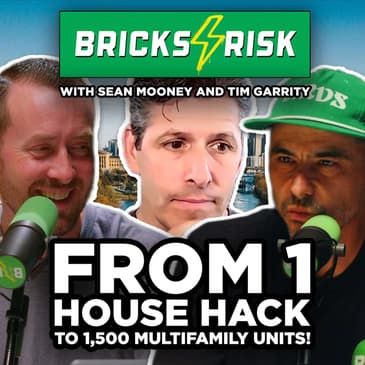
If you've ever wanted to learn how to successfully invest in real estate for the long-term, you talk to Gary Jonas. Gary is CEO of The How Group, specializing in real estate investment/development, property management, and general contracting. As the leader of a vertically integrated company that grew through EOS (Entrepreneurial Operating System / aka Traction), Gary knows a thing or two about how to scale as well as how to build a long-lasting and trustworthy partnership. Sean & Tim dig deep into Gary's journey by asking thoughtful questions that not only reveal some of Gary's secrets for success, but also his recipes for failure. You do not want to miss this B&R smasher!
Big shout-out to our show's loyal and dedicated sponsor: Property Management Redefined. John Sacks and his property management squad love our show and continue to support our mission of helping people through podcasting!
Our goal with Bricks & Risk is that you walk away with 1 or 2 valuable nuggets that can help build your own business. Our audience grows through word of mouth, so if you would please take a moment of your time and give us a review on the platform you’re on, that would be fantastic!
Please also help spread the B&R word by sharing your favorite episode with a friend. You can find all B&R episodes on Spotify, Apple Music, YouTube, and anywhere else you get your podcast content. We greatly appreciate your time and trust.
Until next week, keep learning and keep growing!
** Episode Shout-Outs **
→ La Salle University, Go Explorers: https://www.lasalle.edu/
→ Episode Sponsor, Property Management Redefined: https://gopmr.com/
📲 Contact Info 📲
→ Sean Mooney, Mooney Insurance Brokers: www.mooneybrokers.com/
→ Tim Garrity, The Tim Garrity Team: www.timgarrityteam.com/
💥 Watch us on YouTube 💥
→ YouTube, Bricks & Risk Podcast, @bricksandrisk: www.youtube.com/@BricksandRisk/?sub_confirmation=1
💥 Follow us on Social Media 💥
→ Instagram, Bricks & Risk Podcast, @bricksandrisk: https://www.instagram.com/bricksandrisk/
→ Instagram, Sean Mooney, @sean.moonee: https://www.instagram.com/sean.moonee/@sean.moonee
→ Instagram, Tim Garrity, @realestateinphl: https://www.instagram.com/realestateinphl/
→ Facebook: https://www.facebook.com/bricksandrisk
→ LinkedIn: https://www.linkedin.com/company/bricksandrisk
The giver is the most successful, but the giver is also the least successful. And there's a delineation between giving types that make one successful and one not successful. So you come to me, you ask for help for help. So let's just say you wanted to borrow money, just you know, because that's something that happens all the time. Like I'm a giver, people come to me and they're gonna ask me for money. Okay, I'm gonna lend you money and I'm gonna try and help you out of your situation. But if you don't pay me back, when you call the second time, I'm not giving you money if I'm the giver that's successful. If I'm the giver that's not successful and I'm gonna end up last, I give you money again and again, and I end up getting taken advantage of.
SPEAKER_01Welcome to the podcast dedicated to real estate, insurance, and building your business. Join us as we take you along our own business building journeys with additional wisdom from our network of local and national experts. Welcome to Bricks and Risk.
SPEAKER_00This episode is brought to you by Property Management Redefined. PMR is not just managing properties, we're creating partnerships that build long-term success for property owners. John and his team can be reached at manage at gopmr.com or by phone 267 753 6005. Tim, yes, John. Who's a good client for PMR?
SPEAKER_01Property manager redefine is looking for property owners who value three things accountability, reliability, and a results-driven approach. You want to maximize returns, but still provide client and tenant satisfaction.
SPEAKER_00There's a lot of property managers out there. What does PMR do really well?
SPEAKER_01Biggest thing is they're seamless and they're worry-free. So with that approach in mind, it allows the property owner to put their trust in PMR and know that the results will be there. The other thing I think a property owner is really going to value because they do it so well, is that they have a local expert team based on the ground managing your properties and your tenants' expectations every day so that you feel good about your investments.
SPEAKER_00We have millions of listeners out there. Tens of millions. If they want more information, how do they find PMR?
SPEAKER_01Right here, guys, reach out to John Sachs and his team at Property Management Redefine. Take good care of you. Hey everyone, welcome to another episode of Bricks and Risk. I'm Tim Garrety. And I'm Sean Mooney. Today, Sean, we have a local development superstar. We have Gary Jonas, CEO of the How Group. How are you doing today, Gary?
SPEAKER_02I'm doing fabulous. Thanks for having me.
SPEAKER_01Yeah, thanks for your time. So, How Group amplifies your wealth's potential through a full suite of real estate services from development and investment to property management. Gary leads the charge in creating innovative, low-risk real estate strategies that deliver consistent cash flow and long-term wealth. Whether he's developing distressed assets into thriving properties, getting land entitlements, or managing multi-unit complexes, Gary believes in building for the future while still protecting your downside. As a Philadelphia business owner for 30 years, Gary is laser focused on multifamily real estate. But as a managing member, Gary and Hal also offer property management with over 800 units under management and general contracting, completing over 1 billion in construction over a 20 plus year period. Gary's a firm believer that everyone should own real estate, as am I. While owning 1,500 units himself. He's also an alumnus of LaSalle University. Go Explorers. I love that. That makes you so happy. We got three here as our way. Alright, so let's just start with the obvious. 1,500 units under ownership. Like it sounds crazy to most, myself included. So when did you buy your first building or investment property?
SPEAKER_02So I graduated from LaSalle University in 1992. I bought my first property in 1994. Lived in it for six months. My roommates moved out, I couldn't afford it, and I moved back home and rented it out. So I bought my first investment property in 1994. Why'd they move out? What was the story there? Anyone had enough of you guys? Too much? I think honestly, you're gonna laugh at this, but I think I was a little bit of a maniac. Like I owned the house.
SPEAKER_00You still talk to them, guy, or is that a I do.
SPEAKER_02I do. I still talk to both of them.
SPEAKER_01We're still boys, we just don't live together. That was that was a little too much. Nice. Exactly right. All right, so well, here's a question on that. So you buy your first house, you're living there, you have a roommate, so basically you're house hacking, as they call it today. But then you held on to the real estate and you moved home. So that's an interesting mindset because some people would be like, just get rid of this thing. I made a mistake, why'd I do it? Some people will say, All right, maybe I can rent it out, and then I'll go rent a room in someone's, you know, Manny Yunk row home for like 200 a month. But you actually said, you know what? No, like I want to own this thing. I know I've only owned it for six months. I'm gonna move home, I'm gonna live cheap, and then and then what happened?
SPEAKER_02Yeah, so I I you know what's funny? I never considered selling it. Um my parents owned like five properties in Roxburgh, Manningon, that they had bought over 20 years. And so like I was used to the idea of owning the real estate and knew that I wanted to do it. So when I moved back home and I was renting that place out and, you know, covering itself plus maybe making a little bit of money, my goal was just to save enough money to buy the next house. So it took me two years. I saved enough money, I bought my second house in Maniock. Um, and got two roommates there that stayed because I understood I couldn't be such a you know maniac and it was fine the second time around.
SPEAKER_00Was there something uh so was it your was it your parents' ownership of the real estate, or was it something else that you were like hell bent on, you know what? This is the way to go uh in order to set myself up.
SPEAKER_02So what happened for me was out of college I stumbled into the mortgage business. So I was working for a mortgage company as a sales guy, and it was what they generated all the leads, and we would just take the calls and try and help people out. But I got to see everybody's financials. I saw what they made, I saw what their assets looked like, and there was a clear path that if you were either, you know, a doctor, lawyer, or engineer that had a very high income, or you owned real estate if you were wealthy. That those were the two choices. And so I looked at it and said, well, I guess I better own real estate based on my current situation. And so um, you know, that and reading Rich Dad, Poor Dad, and kind of seeing that story, you know, I was convinced real estate was the way to go.
SPEAKER_01All right, so we're gonna we're gonna fast forward, you know, a while. And you started with a house, then a second house. So let's kind of like fast forward to today. What so 1,500 units, I'm assuming it's not 1,500 houses. What what's your biggest building today? Like what's the biggest one you own with like the most amount of units like in one property or building?
SPEAKER_02So the biggest building we own, I think, is about 156 units. We own three or four buildings that are about 150 units. But eventually what happened is we we got to a spot where we decided our sweet spot is 50 units to 150 units. Okay. That's where we really want to be because it's a little too big for the you know guy just kind of getting started, and it's too small for the institutional guy. So there's there's a spot to create yield there, and it's a very difficult uh project size to scale because it takes a lot of investment in your property management group. So we feel like there's some natural barriers to entry there and gives us some competitive advantage.
SPEAKER_00There were two things I heard you speak about previously, Gary, uh in a maybe a previous podcast you were on. You had talked about uh doing mortgages and there was a quote in there, something along the lines of like you had a hundred employees, but you were making no more money when you had three employees. Uh and then it sounds like when you talk about these investments, um you also said like when you were in investing in single family homes, you were peeling off money to fix one to move money, and and the the margin really wasn't there. Can you talk a little bit about that in terms of being specific when knowing that you should be making more money or the the the margin wasn't there, so you need to redirect your business and go in a different direction?
SPEAKER_02Yeah, absolutely. So what I will tell you is that single family to you know three, four unit type properties, they generally create a lot of equity, but not a lot of cash flow. And the reason for that is regardless of how efficient you are at managing the property, it typically just to pay the taxes, insurance, a little bit of maintenance, pay somebody to lease your property, it's costing you 40 to 50 percent of whatever that income is. And so when that happens, and then you add a mortgage in there, those properties generally don't provide a tremendous amount of cash flow, right? The way people do it, and this is interesting, right, because most of the people that own those properties as investments are people that fit into the category of I call doctor lawyers that they want some tax write-off, they think it's gonna make cash flow because somebody showed them, hey, this property rents for a thousand, the mortgage is six hundred, you're gonna make four hundred dollars a month. But nobody ever showed them the real expenses of operating the building. So it's okay. They continue to buy them because they build equity. So the 10, I ended up getting to 10 single family properties that I own myself. Okay. And that's what you're referencing on the last call. And I was like, look, I just paid off the first one and I walked into the property, and I'm like, well, I gotta spend 50 grand in here fixing it up. I've owned it for 10 years or whatever it is now, and I'm like, I'm never gonna make cash flow on these properties. But I had built up a million dollars in equity in those properties by owning them. So it's not a bad place to start. You just got to realize what you're starting with is building equity, which is fine. And then down the road, I sold those 10 properties, invested in a 22-unit building directly next door to Penn's Dental School, and that building has paid me cash flow for the last 12 years or 13 years or however long we've owned it. Because multifamily, you do have to underwrite vacancy, maintenance, leasing, like all that stuff is already built in there. So what you think you're gonna make generally is what you're gonna make if you want to rotate properly.
SPEAKER_01Yeah, you made an interesting point there. And so I I do some investment development, nowhere near near the scale of what you're doing. But what's interesting about what you just said was owning those 10 houses, paying them off, it builds a lot of wealth. Equity. Like you're you are worth a million dollars on paper. The problem with equity is it's locked. Like the only way to get the equity out is either sell or you know, refinance, take a home equity loan, home equity line, and now you're paying on it. You know, you took the money out, but now you pay interest on it. So equity is wealth, but cash flow is income. So it's interesting because it sounds like you went from like, I need to own these properties so I can kind of like retire early or get to a million dollars faster, but it it was inaccessible. What what were where was the shift in your mind where you're like, look, I can still build wealth. Maybe I don't have to go so quick with the wealth. How do I go a little quicker on the income, on the cash flow? Like when when was that switch you know pushed?
SPEAKER_02So I owned the 10 properties and I had them going, and I realized, man, I'm not making any money here. And then at the same time, my partners and I from the mortgage company started doing buildings that were a little bigger. Like we built our first 30-unit building. Oh, wow. And I looked at it and I was like, oh, okay, I see. This 30-unit building we said was gonna make 100 grand a year, and it does make 100 grand a year. Yeah. Okay, I understand now how I have to underwrite, and I understand that I can keep these properties for building equity and wealth, or I can get in the cash flow businesses, which is where I want to be, right? Because if I want to slow down and have cash flow coming in, you know, that's ultimately our goal. And we became very cash flow focused at that period of time. And everything we do to today is cash flow focused.
SPEAKER_00Well, it's a different approach. So your your first one was I have a job, I'm doing mortgages, I want to own real estate because someday it'll be worth something. And the other approach is I'm going to do this as a business. And if I in order to do this as a business, I need income. And so that is the shift. At what point did you um did you have a job the entire time with 10 singles? Or did you leave at some point and say, I'm gonna I have five, I'm gonna go this road of um being an investor and investing in real estate, and this is going to be my job going forward? Was when was that?
SPEAKER_02Yeah, so that's another great question, and I think it's a trap where a lot of people fall into that that that I see them get themselves in trouble, right? Which is real estate takes a long term time to start building up cash flow. And so I had a full-time job doing in the mortgage business for 20 years. Yep. Okay, or um, yeah, roughly 20 years. And so I was doing that full-time, and even when we started building the 30-unit buildings and they started the cash flow, we were always taking anything we made and buying more property. So it's really just I now know how to put a roadmap together. So if somebody called me today, and I, in fact, just had a call with somebody yesterday, and they're like, I think I have you know $250,000 a year that I can put into real estate, what should I do? And I'm like, Well, you should buy properties yourself. Well, first off, are you looking for cash flow or are you looking for equity, right? So we go through that question, and you know, she wasn't 100% sure. So I said, look, you need to go home and think about that. But the second two things you need to think about are how much time do you have to do this, and what's the return you want to accomplish over five years, 10 years, whatever your horizon is. Like, give me that stuff, how much money you have, how much time you have, and what you want to accomplish over 10 years, and I can help you put a roadmap together to get there. Okay, so like one of the examples I give to people when they say, Well, I don't have the money, like I don't I don't make enough money to have $50,000 a year to just buy another property, but I want to buy a property a year. Like, okay, well, let me let me just give you two examples of how you get there. Okay. One is you do all the work and you partner with somebody that has the cash and you split them 50-50, and now you gotta buy two, right? You gotta buy two to get to the same spot because you're splitting it 50-50. The other is you buy the first one with your 50 grand, you do some work, do it, you fix it up, you sell it. Hopefully you make 50 grand, right? And now you buy the second one with that 50 grand. Now you own one property, you got the 50 grand, you know, and you continue to do that. You buy one, you fix it up, you sell it. You buy one, you keep it. You buy one, you fix it up, you sell it. So now you gotta do two projects a year. You know, like you can get there. There's a lot of ways to get there, and I can help you with a roadmap on how to do it, but I don't know that people clearly define what their goal is. So when my partners and I say, Gary, you gotta do real estate, I said, okay, I wanted to get us to a million dollars in cash flow. So that's $250,000 for all four of us. So if I'm gonna do that, my goal is to do $100,000 a year in cash flow times 10 years. That's my goal. And that's what we started out with. That was the business plan. Get to $100,000 in cash flow a year and do that 10 years in a row, and we'll turn around and we'll all have you know $250,000 in income. Um, and we were able to do better than that. And then we did, it was great. But I don't think people generally start with the end in mind and then work backwards. They just say, hey, I want to do it, and then they get themselves all worked up when if you only need to buy two properties a year, that means you need one every six months, and they're 30 days into trying to find this first good property, and they give up. We're like, well, wait a second, that that process should be a six-month process.
SPEAKER_00Yeah.
SPEAKER_02And you gave up after 30 days, you're not really understanding what this process looks like.
SPEAKER_01Yeah. All right, so we'll we'll just cut right to it. You're you're a total entrepreneur, you're a self-starter. You know, you went from buying a house right out of college to like developing 150 unit buildings. Where does that come from? Like, were you were you a hustler when you were young? Did you learn the value of hard work at a young age? Was it older and you just turned it on? Like, where where does that come from?
SPEAKER_02So my my parents um owned, you know, hustled to get some properties together, right? That that they owned. And they, you know, started their own business when I was probably in high school. My dad was a union electrician, they started a business together. We worked for them on those houses, we worked for them in the electrical business, whenever they needed to get by. Me and my sisters did with them. Like, I we love the story that my dad gave us a set of blueprints and went, go wire that house, you know, and meet his sisters. Like, we're not tying in the electric to the actual panel. Don't get shot. We're running into the, you know, to the outlets and doing the stuff that he wanted us to do. So I think he taught us, him and my mom taught us a uh a valuable lesson on entrepreneurship. And me and both my sisters essentially are entrepreneurs at the end of the day.
SPEAKER_01Wow. All right, so it started with the family business. What was it that you realized you're like, okay, it's one thing for my parents to say, like, hey, this is probably a pretty good path. Like, this is the path that we've done. Like, look what we have, and look, you know, we have time freedom, or we have wealth, or we have cash, whatever it is, doesn't matter. Like, what was it seeing your parents do it and then you doing it, and then going to LaSalle University, which is a fantastic school, you're a business guy. You could have just gone right into corporate America and just wrote your ticket for like 30 years and and done a few things on the side. Like, what was it that made you say, like, now you know what? Even though I'm moving out after six months of my first property, I'm moving back home. Like, most people don't do that. Like, what was it that made you kind of keep pushing?
SPEAKER_02Well, I'll give you a couple things. One of which is I was a terrible electrician, right? Just awful. Take that off the list. My dad. Sorry, Pop. It was like right. Like he eventually it was it was so sad, you know, when he was done and wanted to retire, and him and my mom wanted to retire, there was nobody to give the business to because it was I am bad at that. Like I am clearly bad at that, right?
SPEAKER_03Yeah.
SPEAKER_02So really what happened to me entrepreneurial-wise was I knew I wanted to own some houses, but I didn't consider that entrepreneurial. Like me starting my own business happened because I was working in a mortgage company. I got hired to run a sales department for somebody that was starting a mortgage company. And I was working until two o'clock in the morning, like, this was my chance to be successful and really be the boss and XYZ. And I thought we did a really good job. And then the people that own the business just decided, you know, they were very wealthy. They decided, yeah, you know, we're not really interested in this business anymore. And I went, well, this is ridiculous. Like, I if I'm gonna work this hard, I might as well try and do it myself. And so me and two other guys that worked there, you know, paid our bills for six months and rented a small uh office in in Conchihakin and putting that in the paper to try and get mortgages. And like, all right, we're in business. This is what we're gonna do. Um, and we had six months to figure it out. And we did, we figured it out, and people liked us, and we started getting deals from real estate offices, and and that kind of you know helped us accelerate and grow this mortgage company, which really funded the real estate. So it kind of worked in steps, right? Like once the real estate was gone, we were making good money, then we decided, hey, we need something for retirement, let's get cash flow from real estate, and that's that's when we really started working on that end of it.
SPEAKER_00Can you talk about? The Hal Group specifically, Gary, uh, in terms of what you do now, like what like what is the HAL Group? Sure.
SPEAKER_02So the Hal Group really does three things. Um, we do development work, so the idea is hey, the best way for us to create value in real estate is to buy something that we can improve, whether it's a piece of land, whether it's an old school building, um, or just an existing apartment building that there's different things that we can do programming-wise in, right? So we have a development group, those guys are out there looking for properties and then trying to figure out how to create value there. Um, because of that, and because we did a lot of new construction over the years, we have a construction company which builds for us and then builds for select other developers that we know like and trust. And then finally, we have a property management group that manages all the assets that we have. But to kind of take you back in the journey, when we first started, we had a mortgage company, okay? And we looked at it. There were four of us, and we said, well, who is the worst person in the mortgage company? Who's, you know, business-wise doing the least amount? Yeah. And at that point, it was my partner Andy. So he said, Hey, Andy, you know, it's 2003. Why don't you go out and start trying to buy some real estate? So we'll have a retirement claim because we're self-employed. We don't have a 401k, you know, like you got to do this. And he went out and started doing it. And what we found out when he was doing it is he was really good at construction. So he was buying a two-unit building here, a three-unit building here, totally redoing them. And then other people were asking him, hey, can you do that for me? Like, I bought this rehab, can you rehab it? So we have this kind of little construction business going, and we own, you know, 20 units or something, and he's cobbled together. And then the financial crisis happens in 2008. We end up going to a state chartered bank and saying, Hey, we have better default rates than you. We underwrite really well, we're doing 15% down, purchase money mortgages. Like, you really want this business. And they were like, Yes, we do. So they let us like run a PL for them off of their lines of credit and stuff. And what that meant was I now have nothing to do because all the work that I did for the mortgage company at that point, they're doing. Okay. So now they're doing it. We look at it because we're abundance people, not you know, scarcity people, and we go, hey, that means now there's two of us working in the business and we think we can make the same amount of money. Why don't you go help Andy with the real estate? And I said, All right, well, you know I'm terrible at construction, Andy. This is documented. How about I try and come up with a system to buy them, finance them, I'll take on that piece of it, I'll rent them, I'll do all that stuff. You handle the construction. And that's what we did. Um, but the reason we were able to do it and pour so much money into it is because the mortgage company was still making us money. Yeah. So the mortgage company was paying Andy and I, and we weren't working in the mortgage company at all. But we were all taking the same salaries, and then he and I were over here working on the real estate end of it. That's how we did it.
SPEAKER_01Hey everyone, this is Tim, your favorite BRICS and wrist co-host. But don't tell Sean. I hope you're enjoying this episode, and I'll get right back to it in a moment. Our audience grows through word of mouth. So if you would please take a moment of your time and give us a review on the platform you're on, that would be fantastic. Please also help spread the BR word by sharing your favorite episode with a friend. We greatly appreciate your time and trust. Now, back to the show.
SPEAKER_00You referenced the call uh that you had with a developer recently that said, Hey, I got $250,000 that I want to put into real estate. Gary, what do I do? Do you get those calls frequently? Is it people that are reaching out to you, or are you looking for people to bring in on projects? Like what are those conversations and how do they happen?
SPEAKER_02So the answer is both, right? So I am actively always looking for people that want to invest in our real estate deals. Um, we think it's the best time since 2008 to buy real estate. And, you know, the reason we think that is, you know, we're under contract on a building right down the street from you called the Yarn Factory. You're probably familiar with the building. It's across the street from the movie theater and many of, right? Yeah, yeah. So it's a 50-unit apartment building. It's our estimate that it cost the guy $12 million to build it when he did it seven years ago. Whoa. Okay. We're buying it for sub $10 million today. Okay, seven years later. It's fully occupied. There's no problem with the building, right? It's just that, imagine this happens to you. And I'm not exactly sure that this is what happened, but I'm pretty sure this is probably what happened, right? He went out and he built a $12 million building and took an $8 million loan, he put $4 million down. Interest rates went down to 3%. Oh he refinances, he takes out $10 million. Right? Okay, well, that makes sense. He gives half his money back to his investors, buildings cash flowing, everybody's happy. But then Philadelphia passes a law and says, hey, we're gonna change the way the tax abatement works in the city. The whole city gets flooded with way more units, you know, five years worth of units in one year, and so rents stay flat for the next five years for this guy. So now his loan comes up, the 3.5% rate. Rents have not gone up at all. Maybe they've gone down a little bit, and his rate's gonna double. Right. Well, what's he gonna do? He goes back to his investors. Hey, I need more money. They're gonna say, I'm not giving you more money, this building's not creating any cash flow. We get to buy a building below what it cost him to build it seven years ago. How often does that get to happen? Not often, right? But it's happening every day in this market. Yeah. And so we believe we can buy as much of that stuff as possible. So for that reason, I always need more investors. So I am looking for investors. But let's say somebody listened to this call or to this podcast, and then they called and said, Hey, I'm interested. I, you know, I want to be an investor in real estate. I always start with this I say, if you can do it yourself, you should, you will make the most money. Okay? So tell me what you're looking to accomplish and let me help you with a roadmap for you to do it yourself. And part of that's going to be time. If you decide you don't have the time to do it yourself, or you're afraid to do it yourself, or it doesn't bring you any joy when I explain to you what you have to do, then you can go to the second step, which is to invest with somebody else that does it. And then the question becomes, am I that right person? Or should you just put it in a BlackRock REIT fund? Like, what should you do? Right? Like that, these are your options. And I try and walk people through. Like, if you go to BlackRock, you should make 11% on your money. You come to me, you should make 15% on your money. You do it yourself, you should make 20. Right? That's that's kind of what that math looks like. Over a seven-year period of time, that's what you should be able to get in each three of those investment buckets. And now you just got to decide which of those you want to be in. And by the way, the one that makes 20% gives you the most flexibility because you're 100% in control.
SPEAKER_03Right.
SPEAKER_02Right? As soon as you come to me, you've lost 5% and I'm now in control, and you're not. Right? But if you're out there making $500,000 a year in your job and you don't have time and you want to own real estate, I'm a really good option for you.
SPEAKER_01Yeah. Yeah, that's you made a really interesting point there, like telling someone you can take the money, you put it in a REIT, you can make double-digit, you know, returns. Who doesn't want to do that? And you do no work. You just say, here, here. Then you're like, oh, you could do it this way, you could do it with a partner, you might make this, or you could do it on your own, you might make that. So here's a question. I I had this. So you've been in the HAL partnership for for about 30 years, right? That's correct.
SPEAKER_02I started with the mortgage company, and then in 2008, we really started doing development. But yes, same partners for 30 years.
SPEAKER_01So the easy way to put this, you know exactly what you're doing. And if you do it yourself, you can make the most amount of money. So, what's the argument for like doing it yourself versus like the advice for like a successful partnership? Like, what would you say to one versus the other?
SPEAKER_02Well, I I like partnerships because I like doing stuff with other people. I like companionship, and and so for that reason it works for me. But the first question you gotta ask yourself is are you a partner person? Okay, and it's it's a super important question. And the way I ask it is this let's assume Tim, you and I are partners, right? We're both working really hard, okay? Both working really hard, but your result is double mine, right? Are you gonna call me when that happens and says, hey Gab, I love you. We're friends, but I'm doing double what you're doing, so we got to change our deal. It's no longer 50-50, it's 7525 because I'm I'm bringing in, or 6633 because I'm bringing in two-thirds the income.
SPEAKER_03Yep.
SPEAKER_02Like if you're gonna make that call, you're not a partner person, right? Because thinks what happens. Now all of a sudden we decide we're gonna shift to construction and I'm better at construction than you, and now I'm making two-thirds of the income and you're not. And our efforts are the same. Now I gotta come back to you and I gotta go, hey, by the way, we're gonna change our deal again. We're not really partners. We're just guys that happen to work together and keep score. And we're gonna pay ourselves commensurate with what we see as our value, right? And so if you think of that example and say, hey, that's what I would do, I would want my 66%. You're not a partner person. You better do it yourself because you're gonna be mad, you're gonna be angry, you're not gonna be happy. And if you remember back to the beginning of the story, we said, you know, Andy was the worst mortgage guy. He was doing 10 loans when I was doing 20. He still made 25% of the income. But guess what? When he became the construction guy that was making way more money than the mortgage company was making, he didn't come back to me and say, hey, I'm the valuable guy, right? So for 30 years, we've all had points where we're either the weak link or the strong link, and all we ever cared about was effort, right? And if you're gonna be a partner person, all you got to care about is effort, right? Or do it yourself.
SPEAKER_00It seems to me, Gary, that that's that that's almost impossible to happen. Impossible to be in a partnership with four guys that over the course of 30 years, because people change, lives change, so much can happen in 30 years.
SPEAKER_01You get married, people have kids, you know.
SPEAKER_00It's a lifetime. There had to have been some points along that journey in 30 years that it was either tested or stressed. Is can you think of an example of when you you guys hit a point and and like maybe it became a flash point, but it was resolved? I'm I'm just trying to think of what life would be in that long stretch of time.
SPEAKER_01That's a long time.
SPEAKER_02Yeah, I can think of 10 examples of it of it happening. How much time you got Sean and Dan, let's go. But I'll give you, I'll give you a couple because they're like real life stuff, right? So I'm no longer working in the mortgage company, I'm not running it. My partner, Bill, you know, says, I want to run the mortgage company. But we don't think he's the right guy to do it. Yeah. And we can't even tell him, hey, Bill, sorry. And he's crying on the phone, like talking to me, like he's devastated that I'm telling him, I don't think you're the right guy to run this company. And we got through it because we talked to us. Like, I'm not that I'm not doing this to be, you know, to upset you, Bill. Obviously, I'm doing it because I want you to get the most success possible. And if we trust each other, like we're gonna fight about it, but ultimately when we make the decision we make, we're all gonna live with it. And so we fought about it, and it was scary, and it was all those things. But at the end of the day, we trusted each other that we're trying to do what's best for the company. And when people come from a place of trust, like I really trust you, then it's much easier to get through these types of things that happen. So I'm gonna give you another one just so you can kind of, you know, like it's not easy. Nobody says this stuff is easy. Um but I made a decision for us to invest $500,000 in the company. Okay. And it was for our mortgage company. And the idea was this way back in the day, you guys probably don't remember this, but when you used to go look for a property, you had to take a map out and you had to like look on the map where the property was.
SPEAKER_01Yep.
SPEAKER_02Well, this guy created the first technology that dropped little pins on a map and said, Oh, you're gonna look at these properties? Like, you can just hover over it and click on it, and it'll show you where the property is located, and you'll see this stuff. And the company was called where to live.com. And we invested all this money in this company because we thought, wow, this is tremendous technology. We're in the mortgage business. They're gonna take us into all the offices they go in, and we're gonna get all this mortgage business. We never got any mortgage business, and even though the technology was great, somebody else executed on it better, and we lost all $500,000.
SPEAKER_03Wow.
SPEAKER_02And not one of those guys said a word to me.
SPEAKER_00Wow.
SPEAKER_02Not one of them.
SPEAKER_01Yeah, that's a partnership. That's not only a partnership, that's that's almost like a brotherhood, like a friendship, because everyone makes mistakes in business. Everyone Sean and I have made plenty of mistakes. We just did an episode about our biggest business failures. And I think when you can when you can own your shit and know that you got people that also own their shit, and you can all communicate properly and let each other know, you know, I'm not going anywhere. Like I'm here, I'm here to help you out. I we got to talk about this because it's a big deal. But I think, first of all, finding that level of trust is is very difficult. You know, we're all I think all three of us are very fortunate. We're all from this area. We went to a local college, so we have like these amazing relationships and bonds for life that I might meet people from all over the country and they don't have any of that because it's it's more transient, it's just different. But I think you explaining it in the way that you did of look, you know, I think uh I think the really good example is are you a partnership kind of person or not? And if you're unsure, probably don't go the route of a partnership. Because if you think you might be and you go the route of a partnership, it might blow up in your face. And that and that's not good for anyone. But um I also wanted to ask a question because I don't know if I've ever got this answer from you, but where did the name come from? Where did how come from? Are you willow to share that, by the way, or is that a trademark secret?
SPEAKER_03No, no, not a secret.
SPEAKER_01The sign that ended. Yeah, yeah. All right, it's just a docu sign. All right, we're good.
SPEAKER_02All right, we're good. I love this is one of my favorite stories. So um we're transitioning, right? Like I we put other people in charge of running the mortgage company, and now I'm on my own, I gotta go out and buy real estate. I'm like, all right, well, how am I gonna do it? And I'm sitting in this office by myself, right? And I'm like, I I saw a sign in the conference room and it said, the answer is yes, let's figure out how, right? And so I loved that tagline, and then I thought, I'm gonna send these postcards out with a big question mark on them that says how. And then you're gonna flip it over, and it's gonna say, Let me show you how I can buy your house. Let me show you how I can, you know, like one of those like mailers that I could send out the people. And that's what I did. I sent, you know, I don't think I got one deal from sending out these postcards that said, Let me show you how. But that was my grand idea when we were first starting on how I was gonna generate business.
SPEAKER_01Wow, that's interesting.
SPEAKER_00It's uh shout out to Robbie Sche. So we're problem solvers, right? So that it really is your brand is we we're the problem, bring us the problem, and we'll figure out how to make money off of it and and make the deal and get it done.
SPEAKER_02Kind of exactly right. That's exactly right. That's how we think about it now. Let us show you how, know how, like these are taglines we use, and we we believe it. Like we believe it's our job to be able to come in and show a lot of confidence in you and your team, too, right?
SPEAKER_00Is like we have the ability to know how to do it, or or we'll figure out and and uh our team collectively will get it done.
SPEAKER_01Yeah, 100%. Awesome. One thing you told us that you're very passionate about is called bulletproofing real estate. And I think we've gotten to a little bit of that already. Um talk about explain that more. What is bulletproofing real estate to you and and why is that scale important?
SPEAKER_00And before you go, Garrett, let's set it up because real estate by nature is a good thing. Here we go, here we go, Gar. Is something you can bulletproof where people look and have this perception that well you can't because the the market and the the interest rates and and there you know there's so many different factors that are out of your control. How do you do it?
SPEAKER_02Right. So great questions, right? So yes, is there any look if if we get in a stagflation situation and rates run to 18%, like are there gonna be problems? Sure. But there are things that we can do to get us pretty close. Like our goal is to take as much risk out of the transaction as we possibly can. So let's take them one by one. Okay, so let's take interest rates as the one that everybody thinks about. Okay. So we're gonna buy a project in Chesnut Hill, hopefully in the next two months. We're under contract, and we got to go in and do six or seven million dollars worth of work to these hundred units. Plus, there's people in the buildings. We think this is a three-year project, right? So you would look at that and say, well, you got three years worth of interest rate risk. How are you gonna protect yourself against that interest rate risk? Okay. So two things we're gonna do. One, we're going to a bank, we're gonna get a fixed rate loan from day one. It's a higher interest rate than where we would normally start, right? So instead of um instead of paying 5.75%, we're probably gonna pay 6.5% to get a deal from a local bank, but they're gonna give us fixed rate for five years. So that's three years worth of doing the work, two years worth of additional time to you know deal with the interest rate environment. Okay. So that gave us five years. Most people don't take a fixed rate loan, they take the floating rate loan. And so they have interest rate risk where I don't. Okay. That's number one. Number two, I'm not gonna leverage it at a point where if I'm wrong, rents are down 10%. So during, you know, the last they never go down. I haven't seen them go down more than 10%. So I got to stress test my deal for a 10% variance in rent off of today's rents, right? So some people, here's here's where somebody gets themselves in trouble versus us, right? Somebody might say, hey, it's gonna take me three years to complete this building. So I'm gonna take today's rents. I'm gonna assume they go up 3% a year for three years, so I'm gonna make the rents 10% higher than they are today, and I'm gonna underwrite and borrow money off of those assumptions. We're gonna do the opposite. We're gonna assume that rents stayed the same, and we're gonna plan for our deals still working if they go down 10%. Okay, and when I say still working, we're obviously not making the cash flow that we thought we were gonna make, but we're not giving the keys back to the bank. We didn't lose our money, right? So the difference is this guy needs it to go up 10% for his deal to work and to be okay with the bank. I can go down 10% and my deal still works with the bank. So now I've taken what I believe are market rate out of the equation. I've taken interest rate out of the equation, so I'm to the third one, which is just execution on construction. Right? And so the way I do it with people to tell people to bulletproof their thing is never do a deal for your first time yourself that you haven't done before. Don't ever do it. Partner with somebody that did it, learn how to do it so you don't make those mistakes on your dollars. Okay? If I were going to go out and buy a 500 unit complex today, even though I own 1,500 units, I would go find somebody that owns 500 units and do it with them. Because there's stuff I think I know that I do not know. And I can't do that. You can't take that risk with other people's money. So if those are the three main factors in making a real estate deal work, that's how I'm gonna deal with it. I'll give you another example if you were doing an outsale deal. So I'm gonna buy two lots, I'm gonna build houses on them, I'm gonna sell them. Okay? Well, my partner Andy's father built condos and rates went to 18% and it put them out of business. Right? So we said we're not taking interest rate risk, and two, we're never gonna build something that we can't rent and cover its, it's cover the mortgage. Okay, so if I were doing an outsale deal and we've done this a bunch of I don't know when I'm gonna get a loan and get an underrated as if I'm gonna rent it. And I'll protect my interest rate risk and I'll What's the number you'll let me sell one out of this loan for? And they give me a number, because it's called a guaranteed release price, and then I execute my plan of selling. But in that process, I don't take any I I'm not taking risk that I think I can't handle. So that's those are the ways we bought proof real estate.
SPEAKER_00Is it uh is it smart business or being conservative, or maybe a blend of both?
SPEAKER_02So it's conservative when the market's ripping, right? I'm gonna make less money than somebody else because I'm being conservative. Yep. It's smart business when the market is tanking. Wow, really good way to put it. So, you know, I look at it this way, right? Which is I'm not looking to hit home run after home run. I'm looking to hit a single, single. Every once in a while, the market goes in my favor, I hit a triple or a home run. But if I can just stack up singles, you know, I I don't I want to be the guy every year that gets 200 hits, right? Not the guy that's striking out X number of time and hits 50 home runs. Like, that's not good for business, that level of failure, right? So that I I think it's really critical. You know, if you see a deal that somebody brings you that makes 35%, you gotta understand that deal comes with the chance that you're gonna lose all your money, right? Like there's not deals making 35% and hanging on trees. So if you are seeing that, that generally means that that risk profile is significantly higher. Right?
SPEAKER_00Like it's the just you gotta know that. It's the Pete Rose approach. You can't win the World Series without Pete Rose. Hitting, hitting, hitting, hitting, hitting. Look at the Phillies, right?
SPEAKER_02The Phillies just brought in that one guy that can hit and all of a sudden changed the whole yeah.
SPEAKER_00Yep. And he's probably win the batting title this year. He's at like 318 or something leading the National League.
SPEAKER_01I'm gonna go out on a limb here, Gary. Um in order to get good at bulletproofing real estate, my assumption is you uh had to have had a big loss or a big failure or a big lesson or lessons that taught you to get better at hedging your bets when you buy real estate. Are you are you okay giving an example of like one that comes to mind that made you more like this today?
SPEAKER_00Aside from the $500,000 loss Yeah, but that was that was on tech. I'm talking about real estate. Aside from that.
SPEAKER_02Yeah, uh aside from that, I appreciate that. Well, I'm gonna tell you that I'm gonna give you a story that I think is relevant, right? So I told you the story about Amy's father and and building that real estate during that period of time. My parents owned an electrical contracting business. They used to do a lot of work, they somehow or other got into uh wiring out MRI units and stuff and did a lot of work in the hospital system. And what we saw happen to them was they would make all this money and then the the hospital would go out of business and then they would lose all the money they were making. So we came from seeing these these very risky situations and saying to ourselves, we don't want to put ourselves in those situations, right? We're not gonna do that. So if there wasn't a real estate deal that we did that did that, but I will tell you, if you look at anything bought between 2019 and 2022, right, if you bought during that period of time, that deal probably didn't go as you planned. Okay. Now, we had interest rate hedges on all of those. So we didn't have we weren't in the same interest rate risk as those people, but we did have to deal with rents staying flat, vacancy going up, delinquency getting higher, you know, just a demand issue that was way greater than we expected because of all the permits that came out. So, what did that mean to us? That meant deals that I told people were going to make 15% are making five or six, right? And I'm working my ass off every day on those deals to make them five or six percent, right? And I'm making nothing on those deals. But I can stay in the game because I have cash flow from real estate. Our operating companies, oh, and by the way, I had to give all my profit back in my operating companies between 2019 and 23 to make sure my investors were whole.
SPEAKER_03Oh, wow.
SPEAKER_02But I was able to do that because the buildings that we built up over those years, I could pay myself with the cash flow from all the ones we built during the good times. And when times were bad, I could make sure my investors were protected. And now we come back out the other side. I've way outperformed the market. I didn't perform to what I told them I was going to, but I didn't lose anybody's money and I way outperformed the market. And guess what? Now people want to give me money because I made it through three or four years of this down cycle that happens for what we now think is going to be the 10 years they kill it.
unknownWow.
SPEAKER_01That's a great example.
SPEAKER_00You're CEO of How Group. Um how did that come about? Two questions. How did that come about within your partnership? Was it just clear that you were the leader uh that had the the best acumen to lead the group? And number two, how do you, because it's a big umbrella with a lot of entities and a lot of moving parts underneath, how do you deploy your time uh within the different uh parts of the business?
SPEAKER_02Sure. So it was easy for me to kind of take that leadership role because when me and my two partners moved over into the mortgage business from working for somebody else, at that time I was their boss, right? So I ran a sales team, they worked for me. So when we came over, even though we were kind of equals, it was it was just they were used to me making decisions, and for the most part, they were comfortable with my decision making and let me do it. But Andy made the construction decisions once he became in charge of construction. Bill made the mortgage decisions when I was development. So in theory, we were all running our own division over time. But in 2017, we started you using EOS, um, which is an operating system for businesses. It's very clear the way that you know the org charts are set up, um, the meeting structures are good. So as we wanted to grow our business, we needed a better system structure, and we relied on that, and we think that's helped us a ton.
SPEAKER_00Did you do that yourself or did you bring in uh an implementer?
SPEAKER_02We run an implementer, um, and we still use an implementer for our yearly uh planning sessions.
SPEAKER_01Yeah, so for those for those who are unaware of EOS, that traction is sometimes the uh word people use because of the book by Geno Wickman. Um we operated on EOS for a while when I was running my real estate brokerage. Fantastic system, a lot of accountability, a lot of predictability. Um it's a great system. If no one's ever heard of it, check out EOS Entrepreneurs Operating System or Traction. And then the last one I have for you, Garrett, is your tip for our listeners and watchers is give away information, which some would say, why are you giving it all away for free? Why not charge for it? So, like, where where's the why is why does that philosophy work for you?
SPEAKER_02It works like look at the end of the day, people are gonna get the information anyway, right? So it's like, do I think I'm such a genius that what I do nobody can replicate and I should hold it in a vault over here? No. Uh I think, look, if I'm talking to you and you're like, hey, how do you do this? and I tell you and you're successful, well, that's a credit for me. Like when I call you and I need something, and I'm like, hey, you know, I want to do a podcast, how do I do that? Well, now you're gonna help me because I helped you, right? Right. And I don't um my one of my favorite books, and it's a trick question, is the Adam Grant book. Um, I think the book's called Give and Take. I might have the title wrong, but I'm pretty sure the book is called Give and Take. And in the book, they ask the question which of these groups of people are the most successful documented in life? There are givers, so I'm gonna give that information to you. There are matchers, I'm gonna give that information, but I I wrote a note to myself and I'm gonna call you because you owe me one, right? And then there's takers, which is I'm gonna take all your information. When you call me for help, I'm not giving it to you. Okay. And so the question is, which of those groups is most successful in life, and which of those groups is least successful in life? Now, I'm not gonna make you answer because it's a trick question. The answer is the giver is the most successful, but the giver is also the least successful. And there's a delineation between giving types that make one successful and one not successful. And this is it. So you come to me, you ask for help for help. So let's just say you wanted to borrow money, just you know, because that's something that happens all the time. Like, I'm a giver, people can come to me and they're gonna ask me for money. Okay, I'm gonna lend you money and I'm gonna try and help you out of your situation, and I'll do that. But if you don't pay me back, when you call the second time, I'm not giving you money if I'm the giver that's successful. If I'm the giver that's not successful and I'm gonna end up last, I give you money again and again, and I end up getting taken advantage of. So the giver that gives up their time and of their expertise and of their money to help other people will be the most successful person over time. And I didn't know that when I decided I was just gonna give information out to people. It was just to me, it was the right thing to do, right? At the end of the day, if I'm learning this and I can help you, you know, that feels good to me. I should do that.
SPEAKER_01So it's almost like fool me once, shame on you. Fool me twice, shame on me.
SPEAKER_00Well, a lot of that is the precepts of Bob Berg, the go-giver. We had them on as an episode, and it's it's give without the expectation, and you'll be so much further ahead over in lifetime. But don't be a doormat. He made that very clear.
SPEAKER_01Yeah.
SPEAKER_02That's right. That's exactly right.
SPEAKER_01Awesome. And so it's in the fantastic discussion, Gary. You know you're a really busy guy. Appreciate your time today hopping on with us. But before we shut this one down, why don't you tell our bricks and riskers where they can learn more about you and everything you got going on?
SPEAKER_02Absolutely. Yeah, just go to thehowgroup.com, just you know, the and then how how. Sometimes people try and put an E on the end of it, but just HOW.com. You can also look at stuff we're doing at investments at howgroup.com. Um, if you're interested in investing with us, obviously, as I said to you, like we're we're certainly looking for that. But I do, as we talked about, I do help people put roadmaps together for themselves. I don't charge for that. I do that for people that I think there's an opportunity for them to be successful. Um, and I do think that comes back to you. So um any way we can help, we're happy to do it. Um, anything I can do to help anybody, we you know, we want to try and do it.
SPEAKER_01Love it, man. Appreciate it. Thank you, Gary. Yeah, that's all we have for this one, folks. Thank you for tuning in again to another episode of Bricks and Risk. See you next week. Thank you for joining us on another episode of Bricks and Risk. Our goal is that you walk away with one or two valuable nuggets, and we greatly appreciate you sharing your time with us today. You can find all VR episodes on Spotify, Apple Music, YouTube, and anywhere else you get your podcast content. Until next time, keep learning and keep growing.