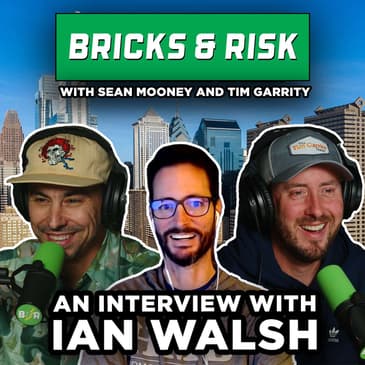
Private lending (aka Hard Money) is a term that investors/developers are familiar with, but maybe not the average buyer or seller. Ian Walsh is a leader in private lending around Greater Philadelphia, as well as in multiple other areas and states. Sean & Tim dig into his journey as a wholesaler, property management owner, and now a private lending partner. Valuable stories and nuggets abound in this one, please enjoy!
Our goal with Bricks & Risk is that you walk away with 1 or 2 valuable nuggets that help build YOUR business. Our audience grows through word of mouth, so if you would please take a moment of your time and give us a review on the platform you’re on, that would be fantastic!
Please also help spread the B&R word by sharing your favorite episode with a friend. You can find all B&R episodes on Spotify, Apple Music, YouTube, and anywhere else you get your podcast content. We greatly appreciate your time and trust.
Until next time, keep learning and keep growing!
📲 Contact Info 📲
→ Sean Mooney, Mooney Insurance Brokers: www.mooneybrokers.com/
→ Tim Garrity, The Tim Garrity Team: www.timgarrityteam.com/
💥 Watch us on YouTube 💥
→ YouTube, Bricks & Risk Podcast, @bricksandrisk: www.youtube.com/@BricksandRisk/?sub_confirmation=1
💥 Follow us on Social Media 💥
→ Instagram, Bricks & Risk Podcast, @bricksandrisk: https://www.instagram.com/bricksandrisk/
→ Instagram, Sean Mooney, @sean.moonee: https://www.instagram.com/sean.moonee/@sean.moonee
→ Instagram, Tim Garrity, @realestateinphl: https://www.instagram.com/realestateinphl/
→ Facebook: https://www.facebook.com/bricksandrisk
→ LinkedIn: https://www.linkedin.com/company/bricksandrisk
[00:00:00] Do you have a deal that sticks out in your head, Ian, that you look back and you're like, man, how do we get that done? We did have a weird one though recently that was kind of nuts. My partner was going to be closing this deal on Monday morning and he got a call at 10am. The guy said, hey, I need to push closing until 2pm. Fine, no problem. Fine. The guy goes, he ghosts overnight. All of a sudden there's an article out two days later that there was a guy in central Pennsylvania who had kidnapped and was human trafficking.
[00:00:30] It was on out and it was being taken in for charge for murder. So Ryan realized what had happened. My partner Ryan realized he goes, the guy pushed from 10am so he could do like the murder or the kidnapping. I don't know what it was one of the two. So you want to push from 10am to 2pm so we can handle the murder and kidnapping in the morning and close it at 2pm in the afternoon. He's like, I don't have a coffee meeting. I have a murder and a kidnapping to take care of.
[00:01:00] Welcome to the podcast dedicated to real estate, insurance and building your business. Join us as we take you along our own business building journeys with additional wisdom from our network of local and national experts. Welcome to Bricks and Risk. Hey everyone. Welcome to another episode of Bricks and Risk. I'm Tim Garrity. And I'm Sean Mooney.
[00:01:29] Today, Sean, we have a great guest, someone who owns the investment space for funding. We have Ian Walsh, managing partner at Hard Money Bankers. How are you doing today, Ian? Good. Good. Thank you. Yeah. So Hard Money Bankers is a full service and self-funded private money lending company providing fast and flexible financing for residential and commercial real estate deals.
[00:01:55] They currently lend in Maryland, Washington, D.C., Virginia, Pennsylvania, New Jersey, Delaware, and North Carolina. Ian started in the real estate business over 15 years ago. He built one of the largest wholesaling companies in Philadelphia at the time and then began Atlas Property Management, which was sold several years ago. He's currently an active partner in Hard Money Bankers and has been a part of over 1,000 transactions to date. Hard Money Bankers deploys roughly $40 million a year in funding.
[00:02:25] And he went to Penn State University. Go Knits. So, all right. First question I want to start with. What exactly is private lending in your eyes? Private lending is going to be just non-institutional lending, right?
[00:02:43] Like, so if I go to a bank, I'm getting money from an institutional source, which is being underwritten completely different than if it were private money, which would be true private money. True private money would be like if you came to me and said, Ian, from your bank account, will you write me a check to do this project? Correct. That would be private money where an individual usually or maybe a small group of people are making a decision on the actual loan.
[00:03:11] So, whether you're sourced from institutional bank money versus an individual or group of people making the decision is the difference. Nice. All right. So, like, I'm not a banker, but I was in the mortgage business. So, from, like, an institutional bank, let's say, a lot of their lending is based on deposits. You know, how many deposits are they taking and then how much money can they lend? How do you establish how much to lend when you're getting started?
[00:03:38] Like, when HMB started and you're getting this thing off the ground, you obviously had to have something backing your capital. Was it someone's bank account? Was it a warehouse line? Like, how did that start? Friends, family, mainly. And then, you know, in the beginning, it's hard to cap raise. It's hard to bring money in. And then after a few years, like, you know, you do good deals. You return people's money. Then it's like it just comes, right? Like, people are just, like, telling their friends and everybody's like, this is how.
[00:04:08] So, but, you know, we do also do a lot of just, like, partner money at this point. Like, you know, we spent a long time building this. So, the end goal is to be 100% self-funded. So, that's really where it's eventually heading. But initially, yeah, cap raising is hard. To get your first million to deploy is, like, you know, hard. But then after that, it's, but you've got to be doing good deals. You've got to return the money to the investors.
[00:04:34] Like, if you're not doing that, you're not going to raise anything past a million or two million or whatever you're trying to raise. So, yeah. Ian, can you get in the time machine, take us back to what that might have been initially? Like, friends and family, like, are you literally picking up the phone to friends saying, hey, this is what I'm doing. I want to raise X. Would you be interested? Like, what was the pitch with the first go around for that? That's a good question. Yeah. I didn't have much to do with that.
[00:05:04] My partner had the most to do with that. And one of our initial investors just happened to be a guy that just struck a chord with it. I don't remember, recall how we came about with him. But, you know, he had sold, you know, his firm for, like, $100 million and decided he was going to deploy some of that into this space. And then, you know, let's say he gives, like, half a million bucks or whatever it is. And then you give him his money back and he gets a good return. And he goes, hey, can I do $750? Can I do a million? Hey, my friend does this.
[00:05:33] So, like, it's not a lot of conversation. You know, the conversations now are much different. They usually tend to be more like those I have more insight to. So, a lot of times people will just, I don't go out asking people for money. So, like, but they'll call me up and just say, hey, do you guys, you know, will you take on capital to deploy or whatever? And my answer is usually no at this point. Like, we try to be in a space at all times where we don't have any pressure to deploy funds.
[00:05:59] It's a really dangerous place to be when you have to deploy funds, which typically comes from institutionally funded scenarios. Because the bank needs you to put money out on the street. And if you're not putting money on the street, they don't want to have your wholesale line out there. And then you're like, all right, well, let's see if we can squeeze this deal through. Well, when you start having pressure to deploy funds, you jeopardize the integrity of the loan. I know it sounds, you know. It sounds right because bad decisions could be made where you're, you know, now you're on a timeline. Now you have to make a deal. Now you have to get that money out.
[00:06:29] And it may veer away from your traditional underwriting process, right? That's, yeah, 100%. And then, you know, you do it on one deal. You know, okay. You get lucky. You escape. You get lucky. You get lucky. But you have a scenario like when the market turned three years ago or whatever, when it turned down, I started getting calls from local guys. So what typically institutional warehouse lines will do is they'll carry maybe, let's say, like 50 loans on their books. Yeah. Right?
[00:06:59] And then they sell it to the secondary market and the bank has to buy it off them. Well, those guys that had pressure to deploy were calling me and going, hey, will you buy our book? Because we're tapped out, right? We can't do anymore. And I look at their deals and I'm like, dude, we can't, I mean, one of them didn't, like, they thought there was a house there. It wasn't a house there. And I'm like, man, but you're pressured to deploy, right? So that pressure, you're like, do I go out of business or do I deploy? And it's just a bad place to be. So we've always made sure, like, we'll turn down money to make sure we don't ever wind up there.
[00:07:29] It's a slippery slope. So how is it done then on your side? Is it, is it you're kind of on the bench waiting for that project to come about? And then once you get the deal in front of you, then it's like, okay, let me go here. Like, what's the logistics behind your timeline and different investments with different projects? Yeah. So it doesn't, because we do enough volume at this point, there's never real. And we, like, my partner does a really good job of keeping the balance between taking on capital or not.
[00:07:57] That, like, we have a pretty good idea of how much we'll deploy this month and how much needs to stay cycling. So at any given time, it's pretty well balanced. So if somebody comes in and goes, hey, we're funding, you know, Ian can probably deploy, you know, a few million dollars this month, whatever. So he knows to anticipate a few million of funds that need to go out. It's never, like, usually, like, we're like, hey, we have 50 million. Let's see if we can go out and find deals because we can only deploy 10 this month. There's a $40 million sitting there. It doesn't, there's a pretty good balance.
[00:08:25] So somebody would call me up and say, hey, you know, I never have any issues on my side. I do a lot of the originating and underwriting on my side. So there's never any concern with, like, do we have the money to fund this? And then on the other side, my partner balances it well. So he just makes sure we don't take on more capital than we need. And that balance is pretty significant. Interesting. All right. So one thing we value on the show, and now that we've been recording the show for just about over a year, we're about to hit our 50th episode in a couple weeks.
[00:08:55] And one thing we keep hearing from our listeners and watchers is they like hearing from experiences, like boots on the ground. So you were a boots on the ground guy. Like, you started out in wholesaling. So how did you get into that end of the market? Because that's very streetwise. Like, you got to know what's going on. You got to talk to people. You got to look people in the eye. You got to shake hands. You got to build trust. And then you got to do it over and over again. So how'd you get into that?
[00:09:23] I mean, wholesaling was a totally different beast than it is nowadays. You know, the wholesalers now are very well polished. And then, you know, I was not, right? I was like, hey, let's. So I was like, you know, I was just getting out of college. And I read that Robert Kiyosaki book, Rich Dad, Poor Dad. And I had that little excerpt in there where he like wholesale the property in Arizona of like 40 grand. And I was like, man, that's a lot of money, you know? So I was like, I'm going to figure out. It makes sense. Like, you just take the contract. You sign it. Like, okay.
[00:09:52] So I think I can do this. So you learn the logistics of it super quick. That's not the hard part. And then I'm like, well, how'd I get the phone to ring? And I'd always been pretty decent at marketing. So I was like, I'm just going to apply these techniques to what I was doing before. And I'm just going to make the phone ring. So then phones started ringing. You know, whether it was mail or back then, a lot of mailers. You still do a lot of mailers. A lot of people do mailers. But a lot of mailers. And then you start to systemize it. Okay, I get 30 leads in. It's going to net me out one deal. So then you start to figure out how much money out, how much money in.
[00:10:24] Yeah. And then we eventually got to a point with wholesaling where we started to get like an acquisition agent. You know, and he was a guy that would look people in the eye. And he was very good at it. He's very good. He's in the business still today. He doesn't wholesale. He runs a brokerage. Oh, wow. Yeah. Most people would know him locally. But he had worked for us to do this. And he got very good at it. And what is that? Is that knocking on doors and trying to get the deals there? Or just the follow-up meeting appointment? He would do the appointment.
[00:10:52] So we actually had, at one point, the best form of marketing we ever had, ever. And to this day, I think it stands. It is door knocking. So we had a different team that would do that. They're going to Germantown. They're going to wherever. Wow. That takes balls, man. Yeah, yeah. We would pull these guys out of work release from jail. Yeah. And they would go out. And there would be like four of them. They'd have a map. And they just got to get you talking, right? So they would get somebody talking at the door. And it would always be, very typically, you're not, you know, when you're canvassing Germantown,
[00:11:21] you're not really talking to the owner. You're talking to a tenant, right? But what would happen is you just start talking to somebody. And they'd be like, oh, my aunt has this house. She's just inherited free and clear. So I remember that was the biggest lead flow we ever had, like compared to anything I've ever done. Hardest thing to implement was certainly that. So we had the canvassing team. And then he would get the appointment. And then we would set the appointment for our other guy that would then go out. And he would run the appointment to do the, you know, we tell him where our numbers need to be. He would go out. And the lower he'd get it, you know, the better.
[00:11:51] And then we would assign that contract from there. Well, it makes sense because you're literally on the ground knocking doors, building a network of sorts, like building your Rolodex. Like, oh, my aunt Judy. Okay, Judy's on the list. Judy? Judy. And then you're like onto the next door, right? And then potentially one or two people that have a relative or a friend or whatever. And you just compound that over like a couple years.
[00:12:18] And it's like you could have blocks of people where you got the landlord's name or you got the tenant's name or, you know, whatever. Just a database of people that you're constantly building. Yeah, we had two other agents on that just started a podcast. We had Nick Giganti and we had Martino. And I always have a hard time pronouncing this. You'll never get that right. Piccariello, I think it is. And, you know, Nick started out as a boots on the ground door knocker.
[00:12:48] Like he was a real estate agent. But he bought a property in Point Breeze. And he's like, I'm just looking around. And there's like, there's vacant lots. There's, you know, homes that are like in disrepair. And I just started meeting people. I just started knocking. Hey, I'm your neighbor. Like, you own the property. Do you rent this property? You know, what's the story here? And he just built a database. It's like an Excel spreadsheet. Yeah, you need like all these addresses. Yeah, he just built this massive database.
[00:13:17] And the thing that he did well is, as you can probably agree with, it's nice to have a database. But if you don't nurture that database or update that database when properties sell or like new owners come in, then again, it's not going to be worth much. And it's funny, when I first got into real estate like 15 years ago, I was very into email marketing. That was how I reached out to my database. I didn't do a whole lot of print or a whole lot of cold calling. I did a lot of email marketing.
[00:13:45] And then that kind of took a backseat when social media really took off. Social media took off. People were like, it's not about emailing. No one, everything's spam now. No one does that. And then now emailing is kind of coming back. People are saying, hey, the value of someone's email address is way more valuable than a follower, let's say, on Instagram. And I think the fact that you started building this company from scratch, where it really is a database of people, because these are communities. Like Germantown is a community. It's a tight-knit generational community.
[00:14:15] And you meet someone and you look them in the eye and you deliver and you take care of them. What do they do? They tell their friends and their family and their neighbors, hey, if you're thinking of selling, call Ian's team and they'll take care of you. So you start a wholesaling, you're building a database, you're closing deals, you're scaling. Is that what interested you in hard money bankers? Because again, so we flip homes.
[00:14:41] When you are looking to flip a home or buy a property and flip it to someone else without fixing it up, you need non-traditional money most of the time. So is that what kind of got you into the private lending? No. So we were wholesaling and we were scaling. That was the big thing. Back then, I thought all I wanted was to be this big company owner and I had an ego and all this stuff. So I thought more was better.
[00:15:11] And come to find out, that was my first lesson in when you take on overhead and you have payroll and big marketing bills. We were spending like 30 or 50 grand a month on marketing back then. Whoa, yeah, that's big. Yeah, yeah. I mean, that's really big compared to the guys today. And I'm like, you know, so we felt that real quick. Like you'd have months where you just eat well and then other months you're like, holy cow, we're fronting 50G a month for marketing. So I thought that's what I wanted. And then I was like, we need to steady this thing out. So the cash flow is kind of insane.
[00:15:40] So we transitioned actually into, and it was a timing thing. We transitioned into property management thinking that property management was going to be like the answer to steadying cash flow. And it happened to be just when the market was crashing, right? So there was this specific type of need for people that were just like, I got to go back to work because I'm going to lose my shirt. I thought I was going to be a full-time landlord. So here's my 20 properties. Here's my 30 properties.
[00:16:07] So we were able to like, it was very easy to market, to get property management in the door. We thought that was going to steady the cash flow. And then we were going to scale from there. So we were trying to run both at the same time. The property management legwork wise ended up taking over the time wise. And then I, we grew that, ended up growing that and scaling out of wholesaling. Which looking back, you know, if I would have, if I would learn the lessons I would have learned, I would have just stayed with wholesaling. You make a fortune wholesaling. Yeah.
[00:16:37] But I ended up going into property management. That is like the redheaded stepchild of, of, of, of real estate. It's the worst, but it's tough. But, oh, it's the worst. But, but it's like, you know, you, I learned a lot from it like that, that, and then that was a business that I really wanted to scale. And, but man, the moving parts to get it right. It's very hard to get it right. You have to have all the right moving parts. The only time you get a phone call is when you're getting bitched at. And it's just like, it's thankless. Right. So it is, but we just, I just stuck with it. It's just kind of in my nature to stick with it.
[00:17:06] Well, side by side, I, I had small partners from hard money bankers that were silent partners in, in the management company at the time. So then along the way I had sold the management company to a company in center city and said, all right, well, you know, I know how to wholesale. I know management met a lot of people in management, right? You do meet a lot of owners network. Yeah. So I said, let's deploy capital in Philly. I know what I'm doing. I know how to underwrite a deal. We've done thousands of deals.
[00:17:36] So let's do that. And then that was more or less how it came to be. And then, um, and then I ended up liking lending a lot more than property management. They're like polar opposites. One of them. So, and then, and then it was all about knots. Like, I think, I don't care about scaling. Like I have no interest in being like the boss. Like I have no, it's all gone. Like all that was left in that box of like property management. We built a pretty big company. You know, I was people's boss. That ego was fulfilled.
[00:18:03] And then, but now like less is more like, you know, low overhead is better always. So absolutely. Do you have a deal that sticks out in your head in that, uh, you look back and you're like, man, how did we get that done? Or like the underwriting on it was just so different that you got to the end and you're like, wow, how do we get, how do we close this? Yeah. Actually we had a recent one that I can think of that was pretty interesting that had, it took. So my, one of my partners in hard money bankers has also been my partner since wholesaling.
[00:18:32] So for even partners for years, yeah, that came back around. We broke up as partners and get back together. But yeah, second marriage. So, um, I went to Vegas this time. Yeah. Yeah. Yeah. We needed some space. So, um, but we both know how to close a deal. There's an arc to closing deals. Right. So we had a deal that came up and every now and then, you know, we do quite a bit of business in the area. So like the buyer and the seller might know, like we might be working with somebody. So what had happened was this, this person was, it was wholesaling a transaction,
[00:19:02] came to me for the transactional funding, which we can do. It's fine. They came to find out the buyer was taught, was already dealing with my partner and buyer. And so I was like, perfect. So we're going to get both sides of it, whatever. Well, the, the, the, the wholesaler who was new to it, she was, she was something else. I don't, I don't even want to like go into it, but I was like, this is going to blow up for everybody if we don't get to handle this. So we got to, at that point, like take control of it. And then I also knew, happened to know the seller in the transaction.
[00:19:31] I said, what's the name of the seller? When it came up and I go, I've talked to this guy a million times. I knew that is. So, so, so we knew everybody in the transaction before we knew everybody in the transaction. Yeah, we knew three. Right. So I was like, so we had to contain the wholesaler who was going to blow it up for everybody else. So between me and my partner, we had to maneuver everything, do the transactional funding, do the A to B, the B to C, and then have the title company on board. And we knew all the parties involved and it just like everything revolved perfectly into that moment. So that was, that was an interesting one. Yeah. Yeah.
[00:20:00] That was an interesting, but you don't get too much excitement in, in lending. I'm cool with that, but there's not much, you know, I've had, we've had weird ones. What if she calls back the wholesaler? Do you take that deal or you just pass on that one? Oh, I'm just aware. I'm just aware now what I'm getting myself into and do I want to take that? Yeah. Yeah. Yeah. Yeah. I just have to know what I'm getting into. And then it depends on what it's worth. Like, you know, but we did have a weird one though, recently that was kind of nuts.
[00:20:27] So every now and then, so in hard money lending, I'll get people that can't really get loans sometimes. Yeah. Sometimes they can though. Some guys use this for just pure liquidity. They're very bankable. Other people are like, couldn't traditionally get the loan. Well, this guy had an interesting background. My partner was going to be closing this deal on like Monday morning. Like it's like a month ago, actually. It's not very long. It was in somewhere in Pennsylvania, central Pennsylvania or something. And he got a call at like 10 a.m. The guy said, hey, I need to push closing till like 2 p.m. Fine. No problem. Fine. We get a call at like 2 p.m.
[00:20:57] Or the guy goes, go. He ghosts like overnight. Ghosts. All of a sudden there's an article out two days later that there was a guy in central Pennsylvania who had kidnapped and was human trafficking and was on out and was being taken in for charge for murder. So Ryan realized what had happened. My partner Ryan realized. He goes, the guy pushed from 10 so he could do like the murder or the kidnapping. I don't know what it was. One of the two. So he wanted to push from 10 a.m. To 2 p.m.
[00:21:25] So he could handle the murder and kidnapping in the morning and close it at 2 p.m. He's like, I don't have a coffee meeting. I have a I have a murder and a kidnapping to take care of. Yeah. I like to leave an hour, an hour of space. Yeah. It's crazy. It was crazy. It was absolutely nuts. We're like, oh, my. Oh, yeah. Yeah. That's your answer right there. Two women that they like. So that was the other thing. So we go. The house was interesting that we were evaluating. We're like, you know what? This kind of looks like it's lived in. The guy says it's vacant, but there's like stuff here. Oh, my God.
[00:21:55] Like they're trafficking people through here. That's what's happening. That's why it looks lived in is there's probably trafficking. Just a couple of these girls are here. And why is there a bedroom in the basement and a chain on the furnace? Yeah. It just didn't look like. Not being sold. Yeah. That one. It was not hitting the open market. Wow. So we didn't do that deal. Fortunately. Yeah. We didn't do that deal. That was off market. All right. So I got one for you. So that was. That was. Wow. Thanks for sharing that. Hey, everyone.
[00:22:24] This is Tim, your favorite bricks and risk co-host. But don't tell Sean. I hope you're enjoying this episode and I'll get right back to it in a moment. Our audience grows through word of mouth. So if you would please take a moment of your time and give us a review on the platform you're on, that would be fantastic. Please also help spread the BNR word by sharing your favorite episode with a friend. We greatly appreciate your time and trust. Now, back to the show.
[00:22:58] So you're from North Jersey. Yeah. And what? And you went to Penn State. So how'd you land on Philadelphia? Like what brought you to the city? So I started with wholesaling. Like by my. So I actually. So I went to Penn State and then my family had then moved to like Flemington, New Jersey. Okay. So I lived with my parents like right after college for a couple of years and then went found like a little condo in like Florence, New Jersey, which is like central, like kind of right across the bridge, Bristol. Yeah. One 30. Yeah. One 30. Yeah.
[00:23:28] And then from there I started wholesaling in Burlington city and I was like, you kind of outgrow that kind of quick. And then I was like, I'm going to go to Philly. It seems like the biggest place next. And it's like 20 minutes, 30 minutes. So then I drove in and saw a sign that said, you know, we buy houses. I called it up and a guy said, yeah, I'm wholesaling too. So I was like, let's meet at a diner. And, um, lo and behold, that was that partner I talked about for 15 years. Diner and said, Hey, you want to be partners? He's like, yeah, cool. I was like, all right, you do, you do this side of the business. I'll do this side of the business.
[00:23:57] And like, and we just ran. Was it like on the telephone pole where you see those like, we buy homes for cash. Yeah. Yeah. He didn't know. With like dollar bills in his eyes. He's like. Yeah. Yeah. He had no idea what he was doing. I had no idea what I was doing. That's unbelievable. So like literally your partner came from that. Yeah. Yeah. At a diner. Never signed a document. I never had a document with them. We just. Yeah. That was it. Dude.
[00:24:22] We, we just, so this morning we just released, um, an episode that we did on the pros and cons partnership. Yeah. And obviously, man, obviously one of the biggest, um, cons let's call it, you know, is aligning yourself with someone that you can trust. And it's like, you're calling, you're calling a bandit sign on a telephone pole in Philly. And now your partner's like, you know, 15, 20 years later, like that's insane. What was it about? Yeah.
[00:24:50] What was it about that diner meeting that were you just naive to the point of like, you know, I'll just work with anyone. Or did you really, were you really like, no, I, I, I think I can do something. No, that sign looks really dependable. Right. I like yellow. I like yellow. Yeah. No. Yeah. Yellow was good. Yellow got me high. No, it was, uh, it was definitely just, I don't know how many, I felt like I needed a partner of some sort and it was a tough partnership for like seven years. I learned a lot about valuable partnership and not valuable partnership because I've had
[00:25:18] probably four partnerships, four or five partnerships at this point. And, um, I learned really what a great partnership looks like. I mean, and people ask me that question too. Like, what do you think of partnerships? I'm like, it's just marriage. Like you're just marriage without the sex. That's what it is. So if you're going to be prepared to be divorced, be prepared to deal with all their garbage and your garbage, like all their tendencies and it's marriage without the honeymoon phase, right? So you have your honeymoon phase of a year and then you're like, I'm not wearing that anymore. I've already sold myself. Right. So what does that look like?
[00:25:47] So once you pass the honeymoon phase, can you deal with this person in a marriage? That's what I think a partnership really comes down to. And, um, but yeah, that, that was just pure. I was my first partnership. So who picked up the check at the diner? Probably me. Yeah. Yeah. That's where he knew. He knew he could deal with you. You were the nice guy. The trusting guy said, no, this one's on me, man. Yeah. Yeah. I got it. I got this coffee. Yeah. I think it was me. Yeah.
[00:26:17] I bet it was. That's awesome. He probably said it was him, but it was me. Yeah. All right. So one of the questions we ask is we ask our guests, you know, what do you love most about you do? And you were a little broad. You said lots of things. So what, what kind of things, you know, you're telling these stories about, you know, crazy things happening in central PA, but then obviously you meet someone at a diner off of a bandit sign. It turns out to be like a great partnership. So like what kind of things do you love most about being in private lending?
[00:26:47] It's not really the widget, right? It's, it's, um, it's the way I structure my life in my, this business, right? So wholesaling that ran me property management, pretty much that ran me, but fulfilled like a different part of life that, you know, needed to fill that ego and like protect looking busy and pretending to be important when I'm not, you know, that kind of thing. So, and then, but I ultimately, when it came down to lending, I was like, this one, I'm going to do the way I want to do it. Like how it's going to fit me. And if it's not going to fit me, I'm just not going to do it.
[00:27:16] So it wasn't really about lending. It was about finally building a business that like fit me the way I wanted it to fit. And that made things a lot better. So that, that is what I like is the business ended up fitting like my life, my personality, my lifestyle or whatever. Um, and because lending itself is boring as hell. Like there's only, there's nothing exciting about it. Unless you get that weird story I just told you, but if you want excitement, you go into property management, you want some crazy stuff. You want to property management. You're also going to like, you know, die 15 years younger than you should.
[00:27:46] Right. Right. If you want excitement, I would recommend insurance. Yeah. Right. There you go. Perfect. That's probably less exciting. It's like, um, being a, one of the actors, like the body double guys, the thrill of double, the thrill of, we're watching like an eighties movie or like the hair looks slightly different from behind. So, you know, you know, the answer already. Yeah. All right. So I learned about that question though, to answer just elaborate on that is if I'm in this business for anything else besides money, right?
[00:28:13] That's my, that's gotta be the goal because if it's not, you're in it for filling it for some other reason. And inevitably you're, my characteristic would show itself and hurt the business. So I need to be very clear on that when I, when I reestablished where I was going, because you're going to fulfill that need somewhere else in the business and it never wound up being a good place to. Wait, say that again. Can you say that again and elaborate what you, what you said? Like, yeah. So like I found businesses become my businesses and most people's businesses are mirrors of themselves. Right.
[00:28:42] Typically if somebody, if somebody needs to get like that, this is why like certain people that flip houses are going to fit better at flipping because they prefer their personality prefers like the big hit. They get some sort of rush out of the big hit versus like to them, property management probably seems like the worst. Terrible. $50 a month for this. Right. So those kinds of tendencies also are their personality. So remove the business and you probably go into their life and their life runs very similar to that. Right.
[00:29:12] So those tendencies had to be squared away in my head as to like what I'm really here for. And if it was anything other than the money that to make money, then I was there to fulfill something else that was going to rear its head in the business and then likely become counterproductive. I never really found ultimately some things were helpful in building a business, like some things that I was fulfilling personally, like some sorts types of drive. But ultimately, if I was trying to fulfill some, something that wasn't really focused around
[00:29:38] making money and like in a, in a, uh, a high integrity way, uh, incorporate a lot of integrity, um, it just wasn't good for me or the business in the end. So that's what I find. Yeah. That's, I mean, that's interesting. It's, I would agree with that, that a lot of times when people, you know, if someone really likes what they do, they're usually passionate about it for lots of different reasons or even a few. But like you said, you're looking at your job, not like you, you went to that, you did
[00:30:08] that property management company. I read online, it was somewhere around like 600 units. Like that's insane, man, to build anything like that, that big. I did property management for two years. We were under a hundred units and it sucked. And I'll be honest with you. Like some of these things, like you said, you're doing it because you, you want to get there. You want to be that person. Like you want to see if you can do it. And sometimes it has nothing to do with money. Like you're doing it because you want to see if you can be that person to either start
[00:30:37] something from scratch, build it up to something. And like you said, you know, maybe you looked important to other people. You looked busy. You looked successful. And there's, there's tons of people who want that. They want to feel like that, that they've accomplished something and it doesn't have anything to do with money. And, and recently I had a, I had a partnership shift. I was running Copper Hill for 10 years with, with two partners and the partnership didn't work out. And when it didn't work out, it's kind of similar to you probably with like property management.
[00:31:06] I was like, well, where do I want to go with my knowledge experience and what I love doing? And it really revolved around helping people in real estate. And the wonderful thing about helping people in real estate is that if you're good at it and you really treat people with respect, like you said, integrity, you can make a ton of money and it kind of brought me back. Like, like basically like I went 360, I went everywhere. I'd started solo. Then I had a partnership. Then I built it up and went back down the solo with, with a group of a few agents.
[00:31:36] And you know, my brother and I still flip homes. You know, uh, I, I work in a title business and we own buildings together. So we have some holds, but what's great about going through all that, as you had stated for myself personally, I feel like once you experience different things that satisfy like your drive, your, your drive in life, your drive in personality, like whatever it is, you kind of get to that point.
[00:32:03] You're like, I really don't care or give a shit what anyone thinks about what I'm doing. I know what I want to do. And when you hit that point, it's a really great feeling, especially, Hey, I'm 45. So to hit that at 45, some people never hit that in their entire lives. And to hit that at 45, it sounds like you hit it at a pretty young age too, to say like, you know what? This is what I love doing because this suits my lifestyle and it makes me money. So why wouldn't I do it?
[00:32:28] And I think, I think you even just sharing that feedback, um, is super valuable to people listening and watching right now. Very helpful. Yeah, hopefully. Yeah, it's a, you're right. You're checking boxes that are just parts of your personality. I mean, it goes to me, it went much deeper. I think I, I mean, I had a pretty, you know, my, so when, so when I had sold the management company, I also stayed on as a partner to continue to build it. So we built it much bigger than that. And that was kind of like, and that was where things got intense. And I think that was where I had to really look in the mirror and like determine those personality
[00:32:58] factors. Cause I'm such a low key person and I was, and I was fulfilling some sort of vision of myself that it just like, I kept, I got more and more successful, but I kept getting uglier and uglier and uglier to myself. Yeah. And I was like, man, that's like, you know, eventually it just rips apart. Eventually it just wasn't, it wasn't great. So, um, and then ultimately like those questions that you can ask yourself about where do I want to go now? You're right. And then I was like, check the boxes.
[00:33:26] I was like, I think though, too, you probably recognize I did. It was like, once I was done, it was like, not like, once I got to that point of like, this is how I saw myself, like, is it the person I wanted to be like this big, important person, whatever. It was like, wow, that was really not fulfilling. Like, that was really not what I expected. And in the end I look around, there's just bodies on the floor and I'm like, and I heard a lot of people and I was like, that wasn't, that wasn't cool. Like that wasn't, I didn't want to do that. Yeah. So it's like, you look around too. It's like, you make the decision to move away from it.
[00:33:55] And then it, it, it, like the clarity coming to be in terms of it, it may be a hard decision at the time, but then looking back, you're like, that was the easiest decision I ever had to make. Yeah. Yeah. Yeah. It was very, the further, like you said, the clarity becomes very strong as you start to make that decision. And then you're like, oh yeah. Yeah. So for sure. Awesome. Appreciate you sharing all that. Um, all right. So you've been investing in Philadelphia for a while. You've been working in Philly, you know, it's one of your markets where you make money.
[00:34:24] What's your outlook for Philadelphia? Like, where do you see Philadelphia going? We're still in a market right now where some of the suburbs are still pretty hot in and around Philly. Like there's still some inventory issues. There's still people like tripping over properties in certain markets, but most sections of Philly, it's kind of like, you can go look at five homes and take your time and pick the one that you want and negotiate on it. So what's your outlook for Philly, uh, as far as a market for real estate? Uh, I mean, I'm an underwriter by nature. So do you want that answer? Yeah.
[00:34:52] Like, so the world's always going to end with me, right? That's all I'm writing is like, how can this person blow up this deal? Right. So I honestly think that like, we're in an unsustainable economy. I, I do think there's a lot of like hope in the air with the election that we just had. I'm not saying whether I'm Biden or Trump, I'm just saying that there's a lot of like hope in the air. It'll keep going. Yeah. Yeah. It should keep going. Um, but in theory, I'm also like, it's still not sustainable. It doesn't feel sustainable. Banks are not in the right place.
[00:35:22] The market still has not cooled off since COVID it's in, in the weird ways, weird ways that don't make sense. So not just Philly. I don't, I, I, something, I think there's a reckoning that's, that's around the corner. I've been saying that for four years, but I think, you know, that's so one of these years I'll be right. I just think that, um, whether it's Philly or the entire market, there needs to be a cleanup happening. So I would say be conservative always with your purchases. Yeah. And you mean, uh, when you say reckoning in terms of a definition, you see some, sort of calamity.
[00:35:51] That's like an Oh, a type of correction at some point to like clean everything out and bring us back to like a more stable real estate environment. I think maybe it might be a real estate environment that we've, that has changed potentially forever. I don't think it may be the same environment we've ever seen. And I do think, yes, I do think that's coming. I think, I don't think it'll be exactly like 2008. It won't be like subprime, you know, whatever. Something else that's the tipping point to lead it in a different direction. Yeah.
[00:36:21] I mean, we've got like, obviously inflation is a big boy word right now and that kind of stuff is all on the market. I mean, the dollar's worth nothing. Um, even though it's being Bitcoin's on the precipice of a hundred. So I will, I love Bitcoin. I'm a huge fan of Bitcoin, what it represents and what it is. I'm a huge fan of it. I'm a maximalist. Yeah. But Bitcoin also is the opposite of the dollar in my opinion. Right. So like, yes. Keep printing and limited quantity. Yeah. Right.
[00:36:48] So how are you going to make that work in a, in a world that, so my, my very long and like, you know, terrible answer to your question is, um, I don't think good things are in the future. You're hearing a, you're hearing a clock, like, like it's making that gong sound and then you see the grim reaper. Well, that's how I feel. I feel like there's too much artificialness, like propping everything up that at some point it's someone's just going to like, all right, let me, let me throw a term out here.
[00:37:18] Cause you're, you're a numbers guy. You're a banking guy. You understand finance. You're, you're making very strong points here. And I don't disagree with anything you're saying. I see agents all the time and they're like, well, this is just going to keep going. And I said, why do you think it's going to keep going? Why do you think the market's going to remain hot for people buying and selling real estate? And they're like, because of inventory. That's, that's what they keep pointing to inventories. I was like, here's the thing.
[00:37:42] There's something in economics called price elasticity, and it's only going to bend so far until it breaks. And when it breaks, everything resets. It's kind of what happened in 2008. It was unsustainable. People weren't making enough money to keep up with the cost of living based on what they paid, the price, the interest rate, the financing they got, you know, the economy becoming harder, you know, the price of goods. Insurance.
[00:38:10] Like, you know, inflation has cooled in some spots, but not in others, especially in housing. And as much as people want to say, no, as long as the inventory is low, like this market is still going to be tight. That's incorrect because sellers always have to sell. I think I've even said this before on an interview with you. Sellers have to sell. If people get divorced, they have to sell. If someone dies, they have to sell. If someone moves or relocates for a job, they have.
[00:38:36] There's reasons people have to sell that they just cannot hold on to the real estate. Buyers don't have to buy. Like, I can go rent. I can go move home. I can go get roommates. Like, I can go nomadic. I can get, you know, I can get an RV now and live out of that and travel anywhere I want. There's probably a house in central PA available pretty cheap. I could. Probably got a weird basement, but as long as it's priced right. But no, I agree with you, Ian.
[00:39:05] I think something's going to happen to correct the price elasticity. Housing is too high. Rents are too high. The cost of living is too high. And jobs have kind of corrected a little bit, but not really. So I think there's going to be something out there that, yeah, it's going to force people to sell, which is going to jack up inventory. And who knows what's going to happen with interest rates and jobs.
[00:39:32] And depending on how those goes, it could be stable when the inventory increases or could get really bad. It could be either one. I agree. And I don't know what the event is. That's the key. Like, inventory is not going to slowly come back online. It's going to be like something's going to hit you like a truck and be like, hey, there's now a billion houses online for 20 grand each because the dollar's worth zero. And good luck. Use silver to buy the house. Right. Use gold to buy Bitcoin to buy the house. It's not going to be like this nice, gentle scenario. It's too lopsided.
[00:40:01] And the moment everybody thinks something's going to continue forward is usually the moment that things are going to change, is what I've definitely found in any market space. Like right now, Bitcoin, like you just mentioned, it's at 100, right? But if you just watch social media, just wait until everybody starts talking about Bitcoin again, and that's a good time to sell. And then when everybody's like, that was so stupid, never should have bought it, buy it, right? It's just like when everybody thinks everything's going to go one way. That's Warren Buffett. Warren Buffett, right? Be greedy when others are scared and be scared when others are greedy. You can just do it on social media now.
[00:40:31] Like literally, you can just time Bitcoin off of social media. It's crazy. So something will happen in the marketplace that'll change things for... Correction and bring us back to reality. Yeah, for sure. I think it'll be pretty drastic too. Yeah, I think it'll be a black swan thing. I don't see, like you said, it's like I don't see it being a gradual regression back into a normal market. You think it's going to be a punch in the face? Yeah, I do. I do. Interesting. All right. So a couple other things we ask.
[00:41:02] Listener watcher tip, you had said be consistent. Why has being consistent worked for you, not only in the other businesses and partnerships you have, but today? That's my superpower is consistency, right? Like I'm not the smartest guy in the room. I'm not. I just show up. I just answer the bell, right? Like every day and everything I do, I just answer the bell and I get a lot of things wrong. But if I keep showing up to the event and make a little adjustment each time, I'll eventually get it right.
[00:41:30] And that's also where I notice most people fail. Like they're just as talented or whatever as I am. And they're just as they're smarter than I am. But they only can do things for two weeks at a time before they quit. So I've just learned that if I just keep showing up over the years and whether you like me or not, I'm going to like. You do. You rise above because there's just people that aren't programmed to do that. Just show up. Just show up.
[00:41:57] I literally, I'm like, man, like if you have a kid, right, you're going to show up every day to drop them off at the bus for work. That's like make it like non-negotiable. Just show up. And then you get a little bit better at every day. Like today when you drop your kid off at the bus instead of standing outside because it's cold, hey, we're going to bring a car today. And then we're going to turn the heat on today. And you get a little bit better at that little thing. So the same thing with like everything I do, marketing or getting up. Like I just, I'm a routine guy. I'm consistent. And eventually I get it right. We have a trail cam.
[00:42:25] We have a trail cam at the end of the corner to watch so that we know when the bus is coming at your house. There you go. Yeah. You know how many days of consistency that took? You have a trail cam to see when the bus is coming. That's genius. That's absolutely what I do. No, seriously. Think about it because what happened in the last year or two with COVID, like they were out of drivers. You'd get an email and he'd be like, oh, the bus is running 20 minutes late or this or that. And now it's like, oh, he's one minute away. Let's go down the corner. Wow. Absolutely genius. That is genius. Yeah. Wow.
[00:42:54] It's moonious. I like to, yeah, we like to call it the moonious, the moony genius. I love the efficiency of that. That's incredible. You know, works. It just works. Awesome. Well, hey man, we've taken up some of your time today. We really appreciate you jumping on with us and sharing your knowledge, experience and wisdom. So why don't you tell our listeners and watchers where they can learn more about you and everything you got going on, Ian? Yeah. Hardmoneybankers.com. Ian, I-A-N at hardmoneybankers.com is my email.
[00:43:24] Shoot me an email, whatever. Reach out to me. Always respond every day. Awesome. Great. Appreciate it. Thanks again. And that's all we have for this one, folks. So thank you for tuning in again to another episode of Bricks and Risk. See you soon. Thank you for joining us on another episode of Bricks and Risk. Our goal is that you walk away with one or two valuable nuggets, and we greatly appreciate you sharing your time with us today.
[00:43:51] You can find all B&R episodes on Spotify, Apple Music, YouTube, and anywhere else you get your podcast content. Until next time, keep learning and keep growing.