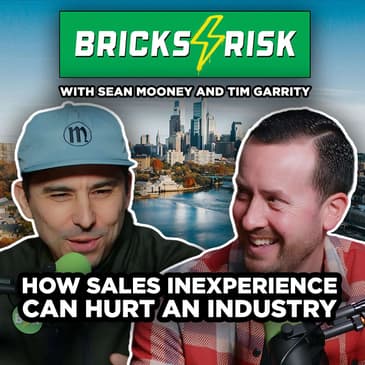

"Low barrier of entry" is something Tim has been referencing for years. Not only on B&R, but also when he was managing an independent, residential-focused real estate brokerage. But it doesn't just apply to the real estate industry, it also applies to the insurance industry. Join Sean & Tim as they dig into some of the foundational issues surrounding their respective industries, as well as their tips and advice for how to approach things differently and set yourself up for success!
Big shout-out to our show's loyal and dedicated sponsor: Property Management Redefined. John Sacks and his property management squad love our show and continue to support our mission of helping people through podcasting!
Our goal with Bricks & Risk is that you walk away with 1 or 2 valuable nuggets that can help build your own business. Our audience grows through word of mouth, so if you would please take a moment of your time and give us a review on the platform you’re on, that would be fantastic!
Please also help spread the B&R word by sharing your favorite episode with a friend. You can find all B&R episodes on Spotify, Apple Music, YouTube, and anywhere else you get your podcast content. We greatly appreciate your time and trust.
Until next week, keep learning and keep growing!
** Episode Shout-Outs **
→ HGTV: https://www.hgtv.com/
→ Episode Sponsor, Property Management Redefined: https://gopmr.com/
📲 Contact Info 📲
→ Sean Mooney, Mooney Insurance Brokers: www.mooneybrokers.com/
→ Tim Garrity, The Tim Garrity Team: www.timgarrityteam.com/
💥 Watch us on YouTube 💥
→ YouTube, Bricks & Risk Podcast, @bricksandrisk: www.youtube.com/@BricksandRisk/?sub_confirmation=1
💥 Follow us on Social Media 💥
→ Instagram, Bricks & Risk Podcast, @bricksandrisk: https://www.instagram.com/bricksandrisk/
→ Instagram, Sean Mooney, @sean.moonee: https://www.instagram.com/sean.moonee/@sean.moonee
→ Instagram, Tim Garrity, @realestateinphl: https://www.instagram.com/realestateinphl/
→ Facebook: https://www.facebook.com/bricksandrisk
→ LinkedIn: https://www.linkedin.com/company/bricksandrisk
It's not sexy. It's not trendy.
SPEAKER_00You're pulling them in, and then it becomes this, like usually what I would say would be a culture of older people doing boring things in a boring job, in a boring industry.
SPEAKER_01So it feels like almost like antiquated, like behind the times. It's not sexy, it's not trendy. This is like someone who could be my grandparent. And what am I doing here? I have a college degree.
SPEAKER_02I went to college.
SPEAKER_01Or I know what I'm doing. I'm smart. I had internships.
SPEAKER_00Yeah, there's better things you can do than scratching your eyeballs out, talking about policies, terms, and conditions day in and day out.
SPEAKER_01Welcome to the podcast dedicated to real estate, insurance, and building your business. Join us as we take you along our own business building journeys with additional wisdom from our network of local and national experts. Welcome to Bricks and Risk.
SPEAKER_00This episode is brought to you by Property Management Redefined. PMR is not just managing properties, we're creating partnerships that build long-term success for property owners. John and his team can be reached at manage at gopmr.com or by phone 267-753-6005. Tim. Yes, Sean. Who's a good client for PMR?
SPEAKER_01Property management redefined is looking for property owners who value three things accountability, reliability, and a results-driven approach. I want to maximize returns, but still provide client and tenant satisfaction.
SPEAKER_00There's a lot of property managers out there.
SPEAKER_01What does PMR do really well? Biggest thing is they're seamless and they're worry-free. So with that approach in mind, it allows the property owner to put their trust in PMR and know that the results will be there. The other thing I think a property owner is really going to value because they do it so well is that they have a local expert team, boots on the ground, managing your properties and your tenants' expectations every day so that you feel good about your investments.
SPEAKER_00We have millions of listeners out there. Tens of millions. If they want more information, how do they find PMR?
SPEAKER_01Right here, guys. Reach out to John Sachs and his team at Property Management Redefine. We'll take good care of you. I'm Tim Garrety.
SPEAKER_00And I'm Sean Mooney.
SPEAKER_01How's it going, man?
SPEAKER_00Uh good morning.
SPEAKER_01Good afternoon. What do you think of my new specs?
SPEAKER_00Uh no comment.
SPEAKER_01Oh, sorry. Sorry about that. Um, I just wanted to talk about these bad boys. What are these? Why are they here? Why was I wearing them as glasses? What are they? Stickers. Stickers. So we talked about this on a couple episodes now. So we've already had some takers. People have asked. Pretty cool. If you walk around Maniok, you will see them. You will see them. But what's the deal with these? What are we doing?
SPEAKER_00We are uh gonna mail them out. So if you email the show, DM the show, hit us up and we'll send you a little care package with some BR merch.
SPEAKER_01Now if I know you, I can find your address.
SPEAKER_00Forewarn. You just you don't even need to tell us where you live or who you are.
SPEAKER_01So even if I don't know you, I can find it on Forewarn. You're right. Okay, cool. So if you want a couple of these, let us know. Water bottles, refrigerators, garage fridge, cell phone, glasses. Good to go. All right. What are we talking about today?
SPEAKER_00Today we're gonna hop into sales, sales experience, and how inexperience in an industry can hurt you in your career.
SPEAKER_01So this is funny because I thought this was only going to be about real estate. No, no, no. But what I just learned about 60 seconds ago, actually maybe two minutes ago, was insurance doesn't really have much of a barrier either. And by barrier, look, I'm I'm putting this loosely. Passing a test in real estate and insurance is not easy. So let me preface it with that. But as far as saying, like, hey, I'd like to get into real estate, or hey, I'd like to get into insurance, it's really not that hard and it's not that expensive. So let's dive into this. Um, what I'll do is I'll start this one off with uh real estate, and let me start off with the stat that I've beaten to death, which is 87% of real estate agents or realtors, whatever you want to call us, they get in and out of the business in five years or less.
SPEAKER_00Yeah. It's a pretty uh I mean I don't know if there's much industries that have that type of fallout in in that period of time. Like it has to be one of the highest.
SPEAKER_01Aside from yours, what's insurance?
SPEAKER_00Insurance clocks in it 90, 90 percent. 90 percent.
SPEAKER_01Again, these are loose numbers. We're finding them roundabout, you know, Gemini helps you out. You check a couple websites. I mean, come on, this isn't in like a textbook.
SPEAKER_00But over three quarters. Like that that's still a dramatic number that is coming in and going out in a short amount of time.
SPEAKER_01All right, so before I dive into real estate, from an insurance perspective, what's like one thing that you see that new people do wrong? It could be mindset, it could be choice of where to work, that you think that statistic is accurate. Is there something that comes to mind?
SPEAKER_00I mean, a couple things. Uh one, I would say that so if you're you can work for a carrier, right? And it's it's a boring industry, right? Insurance is nobody's like, oh, I really want to go and work for an insurance company.
SPEAKER_02Like, that doesn't happen. So I mean some people do. Well, if their grandparents ran it, they're like, oh, I want to do this. No, okay. That doesn't happen. Okay.
SPEAKER_00Um so you have like a boring industry, you work in a boring job, and you go work for an insurance carrier, and like that. You go in, you graduate college, you need a job, you go get a job, and then you're like, ah, this is boring. I'm gonna get out of here, I gotta find something else to do. So I think there's probably a lot of that when you talk about corporate jobs and carriers. The other thing, too, is insurance agencies. Insurance agencies, by and large, are usually owned or run by older people. So it has a high average age. Yep. Just like real estate. Just like real estate. So attracting young people to come in to then go work for uh an agency, uh a brokerage, you're pulling them in, and then it becomes this, like usually what I would say would be a culture of older people doing doing boring things in a boring job, in a boring industry.
SPEAKER_02So it feels like almost like antiquated, like behind the times.
SPEAKER_01Yeah. It's not sexy, it's not trendy, it's like this is like someone who could be my grandparent, and what am I doing here? I have a college degree or I know what I'm doing. I'm smart, I had internships.
SPEAKER_00Yeah, there's better things you can do than scratching your eyeballs out, talking about policies, terms, and conditions, you know, day in and day out.
SPEAKER_01All right, so here's another good question for you, too. What made you get into it? Like, I don't even know if we've ever even talked about this on bricks and risk. Like, so you're thinking back.
SPEAKER_00Why didn't I go the path of, oh man, I scratched my eyeballs out. This is boring. I don't want to.
SPEAKER_01Well, you were you were a super senior, LaSalle University, uh English major.
SPEAKER_00Yeah. I think that's because some credits didn't like transfer over or something.
SPEAKER_01Probably. Um all right, so you get out of college. Yeah. What were you thinking? I needed a job. You need a job. Yep. Why insurance?
SPEAKER_02I didn't pick it, you know?
SPEAKER_00I was like, Did you go to the did you go to the newspaper like, hey, hey Katie, I did really bad in some early interviews with some like corporate jobs. Okay. Um, so it didn't click there, and I was like, oh man, now I now need to find a job. So, friend of a friend of a friend of a friend, hey, this person's looking kind of scenario. Okay. It's like, all right, cool. I was living in the East Falls at the time. Yeah, yeah. Job was in Conchi. Shout out to Gus. Yeah. Gus's crib, skyline views. Whew, railroad track views. That was great. Um, so uh it kind of like fit, you know, not too far. It was a job nine to five, get in. Figuring I'll work there until I figure it out, and then I'll then I'll find what I'm gonna do.
SPEAKER_01This will get me some kind of pay the rent weekly, monthly income. Yep. I can pay the rent, I can live my life, I can go to the Crescent Inn. I can drink Murphy's at the time. I can drink Ying Ling Cans.
SPEAKER_00Yeah.
SPEAKER_01Like, seriously, like, so you kind of like got into it on accident. You weren't getting anywhere with your interviews, and someone said, Hey, I know someone who's looking for young people or business people or just good people. Yep. And that's what got you in. Yep. Okay. All right. How about you? All right. So let's let's first talk about real estate in general. So, like, just like the question you answered. Honestly, here's the it wasn't like this when I first got in. When I first got into real estate, there really wasn't much of this HGTV, million-dollar listing, owning Manhattan social media vibe of real estate.
SPEAKER_00The glamour of real estate.
SPEAKER_01Real estate is cool. Yeah. Actually, to be quite honest with you, when I first got in, real estate, in based on what I heard and even what I believed, was like a little, little grimy, a little slimy.
SPEAKER_00Like we'll talk about your background too, because it wasn't like you got into real estate right away, right? So you had background prior to real estate. Yeah. So you could see real estate from afar. Yeah, real estate was kind of my step two. So like you had insurance was your step one. Yeah, and you had some perspective on looking at real estate. So obviously, at the time before you got into real estate, there was something that you connected with real estate that took you there. What was that?
SPEAKER_01Yeah, so just like you got into insurance, friend of a friend. My dad was a street line officer for over 40 years. Shout out to John Garretti. Giant G. Mentor. Favorite song? What was the song that we Oh uh Motown Philly, top top three all-time part?
SPEAKER_00Yeah, wasn't it Marky Mark?
SPEAKER_01Oh, yeah, sorry. Good vibrations still. Yeah, yeah, yeah. Those those are two of the top three.
SPEAKER_00Oh, I I'm gonna I ha have it on the radio.
SPEAKER_02Uh I took a picture the other day.
SPEAKER_00We'll close out with it. I was driving and then it was uh it popped up on the radio. I was like, I took a picture. It's great.
SPEAKER_01Um so he was in, you know, and 9-11 happened when I finished college, and there was nothing. Stock market crash, jobs, nothing. So I'm hustling in a restaurant. I'm at I'm working at a restaurant at South Jersey Shore. Shout out to Ocean City.
SPEAKER_00And uh Pete Madden uh is running for mayor of Ocean City. Is he really? Yo, vote for Pete. Vote for Pete. I love that. Um He's a realtor, actually. Yeah, Berkshire down there. Yeah.
SPEAKER_01Well, actually And his dad was an insurance agent. I think the current uh actually, I don't know who the current mayor is. I think it's one of the Gillians, but anyway, I won't get too local, too homerish here. Um so I'm working at this restaurant and I'm hustling, making decent money, living on my own. I live in Manion, live in an apartment with buddies. And uh I remember that summer, my dad's like, all right, well, the summer's about to end. You're gonna have to go find another job back in Philly after summer ends.
SPEAKER_00Was your dad like my dad when he's like you can come back and live here for one year? And on like day three, sixty-four, he's like, All right, kid, hit the bricks.
SPEAKER_01My parents didn't do that, but they said day one, you're paying us rent.
SPEAKER_02Yeah.
SPEAKER_01So it it forced me. It's good. Yeah. I actually I'll never forget that because I remember, you know, you're you're working in restaurants, you're making all this cash. I got like all this cash in like my top drawer type of thing, and I would just peel off whatever I owed them every month, which I can't remember, maybe a couple hundred bucks a month, and said, here's the rent. Here's the rent. I think I did that for six, six months, and I was like, I'm gonna go rent over here.
SPEAKER_00Was it Ocean City rent or Abington rent?
SPEAKER_02Like what was this? This was Abington rent.
SPEAKER_01Uh, and then when I went to the shore, I kept doing it.
SPEAKER_00But they didn't adjust accordingly because you were at the shore.
SPEAKER_01Correct. They didn't they didn't upcharge me because the Jersey Shore crib was nicer. Yeah. So anyway, so my dad's a loan officer and says, you should look into Chase. It's JP Morgan Chase. They're looking for young LOs. And I said, Okay, well, what is that? I don't even really don't even know what you do. So then he was just kind of telling me a little bit about it. He had some rate sheets, you know, he he had stuff written down. I talked to this person, I talked to that person, they're buying a house for this. I need to give them a mortgage for that. So he's kind of like giving me a very, you know, broad view of how his business works. And I was interested enough. And he was like, look, it you know, there's marketing involved. You're a marketing major, you gotta go out and sell yourself, you gotta meet agents, you gotta help clients. So I went in, took the job, again, 100% commission. So, you know, what what do they have to lose? And uh I went in and did really well with it. I was very fortunate, I will say, in my first year, I came in right when the refi boom was happening in like 2002. Yeah. So it already been going on for a little bit, but I came in and there was just like lots of people, old school, you know, suburban, uh, mortgage office, everyone's pushing paper. There's processors, there's in-house underwriting, there's closers, the manager, all the loan officers and a pen. So, like, real old school. And um I killed it my first year. Just because I was a grinder, I worked very hard. I was I was good at customer service, good on the phone. And um, I was very interested in learning. So I was constantly like asking questions of like my dad. So I had him, I had my branch manager, I had other LOs, um, a couple young, there was a couple guys that are a few years older than me, so learning from them. And I just got I understood it like right away and just like ran after it. So did that for like two years. Then I got a job with Pulti Homes in their mortgage department, Pulti Mortgage, and that was through a realtor relationship. Shout out to Dan Caparo, Tina Caparo, thank you for the opportunity. Thanks, guys. And uh I did that very successfully for six years. I was a young manager, I was 24, and then I got laid off. You know, financial meltdown happened, you know, the great financial crisis, as people call it. And when I lost my job, I I was in this spot where I was 30, and I said, I don't want to lose a job again. So what are my options to potentially control my destiny, my career a little bit better rather than just go work for another builder or another mortgage company or another corporation?
SPEAKER_00So that was the draw for you? Like you had in your mind, I don't want to go through this again.
SPEAKER_01I don't want to do that again. And I think the big reason for that is like I busted my ass for that company. I was a rising star. They encouraged me to go back and get my masters, they were paying for it. Like I was hitting everything that you could hit in this job. Like I was doing very, very well. And when I lost it, that is really what made me realize no matter how well I do in this job, I can lose it. So then I really I'd say the foundational mindset I had was I want to be able to work that hard, put in that amount of skill, talent, my customer service skills, my mortgage skills, everything I've learned for the last eight plus years, and I want to go parlay that into something where it's mine. It no one's gonna be able to take that away. And that's that's also the reason why I decided to be a solo agent. Because I really, one, I wanted to learn, but two, I also just wanted to like build it myself and knew that I knew it was gonna take years, but you know, Maria had an average job and we had just enough to get by. And I was like, look, if we have just enough to get by now, and I close a couple the first year and I close a couple the second year, which is what I did, we'll be fine. We'll we'll be all right. And then the sky's the limit from there.
SPEAKER_00So as it relates to when we talk about barrier of entry, how do you relate that in your situation as to did it have an impact? Was it applicable? Like, talk about that a little bit.
SPEAKER_01Yeah, go into like the topic like why like sales inexperience can hurt an industry, which is is basically our topic here. Is that both real estate and insurance have low barriers of entry? Low barrier of entry meaning it doesn't take a lot of time to get a real estate license, it doesn't cost a lot of money, and you can keep just keep taking the test. Like take the test a few times if you have to. As soon as you pass it, boom, you're off and running.
SPEAKER_02We're talking about sales. Correct.
SPEAKER_01That's your step.
SPEAKER_02That's your first step.
SPEAKER_00You can work in real estate and insurance. It's just the application of being a sales agent.
SPEAKER_01Yeah, like you could go work for uh a property management company and be an admin. Right. Or be an office manager and not really have to anything to do with the license itself. It's the transaction. But it's like if you want to be in sales, real estate sales, you have to start with, I believe it's 75 hours of continuing education. Um, you can take the pretest work or not, you pass the test, and then once you pass the test, you apply with the state of Pennsylvania, which is where we're at, and boom, you pick a broker and you're off to the races. And there's brokers everywhere. They're like, oh, we'd love to, we'd love to meet you, we'd love to take you out to lunch. We think you're gonna be great. Oh, we need team members, we're hiring. It's just all this noise, and I really didn't understand any of it because I didn't really have a mentor. I didn't have anyone guiding me. Hey everyone, this is Tim, your favorite bricks and risk co-host. But don't tell Sean. I hope you're enjoying this episode, and I'll get right back to it in a moment. Our audience grows through word of mouth, so if you would please take a moment of your time and give us a review on the platform you're on, that would be fantastic. Please also help spread the BR word by sharing your favorite episode with a friend. We greatly appreciate your time and trust. Now, back to the show.
SPEAKER_00Do you need a broker? Like you can't just say, Hey, I'm going to transact business.
SPEAKER_01Yeah. So basically, when you pass your test, the only test you can really take, well, there's a couple, but if you want to be in residential real estate sales and represent clients on resale and new construction and everything else, you need to take the 75 hours, pass the test. Then you become a real estate salesperson in Pennsylvania. Yeah. As a real estate salesperson, you need to hang your license under a real estate broker. So that's someone that has taken another level of classes, passed another test, and now they're managing something. It could be a party of one or a company with 30,000 plus agents, like real. It could be one or the other. Yeah. Doesn't have to be local, it can be national. So as that salesperson, you have to choose a broker to hang your license just so you can practice. Because they're the overarching body that manages the liability for you being an agent. You're not an employee, you're a 1099 independent contractor with that broker. Yeah. So that's that's the structure. From an insurance standpoint, which I I just found this out, I said, Well, what kind of class hours did you have to take? And what did you tell me?
SPEAKER_00Nothing. Nothing. You know? Uh are you like, yes. No more school. How did you wind up in insurance? Oh, I I found this place where you know what?
SPEAKER_01I had a ball after I logged a mirror and they hired me.
SPEAKER_00Yeah. Now I will say, uh, you have you have to pass the test, and I don't know actually know what it is today on to be a hundred percent transparent. Actually, real estate has not changed that much.
SPEAKER_01Yeah. But I bet you mortgages have changed. I bet your insurance has maybe changed a little bit.
SPEAKER_00So let me say this is the book that you have to study for. Like, so the test is I don't know, 200 uh multiple choice through the state. Yeah. Um, the book is like that. It's dense insurance material. So to think that you'll go and just sit for a test and pass it without doing any work, right? Probably not. Is there someone out there that did it? I'm probably sure. Okay. But you do have to put some time in, obviously, to digest the material in order to pass. So it may not be required. I think there was a 24 hour thing that you had to do. Do to like take a pretest, to pass a pretest, to sit for the test. So there might be something like that. But in general, you pass the test, you become licensed.
SPEAKER_01Here's a question. Does insurance have a state portion as well as a national portion, or was it just like one test?
SPEAKER_00Yeah, so there are uh no, it wasn't state specific. It's um it's uh there's uh the first part is just about licensing and and like who can be they they have a carve out for that. Yep that's always part of it, but then it becomes just a standardized test, not geographical, not anything to Pennsylvania. It's uh it's the test.
SPEAKER_01All right, so real estate, more specifically, sorry, I'm just fixing my mic here. Um take your time. Real estate uh is interesting because there are it's kind of two tests in one. So they treat the state test, okay. This question, these questions only apply to Pennsylvania, let's say, just like they would any other state.
SPEAKER_02Yeah.
SPEAKER_01And this portion applies to real estate nationally, the overarching, like how residential real estate works in the US. So because of that, you actually get two grades, two scores. So you could pass the national and you could fail the state, and vice versa, and have to go back for just one of them.
SPEAKER_00Yeah.
SPEAKER_01Where at, or you could pass both. I passed both first time.
SPEAKER_00There you go.
SPEAKER_01How about that? I'm not even a test taker. Did you fog the mirror on the way out? Or was it? I did. They're like, do me a favor, get blow on this. I went, and they're like, one more time. Good. Okay. Um, so real estate's a little bit different. You have to understand how real estate works in Pennsylvania. Right. Because you can only practice in Pennsylvania unless you want to go get licensed in another state. Uh, and then you also have to understand real estate on a national level.
SPEAKER_00I think with insurance it's a little different because it's more just policy driven, right? So, like a policy is a policy is a policy. Whether that policy is in Pennsylvania or Delaware, Ohio, it doesn't really matter. Uh, it's just more uh policy language that you have to understand rather than in PA than what happens in Pennsylvania.
SPEAKER_01Yeah.
SPEAKER_02Yeah, that's interesting.
SPEAKER_01All right, so let's talk about why this is technically, you know, not the most ideal way to get into our industries. And here's how I'm gonna preface it. Go ahead. It's because of the failure rates. Now, again, I'm not saying because the lower barrier of entry is the only reason why the failure rate is high. That's not. That's one reason. A lot of it is in the structure of real estate, in my opinion. I could go on for a week about this, but having it be a trendy thing that people see all over the media now. TV, you know, social media, Netflix, like everything, it seems much easier on TV and it seems cool. Like people are interested. Like, people like real estate, they like homes, they like big buildings, they like touring things. Like, what does it feel like? Is it modern? Is it traditional? Like, real estate is a vibe. Like, people get into it, whether you have a real estate license or not.
SPEAKER_00Maybe I should reach out to HGTV and see if they want to like start an insurance trend.
SPEAKER_01You know what? That would actually be a pretty good idea because you would be the poster child for having a sweet insurance show on HGTV. Be like just like our performance at the Ambler Theater.
SPEAKER_00That was pretty cool, you know. Um but like take insurance and make it sexy. So, like, yeah, make it cool. Netflix, if you're listening, I'm available. It could be the next thing.
SPEAKER_02Fly me to the Mooney. That's yo.
SPEAKER_01Yo, I like that one. That's good. That's pretty good.
SPEAKER_00Yeah.
SPEAKER_01So, um, all right. So again, like talking about low barrier of entry, testing is is one. It doesn't cost a lot of money, it doesn't take a lot of time. So, in real estate, for example, in six weeks, I took all my classes, studied, passed my tests. I'm on the street, and they don't even care what my background is. I'm lucky I had a mortgage background because I felt like I was a little bit more prepared than like someone else who didn't have that. And, you know, I could just go out and meet someone, they're like, hey, I want to go buy a $500,000 house. I'm like, I can help you. Yeah. I've never even shown a house before. Yep. But I can help you. And then there's like people, well, you get training, you get this. It's like, not really. You really don't. Like, you can go to training, you may learn something, but there is no formal system. The state's not really monitoring. Okay, now that you're licensed, what are you doing so you don't screw it up for someone?
SPEAKER_00Well, I guess it's inherent that you're working with a broker. Yep. And the broker is going to guide you and steer you and answer all of the questions as you proceed with sales.
SPEAKER_01So here's, I'm going to give a really good example here. Let's say we're 20 years ago, okay. We're back to the old school real estate residential model where you had offices on main streets, and people used to like look at the window, they look at all the listings, and then they walk into the office. And there'd be probably an administrative assistant there. And the person would say, Hey, I would like to talk to a real estate agent about buying a house. I saw something on the window that looked interesting. And the admin would say, Oh, hold on a second. Let me get one of our agents for you. And they would go in the back and maybe they would be taking turns, or maybe it was floor time. It doesn't matter what it is. And they're like, Tim, you're up. And this is the first person I've ever talked to about residential real estate in my career. But the admin doesn't tell you that, and the storefront doesn't tell you that. So then I come out and I'm sharp. Hey, Bill, how are you doing? Nice to meet you. I'm Timmy. And we start talking about real estate. And they're like, I saw that one in the window. Cool. When would you like to go see it? How about tomorrow? Great. I got your information. I'll show you that home tomorrow. I schedule the showing, I meet them there, I take them through, and I want to buy it. Like, this is what happens. This is reality. This is like, and this is what people didn't know back then because you couldn't really look someone up and be like, you know, how long have they been doing this? You know, what are their Google reviews? Like, have they sold anything? Where do they work? Do they have a website? Are they on social media? The nice thing about today is there are some uh consumer checkpoints, let's call them, that they can go do their research and just instead of saying, hey, Timmy was a nice guy, they can look me up and say, yo, he's actually doing stuff, or he's been doing this for 16 years, or he ran a brokerage, or what he's on a podcast with this really good looking guy that just unbelievable. He wouldn't be friends with that guy unless he knew what he was doing.
SPEAKER_00I'm no Dash Riprock, but I did get a date to my senior prom. You did. You know?
SPEAKER_02Um insurance standpoint. That's a that's a Dave Newton's ism.
SPEAKER_01Nice. Um shout out to Dave. And let's talk about uh insurance. Okay, so you get you passed the test. Yeah. What did you do? Like, what was your next step? Did you have to go hook up with someone who ran an office? Was it more like an apprentice license or like a salesperson or a trainer?
SPEAKER_00So uh kind of the same thing where you get the license, but you got to hook up with someone, right? You have to. It's not like Sean Mooney insurance, right? There has to be a product that you sell, you have to get registered, uh, that they have to approve you to become a licensed agent to sell them. So there is some background checks that get done. Fingerprints. Fingerprints. Uh no, you had to fingerprint uh with the state to get the license. Okay. So that's all done. Um, but in a similar way, you had to elect to work with a carrier or a broker or an agent that you then, you know.
SPEAKER_01Like a superior. Someone's got to watch over you. Yep. Now again, all right. So you hook up what was the first place you worked at? State farm. So you work at State Farm. Yep. And when you go in, depending on the office, they have their way of like either training or providing leads, or, you know, just uh how often you should be in the office.
SPEAKER_00But the same way is like I am I'm a licensed agent. I can go in that office and I can start to write insurance policies day one. Right, exactly. Yeah.
SPEAKER_01So it's kind of like, okay, well, what am I doing? No idea. And then you're also at the mercy of like the political system of the office, because every office had had one back then, still has them today, where it's like their seniority. Oh, this person writes a lot of business. So we know it's going to be a sure thing when we give him or her a lead. And, you know, again, like the whoever's running the lead system at the office has to be a little careful about giving it to Shawnee Boy and saying, Hey, Sean, this is your second day. How'd you like to talk to, you know, Mrs. Smith about her $300,000 house in Ambler?
SPEAKER_02Yeah. How about that? Yeah.
SPEAKER_01And that's that's where it starts.
SPEAKER_00Yeah, there's some inner politics, obviously, when that that happens. Uh fortunately for me, uh, it was a smaller office, and there was uh uh an office admin person, then there was me, then there was the agent. So it was more or less, Sean, you're gonna be you know, someone calls in, someone stops by, it's like, oh you. Yeah, you're handling the floor. And I got the office right on Butler with the big window. So there's no hiding. It's like you're right there. Right there.
SPEAKER_01So you basically basically get thrown to the wolves. Yeah. Now again, also it's like when you're in like corporate America, so I did that for, you know, a little bit, a little bit less than a decade. Um, you know, they have a much more robust onboarding system. Like there's traveling, there's like this big corporation that's constantly training you on things, giving you marketing materials. Now, it's not to say you don't get that at State Farm, or even the independent programs where I started out first, which is Brown McKinney, shout out to Rudy Brown. Um, it's just different because you know, when you're in corporate America, even though I was a full commissioned loan officer, it was just more structured. It's this big, overarching company that, as much as I wasn't an employee, I was an employee. And they're looking at it as like, look, we we don't want this employee to mess with our brand, our company. Whereas, like, if you get your license through the state, whether it's an insurance or real estate, they're just like, look, like our job is to get you the license. Now that you have your license, like you go figure out who you want to work with, why you want to work with them, will you be successful, will you not? Are you gonna be honest and ethical? Are you not? Like, there's a whole lot of what ifs.
SPEAKER_02Yeah.
SPEAKER_01And then on top of that, both of our jobs, we didn't make any money in the beginning, which I actually find to be probably the number one reason why people get in and out in five years or less. Probably you get to that five-year mark, it goes down. Because if you've been doing it for three, four years, you kind of have a sense on what you make. But I think five years is a barrier. There's a big wall right there. Because if you're not anywhere near what you want to make in real estate, by the time you get to five years, you're probably just gonna throw in the towel. Say, I gave it enough time.
SPEAKER_00Well, two things. I I don't know what could the flame out rate be higher after one or two years? I think it is. Right, but but that number is what? Instead of 87, it's 93.
SPEAKER_01Like, yeah, it's I don't know the exact number, so I don't want to be quoted, but in general, most of those people get out in year one and two. Okay.
SPEAKER_00And I think it's a point in five years, if you're younger, your friends are starting to like step up. Yeah. They're starting to graduate. Oh, I got this new job. Oh, I moved over here. Oh, I got this promotion. So not only is it you're stagnant in your position as to, oh man, I just can't, I can't get this to work. I can't make any headway, I can't do, I can't get where I thought I was going to get to. And now I'm watching all my friends climb the corporate ladder to get the new position and the promotion and bought a new house. You know, start things start to click and you start to wonder, is this really for me? Is there something else better out there for more me where I can earn more money, where I can work in a situation or a job where I'm I can get promoted. You know, so I start to, I think after five years, it's like, man, you know, this isn't for me.
SPEAKER_01Yeah, a lot, a lot of comparison culture. That's the way I mean social media doesn't help. And I think um people, especially today, they they see what they see on TV or on social media or YouTube or wherever, and they're just like, that's what I want to do.
SPEAKER_00Yeah.
SPEAKER_01I want to be like Ryan Serhant, crushing real estate in Manhattan. I I want to be a broker.
SPEAKER_00I want to do those million-dollar deals.
SPEAKER_01I want to do my own commission AI platform. I want an office, you know, in Manhattan. Like, again, it's awesome to dream big. I want everyone in this world to dream big. But I think because it's shiny object syndrome and you see so much out there, and you just think you can even like let's go to the example of like one of your friends or family members gets into real estate and they go out and you see them closing deals. Yeah. You're like, I think I can close deals. I'm smarter than him or her. I'm better than him or her. I'll work harder. You know, I'm a better marketer. I, you know, have more friends, I have a bigger family, whatever it is. And then you're just gonna be like, let me go do that. And you don't really think about or research what that decision entails. You just jump right in headfirst, which I like people jumping into things, but when you're jumping into a 1099, 100% commission job, whether it's you or you and five people, it doesn't matter, you have to be careful about the decisions you make, where you work, how you're gonna do it, do you have enough money? Is this the right time? Like, how long does it does it take to really start doing well? Like, do you have to spend money to make money? Like all these questions. And the state, unfortunately, does not tell you that. Neither does national.
SPEAKER_00I will say that if you are a person that becomes enamored with this like lifestyle or real estate, if you really pay attention to the shows that are out there, a lot of times they don't show you the backstory as to like how much time this person put into this, or yes, they got this deal, but they've been working this deal for five years.
SPEAKER_02Yeah.
SPEAKER_00You know, you really need to pay attention to the smaller details. And if you watch the Serhan show, his whole life is real estate. Shout out to Ryan Serhan. Um so don't just look at it as the end result of the sale and the commission. Pay attention to the time that all of these professionals are putting in to get to get to that place at the end where the deal is done.
SPEAKER_01Yep, absolutely. Um any words of wisdom you want to give to people out there knowing that, hey, sales and experience can hurt an industry like yours and mine. Anything you want to say, like a tidbit, advice?
SPEAKER_00Yeah, I mean Nugget. It's uh it's tough, right? I think you have to allow yourself the proper runway. Don't, you know, don't go in to a real estate position or uh an insurance, really any sales position. It's not, you know, I think yes, they are applicable for R2 industries, obviously, probably to a to a larger extent with ours. It's the margins are so small, you need to allow yourself that runway to get going, to build your sphere, to to to really allow your business to snowball into something. And so it's it's gonna be three years before you actually start to click and things start to happen for you.
SPEAKER_01So your advice would be like prepare, be prepared to be broke for three years.
SPEAKER_00Yeah, I mean or broke enough. Listen, I think you have to be um, you have to have a realistic view, right? It may require you to have another job. It may require you to not have the fancy car or you know, make some concessions in your life with your lifestyle to want to get to a position a couple years from now where you're in a really good spot. So that's what I would say is be realistic about it and and be willing to do some things, have some sacrifice, work another job in order to carry you to get you to that point where things do click and your business is going.
SPEAKER_01It's awesome.
SPEAKER_00You like what's yeah, from a real estate perspective, new agents or someone that's thinking about getting into real estate, what's your kind of wisdom that you'd lay on them to be successful?
SPEAKER_01Let me give you a good analogy here because you know how I love to do that. Yeah. So I just I just wrote that podcasting article for Inman. Shout out to Inman. Yeah, that was great. Thank you, man. Um, in one of the big uh steps I gave, I gave five steps on how to successfully do a podcast and like keep it going. And one of the steps I gave I gave was banking content. When you start, like create a bunch of content and stockpile it away. Like put it somewhere. So you have, I think I said if you're gonna do it weekly, you should have three months worth of content, 12 episodes. Yeah. If you're gonna do it monthly, you should have like three. Again, either way, you got about three months worth of content. Yeah. And the reason I said that is because that allows someone to have a life, make mistakes, miss a week, but still remain consistent. And if you start with all that content, it's doing exactly what you just said. It's delayed gratification. So how that parlays into real estate is you know what? You're gonna have to save some money to get started. If it's just you, especially, whether you're renting or owning or even living at home, you need to have a life. Like you need to be able to live because being social is also part of real estate. And you should be able to live. Like it shouldn't be work all day, all night, no life. And you're just working every Saturday, every Sunday, and you have nothing going on. So if you save money with whatever you're doing, and again, like let's say you get laid off from your job like I did, you know, I had Maria and she had another job. So that was kind of my safety net. But still, let's say you get laid off from your job and you don't have a significant other, like go out and wait tables or drive Uber or Amazon or like do something where you can bank three or four months worth of rent, worth of lifestyle, worth of car payments, student loans, all these things that people deal with, credit card payments. And then while you're doing that, prepare yourself to get into real estate. Like take the classes slow, study for the test, pass the first time, don't waste your money. You know, start to research real estate agents in and around your area. What are they doing? Like, what's the average age? Like, how who's dominating my neighborhood? Like, these were kind of some of the things that I did. I did a lot of research while I was getting into real estate. And it's just that's just the way my mind worked. I wanted to be prepared. I'm a grinder, I'm a hustler. I'm like, I'm just gonna like look into it and understand it so that when I pass my test, like I feel good about starting day one. So definitely it's delayed gratification, save your cash, like prepare yourself to get in this, whether you got a significant other or not, and know that it's going to take a few years, two to three years easy to get it moving in the direction you want it to move, just to get it moving. And you're probably still not gonna be making the money you want.
SPEAKER_00Maybe that's the reason why. So very easy to get this is actually the point that drives all of this home, in that it's very easy to get into these industries. Super easy. You can do it tomorrow. But there's a giant moat between getting in and being successful.
SPEAKER_01Yep. That's a really good way to put it.
SPEAKER_00And that's why that's why these numbers are so high. Because you can't correlate the entry in and the success. They're not like here and here.
SPEAKER_01And there's no back system in place to make sure you are going to be successful.
SPEAKER_02It's really up to you. It's here and here. Yeah.
SPEAKER_00Like you need to take getting in, and then to get to the point where you're successful is a giant leap. Yep. And it's on you. Which most people are not built for that. They need a reliance on the system. They need a reliance on their team members. They need a reliance on the corporation, how everything else is the salary, the boss, whatever. So, so maybe that is why people get out because to become successful is so difficult.
SPEAKER_01I love it. Go ahead and shut this one down.
SPEAKER_00All right, folks. Thanks for sticking with us. We talked about the stickers. If you hit us up, we'll get the little care package out to you. Just shoot us an email, bricks and risk at gmail.com. Get us on a DM, Instagram, find us on YouTube, LinkedIn, great community there. Send us a note, and thanks for joining us today. That's all we have for this one, folks.
SPEAKER_01Thanks for tuning in again to another episode of Bricks and Risk. See you next week. Thank you for joining us on another episode of Bricks and Risk. Our goal is that you walk away with one or two valuable nuggets, and we greatly appreciate you sharing your time with us today. You can find all BR episodes on Spotify, Apple Music, YouTube, and anywhere else you get your podcast content. Until next time, keep learning and keep growing.