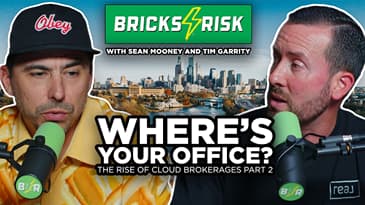
"I hope nobody finds my office." That's how this episode opens, and it's coming from a guy who helped build a Center City brokerage to nearly 50 agents. His co-host Sean Mooney just bought a brick-and-mortar building on the main strip in town, put a deadbolt on the door, shut the blinds, and also hopes nobody randomly walks in. Two business owners with very different setups and the same quiet belief: the office is not what brings in the business.
THE $800 OFFICE THAT PAID FOR ITSELF
In the early days of Copper Hill Real Estate, Tim made a call that went against the grain. Instead of a traditional lease, he took the cheapest private office in a brand-new co-working space under construction across from City Hall: $800 a month, a door that closes, a conference room overlooking downtown, and free coffee. Copper Hill was one of Pipeline's first tenants. In year one, a relationship made in that building turned into a $700,000 high-rise condo referral. Four years later the team graduated to The Sterling, about 2,500 square feet for roughly 20 agents, with wine-and-cheese nights, pizza nights, training, and investor call-a-thons that gave the space a purpose. The team grew to close to 50. Then COVID rewrote the rules, and when Tim joined Real, he heard the same question again and again: "Where's your office?" His answer: my house.
THE DEADBOLT AND THE DIGITAL STOREFRONT
Sean's world is different. In his insurance agency, new hires need desks, and changing an address with 50 carriers is an administrative headache nobody wants. So the sign out front still carries the previous owner's name while Sean puts his time, money, and energy into a digital storefront that actually drives his business. Real estate teams don't need everyone in the room at once. Insurance offices often do. That contrast alone is worth the watch.
GHOST KITCHENS, PIZZA POP-UPS, AND A HOAGIE SELLOUT
To explain how workspace has changed, Tim turns to his favorite topic: pizza. Ghost kitchens run 10 to 20 restaurant concepts out of one delivery-only facility, basically co-working for restaurants. A couple of Philly pizza makers went from a home kitchen to pop-ups to a Main Street storefront in Manayunk. A hoagie maker drops one Instagram post, sells 100 sandwiches, and is done for the day. The common thread, as Sean puts it, is technology. Cloud-based brokerages flipped the old real estate model built around physical footprints, and the guys admit that a 2010 prediction that half of agents would be officeless by 2026 would have sounded crazy.
WHAT THEY'D TELL YOU BEFORE YOU SIGN A LEASE
Tim's warning: don't sign on a "Field of Dreams" hope that an office will make your phone ring. Space has to directly help with recruiting, client acquisition, operations, or production. Sean's approach: let a physical presence reinforce a community you already live and work in, rent while you're young and agile, buy when it makes sense as a long-term equity play, and show up for neighboring businesses with value first and no expectation of a return.
If you're an agent choosing between a spare bedroom and a downtown lease, an insurance owner planning your next hire, or a small business owner wondering whether your sign matters, this episode gives you a smarter way to decide. And if you're a homebuyer or client wondering why your agent works from home, now you know.
0:00 "I hope nobody finds my office"
1:15 Sponsor: Property Management Redefined
2:40 Tim's office journey: Brewerytown to Walnut Street
5:25 Why Copper Hill chose co-working
8:15 The $800 office and the $700K referral
9:45 The Sterling Building, and "Where's your office?" at Real
18:15 How COVID changed office and restaurants spaces
21:10 Technology has allowed businesses to go without space
24:20 Real estate vs. insurance: who actually needs space
33:56 Tim's advice before you sign a lease
34:40 Sean's advice: rent, buy, and give value first
36:50 Wrap-up and subscriber goal