
But what happens when technology makes geography less important?
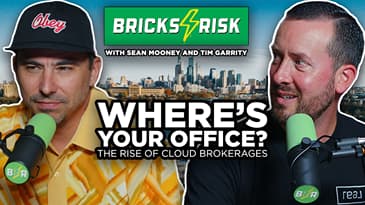
In this episode of **Bricks & Risk**, Tim Garrity and Sean Mooney take a surprisingly deep dive into the question every real estate professional has heard: **“Where’s your office?”**
What starts as a funny conversation about real estate agents sizing each other up turns into a much bigger discussion about credibility, perceived expertise, local knowledge, networking, technology, AI, and the changing economics of running a professional services business.
Tim explains why the question used to carry real weight with buyers, sellers, and other agents—and why he believes it means something very different today. Historically, having an office in a particular neighborhood could signal that an agent actually knew that market. They might live there, work there, raise their family there, participate in community events, and constantly interact with the people who lived there.
But an address doesn't necessarily equal expertise.
Today, an agent can access enormous amounts of property and market data without physically sitting in the neighborhood they're serving. Tim explains how his own experience traveling throughout Southeastern Pennsylvania, Southern New Jersey, and Northern Delaware helped him develop geographic knowledge long before today's technology existed—and how tools like MLS data and AI have completely changed the information advantage that once came from simply being local.
The conversation gets even more interesting when Tim and Sean separate **clients asking where your office is** from **other agents asking where your office is**.
For a consumer, the question may be about convenience, accessibility, or the assumption that a nearby agent knows the market.
For another real estate agent, it can become something very different: a way of figuring out who you're with, where you're located, how large your organization is, and where you fit within the industry's informal hierarchy.
That leads to one of the episode's biggest questions:
**Are people judging your ability—or simply judging the signals surrounding your business?**
Tim also explains why being genuinely hyperlocal can still have enormous value. If an agent does most of their business in one neighborhood, physical proximity can help reinforce their reputation and, more importantly, create relationships with the other professionals operating in that market. Knowing the agents, knowing the inventory, knowing the buyers, and having established trust can create opportunities that an office address alone never could.
Sean brings the insurance perspective into the conversation, explaining how the role of a physical insurance office has evolved from a time when customers literally walked into a local agency to obtain coverage to an environment where customers can communicate with their insurance professional from virtually anywhere.
And then the conversation takes another turn:
**Should you rent your office—or own it?**
Sean shares the story behind moving from years of renting office space to purchasing his building in Ambler, Pennsylvania. What began as a conversation about location becomes a lesson in business maturity, capital allocation, stability, and knowing when a business has reached the point where owning its physical location may make more sense than continuing to rent.
Ultimately, this episode isn't really about office space.
It's about **what creates credibility in business.**
Or the results and service you provide once the customer is sitting across from you?
⚡But relationships still matter
⚡Local knowledge still matters
⚡Trust still matters
And knowing the difference between **looking like an expert and actually being one** may matter more than ever.
Chapters
00:00 – Intro: Does Your RE Office Location Still Matter?
03:55 – Why Real Estate Agents Ask “Where’s Your Office?”
07:04 – How Local Expertise Builds Real Estate Credibility
10:09 – Why Insurance Agencies Used to Depend on Local Offices
14:02 – Does Being Local Still Matter to Real Estate Clients?
16:30 – Real Estate Agents, Office Location & Industry Status
19:24 – How AI and Data Are Changing Real Estate
24:50 – The Difference Between Local Knowledge and a Local Office
26:01 – Why Hyperlocal Real Estate Agents Still Have an Advantage