
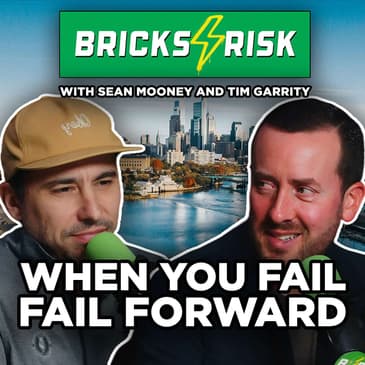
Stop sitting on the sidelines waiting for someone to give you permission to do what you wanna do in business. Shoot your shot! As easy as that is for us to say, we recognize that it's very hard for someone to do. Both Sean & Tim have shot and missed many times throughout their careers, but it doesn't mean we stop shooting. This one is all about giving yourself some grace, dive into another B&R mindset banger!
Big shout-out to our show's loyal and dedicated sponsor: Property Management Redefined. John Sacks and his property management squad love our show and continue to support our mission of helping people through podcasting!
Our goal with Bricks & Risk is that you walk away with 1 or 2 valuable nuggets that can help build your own business. Our audience grows through word of mouth, so if you would please take a moment of your time and give us a review on the platform you’re on, that would be fantastic!
Please also help spread the B&R word by sharing your favorite episode with a friend. You can find all B&R episodes on Spotify, Apple Music, YouTube, and anywhere else you get your podcast content. We greatly appreciate your time and trust.
Until next week, keep learning and keep growing!
** Episode Shout-Outs **
→ The Birds: https://www.philadelphiaeagles.com/
→ Episode Sponsor, Property Management Redefined: https://gopmr.com/
📲 Contact Info 📲
→ Sean Mooney, Mooney Insurance Brokers: www.mooneybrokers.com/
→ Tim Garrity, The Tim Garrity Team: www.timgarrityteam.com/
💥 Watch us on YouTube 💥
→ YouTube, Bricks & Risk Podcast, @bricksandrisk: www.youtube.com/@BricksandRisk/?sub_confirmation=1
💥 Follow us on Social Media 💥
→ Instagram, Bricks & Risk Podcast, @bricksandrisk: https://www.instagram.com/bricksandrisk/
→ Instagram, Sean Mooney, @sean.moonee: https://www.instagram.com/sean.moonee/@sean.moonee
→ Instagram, Tim Garrity, @realestateinphl: https://www.instagram.com/realestateinphl/
→ Facebook: https://www.facebook.com/bricksandrisk
→ LinkedIn: https://www.linkedin.com/company/bricksandrisk
You don't want to be 60, 70, 80, 100 years old looking back on certain things in your life and saying, why didn't I do that? Why didn't I just take that shot? Like, shoot your shot. If you want to do something, whether it's personal or professional, let's stick to professional because it's a business podcast. You have to be willing to fail. That's the end of the story. Prove yourself. Welcome to the podcast dedicated to real estate, insurance, and building your business. Join us as we take you along our own business building journeys with additional wisdom from our network of local and national experts. Welcome to Bricks and Risk.
SPEAKER_00This episode is brought to you by Property Management Redefined. PMR is not just managing properties, we're creating partnerships that build long-term success for property owners. John and his team can be reached at manage at gopmr.com or by phone 267-753-6005. Tim. Yes, Sean. Who's a good client for PMR?
SPEAKER_01Property management redefined is looking for property owners who value three things accountability, reliability, and a results-driven approach. They want to maximize returns, but still provide client and tenant satisfaction.
SPEAKER_00There's a lot of property managers out there.
SPEAKER_01Yes, there are. What does PMR do really well? Biggest thing is they're seamless and they're worry-free. So with that approach in mind, it allows the property owner to put their trust in PMR and know that the results will be there. The other thing I think a property owner is really going to value because they do it so well is that they have a local expert team, boots on the ground, managing your properties and your tenants' expectations every day so that you feel good about your investments.
SPEAKER_00We have millions of listeners out there.
SPEAKER_01Tens of millions.
SPEAKER_00If they want more information, how do they find PMR?
SPEAKER_01Right here, guys. Reach out to John Sachs and his team at Property Management Redefine. We'll take good care of you. Hey everyone. Welcome to another episode of Bricks and Risk. I'm Tim Garrety. And I'm Sean Mooney. And I was laughing, trying to deliver the opening line because me and Mr. Mooney here were having a fan disagreement on the Philadelphia Eagles as we barely just beat the Buffalo Bills. Sorry, Vin. Uh, we were talking about that. I I did really feel bad for you about that game because it was hard to watch for both sides, harder for you. Um, but we were just talking about I was telling Mr. Mooney here, I'm I'm the type of fan that I'm overly optimistic. So I always find the silver lining and everything. And Mr. Mooney's the fan that we stink. Ah, we stink. No, they don't this person stinks.
SPEAKER_00That person stinks. Well, how do you judge if they stink or not? You judge it by what they do on the field. And by what they do on the field is they stink.
SPEAKER_01Last time I checked, uh, we've already clinched our playoff seat. Uh we're we're hoping nobody cares about clinching a play. We care about the Super Bowl. And if you play like that, you're not gonna win the Super Bowl. Well, we're we're in the playoffs, which means we have an opportunity to still win the Super Bowl. So why don't you wait? Uh fire them all! No, no, no. All the coaches, get rid of everyone. They all stink. Just Patula. Just Petula. I don't know. I will not disagree with that.
unknownOkay.
SPEAKER_00Listen, when you are uh I don't know if they're last on the league, but I think they're in like the bottom five of Yeah, I think in the tw mid-20s. I think I know exactly what you're about to say three and outs and third down conversions. Yeah, it's horrible. But we still won. But it looks like like at a game like that, here's what I'll say. In a game like that, it looks like you come out, you play well, the other team makes the defensive changes at the half to basically shut down your offense, like making the adjustments, and you don't have he, the offensive coordinator, doesn't have the answer to the other team's adjustments.
SPEAKER_01No, and the thing is, I even I said this to Vin. If that game went into overtime last night, you would have won.
SPEAKER_00Probably. Probably. Because we couldn't have advanced the ball 10 yards to get a first down.
SPEAKER_01All right, so enough of our homerism. Uh perfect topic.
SPEAKER_00What are we talking about? Talking about failing. Oh, Mr.
SPEAKER_01Mooney's favorite, but the second part is more me. When you fail, fail forward. Fail forward. Do you know who is a guest that we've had on Bricks and Risk who said this multiple times on her episode? Now, again, a lot of people say this. This isn't the first time I heard it in that episode. Do you remember which guest we had that was talking about failing forward? If you don't, it's fine. I do not. So it was Amy Stockberger. Shout out to Amy Stockberger with uh Amy Stockberger Real Estate out of Sioux Falls, South Dakota. Yes. What's up? And she said it uh a few times on our show where she said she has a PhD in failing forward. And why I think you get all these lines, you you interview guests, the two of us spit at the desk, and and you know, we rap about a topic, we call them toppies, and you know, all these things come out, like all these great points and these nuggets, as we call them, one or two nuggets in every episode. But sometimes you gloss over certain things, as as it just we witnessed right here of like you interview someone, they say something, you're like, Oh yeah, now I kind of remember it. But when you had said fail forward, it just reminded me personally of that episode with Amy, who said she had a PhD in it. And here's why it was so effective in her episode with her entire business model with the VIP system. So basically, what Amy does is that when someone buys or sells a home for her, they automatically go into her VIP system so that from that time that they buy the home until forever, they have access. They have access to her tool shed, her party shed, her client events, all of her vendors, multiple benefits, the moving truck for free, forever. It is an unbelievable way to build a business, not only you know, now and provide lots of value to your clients, but also very forward thinking of if I do these things for my people, they will never go anywhere else for their residential real estate.
SPEAKER_00I've never seen anyone do what she does. I agree. On the level that she what did she she was capturing 10% of all?
SPEAKER_01Yeah, she was like 10, 10 plus percent of all the market share, the residential sales in and around uh Sioux Falls, which is unbelievable. You know, top 25 team or so in the entire country of residential real estate teams runs an independent brokerage. It's like everything that I used to do, she's doing that on like steroids times 100 and just building this massive book of business that you know can be bought and sold, basically. Like she is building clients for life. This is like the epitome of clients for life with her business model. Um but going back on that episode to talk about failing forward, tell me your thoughts on that concept of when you fail, fail forward. What are some thoughts? So two things. Yeah.
SPEAKER_00Number one every time you fail, you're always going to take something from it and use that as a learning experience to either A not do it again, or B be able to implement some different things to make sure that you're doing it differently going forward.
SPEAKER_01Yeah.
SPEAKER_00So that's number one. Uh-huh. Number two, like if you're not failing, you're not trying. Right? And and I think that Amy is a perfect example of that. Like, if you're afraid of failing, you're not gonna try things.
SPEAKER_01Yeah, you're not gonna attempt things that may be out of your comfort zone or financial zone, you're not gonna take risks. Right.
SPEAKER_00And I would love to get her back on the show to like she's always talking about we did this, and these are all her wins. But I would love to talk to her about like what else have you done that you tried that you had to scrap, like just shut it down because it wasn't because I feel like she's the type that tries a lot, like she's got so much energy. She's she's she's such a great organizational mind to like put the pieces together to make things go. So she probably doesn't have a lot of failures just because by way of her operational skills. But uh, I would love to hear her like, oh, these two things. We tried this and it just didn't work, you know.
SPEAKER_01All right. So let's those are two fantastic points. Let's let's kind of dissect those a little bit. So your first point of saying, like, when when you fail, you need to learn from that, yeah. And and pivot and adjust, basically.
SPEAKER_00I'll always say I always learn more from failing. Failure always offers more um learning than trying something and succeeding. No, I agree.
SPEAKER_01Because it's more painful to fail than it is joyful to succeed. I think it's like when you fail personally or professionally, you have your tail between your legs. No matter what you're doing, it'd be a small failure, it'd be the biggest failure of your life. It doesn't matter. You have your tail between your legs because you're like, why did I fail? So you second guess everything. Your confidence goes down. You know, you start looking at everything you've ever done, you're like, is that wrong? You you're you're just you're you're looking at if it's a financial failure, you're like, why did I waste all that money? Why did I waste all that time? So when you fail, no matter what you're doing, you're gonna go down to zero. Like you are like at rock bottom of questioning everything you're doing. When you succeed, like something goes well, a big, a small success, a small win, or a big win, you'd be like, okay, what where's the next win? Yeah. It's a little less, it's it you don't dwell on it as much when you succeed. You actually, when you succeed, it encourages you to like, okay, that was that was okay. But like, how do I go to the next level and the next level and the next level? But when you fail, you almost look at it and be like, what am I doing? Do I have the right job? Like, am I in the right career? Like, am I in the right relationship? Do I live in the right area? Like, am I making poor health decisions? Like, there's lots of ways to fail.
SPEAKER_00We've all been there. Like, we've all had those instances many times. And really, it it does kind of there's two ways to kind of go about it. It's like fail and fold up the tent, right? Like just give up. This isn't for me. I'm gonna fail and you and you give us, or like fail and be like, I'm never gonna do that again. I'm learning from this. And yeah, why did that happen?
SPEAKER_01All right. So that was failing and learning. Yeah. And your second point was if you are not failing, then you're probably not pushing your pushing yourself. You're your boundaries are are too tight. Because if if you are avoiding failure, you don't have you're not looking to like go outside of your comfort zone. It's like your comfort zone is right here, like you don't leave the circle. Because if you leave the circle and you fail once, you're like, uh-oh, just it'd be devastating.
SPEAKER_00There's something on TikTok or somewhere on the uh on social media that's like all of your growth happens in this uncomfortable space. Yeah. Like, and that's a perfect example to illustrate the fact that you have to be uncomfortable. You have to try things that you haven't done before because that's where growth comes from.
SPEAKER_01Yeah. And all right, so if I can take this topic as well, failing forward, why I think that's important. I think for someone, let's take the person, most people who are they're frightened, they're frightened or scared to fail. It's way more normal to feel that way than it is to like look failure in the in the eye, in the face, and say, like, you know, bring it on. If this doesn't work, it's cool. I'm gonna do this. You know, it's yeah, that's way more the exception. So let's talk about the majority of people who are afraid of failure. So let's talk about, you know, without getting like psychological, let's say, why someone might be afraid to fail. Ryan Sirhand said this. Um, I think he said this on our podcast when we interviewed him. He said the way he put it is kind of different than the way we're talking about.
SPEAKER_00You're not gonna give him a shout out?
SPEAKER_01Oh, shout out to Ryan Sirhand. What's up, man? His new show. By the way, Owen Manhattan is crushing. I haven't seen all of the new season yet, but I'm in it right now. It's very good. I've seen them all. Congratulations. It's it is really good.
SPEAKER_00I actually think one was better than two.
SPEAKER_01Well, I really enjoyed one. I'm only two episodes deep into the new one. Um I think they need to focus more on him. Okay. Um, but what Ryan said on his episode was the way he put it was like people aren't afraid of failure, but they're afraid of being embarrassed. Yeah. Which is failure in itself. Because it's almost like the way he put it is like a byproduct of failure. You can you can fail privately and people will keep going, but if you fail publicly, it's there's no coming back from that. But let's let's talk about that. While I don't disagree with that, I will kind of disagree on how he put it. Almost everything is public now. Because in some way, shape, or form, most people are on some kind of social media platform or text people, so there's something in writing, or there's emails.
SPEAKER_00No, I disagree. Let me finish my thought.
SPEAKER_01Okay, keep going. So I'm talking about things are more public than people probably care to believe. So so there's that. But I let's get back to my initial zone of not wanting to leave this. This is your comfort zone. And you said if you go outside of your comfort zone, that's where you learn the most.
SPEAKER_00That's where you grow. That's where the most growth. That's where the growth happens. Yeah.
SPEAKER_01I agree. So if you constantly stay in that comfort zone, you will probably have some kind of career based on people telling you what to do, when to do it for your entire life. And it's not to say you can't make a good living off of that. And it's also not to say that that's not a comfortable career path. You might be perfectly fine with that, but you have to go through all of the daily minutiae that comes with that every single day of your working life. So that is what you're basically signing up for. When you look at this as a bubble or circle that is to be broken on occasion, not all the time, unless you're a psychopath, broken on occasion to learn lessons to make you better as a person, as a business owner, as a salesperson, as a marketer, as whatever, a public speaker, whatever you're podcaster, whatever you're trying to do. You have to be willing to get outside your comfort zone to make your career better and more under your control. Like you have a say in your career if you are okay with failure. Because as you fail, you're gonna be like, okay, it might take you a month or a year to shake off that failure sometimes. It might take one minute. Okay, fine, didn't work. I'm gonna do this. Hey everyone, this is Tim, your favorite bricks and risk co-host. But don't tell Sean. I hope you're enjoying this episode, and I'll get right back to it in a moment. Our audience grows through word of mouth. So if you would please take a moment of your time and give us a review on the platform you're on, that would be fantastic. Please also help spread the BR word by sharing your favorite episode with a friend. We greatly appreciate your time and trust. Now, back to the show. Now, what were you gonna say?
SPEAKER_00Um, I think there's a lot of instances in life where you have opportunities to fail in private. Yeah. A lot. Yep. And I think people would be more inclined to go that route. When it becomes public, I agree with Sir Hunt a hundred thousand percent in that failing privately is okay. Yep. I can do things, I can invest in this and try it, and no one in my network will even know.
SPEAKER_01Yeah, like investing is a good, it's a good example. I made this investment, it didn't work out, I lost my money, no one knows.
SPEAKER_00I started this YouTube channel that's based on whatever, and I'm trying to like grow that. Nobody needs to know, like, it's me behind this, and I can try to do it, and I have no problem trying to do it because in the end, if it doesn't work, who cares? Right. So I think there's a lot of that, and I think people are more willing to do that when it's not in the public square. When you cross over that line, that threshold where you're putting yourself out there. Putting yourself out there, yep. And you are at the mercy of your friends, your family, your network, your colleagues, everybody you know, and you're laying it on the line, I think people like take a big step back, and those numbers of will of the percentage of willingness to go privately is probably way higher. Once you cover that threshold, right, and now you're you're publicly you are in the public square to be publicly exposed for a failure or a win, I think that's when people shrink, and that's really dictates people's behavior about being public. Yeah, this is very common in residential real estate.
SPEAKER_01And yeah, because there's no hiding. I remember this from my days at Copper Hill when lots of dozens of agents were working for us, and I would I would individually mentor almost all of them in some way, shape, or form. Some people wanted it once or twice a month, some people wanted it once or twice a year. So again, it just depends. And I remember there were some conversations that I would have with some agents, and they were like, uh, I'm just stuck right now. I'm not getting any business, and I'd be like, Well, what are you doing? And they're like, Well, I'm doing this, and it wasn't much, whatever they were doing. And I would say, I'll be honest with you, I would I would do, let's say, email marketing because it has a high ROI, low time spent, but here's the kicker you have to put yourself out there in front of everyone you know in some way, shape, or form, whether you're just emailing statistics like a market report, or you're emailing like, you know, tips on like where to go for like a festival in Philadelphia. Whatever. Doesn't matter. And there were so many times where people were like, I I'm not comfortable doing that. And I would really be like, why? Like tell I don't want to put myself out there. I'm afraid that if I do that and they don't want to work with me, it's just gonna be like it really kinda it I hate to say it, but it really comes down to like your ego.
SPEAKER_00Do you know why? I will tell you why on a psychological level why they didn't want to do it. Sigmund Mooney? Yes.
SPEAKER_01All right, Sigmund.
SPEAKER_00Lay down on my couch because there's an opt-out button. That's true. A million percent so if they send an email and there was no I don't want to hear from you ever again. That would be devastating to someone. Yeah. And so rather than experience that jolt of someone saying, stop sending me your emails. Right. I'm not gonna do that.
SPEAKER_01This goes back to the Dustin Brome episode. Another shout out. What's up, Dustin? And he was the one out of all our guests was very passionate about saying you have to be yourself when you put yourself out there. It could be email, it could be social media, it could be shaking hands and kissing babies, whatever. You have to be yourself when you put yourself out there because the authenticity will attract the right people to what you're doing, but it'll also repel the wrong people from wanting to work with you, which is a good thing. So he was confident enough in his career. Again, was working on a team, then was doing it himself, then kind of pivoted into more of a coaching, uh, mentorship, leadership role as a as an authority on residential real estate in and around the US, basically. Now that's that's where he is in his career. And it took him a while. It took him over 10 years.
SPEAKER_00I actually went back to see his first YouTube video he made.
SPEAKER_01Was that the one that I saw? Yeah. I mean, again, we watched that, no offense, Dustin. It was pretty terrible. But again, I just did a video that I sent to you on purpose and you chopped me up. And that's that's great. I wanted that. But that's because I wanted to get better.
SPEAKER_00That's the so this plays a crucial point in saying that. He decided I'm gonna decided I'm gonna put this video out there. I will I will be on the public square because he bought into the idea of that. Like I will, it won't be a great video. I I'm not gonna be a great personality online, I'm not gonna be engaging, I'm not gonna be great on video. There's gonna be plenty of issues, but if I do it, I'm going to have the ability to connect with some people. Yep. And that's where he started. And from there, you put more out, you gain more of a following, you get the hate comments, you get the people, you know, declining to accept your newsletter, you're taking all those hits along the way, and now he's got a community of thousands. Yeah. But if he didn't, it if he didn't take that first step, he wouldn't have what he has today.
SPEAKER_01Yeah, I was listening to his podcast uh earlier today, actually, because I'm I missed a few of his last uh episodes, and and he's like in the 400s now, and one thing he says like, he's like, I've been doing this for eight years, and he's like, and I've never missed the Thursday. And it's just like it's so impressive to see someone like do something like that, but also I mean, that takes a ton of time, effort, and commitment and money to do that. But when you when you watch someone like that, you hear something like that, it really just encourages like guys like you and I, I feel like, because we're like two years into this, and it's the same thing. Like, we haven't missed a Tuesday. Like we're just plowing through it. We enjoy doing it, and we learn something new every time. Fun fact the last couple episodes that we're doing in this batch right now, because we batch record, we had no notes because it was the holiday, we retired. I just said, you know what? I don't feel like organizing these things because that's my end of the bargain with this show. And I said, I'm just gonna go You just got back from Pontiac. Yeah, I'm like, I'm just gonna come up with four titles and we're just gonna show up at the studio and just talk. Yeah, this is the title. All right. So before we actually close it down with this one, when you fail, fail forward. Yep. If someone came to you seeking advice, what would you tell them?
SPEAKER_00Uh what's their question to me?
SPEAKER_01Let's say they go to you and say, Sean, you said fail failing forward is a good thing. Yeah. Why should I be open to that?
SPEAKER_00Well, because of all the points that we just made, but most importantly, is you have to put yourself out there and you have to try, right? You have to try new things, you have to try to grow, and that growth only happens in those spaces that are uncomfortable. So, you know, listen, did I do I do I think uh I was dreadful about my thoughts about this podcast? Did I want to be on video? No. Do I think my voice sounds like terrible? Yes, it probably is.
SPEAKER_01Um Do I think my outfits are cool?
SPEAKER_00That's like the only thing I have going for me. Um but if if if those things like steer my direction, we would have never had we wouldn't be here. Right. And so if you line up all the things that have happened in the last two years, if you just take them off the table, it's like, wow, like I'd be missing out on a lot had I not decided to do that, to start a podcast, to get on video, to do this, to go to these different events, to you know, all any number of things is I would say don't say no because you don't feel comfortable about it. I think the better way to approach it is maybe think of what doors you might be able to open if you do decide to go that route. Right? Like think down the road two or three years. Long-term thinking. Take someone that is doing what you want to do and look at what they've become, you know. Dustin, look at Dustin uh the first video to where he is now and see that growth and see the community that he's built. So, so look at it from the lens in reverse of what the possibilities might be and lie ahead if you decide to say yes rather than no.
SPEAKER_01Yeah. No, I think that's great. I'd say for me, it would be if someone came to me and said, Hey, you know, why should I be open to failing and why should I fail forward? I mean, for me, I would just say because you don't want to live with regret. And I think so many people are scared to go out on their own, whether you're an agent, insurance, or you just have a corporate job and you've always wanted to work for yourself. So many people are afraid to go out on their own, mostly because of financial. Let's let's call it like it is. But I actually think there's a huge part of every person before they decide to go out on their own that, like you said, they just don't want to put themselves out there and they don't want to publicly fail. Because if they publicly fail, they're just never going to get over that. And here's what I'll say as I just said, you don't want to be 60, 70, 80, 100 years old looking back on certain things in your life and saying, Why didn't I do that? Why didn't I just take that shot? Like, shoot your shot. If you want to do something, whether it's personal or professional, let's stick to professional because it's a business podcast. You have to be willing to fail. That's the end of the story. Because if you're not, you're always gonna be right here in this circle, that comfort zone, and you're never going to be able to grow in the ways that you feel like you can grow unless you take chances. Now, again, sometimes you have to take lots of little risks, lots of little chances in order to realize a big gain. And there's gonna be times in your career that you will have to take a big risk to also potentially fail, to move on to the path that you're trying to go down anyway. And I just went through something like this recently, a year and a half ago, where I had to make a very big decision to pivot in my career. And I will say a year and a half later, it is absolutely one of the best decisions I've ever made in my life. But again, very hard to do. So why don't you go ahead and shut this one down?
SPEAKER_00All right, folks. Get us on the YouTubes, get us subscribed, hip that bell. If you want to reach out to the show with comments, hit us at bricksandrisk at gmail.com. Find us on Apple, Spotify, leave a review if that's your if that's your belly wick. Social media, get us on Facebook, Instagram, LinkedIn, and somewhere else. TikTok, maybe.
SPEAKER_01Anywhere else you want to find us. Oh, and check out our blog on bricksandrisk.com. Oh, yeah. Don't forget we have that. That's all we have for this one, folks. Thank you for tuning in again to another episode of Bricks and Risk. See you next week. Thank you for joining us on another episode of Bricks and Risk. Our goal is that you walk away with one or two valuable nuggets, and we greatly appreciate you sharing your time with us today. You can find all BR episodes on Spotify, Apple Music, YouTube, and anywhere else you get your podcast content. Until next time, keep learning and keep growing.