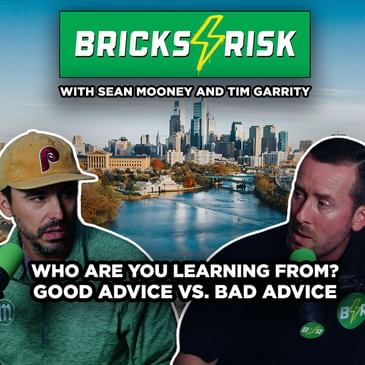

Question of the Day: Where do you want to go, and why? Sounds simple, right? Welp, it isn't. It requires experience, success, failure, and deep inner thought. But, when figured out as early on in your career as possible, you will be in a much better spot to deliver on your own goals, personally and professionally, and not the goals of other people who have nothing to do with your business. Dive into our 95th ep (crazy to say that) with Sean & Tim as they take you down a deep and winding rabbit hole on taking stock of your business today!
Our goal with Bricks & Risk is that you walk away with 1 or 2 valuable nuggets that can help build your own business. Our audience grows through word of mouth, so if you would please take a moment of your time and give us a review on the platform you’re on, that would be fantastic!
Please also help spread the B&R word by sharing your favorite episode with a friend. You can find all B&R episodes on Spotify, Apple Music, YouTube, and anywhere else you get your podcast content. We greatly appreciate your time and trust.
Until next week, keep learning and keep growing!
** Episode Shout-Outs **
→ YouTube (and their 23 updates): https://www.youtube.com/@BricksandRisk
→ Sponsor, Property Management Redefined: https://gopmr.com/
📲 Contact Info 📲
→ Sean Mooney, Mooney Insurance Brokers: www.mooneybrokers.com/
→ Tim Garrity, The Tim Garrity Team: www.timgarrityteam.com/
💥 Watch us on YouTube 💥
→ YouTube, Bricks & Risk Podcast, @bricksandrisk: www.youtube.com/@BricksandRisk/?sub_confirmation=1
💥 Follow us on Social Media 💥
→ Instagram, Bricks & Risk Podcast, @bricksandrisk: https://www.instagram.com/bricksandrisk/
→ Instagram, Sean Mooney, @sean.moonee: https://www.instagram.com/sean.moonee/@sean.moonee
→ Instagram, Tim Garrity, @realestateinphl: https://www.instagram.com/realestateinphl/
→ Facebook: https://www.facebook.com/bricksandrisk
→ LinkedIn: https://www.linkedin.com/company/bricksandrisk
If you're not failing, are you really trying? Trial and error.
SPEAKER_01Trial and error is it's it's a part of growth. It is growth. Like you have to either have success to keep moving forward with that concept, idea, however you're running it, whatever it is, opportunity. And then you also have to have failure to realize that's something to learn from.
SPEAKER_00Failure happens.
SPEAKER_01If you're not failing, are you really trying? No, right? No, because if you're avoiding failure because you don't want to be rejected by other people or by your own standards, playing it safe or finding a comfortable way about business, it doesn't allow room for growth. Welcome to the podcast dedicated to real estate, insurance, and building your business. Join us as we take you along our own business building journeys with additional wisdom from our network of local and national experts. Welcome to Bricks and Risk.
SPEAKER_02This episode is brought to you by Property Management Redefined. PMR is not just managing properties, we're creating partnerships that build long-term success for property owners. John and his team can be reached at manage at goPMR.com or by phone 267-753-6005. Tim. Yes, Sean. Who's a good client for PMR?
SPEAKER_01Property management redefined is looking for property owners who value three things accountability, reliability, and a results-driven approach. You want to maximize returns, but still provide client and tenant satisfaction. There's a lot of property managers out there. Yes, there are. What does PMR do really well? Biggest thing is they're seamless and they're worry-free. So with that approach in mind, it allows the property owner to put their trust in PMR and know that the results will be there. The other thing I think a property owner is really going to value because they do it so well is that they have a local expert team boots on the ground, managing your properties and your tenants' expectations every day so that you feel good about your investments.
SPEAKER_02We have millions of listeners out there. Tens of millions. If they want more information, how do they find PMR?
SPEAKER_01Right here, guys. Reach out to John Sachs and his team at Property Management Redefine. We'll take good care of you. Hey everyone. Welcome to another episode of Bricks and Risk. I'm Timmy G. And I'm Sean Mooney.
SPEAKER_02What's going on, man? Uh, what's going on? Not too much. But before we get started, I did want to say that uh I looked at the YouTube stats recently. Okay, where are we at? Uh 23% viewership from subscribers. So, what I'm gonna ask, if you're watching this on YouTube, that's a good stat. Before we get started, go hit the button down below. Get subscribed so you get all the feed, you get all the updates, and we'll see if we can bring that number up uh to a higher limit there.
SPEAKER_01Look at you with the uh subscribe shout out on the beginning of an episode. Not something we normally do, but I love it. Yeah, absolutely subscribe. It puts it in your feed, all the shorts.
SPEAKER_02Helps us, helps us uh learn more about the way that we're performing and serving up better content for everyone that's watching out there.
SPEAKER_01Yeah, because the back end of YouTube, if you're unaware, it gives you everything, gives you demographics, gives you what people are watching, why they're watching.
SPEAKER_02So 23 updates coming to YouTube. I don't know if you caught them. No. Tari, did you catch the update? I did not catch the full update. Man, you mean you didn't catch all 23? It was a drop. Uh, but one of the big ones now, they're incorporating collaborations on YouTube. No way. Yeah, like Instagram? Yeah. Oh, that's very smart. I love that. I love that. So Young Junk, yo, bricks and risk can collaborate on a video. Let's link arms. Yeah. Good stuff. Uh, a couple other good ones that they're popping out. Uh, it's it's uh what I see as a move towards more of a social uh platform than just uh video hosting.
SPEAKER_01Dude, that's super interesting. Uh-huh. I love you. Good stuff coming. That's more your universe, not mine, but I love it. Just the same. It's awesome. Um, all right. What are we talking about today?
SPEAKER_02Today we're gonna be talking about advice in business. Okay.
SPEAKER_01Like good versus evil.
SPEAKER_02Uh yeah, something like that. Uh, but you know, maybe uh some trappings along the way in terms of some bad advice that you've received, business maybe steered you into a direction that you were like, whoa, how did I get here? Yeah. Or maybe some good advice that you know was fruitful and changed course of your direction of your business and you know, put you on a different path. Awesome.
SPEAKER_01I'll relate this to real estate to start. So, again, in real estate, most people get a lot of advice from social media, YouTube, websites, gurus, podcasts. Not every podcast is has a visual like we do. So with people getting advice from everywhere, yeah, it's very easy.
SPEAKER_02You didn't even mention, like, if you're a realtor in an office getting, you know, I mean, it's like not the in-person advice, it's just you know, a completely different animal.
SPEAKER_01Right. But let's talk about most people I feel like are getting advice these days from like either a social media platform or something like a like a YouTube, which, as you had just mentioned, is starting to take a social media media approach, which I think is very smart. Yep. Um, so let's talk about that to start, where if you're looking for advice, what happens is we start searching people on social media and then we find someone, they say a couple things, we jive with, and then we just start listening or watching like every day. And that's usually how it goes down today. It's how it goes down with me. I'm sure a lot of other people would agree with that. And in the real estate space specifically, I feel like it is extremely easy to just get advice that may or may not be a good fit for you. Now we say good advice and bad advice. I'm not necessarily like judging the advice because everyone is different. You know, some people will look at the advice that I get and they're like, that's exactly what I need. And some people will also look at the advice that I get and say, I don't need that. So I think the perspective of just getting advice to you that may or may not work for you is super easy to happen these days. And it's very easy to just go down a rabbit hole with bad advice, let's say, something that's not a good fit for you and your business, especially if you're a real estate agent. Well, I think I just start building it that way.
SPEAKER_02I think one of the big issues is that when people give advice, um, they don't give advice that is based uh for the purpose of benefiting the person that they're giving advice to. That's true. It more comes from a place of look at what I done. This is how I did it, this is how you should do it. And I think that's a that's a a high amount of advice that takes place and interchanges uh on a daily basis. And the problem with that is just because it worked for one doesn't mean it's a good fit and it's gonna work for another person.
SPEAKER_01Right. Like the best example I can give is just trial and error in business. So you and I have both been through it. We've both been in business now for almost a quarter century, which is crazy. And um I think understanding just any kind of advice you get, whether you're reading a book, whether you're looking at social media, whether you're watching a YouTube video, even watching a business show on like CNBC, like Shark Tank or something like that. Favorite show on earth. Um, or like you said, just going into an office environment or let's say like an event somewhere, somewhere in the country, you're trying to get some training, you're trying to get some perspective, you want to network with people. It's so easy to just listen and hear and absorb what you get and just say, that's what I should do. And I think, and we'll get to this more like toward the end with uh with some of our tips. And I think it's so easy to say that's what I should do, because you don't really truly know where you're going yet and why. And you might work your entire career and never have definitive answers on either of those. So I'm not telling anyone that they gotta know exactly where they're going and why, but I think that is probably one of the main culprits. It usually comes, as you said, they're putting advice out there for the masses so that the people that want to absorb it or feel like it will be a good fit for their business will absorb it. But then also there's casualties along the way.
SPEAKER_02Well, it's also too is you have the person giving the advice, and it's I took my business from a million to 10 million. And then you're like, well, that's what I want to do, right? So so now I just follow what that person did, that's the playbook, and then I get to 10 million. I get to 10 million, and along the way, it will it could prove out that yes, this this works for you, this is good, or this isn't what I wanted at all. Yep. So, you know, you kind of have to take it with a grain of salt in terms of what's the end goal, you know, what are you looking for? Looking how how to improve or what the end goal or result might want to be, and then finding the path that works for you individually.
SPEAKER_01Absolutely. All right, so um, so let's do this. Here's one point I'd like to make when you're absorbing advice, social media, anything, it doesn't matter. One thing you can ask yourself is Is this who I am aspiring to be like myself? Or maybe is this not someone I aspire to be like myself? And I think uh that can be taken in so many different ways. I don't want to go down this rabbit hole for like a half hour, like you know, personal preferences and stuff like that. But I think that's a really good question to ask yourself up front because let's say it's someone that's that's pitching growth. Grow, grow, grow. This is how you grow. You don't have a business unless you grow, which is true. But there's slow organic growth, and there's super crazy gasoline fueled growth, hypergrowth. So growth is a very slippery slope in itself. And I think asking yourself, is this someone that I feel like I truly want to be personally and professionally, or is this not someone that I truly want to be like will help you get closer to that spot of saying where do I want to go and why? What are your thoughts on that?
SPEAKER_02Yeah, I mean it's always if you start from a place Simon Cynic, start with why. Um why? You know, why do you want to grow? Why do you want to do this? Why do you want to do that? Um if it if the if the goal is centered around that and that's your starting place, I think that's gonna guide and help people in in a much better way in in choosing the the course that they want to go.
SPEAKER_01Remember we just did the episode about the realtor Joneses? Yeah. And the first example I gave, I actually gave that in a normal voice. I didn't give it in in my Mickey Mouse voice. Uh-huh. Or or the other strange voice that you thought was weird. Right.
SPEAKER_00And um when I the first point I made was hey Tim, you're at five million in volume. How'd you like to get to ten million in volume?
SPEAKER_01Sorry, can we can we can we go ahead and uh AI and just put the can we pump up the volume on that because it was so money and you don't even know it? Consider it done. Um that's such a good example. The reason I want to give that particular example is like who the hell said I want to go to 10 million? So the reason I made that example in the Realtor Jones' episode, which hasn't hit yet, but it will hit, um, is because it's so true. Someone's telling you where you should go and why. Not necessarily you saying to yourself, this is where I want to go and why. So to your point about Simon Sinek and and the why, what's the name of that book? It's like find your why, or it's just called what's it called? Start with why. Start with why. Um, and that's such a great book, even though I haven't read it, just on the philosophy of asking yourself why. So when you can actually take a step back instead of just doing, doing, doing all day and being like, This is what I'm supposed to do because this is what I want to do, or this is what I need to do. It's good to just take a step back, take a minute, take five minutes, take three hours out of your day, and just say, Why the hell am I doing this? Like, for one of the best examples I can always give is cold calling, because I hate cold calling. It's not my thing. But there are so many people in real estate as well as in insurance that love cold calling. Meaning they may not love the act of doing it, but they love the end result of doing it. For me, I do not like the act of doing it, and I don't want the end result of doing it. I just don't want that. I'm a content marketer. So for me, that is something I want to do, and I've been doing this for 15 years now. That is the end result of what I want.
SPEAKER_02It's especially true for people new in business. You take the example of a reorder, right? You don't know what you want. You don't know what you want. So you're out there, you're just getting started, you latch on to a group or you work with a team of reorders, and you know, some of the big box shops are then telling you, you know, this is what you should be doing. And and this is this is the um actionable steps that you should be taking because this is what you want, right? So they're saying you do this because you want this. Right. And so over time you kind of learn, all right, well trial and error. Well, I I don't want that, right? I want this. And if I want this, then I should be doing these steps, not those steps. Yeah. So early on, you're just kind of finding your way through business in general. Um, and I, you know, I did it with insurance, so it's it, it's the same exact thing. Um, really any type of, let's call it like a sales job or sales position. Anything sales related, sales marketing, or even outside of sales. I wouldn't even categorize it as something being specific to sales. Yeah.
SPEAKER_01Because you could have You could be a manager at a corporation and and get amazing things.
SPEAKER_02Um, so uh it's just finding eventually coming to the spot where you say, I've done this, I've done that, people have told me that I should be doing this, and this is what the end goal should be.
SPEAKER_01I just went to this conference, they said I'm a moron for not doing this. Which some of them do tell you that.
SPEAKER_02Um, but over time it's to be revealed. Find your why, and then chart the course on how to get to that.
SPEAKER_01Hey everyone, this is Tim, your favorite bricks and risk co-host. But don't tell Sean. I hope you're enjoying this episode, and I'll get right back to it in a moment. Our audience grows through word of mouth, so if you would please take a moment of your time and give us a review on the platform you're on, that would be fantastic. Please also help spread the BR word by sharing your favorite episode with a friend. We greatly appreciate your time and trust. Now, back to the show. All right, so one good exercise I think we can do is individually what we're gonna do is we're gonna go over like one good piece of advice that we've gotten that has helped us, and like one bad piece of advice that has not helped us. And for the sake of, you know, not crapping on anyone, um, I'm just gonna give more general examples. So for me, I think one of the best pieces of advice or like total pieces of advice, like something in totality that I have done well with in the last couple years are really social media advice. And the social media advice not only helped me when I was, you know, one of the co-founders at Copper Hill and scaling that company and managing that company, but then also now that I've pivoted in the last year and a half to the Tim Garratty team, it's it's really helped me with where I am today, where I want my business to go and why.
SPEAKER_02And so you're saying you're online, you're on social media, doing your scroll, looking at different what, uh real estate personalities that are giving tips?
SPEAKER_01Mostly, it's mostly podcasts. Okay. Um, but again, the the real estate personalities lead to the podcast. Right. You find someone on social media, you find out they have a podcast, or you see a clip on social media from another podcast, you're like, oh, I'm gonna go check that out. So it's more like the discovery of podcasts through social media, I'd say, is where I get most of my tips.
SPEAKER_02Um I won't ask you for a bad one, but can you offer two um that you may uh get dialed into that have helped? In terms of uh podcasts?
SPEAKER_01Yeah, or something or I'd say a good one recently that I started consuming is from BAM. It's called the walkthrough. What's up, Eric Simon? And the walkthrough is very, very dialed into social media. And the reason I want to give this particular example about social media advice is I don't use social media to necessarily get cold leads. I don't necessarily put social media out there thinking that someone's gonna DM me or follow me and say, hey, can you help me sell my house? Can you help me buy a house? Can you help me invest in a house, rent a house, whatever? That's not why I do it. I do social media myself to also to actually like accentuate, to like uh make my brand perceived or received in a different way that someone wouldn't get from either shaking my hand in public or you know, uh listening to the podcast or doing business together or getting an email or getting a written note. Like these are all different things I do for my network. So the people in my network, in my, you know, let's call it my sphere of influence, if you want to be specific, will watch my social media and just get to know me better or see what I'm doing. Like, where am I selling? Where am I renting? Why am I doing that? Where's my knowledge base? Like, how did I do on that listing? So getting that social media advice, not only at Copper Hill, but also now as the Tim Garretty team, has really helped me with figuring out how do I want to scale my business? Like, and why do I want to do that? And that's that's my good example. What's a good example for you? Uh actually, you know what? Why why am I going good first? Might as well go half empty. What's what's your bad advice? I mean, that would just make a lot more sense. Make a ton of sense, at least for me.
SPEAKER_02Uh the um pessimist in me. Philadelphian. Um so I think if we go back um in time, um some of the worst advice I got was initially in thinking about starting my agency. Starting moody insurance brokers. Right.
SPEAKER_01And so starting an agency itself or just starting an agency the way you did?
SPEAKER_02Both. Okay. So I think on the one hand, uh when I was thinking about doing it, because I've always had this like seed of a thought to start my own, right? And so in the beginning, trying to talk to as many people as possible. And it and it was very typical that you would get the response of you don't want to do that. Right. Like people are most like discouraging you. Yeah. Don't do that. Why would you do that? No, yeah. That that's the the the resounding uh comments or feedback or advice that I got initially was just that. It was don't do that, you'll hate it. Chances of I actually, it's funny, when I left my old position, my last position as your corporate W-2 job. Uh yeah. Um, I was given a letter. I or maybe I bring it in. I don't know. Oh, yeah, we gotta get that. Of um were they just like crapping all over you? It wasn't crapping. The the tone of the letter was all of the reasons why I shouldn't leave. No way. Yeah.
SPEAKER_01Was it like uh all right, so you you give your notice. Is that what happened? You gave your notice and then you got a letter? Yeah. Or did you already like leave and then you got a letter?
SPEAKER_02No. So I was like, hey, I made the decision. I'm moving on. This is what I'm doing. And then it was like, What? Yeah. And then it was minds blown. A letter stating why I shouldn't leave. Get out of here. And and all of the reasons kind of centered around you're not gonna make it. You're not you're not Damn. Yeah.
SPEAKER_01Oh, you must have loved that. Yeah. Like just throwing friggin' wood into the fire, into the furnace. You're like, let's go. Yeah.
SPEAKER_02I mean, it was. It was like, and I'm sitting there thinking, like, you really like. Yeah. Like trying to chop you down. It wasn't even the tone wasn't chopping down. Okay. The tone was more like you don't want to do this because you you're not going to be able to. It wasn't like you stink, you're not going to succeed.
SPEAKER_01It's not like saying like you're not capable. Right. They were saying this is a bad idea, Sean. Right. Get that idea out of your head.
SPEAKER_02Yeah, like the industry, like where, like, where are you going to get new business? How are you going to staff? How are you going to do this? How are you going to do that? Oh, I freaking love this story. Yeah. And so I still have it. It's probably in a frame in your office. Above my bed. It's got like gold plated like framing around it. Um so yeah. So that was part of part of the advice, let's call it bad, um, as to, you know, why I shouldn't do this and why I shouldn't go out on my own and start an agency. And and so that was the one voice, let's call it. And then the other voice being, you don't want to start an independent agency.
SPEAKER_01Independent is like, that's like suicide. Like, don't do that. Yeah. You're you're not coming back. Yeah. You're not coming back from war if you if you do that. Yeah.
SPEAKER_02So uh I guess once I made the decision, like, oh, I am doing it. Right. Okay, well, you're gonna do it. Like, don't be an independent agent, right?
SPEAKER_01So the first layer was don't do it at all. Yeah. Like captive, independent, whatever. Don't do it. Yep. The second layer was no, don't do it independently, because these are the reasons why you're gonna fail doing it independently. Yeah. Oh, I freaking love this story. Yeah. Have I never really heard this? Well, I have a podcast, folks. You know what comes out.
SPEAKER_02That letter, I I don't think I've ever talked about it, but uh, I guess just in conversation now that we bring it up, like it's like, you know, oh yeah, that's great.
SPEAKER_01A bit advice.
unknownAll right.
SPEAKER_01Well, give me give me the good. I'll let you go to your good now.
SPEAKER_02So I think uh mine's kind of uh for good advice. Um, I was always told early on, um, you kind of are who you hang around, you know. You are yeah, you become the person who you spend the most time around, or you know, who you're in the room with.
SPEAKER_01That that kind of like either like um your environment or like your coworkers or your mentor, whoever. Yep. It could be your siblings, you know, your whatever.
SPEAKER_02Yep. So uh I was told early on by some pretty smart people that, you know, when you take advice or you're talking to people, try to be around the people that are already two steps ahead of you. Yep. You know, concentrate on on being around those people and talking to those people and gaining insights from those people that have already done it. They kind of took the path that you want to go and have been successful doing it. Yeah. And so that's one piece of advice that really good advice that I leaned on heavily and used throughout building uh the agency that I had to focus on that has really been helpful for me to try to get from one level to the next and ladder up with the a you know, with the agency.
SPEAKER_01We just had an episode that released with uh Corey Jacobson from Wealth Juice. What's up, man? Corey. And he made a really good example. And he said with his mentoring coaching business, they're not looking for the person who wants advice on how to build a 250-unit portfolio because that's not where they are. They want the person who's like just getting started or like has two units, wants to get to five. They really get me the they are get me the first deal. Yeah. Get me, get me the first deal, and then help me. Yeah. Cause they're at 80. Right. So they're like, all right, anywhere between zero and eighty, I've already done in different ways. And I'm sure they'd be like, yeah, maybe I wouldn't, maybe I wouldn't do 80 the way I did it, or maybe I wouldn't do it as fast, or maybe I wouldn't do it as diverse my portfolio. Yeah. But that's not the point. Right. The point is going to someone that is like just a few steps ahead of you, but is also in the direction that you want to go, yeah, is fantastic advice.
SPEAKER_02Yeah.
SPEAKER_01Um, I'll go with my bad advice. Let's go bad. I'll go glass half empty. It's like, you know, I'm drinking my beer, I drank half of it, and I'm just like, someone's like, you need a beer, and I got half left. I'm like, of course I need a beer. I only got half a beer left. Or a Carra-Cara. Or a Caracara. If I got half a beer left and someone says you want it, I'm like, no, I'm good. I got half a beer. Case in point. Um, so my bad advice came from a book. I'm not going to name the book. Right. But it was really in um understanding kind of like the structure of a brokerage andor a team. So this is how you build it. Like, what happens in residential real estate if you're a solo agent, let's say, if you haven't gotten to this point, even if you have gotten to this point, if you're good at what you do, whether that's cold lead, warm lead, generation, doesn't matter, you get to a scale of volume, even if you have like a transaction coordinator or a marketing manager, you just can't take, there's not enough hours in the day to service all the people who want who want you to help them with real estate. This is where the team model came in. It's also where the brokerage model came in decades and decades ago. It was all probably like individual people slinging deals, and then eventually they're just like, why don't we just start a company where we can all sit in a room together and we can sling deals together? So then they did that for decades and decades, and then the team model was spawned off of the brokerage model. Right. So the book was basically saying, This is what you should do if you want to scale your brokerage or team business.
SPEAKER_02I'm not gonna ask you for the title of the book. Yep. Was it recommended to you by someone? It was. Was it an agent? It was. Like an experienced, successful agent?
SPEAKER_01Someone I knew said, Did you ever read this? I said no. And they're like, it's a great book. Okay. Cool. So I read it. At the time, what was your take on it? At the time, I thought that was the way to do it. Yeah. Like I really read this book, and I'm like, this person's successful. This is making a lot of sense to me. At that point, I had already been like um building out the brokerage. Yeah. So when we started Copper Hill, we were just, we were solo agents, just going out trying to get market share on the street, get our signs on the street, meet another agent, bring them in, that kind of thing. And then eventually you get to a point where even that gets too busy, and you're like, okay, how do we like scale this thing properly? So that's when I read this book. And at the time, I thought it was great advice. And then as I got toward the end of pivoting from Copper Hill, looking back on it now, it was terrible advice. But for me, it's not to say it won't work for someone else. Sure. But the advice to me was like, I don't want this huge brokerage. I don't want that. That's where I got to at the end of that. And I just said, I don't want any part of that. Now, again, maybe my mind changes in five to ten years. I doubt it. Because for me, I had just gotten to a point where I was like, I've kind of done that. Like, we did a crazy amount of volume. Like we brought in by most people's standards a lot of agents. You know, the culture was great, the brand was fantastic. So, like, we we built something.
SPEAKER_02Yeah.
SPEAKER_01And it was great. But I think really at the end of it, I think the visions were kind of changing a little bit, which is really ultimately why, you know, people went separate ways. But for me, being where I am right now, I just look back on that book and I'm like, man, like I there are no regrets in my life at all. But I look at that as like, that was a terrible thing for me to read and buy into because that's ultimately not the direction I wanted to go. It didn't fit your persona. Yeah, it's not where I wanted to go and why. It's the best way I can put it. Where do you want to go and why? Two very simple questions that are extremely difficult to answer. Like I said, you could live your whole life and not and not have an answer. Where you want to go and why.
SPEAKER_02That that brings us into trace our top, our top three.
SPEAKER_01Let's our Timmy G top three. All right. So the first one, first piece of advice I'd like to share with the listeners and watchers is your career is measured in decades, not years. And this is really what I think hits home, as you said, the where do you want to go and why? I think everyone is just trying to get ahead, like every day, every week, every month, every year. If I'm not doing better tomorrow than I did today, or if I'm not doing better next year than I did the year before, I'm a failure. Right. And that's not true because I've had two and a half decades of my business career right now. I started out in the mortgage industry for almost a decade. That taught me a ton. And it helped me realize I didn't want to do mortgages anymore. So that was, and that was a good run. I got corporate America experience, I made a good living, I was passionate about my work. And then let's call it my second decade was really in becoming a solo agent and running a brokerage. And I did all that, and that taught me a ton. Yep. And now that I'm five years, let's call it into my third decade. I don't run the brokerage anymore. I run a very, very small team. I'm a full-time practicing agent. And that's that's taking me in a that's the let's think about the podcast. The podcast, I feel like, was almost spawned from where I was in that decade to say, like, no, this is a great idea. Like, let's go share what we know. So, so that's really you know, why I say measured in decades, not years.
SPEAKER_02Well, so much can change. You're not the person, you know, Tari just said earlier, I've been doing video for 25 years or something to that effect. Um, and where you are 20 years ago is not where you're gonna be. Um 20 years from there. So uh, like you said, you know, things will probably change. Uh, you probably not go to back to the brokerage side of things, uh, if I had to guess. Probably not. Um, but who knows? Uh maybe there's an opportunity that comes about uh that really catches your interest. Um it's possible. But I think looking at it from year to year, you know, if you if if next year is down, you can't look at that as a failure, right? You have to learn from those instances. And and nothing wrong with being critical of yourself and trying to figure out why. Why did why is this year not as good as last or whatever it may be. Um, but in looking at things in totality more than the the micro.
SPEAKER_01Well, that brings us to number two. Why don't you read that one? I feel like it was total segue. Trial and error. Trial and error is it's it's a part of growth. It is growth. Like you have to either have success to keep moving forward with that concept, idea, however you're running, whatever it is, opportunity. And then you also have to have failure to realize that's something to learn from. If you're not failing, are you really trying? No. Right? No, because if you're avoiding failure because you don't want to be rejected by other people or by your own standards, playing it safe or finding a comfortable way about business, it doesn't allow room for growth. And if you're not growing, you're dying. And it's almost like I wouldn't even just say this is just professional. This is personal, too. This is personally, people do different things. Like people are single, and then people get married, and people have children, and people retire. Like trial and error is also good for your personal life because we all make mistakes. We make mistakes all the time in our regular lives, and then you're like, oh man, that was kind of a bonehead move. Why did I do that? Does your does your wife say that you make mistakes? Yes. Does yours? No. Good job, Katie. Um keep propping this guy up. Yeah. What time is it?
SPEAKER_02Uh in the last hour.
SPEAKER_01All right, so this brings us to number three tip, and it's a quote. I'm a big, I'm a big stoic guy. I'm into stoicism. And I actually got this. What's a stoic? A stoic are all like these old school like philosophers from like ancient times, like Greek, and you know, there's there's different, you know. I don't have the definition, but they're old school like people giving advice. And here was the quote. I saw the movie 300. I know all about that. You know everything about it. Um, here's the quote, the stoic quote. Hit me. Never forget that it takes very little to live a fulfilled and happy life. And that came from Marcus Aurelius. So the reason I wanted to share that quote is I think that hits home on the where and why. That if you know where you're going and you know why you're doing that, personally, professionally, or a combination of both, then you will start to understand this a little bit better. That maybe the happiness isn't money, or maybe the happiness isn't an award. Like maybe the happiness is just spending more time with your friends or family or whoever. So the reason I wanted to share that is I felt like it kind of like put in into Timmy G perspective, which you're probably like, okay, yeah, enough with the uh corny stuff.
SPEAKER_02I I should have been more prepared and bought my Chinese proverbs. You should have. Um next episode. This quote really doesn't even say much. Uh there's not even much to it. Like it it it's but I think that's the point.
SPEAKER_01That's the point. It's simplicity.
SPEAKER_02Right. It's like if you know where you're going and you choose that road and you stick to that road, then fulfillment can come because this is what you chose.
SPEAKER_01Exactly. It's almost like back to our like commitment episode. Commitment and consistency. We're talking about that, so it kind of hits home. But uh, all right, why don't you go ahead and shut this one down?
SPEAKER_02More stoics to come in uh I want these Chinese proverbs. We're gonna hit the Chinese proverbs for sure. All right. We talked about it when we said when we teed off in the beginning of the show. Get subscribed to the channel. If you stayed on this long and you're not subscribed, what are we doing? Come on, people. Come on, people. Uh hit us up on the email, bricks and risk at gmail.com. Shoot us a note. You can leave a review, go to Apple Podcasts for that. We'll share it up on the show from time to time. You'll become a celebrity. You will find us on YouTube. We got a great LinkedIn group that we are about to hit 700. Unbelievable. Thank you, everyone. So we share some different videos that you won't find elsewhere on LinkedIn. And um that's been a great tool for us to grow the community and uh to gain new followers and get our message out.
SPEAKER_01That's all I have for this one, folks. Thank you for tuning in again to another episode of Bricks and Risk. See you next week. See ya. Thank you for joining us on another episode of Bricks and Risk. Our goal is that you walk away with one or two valuable nuggets, and we greatly appreciate you sharing your time with us today. You can find all BR episodes on Spotify, Apple Music, YouTube, and anywhere else you get your podcast content. Until next time, keep learning and keep growing.