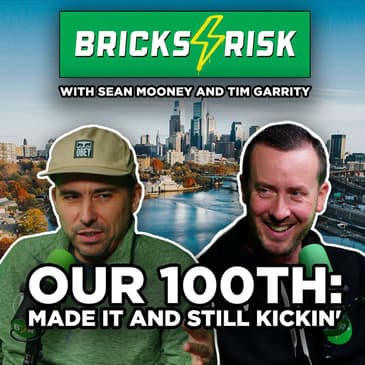
Hard to believe, but we did it! 100 episodes of the Bricks & Risk Podcast. Sean was low-energy+ on this one (haha, JK), he was battling a cold; but nevertheless, we both showed up to make another valuable (and humorous) ep. Not many podcasts have come as far as Sean & Tim have, only approximately 5% of all podcasts make it to 100 episodes; but one thing's for sure, we could not have done it without all of you: the listeners and watchers. Thanks for your continued loyalty and support!
Also, a big shout-out to our show's loyal and dedicated sponsor: Property Management Redefined! John Sacks and his team love the show and continue to support our mission.
Our goal with Bricks & Risk is that you walk away with 1 or 2 valuable nuggets that can help build your own business. Our audience grows through word of mouth, so if you would please take a moment of your time and give us a review on the platform you’re on, that would be fantastic!
Please also help spread the B&R word by sharing your favorite episode with a friend. You can find all B&R episodes on Spotify, Apple Music, YouTube, and anywhere else you get your podcast content. We greatly appreciate your time and trust.
Until next week, keep learning and keep growing!
** Episode Shout-Outs **
→ Remember to Subscribe: www.youtube.com/@BricksandRisk/?sub_confirmation=1
→ Episode Sponsor, Property Management Redefined: https://gopmr.com/
📲 Contact Info 📲
→ Sean Mooney, Mooney Insurance Brokers: www.mooneybrokers.com/
→ Tim Garrity, The Tim Garrity Team: www.timgarrityteam.com/
💥 Watch us on YouTube 💥
→ YouTube, Bricks & Risk Podcast, @bricksandrisk: www.youtube.com/@BricksandRisk/?sub_confirmation=1
💥 Follow us on Social Media 💥
→ Instagram, Bricks & Risk Podcast, @bricksandrisk: https://www.instagram.com/bricksandrisk/
→ Instagram, Sean Mooney, @sean.moonee: https://www.instagram.com/sean.moonee/@sean.moonee
→ Instagram, Tim Garrity, @realestateinphl: https://www.instagram.com/realestateinphl/
→ Facebook: https://www.facebook.com/bricksandrisk
→ LinkedIn: https://www.linkedin.com/company/bricksandrisk
My old ones, my globes.
SPEAKER_01The one you bought 10 pairs of the same ship. The shoe cam.
SPEAKER_05Ooh, look at that. That's a perfect bricks and wrist green. NB440 spruce green. That's got all the birds on. In honor of BR. My old ones, my globes. Oh yeah. The one you bought 10 pairs of the same shield. I think you have too many shoes. Shut up. So they're greenish. They're like green and gray. And they stopped making them. So I had uh I found I have a pair sitt one last pair sitting aside that I haven't opened up. Really? But I had to. You wore the other nine? What's that? You wore the other nine? Yeah, I'm down to my last pair. I had to buy a half a size up because that's all I could have played. That's it. Prolong, prolong the joy. So maybe we'll do a re a reboot, a recap. Uh nice. When I gloss them out. Love it.
SPEAKER_02Welcome to the podcast dedicated to real estate, insurance, and building your business. Join us as we take you along our own business building journeys with additional wisdom from our network of local and national experts. Welcome to Bricks and Risk.
SPEAKER_05This episode is brought to you by Property Management Redefined. PMR is not just managing properties, we're creating partnerships that build long-term success for property owners. John and his team can be reached at manage at goPMR.com or by phone 267-753-6005. Tim. Yes, Sean. Who's a good client for PMR?
SPEAKER_02Property management redefined is looking for property owners who value three things accountability, reliability, and a results-driven approach. You want to maximize returns, but still provide client and tenant satisfaction.
SPEAKER_05There's a lot of property managers out there. Yes, there are. What does PMR do really well?
SPEAKER_02Biggest thing is they're steamless and they're worry-free. So with that approach in mind, it allows the property owner to put their trust in PMR and know that the results will be there. The other thing I think a property owner is really going to value because they do it so well is that they have a local expert team, boots on the ground, managing your properties and your tenants' expectations every day so that you feel good about your investments.
SPEAKER_05We have millions of listeners out there.
SPEAKER_02Tens of millions.
SPEAKER_05If they want more information, how do they find PMR?
SPEAKER_02Right here, guys, reach out to John Stacks and his team at Property Management Redefine. We'll take good care of you. The hundredth episode of Bricks and Risk. I'm Timmy G. And I'm Sean Mooney.
SPEAKER_05We did it. Yes, sir. Triple digits. Did you know if we were in Paris right now, it would be Saint Saint 100?
SPEAKER_02100. Neither of us speak French, so we're kind of just making that up based on a clip that we heard from uh Yunk Junk. So um, dude, we did it, man. We made it to 100. Congratulations. Congrats. This was one of our major goals up front. We said, wouldn't it be nice to get to triple digits? Um most podcasts that I listen to, at least business podcasts, make it up to like 300, 500. And you're just like, that seems like it would take a decade.
SPEAKER_04Yeah.
SPEAKER_02And here we are, about two years in to our first little longer than two years since our first recording. Right. And we are at 100. So in honor of the hundredth, we're gonna do some questions. And I'm gonna let Terry from Yunk Junk take it away. Hey, hey! First up we have Judy.
SPEAKER_05Jody with an exclamation point, Judy! Alright. You're not gonna give a a briefing of like this is what we're doing?
SPEAKER_02If people have been watching Bricks and Risk or even listening, I'd say most of you know all about Judy. No, I mean the format.
SPEAKER_05Like we're gonna have Tari be the.
SPEAKER_02They're just questions, we're just gonna answer them. That's the format. Does that work for you, uh Captain Prepared? Yeah.
SPEAKER_05Yeah? Okay, let's go. Judy. And she writes. Judy writes in to say. What are the goals with Bricks and Risk?
SPEAKER_02Okay. Goals. Well, I'll let you take this one first. So when we started Bricks and Risk, and now that we're at 100 episodes, like what's a goal for you or like some of the goals that you have with our with our show? This is a show now.
SPEAKER_05So I think that uh when we started, we said, why are we doing it? And we were doing it um because we like the medium, um, and we wanted to share what we knew uh about business and real estate insurance and growing your business. And um that was one. And another one was to build our network um and do that. And so I think looking back from the start of kind of setting out to do that, um I think that that we have accomplished that. I think that over a hundred episodes, we had some really good guests that brought a lot of great information to our listeners and viewers. And I think that building our network and our database and our Rolodex uh has definitely been enhanced uh by doing this. And you could list any number of people that kind of came into our orbit and enhanced our show and enhanced our business relationships. Yep. I mean, if you think about it, you know, when we were buying the house, you know, and getting Jen uh to do the title work, the title paperwork, the like the deed package.
SPEAKER_02Yeah, yeah, um shout out to Jen Ahinger with uh Certified Abstract.
SPEAKER_05Yeah, so like that was definitely something we wanted to do, and something that definitely happened and will continue, you know, as the show grows. So I think a couple of those things kind of show what we were shooting for and how we kind of um were able to do it.
SPEAKER_02It was like get more business, make more relationships, and give back and help people. And now that we're here at 100, I think um one of my goals is I've personally been like thinking like, what do I want to commit to? So we've talked about commitment, consistency, all that stuff. And personally, I'm not gonna say what that goal is, but I have a commitment in my head of saying I want to get to this, let's call it summit, probably a false summit on the mountain, where I think if we get to that point, based on a lot of people that I listen to and watch, I I mean, who even knows where this could go? And the reason I I'm thinking that way is because we've 100% done this, done this on our terms, with our names, with our authenticity, dressing the way we want, acting the way we want, because this is who we are. This is this is how we roll. So um that's kind of my next goal personally is to get to that commitment. And once we get to that, see where things are. Alright, what we got next?
SPEAKER_04All right, next up envelope number two. Number two. But before we go there, let's all take a look at the shoe cam. Ooh. Look at that.
SPEAKER_05That's a perfect bricks and wrist green. NB440 spruce green. It's got all the birds on. In honor of BR. In honor of BR. Love it. I you know, I my old ones, my globes. Oh yeah. The one you bought, 10 pairs of the same shit. So they're green is. One last pair sitting aside that I haven't opened up. Really? But I had to put it wore the other nine? What's that? You wore the other nine? Yeah, I'm down to my last pair. But I had to buy, I had to buy a half a size up because that's all I couldn't find. That's it. Prolong, prolong the joy. So maybe we'll do a re a reboot, a recap. Uh nice. When I gloss them out. Love it. Cool. What do we got? What's number two? All right.
SPEAKER_02Next up we got Wooder. Wooder. Wooder. I mean, it wouldn't be a Philly show without saying water, even though I don't really say it. I say water. That's terrible. Hey. Total violation. Tomato tomato.
SPEAKER_05And Wooder rights. Yeah, but like you grew up saying wooder.
SPEAKER_02I didn't really grow up saying water. You never say and there. I was a here and there wooder. Keep going. That's pathetic. Where do you each see your businesses in five years? Hmm. All right, I'll go first on this one. Yeah. All right. So five years. I mean, I had a big pivot year and a half ago. We've talked about that on the show. Went from running a, you know, a sizable independent brokerage to now running a very small team at Real. Tim works for Real Broker. Scrolling. Um, and I think for me personally, like now getting to this point, having the show, like everything we've learned, the people we're meeting, I think it's constantly evolving as of what I want in the future. One thing I know for certain, I'm going to keep helping people buy, sell, rent, and invest in real estate. 100% want to do that for as long as my brain and my legs will carry me in some way, shape, or form. That I love. I think another thing that could potentially like be added on to my business is like kind of like growing my real estate agent network. Just bringing more people like into my own ecosystem, the way I've built my business, the way I, you know, help create a podcast, how I've done that, you know, just kind of I love to teach and mentor. So I think that's gonna be a an added layer of my business. Probably about five years. Maybe, maybe there is actual compensation involved in that mentoring approach with agents anywhere and everywhere. So that's that's kind of what I see. Next five.
SPEAKER_05So in five years from now, I think that uh I'll be out of insurance and podcasting full time. If I had to guess. If I had to guess. If I had a crystal ball. I mean, it'd be like take the insurance and if that doesn't happen, uh could happen. It could. Um if I was still operating uh my agency. Um I don't know. I don't know. I don't know what the growth number would be. Um I think that an acquisition at some point in the next five years would really get some juice under me.
SPEAKER_02You acquiring someone and taking the premium, the size of moody insurance brokers up to the next level. Yep. That would be something we've talked about that before on the show.
SPEAKER_05Yep. And then ultimately in five years, just running the business and not, you know, being on the uh day-to-day ins and outs of you know working on the business, not so much in the business. Yep. Awesome. That's kind of where I'd be shooting for. Very cool.
SPEAKER_02All right. Number three. This one, this one's called water.
SPEAKER_04Number three. That's pathetic. I'm semi gluten-free.
SPEAKER_05Yeah. I'm like gluten-free light. He's like gluten-free zero. Well, they say uh when I drink the beer, they can't say gluten-free because gluten-free ultra? No. Because you have to have so many like things that you need to do. So they say gluten-reduced beer. Okay. So I'd be in the category of gluten-reduced. All right, what's the question?
SPEAKER_04And they write. What are some qualities for success you look for in a new entrepreneur?
SPEAKER_02Okay, so a new entrepreneur crosses your path. We've talked about the many uh Mooney understudies, the uh the mentees of the Mooney way of doing business, yeah. The Mooney wisdom. What kind of things, what kind of qualities do you like to see an entrepreneur? It's like one of your mentees. I'm thinking about going into business for myself. Doesn't matter what they're doing, could be our boy down in Wildwood with the trash cans. Oh, yeah. Or could be someone else.
SPEAKER_05Yeah. So uh, like I've always said, I am their absolute biggest cheerleader. Like I am the one that's gonna be rooting for them.
SPEAKER_02I remember when you were saying this, I thought you were gonna say I would tell you not to do it. Because there's part of me. Because again, there's there obviously is the Mooney there that says, Oh, you don't want to do that. Why do you want to do that?
SPEAKER_05Uh maybe if it was starting an insurance agency. Right. Maybe you'd crap on that. Yeah. Okay. But keep going. But anybody else, I'm like, you know, let's go.
SPEAKER_02Um, so the question was what qualities? Yeah. So if someone comes to you and says, I want to start my own business, is there like a quality or qualities that you're kind of trying to suss out, like identify from that person to think whether or not you think they can do it? Because there are qualities that I will say, if you don't have them, you might be in a lot of trouble starting your own business.
SPEAKER_05I think if I were to pick one or two, um I think being able to be an independent thinker would probably be at the top of my list.
SPEAKER_02Yeah. Like curious.
SPEAKER_05No, not curious. Um, more so like not guided by other people. So we've said like the fork in the road, everyone's going right, you're like, maybe I'll go left. Yeah. Um, because there's always going to be times where those uh situations come about where you really need to have an idea, stick to an idea, and like drive through on your own with that idea. And so if you're the type that always is relying on other people and relying on other people to kind of steer you, um, ultimately you're going to it's going to be an issue for you. So I think the ability to think clearly on your own and make your own um determinations about what to do and when to do it, uh, I think that's a key thing that people going into business uh should have. Yeah. Because I mean, I could rattle off so many different scenarios where you you come to a point and it's like, what should I do? And you really need to hear have that clear thinking and commitment.
SPEAKER_02You almost have to know you have to choose a direction. And it might be the wrong direction, it might be, but you have to be good with if I choose the wrong direction, guess what? I will learn from my choices, from my mistakes. Instead of just saying, Well, I have to figure out which one is right. Sometimes there is no right. Sometimes you have to choose the wrong direction in order to get closer to the right choice of where you're going and why you're doing it.
SPEAKER_05And being persistent.
SPEAKER_02Yeah. As Calvin Coolidge once said. Yes. Calvin Coolidge did say that persistence.
SPEAKER_05Because that wrong decision may still be the wrong decision, but you have to, it's incumbent upon you to turn that wrong decision into the right way going forward. Lemons into lemonade. As Judy would say. As Judy would say. So those are two key things I would say uh for anyone that's thinking about going uh the entrepreneurial way.
SPEAKER_02I think that's really good. I'd say for me, um probably comes down to that episode we did on commitment and consistency. And remember, I was just on Maria Quatron's podcast, and we were talking about socks. We were talking about John. Hat tip Maria. What's that? Hat tip Maria. Hat tip to Maria, Maria Quatron with Remax. Be the solution, be the solution podcast. Um one thing we were talking about. I said I was like a very foundational, fundamental kind of guy, and I talked about the example from John Wooden at UCLA, was very big on when his players would come, whether new players or whatever, just spot checking players, he would check their socks and say, What do your socks look like? Because he wanted to make sure they were able to play basketball the best as best equipped as they could. And he knew back then your socks are sideways, your socks are bunched up, maybe not the right kind of sock. Whatever it was, you're gonna get blisters. Like shoes were not that they didn't have the technology back then. People were like Chuck all you know, Chuck Taylor All-Stars. No Chucks. No pumps, no pumps, no new balance. Um so I say that because I think for me, it really is in the commitment. And I tell people this all the time in real estate. I deal with first-time home buyers, and I'm like, before we look at anything, here's some advice. If you're gonna buy a house, my upfront advice is you want to be the owner for somewhere a minimum of seven to ten years. And here are the reasons why. Go through a real estate cycle or two, pay down the principal balance, put some improvements into the home, you know, make it your home, have the tax benefits, have the appreciation. Like there's many reasons why owning real estate is a good investment. There's also reasons why owning real estate can be a bad investment. And one of the biggest mistakes that people make, residential real estate, is time. They buy and then they try and sell too soon. Now, people can buy and two years later it can be worth 50% more and they make a ton of money. But guess what? You gotta go buy something else. So let's just call it like it is. But I think in the commitment for being an entrepreneur, and I the reason I relate that to real estate is because when people want to go into business for themselves, they're in love with the idea, the concept. I get to do this, I've always wanted to do this. I don't have a boss, I've always always wanted to just do something on my own. You know, I'm good at marketing. I've always wanted to do my own marketing, like I've always wanted to do that. But if you're not committed to being an entrepreneur, I don't care what you're doing. If you don't give yourself the runway, we've talked about the runway. The runway is time. And also the runway is setting your own expectation that I need to give this thing time so that I can learn, so that I can grow, so that I can pivot, I can adapt, I can work with more clients, I can build my brand, I can get better at marketing, I could have better customer service, I could have more Google reviews, whatever it is. And one thing my dad has always said to me, John Garretti, Johnny G. John G. Because he's full of wisdom, is one he's said this word to me over and over and over again ever since I got into the mortgage business, and I was working along alongside him when I was 22 years old. And he would say, It's about longevity. If you have longevity in this industry, you will do this for the rest of your life. And he did mortgages for over 40 years. So if I'm gonna listen to anyone about commitment or consistency or longevity, it's him because he's done it. And he had four kids, and we all went to private schools, and we went to, you know, not cheap universities, and we paid for a lot of that ourselves, but so did my parents. So I look at that the commitment, I think to me is the number one quality I look for for someone wanting to become an entrepreneur.
SPEAKER_05I wonder if your John Wooden uh example also hit on attention to detail.
SPEAKER_01Yeah.
SPEAKER_05Um obsessive. Of who cares about socks? But like someone that is well prepared and has all of their stuff together is a more coachable person and a more prepared person and someone that looks to make sure things are right. Yep. I think that's a great point.
SPEAKER_02All right, what's next? Terror.
SPEAKER_05Next up.
SPEAKER_02Yo folks. Yo, folks. Shout out to our boy Dustin Brohm. Man, I wish I knew that would happen. Crapped all over me on that video, which was one of the greatest things that could have ever happened to me, Dustin. That's why I sent it to you. I knew I needed to improve, so you're the man.
SPEAKER_05I wish we did a t-shirt. Hashtag yo folks. Yo, folks, it's definitely become a line. Yo folks writes. This letter comes from yo folks in Albuquerque.
SPEAKER_04What is the biggest benefit you have realized from starting and growing a podcast?
SPEAKER_05Wow.
SPEAKER_04Okay.
SPEAKER_05I like how you seemed excited and like you were like surprised, but you actually wrote the question. I wrote the question.
SPEAKER_02That's probably why I'm excited. Like, good job, Tim. Thanks, Tim. You did well, Tim. I'd say the biggest it was the biggest benefit, right? Um I would say for me, the biggest benefit has been in the credibility of starting a podcast from scratch, like you and I. And then the choices, the choices that we've made have led to what I would just call credibility. So how we have started this, we started Young Junk's where we are right now. Shout out to Young Junk. Manny Yunk. Creating it in a professional studio with professional equipment, with professional people behind the scenes, making sure we turn out a professional quality product. And I think the credibility for me has come in lots of different ways. It comes from like people I know, friends, family, clients, whoever. People mention it, they they speak positively about it. But I've been to like events, you know, I've been to real estate events, I've been to lunch meetings, I've been out somewhere. And someone's like, yo, folks. Yo, folks, I know who you are. I'm like, you do? They're like, yeah, that you have a podcast. And as cool as that is, again, it's you know, that's probably more of an ego thing. That's a cool experience. But what I think is just so great about moments like that is that people are actually watching and listening to you and I get on these mics and spit for 30 minutes, 60 minutes at a time, and just talk about like what we know and and what we think. And it's it's been awesome, man. The credibility to me has just been through the through the roof.
SPEAKER_05What was the question?
SPEAKER_02Biggest benefit from bricks and risk. Uh besides getting to wear lots of clothes that have been sitting at the back of your closet.
SPEAKER_05Yeah, so um, you know, when I was growing up, um, my mom never thought I would really turn into much. Yeah, okay. So by having a podcast, I think one of the biggest benefits is my mom now feels like all that money she spent on me and all that time and stress and energy and stress and energy, um, it panned out. That's awesome, man. I I'm just joking.
SPEAKER_02But um But anyway, let's let's call that like it is, and there's probably a little bit of truth to that.
SPEAKER_05No, but she can be like, oh, look, Sean has a podcast and he's on TV. That's true. Right? Right. Um so one of the biggest benefits He's on the television. Um, she she probably couldn't actually turn it on that like the YouTube try to even get to me. The Facebook. Um, so the one of the biggest benefits, I would say, is the ability to build our network. I think that single-handedly has been the best um outcome uh of having the podcast. Yep. Um, because you're in so many different rooms, you're you're you're having so many different conversations with people that are adjacent to our businesses that overlay on our businesses. Um I've mentioned to you a couple different things that have kind of popped up um from the podcast that and likewise. That I'm like, well, that would never that would never have happened. Never have happened. So um getting us in the room with some great people, um, having great conversations, and you know, opening some doors for us has to be for me uh just one of the best outcomes so far uh by having us. And we're only at a hundo. Yeah.
SPEAKER_02All right. What do we got next?
SPEAKER_05Next up, we got M O O N E E. Yes. All caps, no trick spelling. All right, let's do it. And they're otherwise known as the dot king.
SPEAKER_04How important is it to have a personal brand in business? Oh, we just did one of these with Cheldon Rumor.
SPEAKER_02She was fantastic. Unbelievable. Thank you, Cheldon.
SPEAKER_05Why don't you hit this one first? Personal brand. So, what I would say with this is it really depends on what industry you're in. Uh, if I was to do a blanket statement, I would say it absolutely matters now in the year 2025 that to have a personal brand, um, because I think that it can help accelerate your business probably more than anything else out there. Um the key, the key advantage of having a personal brand is the exposure. Obviously, by having a personal brand, you're you're kind of aligning yourself with kind of what you do and and how you do it. And so people are able to see, oh, this is George Robertson. He's the uh G Robbie, you know, the HVAC guy. And if you're running a business and operating like that, the exposure then becomes free advertising. Yeah. And the second part of it is it really becomes it becomes a warm lead. So if someone sees you online and they know what you do and get familiar with how you do things, who you are, what you're doing, the and then they reach out, it's a warm lead. It's a warm lead. You're you're attracting business. Yeah. And so by having a personal brand, it really can help in a lot of ways, but growing your business with the warm lead approach is just one killer way to have an advantage with doing it.
SPEAKER_02All right, I got a really good example. So I was actually having a conversation with someone today who also has a podcast and who's also in real estate. So we were talking about him, and I said, Look, you know, your your agent brand is a little bit more consumer-facing. Were you talking to Uric Simon? No. I'm not going to mention names, I'm just going to talk about it. So I'm talking to the agent. I said, your personal brand for being an agent is consumer facing. Right. Okay? Buyers, sellers, tenants, landlords, investors will be attracted to that because they want you to help them go buy, sell, rent, invest, residential real estate. That's your agent brand. So that's one thing. Your podcast brand is technically like agent-facing or industry facing or just like a credibility factor. It's not really going to attract a buyer or a seller to you as an agent, but what it does is it attracts other businesses, other relationships, you know, industry people, which are all good for your agent business. So we talked about that.
SPEAKER_05Wait, couldn't you have the podcast driven towards the buyer, the listener being the buyer?
SPEAKER_02Well, he already had the podcast, and then he pivoted. Just let me finish. So two separate brands, two different timelines, doing two different things. Now they technically link on the back, but that's how it came to be. And then I look at the bricks and risk brand. Okay? Because starting the show, calling it bricks and risk, you came up with that. Developing the name, developing the look, developing the logo, plastering it everywhere, marketing it everywhere, has almost become like a personal brand for both of us. Because when people see the bricks and risk brand, they don't necessarily think of real estate, they don't necessarily think of insurance, but they do think of Sean and Tim. The Sean and Tim show. The Sean and Tim show. Right. So they think about that. So because of that, that is a personal brand. And we were just talking about how valuable having just like the benefits of a podcast are. So I almost look at the personal brand of the podcast as kind of like the personal brand on steroids. Because it's accomplishing many different things. It's not just someone saying, Oh, hey, I listen to the podcast, Tim's in real estate. I want him to be my agent. No, that's part of it. But it's also like I want to like communicate with him. Maybe I want to be on the show. Maybe we want Sean and Tim to be on our show. Like, let's network, let's share contacts, let's share knowledge, let's share experience. Like, it just invites in opportunity. And I that's what I feel like a personal brand is. A personal brand, the reason you're doing it is to differentiate yourself from other people who do exactly what you do. Because if there's two agents, they can both help you do the same thing. Which one do you identify the most? If they both have the same service and it costs the same amount of money, which one do you want to work with? And that's where a personal brand comes in. If someone identifies with it and therefore they usually come to you.
SPEAKER_05It's like when they're DMing us and they're like, hey, Mooney's shoes, can you send me the link like where to buy them? Those are killer.
SPEAKER_02And then what we do is we make money off the link. It's an affiliate connection. We become a new balance ambassador. We'll make 18 cents next month for the two clicks that you clicked on yourself. So dope. Dope city. Alright, what do we got next?
SPEAKER_04Alright, next up, we got an old favorite. Down the shore.
SPEAKER_05Down the shore?
SPEAKER_02Down the shore.
SPEAKER_05I was very close to doing up the mountains, but I went with down the shore. You know what's funny is like all of these are obviously taken from shows, and like I I know like the exact time when we were talking about it. Me too. They're like placeholders in time.
SPEAKER_03Yeah.
SPEAKER_05And they write. And down the shore writes. If you could take your family anywhere in the world, where would you take them? Down the shore.
SPEAKER_02Down the shore. Duh. Do you know what's funny? The name has had absolutely nothing to do with the question, but that actually was fairly relevant. Semi relative. They were kind of like connected.
SPEAKER_00Mm-hmm.
SPEAKER_02Alright. Go for it. Glenside.
SPEAKER_05If you could take your family. Glenside, Pennsylvania.
SPEAKER_02I love how you say Glenside, Pennsylvania, and yet I just helped you move to another town, not Glenside.
SPEAKER_05If I if I because I'm not living there, but I'd want to take my family there.
SPEAKER_02Oh, okay. Hey everyone, this is Tim, your favorite bricks and risk co-host. But don't tell Sean. I hope you're enjoying this episode, and I'll get right back to it in a moment. Our audience grows through word of mouth. So if you would please take a moment of your time and give us a review on the platform you're on, that would be fantastic. Please also help spread the BR word by sharing your favorite episode with a friend. We greatly appreciate your time and trust. Now, back to the show. Give me something. It's beautiful. Give me something non-drive worthy. If you had to hop on a plane or a ship or a steamboat. Because I don't fly. Or a hoverboard. Where would you where would you take your?
SPEAKER_05Where would we go?
SPEAKER_02Yeah, where would you go?
SPEAKER_05Anywhere. Uh Alaska. Really?
SPEAKER_02Yeah. Okay. Why Alaska? Just go fishing.
SPEAKER_05Catch some big fish out there. Yeah, some big halibut. Some alifish. I'm sure all my family would love to go to Alaska to watch me fish.
SPEAKER_02Your six-year-old Brendan would be like, hey dad, I caught a polar bear. Yeah, check this out.
SPEAKER_05Yeah. Um, I think it'd be good. I heard good things. Yeah, I've heard good things about Alaska. That's interesting. I'd like to be like on the vast, wide open terrain.
SPEAKER_02Okay. And do you think your family would be down with that fun too? No, it's just for me. So it'd be like, you're going. You want them to be there with you and be a part of it. It's not necessarily their first choice.
SPEAKER_05Hey everyone, watch me watch the blanket terrain. Right, right. Hey everyone, watch me dive into these frigid waters. Yeah. So let's do two. So, you know, we'll do one for for me and then one for family. One for Katie Mack and Kiddos. Um somewhere worn with sand.
SPEAKER_02Uh Hawaii. Okay. Hawaii. So Alaska and Hawaii. You go to one of the two final states.
SPEAKER_05Yeah.
SPEAKER_02Yeah. You don't want to go outside the country. Because then they wouldn't, they wouldn't have two robber seltzer, and they wouldn't be they wouldn't be buying and selling things with dollar bills.
SPEAKER_05Yeah, and if you get arrested, you know, I wouldn't want to be arrested in a foreign country.
SPEAKER_02Very true. You'll get out of it, even in Alaska or Hawaii. We know enough.
SPEAKER_05I've seen this uh like how I became a smuggler.
SPEAKER_02Or what was it like something abroad, like arrested abroad or something?
SPEAKER_05Or they're like in a take this briefcase to drive it over here and then get locked up. Locked up abroad, right? Or something. Yeah, yeah. That's what it is.
SPEAKER_02Okay. Um I'll go with the obvious choice, and then I'll go with the not so obvious choice. The obvious choice, which my wife Maria and my daughter Ella already know, is I want to take them both to Japan. Because I've been there. I went there for my 40th birthday with my two brothers, Pat Garrety, Ryan Garrety. Shout out. What's up, boys? And for our 40th birthday, so my older brother Pat was first, and we said, Where do you want to go? He's like, Maybe like a beach town. So we're picking out a beach town. Ryan and I are ready to take him. He's like, nah, let's just do it in Philly. So we got bombed in Philly for his 40th. And then Ryan got upset with Pat when he had a couple too many and said, Why couldn't you pick a place? We wanted to take you somewhere. We're down in like Delaware Ave, like bar hopping. Why couldn't you pick a place? So then to stop my brothers from fighting, I stepped in and said, All right, for my 40th in two years, we're going to Asia. And they were like, Whoa, okay. It's extreme. So I took two years. If I were gonna go anywhere in Asia, it's just my choice, where would I go? So I had China, Singapore, and Japan. Japan made the most sense just because I felt like it was going to be like Western-ish. It would, you know, you can get by there. I did some research. Some good snowboarding in Japan. But the one thing I wanted to see is I wanted to see the biggest city in the world, which is Tokyo. It's the largest by population city in the entire world. And it was unbelievable. Went there, went to Kyoto, awesome trip. I want to take my wife and my daughter there. I want to go back and I want to go through the countryside. Because I've heard so many things. I've met so many people since that trip that have been to Japan. I've had conversations with them. Gotta go here, you gotta go there. So that would be like I've already told them that they want to go, so we're gonna go at some point. Have you thought about Glen Side? I actually, G side was second on my list. Yeah. Makes sense. Japan hopscotched them. They just went.
SPEAKER_05Makes sense.
SPEAKER_02Uh I'd say a place that I haven't told them that I'd like to go sounds really bizarre. I'd like to take like a train ride with them to like multiple cities in the U.S. hop on a train, you can sleep on the train, you get the scenery, you can eat, you can drink, you're not in the air, you go to a couple different cities, come back to 30 Street Station in Philadelphia. That's a trip I'd like to take.
SPEAKER_05We're kind of boring. Are we? Yeah. Like that's Alaska's boring? No, but like you're boring. You want to be like, I want to talk to someone who's like, I want to jump out of spaceship little town in East Panama.
SPEAKER_02Well, there's nothing wrong with being honest. Next question. Like, this will be an hour and a half long episode if I even entertain this with Mooney. Droid versus iPhone. Yeah. Maybe I should have put on it. I should have put iPhone versus iPhone because now we have the same phone. I think it took me making fun of Mooney on a podcast for a span of about 12 months to get him to finally say, okay, I have an iPhone.
SPEAKER_05I remember that phone call too. Was it Tim or was it my daughter who I have to communicate with? Definitely Tim. Sorry, Mal. Sorry, Ma.
SPEAKER_04They're right. Why is the value of relationships at the core of both of your businesses?
SPEAKER_05Like we haven't beaten that to death. For you. Value of relationships. I mean, wasn't wasn't that the first episode we did? It was called relationships. Relationships.
SPEAKER_02And we just talked. About relationships.
SPEAKER_05I mean, if you're in business, it's about relationships. I don't, you know, any guest we had on with a few that may not apply, but it's relationships. It really is how you do business. That's the firepower. And so I don't even like what's the alternative of not being relationship driven or relationship.
SPEAKER_02Transactional, you know, being driven by numbers. You know, if I piss people off along the way, I piss them off.
SPEAKER_05Well, okay, so let's take that. I think that if you're like selling widgets, you don't there there might not be a need for relationships inside of your business. I mean, you could get by. You might have vendors that you, you know, you might have certain uh relationships, but you don't need the relationships in order to grow your business. So industry specific, uh, where you're dealing with people uh on a day-to-day basis, relationships are important. They're kind of foundational for businesses that that we, you know, for you and I, for businesses that we've had on the show. Um it really is the engine that makes everything go.
SPEAKER_02Yeah, one thing you said that I thought was interesting, you you were talking about the widgets, so maybe someone selling a product, making a product, selling a product.
SPEAKER_05You're on TikTok shop. B2B, B2C, doesn't matter.
SPEAKER_02Selling here's here's how I will disagree with that example. Your employees are relationships, your suppliers are relationships, as well as your customers, whether it's a service-driven business or a product-driven business, relationships will make the ride smoother, cheaper, make you happier, more fulfilling. I look at relationships in the sense of I don't really even care what you're doing in life, what you're doing for business, friends and family. If you kick relationships to the side, you're probably really more focused just on yourself. Okay, I'm just gonna do it my way. I got the answers. Ego, whatever it is, it doesn't matter what it is. If you don't have at least one other person, or in our case, many, many people to enjoy the ride with, I don't think you have really much of anything, in my opinion. So, especially in business, let's keep this business related. What I have found through relationships is it makes your business grow for less money, less time, and you have trust. You have trust of customers, the people who work alongside you, your mentors, your neighbors. It doesn't matter. And having trust, and again, I've had my trust broken so many goddamn times, it still doesn't make me look at relationships or people as a positive. Because every time trust has been broken with me, I look myself in the mirror and I say, Well, where did that go wrong? Like, why was that trust broken? And always something can point back my own opinion to myself. I can look in the mirror and say, Well, if you weren't so goddamn nice, Tim, and I don't talk to myself, but if I were, if you weren't so goddamn nice, because I can be too nice, that probably wouldn't have gone as far as it did. And because it went as far as it did, that's why it ended the way it did. So I think for me, I just look at relationships as it's something you can always get better at. You can have more relationships, you can have less relationships, you can have super high-level, unbelievable best relations best relationships in your life, and you can have low-level acquaintance relationships. But whether you work for someone else or you work for yourself, that people are what drive things. Even in an AI-fueled world, everyone's talking about AI. They're like, what does everyone say about AI, the experts? It's a tool. They're not saying it will get rid of everyone. They're saying it might, yeah, some jobs will be lost, but some jobs will also be created. So I think looking at people as relationships, opportunities to have relationships, is only going to help your business and not hurt your business. Next.
SPEAKER_05Next up, we need a button.
SPEAKER_02Obey hats. Obey hats. Yeah. What up? Of course he's got one on. It's called the icon. Sorry. Icon. Obey icon. I actually own an obey shirt from like way back in the day that I have to wear to one episode one time and just be like, this is my obey shirt. It's funny, people. Obey propaganda.
SPEAKER_04How do they know so much about you? Because they're asking two personal questions. Sean, when you're not pretending to be gluten-free, what's your favorite cheesesteak in slash around Philadelphia?
SPEAKER_05Oh. Let's do it. You know.
SPEAKER_04Favorite cheesesteak. Oh. Tim, we know you like bread. What is your favorite cheesesteak in or around Philadelphia?
SPEAKER_02Yeah. All right. So I'm going to make mine real easy. And people are probably not going to agree with this, which is totally fine. I like a chewier roll. I like a fluffier, chewier cheesesteak roll. So I like Delisandros. I love Pudges. And then if I'm going to, let's just go with like, well, no, if you're going to stick with cheesesteaks, I'd say I like Delasandros. I'd like Pudges out in Bluebell. And then if I want to go new school, seated roll, fancy, dancey, I gotta go. I gotta go, Angelos. Angelos is freaking unbelievable.
SPEAKER_05So I will say for nostalgia purposes only. Which we know you roll that way. It's Del Sandros. My man. I mean, Pav worked there, so like obviously it's my. Shout out to Dan Pavlix slinging cheesesteaks at De Los Andros when we were 24. I think he was in like medical school when he was like, Yeah, I need a job.
SPEAKER_02He's like, I need a job, so he just showed up at Delos Andros.
SPEAKER_05Like, yo, I think I can get free steaks if I work at De Los Andros.
SPEAKER_02Can I make steaks? What do you pay? Like, we pay $11.50 an hour for academy.
SPEAKER_05He asked what they pay.
SPEAKER_02I think he went in for the t-shirts.
SPEAKER_05Yeah. Which I have. I still have one. I still have one too. Thanks, Pev. Um so number one, let's just take that off the board because that's like will just always be number one. Okay, so we have the same number one. Yeah. Which is weird. That is. Um very bizarre. You know, I don't think I've had enough stakes to Bro, don't give me that crap. What's your number two? My number two, I would say, is I think I know what it is. I know you're thinking what I'm gonna say. I would say, I would say Angelo's is my number two. Okay.
SPEAKER_02So we're pretty much on the same train with that. I was gonna say Verona. Yeah. Or maybe high stakes. I know you like high stakes.
SPEAKER_05Yeah, like high stakes and Verona and high stakes. I mean, you catch them on the right day, and it's like one and one A, and you can flip them, you know, either way. Highstakes does give me the gluten-free option, Tari. And I put the steak on top of the curly fries. So it then becomes like not a cheesesteak, but a weird like a casserole. Weird steak thing. Yeah. So high stakes does that for me.
SPEAKER_02That's good to know.
SPEAKER_05I was actually if I ever go gluten-free, I'll I'll call them for that special. I was actually talking to Jay. Do you know Jay McGlynn?
SPEAKER_02I don't.
SPEAKER_05Um, I was talking to him last night and we got in the conversation about high stakes. And his wife, Caroline, likes to go to high stakes like every once in a while because it's like a little like eclectic. It's like a little like it's kind of funky, right? They have like bands that go to the stoner. Yeah.
SPEAKER_02Yeah, they want the stoner vibe. Yeah. And like you go there, and like people bring six packs and like hang out. Oh, really? Yeah. That's kind of cool.
SPEAKER_05Yeah.
SPEAKER_02Nice. I haven't been there yet, but I will be there. It's only six, seven minutes from my house.
SPEAKER_05So my other point was there's so many oh, Cafe Carmela. Yeah, Cafe Carmela, Northeast, right? Is a really yeah, they have two locations. Really good. Clinton Valley? Yeah. Yeah, yeah. Uh, really good cheesesteak. But what I was saying was there's so many like wands that I know of that I haven't had. Yep. Like Johnny's. I've heard Johnny's is supposed to be pretty good out in Delco. Gazzo or whatever that one is. Um, but like there's like so many. There's like a dozen down in the city that yeah. There's a lot of new, there's a lot of new school stuff. Big Rube down at the uh pitchers.
SPEAKER_02Oh, yeah, yeah.
SPEAKER_05I want to try that. Yep. I haven't Tari's shaking his head. Maybe he had that one. Have you had that one?
SPEAKER_04Big Rube's a legend. He makes an amazing Sammy. Awesome.
SPEAKER_05See, so like that, yeah. Um a lot out there that I want to get at. All right. What we got next? All right. Next up we got shout out. Shout out. I don't think that we gave enough attention to the Obey hat. Like we didn't really talk about the Obey hat.
SPEAKER_02Well, the object is not to talk about what I wrote on the envelopes, because I just did that to, you know, hopefully get you to laugh or make funny a little bit more.
SPEAKER_05Got it.
SPEAKER_02Yep.
SPEAKER_05So can we get we should have an episode?
SPEAKER_02Yes. We should do an obey episode. Talk about all the different obeyes. What was your favorite topical episode? And why? Ooh. Toppies. Topical. For those who don't know, topical episodes, otherwise known as toppies, are where Sean and I just sit here and rap about something. We don't interview a guest. So we have guests, guesties, and toppies. What's your favorite toppy?
SPEAKER_05Ooh. Um. I'll let you go first. Let me think it. Let me let you know.
SPEAKER_02Did I get a shirt for when we in when we do our upcoming invasion that says guesties or toppies? And just see what people what people say.
SPEAKER_00Yeah.
SPEAKER_02And it'll just be like Kelly Green with the yellow writing. Yo folks. Yo, folks. Toppies? It'll say hashtag yo folks on the back.
SPEAKER_00Yeah.
SPEAKER_02Um topical. I've already told you this, and it's not because it's just on the subject of real estate, but the most fun and actually the most recommended topical episode that I give to people. I talk to people in the real estate industry all the time, every day. They ask me questions. I've used our podcast episodes to say, listen to or watch that episode because I talk about that, or Sean talks about that, or we talk about it, whatever. My favorite episode was the all-inclusive versus the a la carte brokerages, otherwise known as old school versus new school. And the reason that was my favorite topical is just because as someone who's been in this industry for 15 years, residential real estate, I came into the industry with only independent brokerages. I was able to see without rose-colored glasses. I was able to see unbiased. No one was barking in my ear for 15 years saying, our brokerage is the best. This is the best place. We have the best, this, we do the best that. So the all-inclusive versus a la carte to me, one, I love to make analogies just because I like to relate it to things so that people can digest it in a different way. So I relate it to travel because I thought everyone could relate to that. Everyone's done all inclusive or knows what it is. Everyone's done the vacation without going all inclusive. Everyone knows what's that, what that is, that's how I look at it. It's like the one that says, you need this, you need that, you're all in. Or the one that says, What do you want to do? Pick what you want. Tell me what you need. I'm here when you need me. And that one to me really brought home a lot of my real estate knowledge and experience into the podcast that now I tell people all the time, especially when they're like, I want to make a change, where do I go? Listen to that. And you'll you'll be able to come to a better decision.
SPEAKER_05You could have done a top three new school versus top three old school. I could have. What do you got? Um topical, I think to kind of pivot off of that is the insurance ones where we talk about um like what's really going on in the marketplace.
SPEAKER_00Yeah.
SPEAKER_05Um, we talked about that because there's been so much change over the last couple of years within uh insurance, and that's like what I deal with on a day-to-day basis. And the consumers are just so ill-informed about what really is going on. Um, and so that's one I would probably lean back to to kind of say um, you know, enjoyable in the sense that it's it's really allows me to like educate people on a topic of like what's really going on and really how to set themselves up because we you know people are clobbered with oh, I get this insurance, I got that insurance, you know, and um, you know, what's really best, what's in their best interest, and kind of laying it out to kind of talk about this is what's going on, and this is what you can do to you know handle it.
SPEAKER_02You know what's interesting? It's like so we think about we graduated college right around the same time, like 2001. Oh, wait, I graduated in 2002.
SPEAKER_05I like how you say we graduated. You were 2002, I forgot. We graduated high school at the same time.
SPEAKER_02High school was the same, college was different, a little different. Sean was what we called a super senior.
SPEAKER_00Ooh.
SPEAKER_05I talked to Joe O'Donnell the other day, and he Oh, he was like a super, super senior. I think it was like eight years.
SPEAKER_02Like it's awesome. Yeah, that's Van Wilder. He was he was he was Wooderson. Um, so basically, one thing I've thought about that like now that we're talking about now and like you saying I like I did this insurance one, I was like, I did this real estate one. You have been in the insurance industry since 2002, I believe. I have technically been in the residential real estate industry since 2002. So we have both been in our industries. Now I started out in mortgages, yeah, but that's like saying you're a home inspector and you became a real estate agent. You're like, well, it's the same industry.
SPEAKER_03Yeah.
SPEAKER_02You're kind of in it. You're in it. So I think it's interesting that you and I have been in the same industries for almost our entire professional careers without any deviation. So that now when we talk about these things, I feel like we actually have something to add because it's been almost a quarter century for each of us in our industries.
SPEAKER_05Well, the other thing, too, is we've seen the markets, right? We've seen ups and downs. The ups and downs. We've been through it. And that lends, you know, the credibility. We've been around the block, we've seen the markets change, we've seen the ups, we've seen the downs, we see what works, we see what doesn't work. You were independent, you were working for corporate companies.
SPEAKER_02I was working for different uh we've we've done different things within our industries, but we've we've stayed in our industries.
SPEAKER_05And we've I guess the reason I say that is because it allows us to see what the landscape is within our industries. Right. And so when we're talking about different topics or we're talking to people that are wanting to come in, it's like we can give them a lot of different layers to perspective. Yeah. Yeah.
SPEAKER_02It's awesome. Okay, this is the last one, or that was the last one. This we have the last envelope. All right, last one. What do we got?
SPEAKER_04Park in the driveway, drive on the parkway. And this one is empty. So producer Terry is gonna throw one in. All right, Terry. How important is it to have a convenient and fun location to podcast in?
SPEAKER_02Wow. I'll go first. Um it's super important. I actually, I honestly believe almost, I just did a podcast seminar with Jason Ostrowski. What's up, Jay? And had a lot of fun. It was super humbling for anyone even to ask me and say, you know, we think highly of your podcast. Would you be willing to speak in front of a group of 50 people and tell them how to podcast or what to look out for, whatever. Definitely one of the things I talked about that seminar. Also, one of the things I talk about to anyone who's either thinking about the space or is already in the space is consider a professional studio. Consider working in a setting that's ready to go, that looks professional, has professional equipment, has professional staff, could be team of one, team of ten, doesn't matter. Have it be somewhere convenient that you can get to easily, that other people can get to easily. Your guests, if you have guests on, if it's not just Zoom. And the reason I say that is because the number one compliment I get on Bricks and Risk is production quality. That is the number, not great episode or yeah, good job making fun of Mooney, or like, yeah, I'm also a New Balance fan. No, it's the quality of your podcast is so well done, so much so that I've introduced Terry to a few people that I know who said, How do I get production quality like that? So, hope that answers your question.
SPEAKER_05Some people might want to fight me when I answer this question. All right. I don't fight, so it's not gonna be me. It's a little abrasive. Okay. I don't really consider I shouldn't say this the way I say it, but when you have like a podcast that's like like a Zoom podcast, yeah. It doesn't feel like it's a podcast. To you. To me. Okay. Explain that. I feel like it's uh a differentiation when you have someone on a laptop that's calling in to someone on a laptop. Yeah, like a zoom meeting.
SPEAKER_02Anyone can anyone can have a zoom meeting.
SPEAKER_05So the differentiation is to me, if you're serious about your podcast, if you're serious about wanting to put out awesome content with awesome guests. And we we do we have people zoom in and from time to time, depending on what the circumstances are.
SPEAKER_02But it's not the act of zooming. You're saying if you want to have a podcast, then have a podcast.
SPEAKER_05Yeah.
SPEAKER_02Don't act like you have a podcast, have one.
SPEAKER_05Yeah. Be serious about it. And and maybe it's uh, you know, you do it different ways or something, but having a place and a professional output uh makes a difference.
SPEAKER_02Yeah, and even if like you did it, you know, out of your home office or your corporate office, it's not to say you have to go to a studio to do it, but really think about the quality.
SPEAKER_05Well, that's a you can have a studio like setup, you know? You can have that, and it I'm talking about like the ones that are just feel like Yeah, the ones that just say, Hey, you want to do a podcast thing?
SPEAKER_02Sure, I'd love to I have a laptop, you have a laptop. Yeah, all right, let's jump up. Here we have a podcast. What do you want to talk about? Yeah. Whereas, well, then there's another layer to that too. I also think the consistency of the podcast, yeah, this is also where the studio comes in. The studio, Young Junk helps us be consistent because it takes less time, less of Sean's time, less of my time to produce a quality podcast because we pay money to come to a studio. Like you get what you pay for. You want to DIY it, you are likely going to get DIY results. You want to pay a professional who knows way more about video and production than we do to produce your show, then go work at a studio with production capability.
SPEAKER_05And I think in the end it it comes out, right? So, like when people see us, you know, we do get that reaction. Like, oh, you guys actually like do have a podcast.
SPEAKER_02Well, and I think that really the consistency plays into that too. How many people do we know that have even started podcasts since we've started? And unfortunately, it's just inconsistent. And do you know what? Here's the thing that's perfectly normal because it's so easy to get off the rails when you start a podcast, when you start doing it. It's so much work. It's so much work. It's time, it's thought, it's dedication, it's commitment. Like it's all these things, all these things that we talk about, like in business. The podcast is all those things. Like, I think the reason we got to a hundred episodes is because we just said, we're doing it in a studio, we're saving time, we still want to be dads to our kids, we still want to grow our businesses, we still want downtime, we still want to go eat cheesesteaks at Delos Andros. I mean, you'll get yours over chips or something. But I'll eat over the I'm gluten-free. You're semi-gluten, gluten-free there?
SPEAKER_00Yeah.
SPEAKER_03Yeah.
SPEAKER_02But yeah, that's that's a really good question.
SPEAKER_05And that brings us to 100, right? So, like, here we are at 100. Who knows what uh is to bring uh in the next hundred? Um, but um being dedicated has definitely we just kind of like like for a hundred weeks, we're dropping an episode, right? Yeah, it's like we're not gonna miss. That's crazy. We haven't missed. We haven't missed. And you see some others that we've been close to missing, but we haven't missed. Um, but you see some others that did 10 episodes, take a month off, and then they're back, or did it once every two weeks and then they take three months off.
SPEAKER_02Yeah. Again, there's nothing wrong, there's no right or wrong way. I think getting to 102, to close this out, is that having some kind of commitment to your audience as to what your cadence is gonna be. Figure out what you're capable of doing in the beginning and stick with it. Like if you're DIYing it, do it once a month. Don't do it once a week. Don't do it twice a week. You won't have the time. You won't have a life. If you do it yourself, say, look, I'll do one a month and I'll see how it goes. You can always start going one every two weeks from there. But I think if you start out once a week or once every two weeks, and then you start going to once every three months, yeah, people are just gonna they're gonna turn it off. They're gonna disengage, they'll find another one. There's millions of these things, and they'll find someone else that's gonna keep up with their routine.
SPEAKER_05Well said.
SPEAKER_02All right. That's all we have for this one, folks. Thank you for tuning in again to another episode of Bricks and Risk. See you next week. Happy 100. Thank you for joining us on another episode of Bricks and Risk. Our goal is that you walk away with one or two valuable nuggets, and we greatly appreciate you sharing your time with us today. You can find all BR episodes on Spotify, Apple Music, YouTube, and anywhere else you get your podcast content. Until next time, keep learning and keep growing.