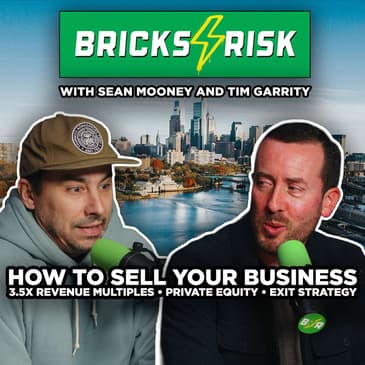
It only took us 100+ episodes and just over 2 years to finally make the "Bricks" (aka Real Estate) and "Risk" (aka Insurance) connection. Selling your insurance agency is just like selling your home. If the No. 1 rule in real estate is Location, Location, Location, the No. 1 rule in seeing what your insurance business would sell for on the open market is Presentation, Presentation, Presentation. Whether you're just about to start your morning workout routine, or know you have a 45 minute drive ahead of you, dive in with Sean & Tim for another B&R banger!
Big shout-out to our show's loyal and dedicated sponsor: Property Management Redefined. John Sacks and his team love our show and continue to support our mission of helping people through podcasting!
Our goal with Bricks & Risk is that you walk away with 1 or 2 valuable nuggets that can help build your own business. Our audience grows through word of mouth, so if you would please take a moment of your time and give us a review on the platform you’re on, that would be fantastic!
Please also help spread the B&R word by sharing your favorite episode with a friend. You can find all B&R episodes on Spotify, Apple Music, YouTube, and anywhere else you get your podcast content. We greatly appreciate your time and trust.
Until next week, keep learning and keep growing!
** Episode Shout-Outs **
→ Phoenixville, PA: https://www.visitphilly.com/areas/chester-county/phoenixville/
→ Episode Sponsor, Property Management Redefined: https://gopmr.com/
📲 Contact Info 📲
→ Sean Mooney, Mooney Insurance Brokers: www.mooneybrokers.com/
→ Tim Garrity, The Tim Garrity Team: www.timgarrityteam.com/
💥 Watch us on YouTube 💥
→ YouTube, Bricks & Risk Podcast, @bricksandrisk: www.youtube.com/@BricksandRisk/?sub_confirmation=1
💥 Follow us on Social Media 💥
→ Instagram, Bricks & Risk Podcast, @bricksandrisk: https://www.instagram.com/bricksandrisk/
→ Instagram, Sean Mooney, @sean.moonee: https://www.instagram.com/sean.moonee/@sean.moonee
→ Instagram, Tim Garrity, @realestateinphl: https://www.instagram.com/realestateinphl/
→ Facebook: https://www.facebook.com/bricksandrisk
→ LinkedIn: https://www.linkedin.com/company/bricksandrisk
The person selling the house always has this laundry list of things. They're like, I gotta do this and I gotta do that and I gotta do the other thing. Most of the time, nine times out of ten, I come in, I'm like, tell me what you think you need to do to your house or things that you are planning to do to your house before you sell it. And they have this list, and and sometimes it can be like tens of thousands of dollars. Look, forget about the list. Nine times out of ten, I'll come in and I'll say, just no. Just take that list, move it over here. Here are three things that you can do nine times out of ten are the only things you need to do, are really going to be cleaning, decluttering, and painting. That's it. If it's a single family home in the burbs, maybe there's some landscaping involved, things like maybe you gotta fix your fence, whatever. Like there could be some things. Yep. But most homes, even if they don't look great from the outside, paint will transform the way your home looks from the street. Not only that, inside the most important part, oh, you know, this and that and the other thing. You know what? Paint this whole house white. Everything. The walls, the ceiling, the trim. Just use the different, you know, the different sheens for the different areas. That's it. People are like, that's it. I'm like, that's all you gotta do. Welcome to the podcast dedicated to real estate, insurance, and building your business. Join us as we take you along our own business building journeys with additional wisdom from our network of local and national experts. Welcome to Bricks and Risk. This episode is brought to you by Property Management Redefined. PMR is not just managing properties, we're creating partnerships that build long-term success for property owners. John and his team can be reached at manage at gopmr.com or by phone 267-753-6005. Tim. Yes, Sean. Who's a good client for PMR? Property management redefined is looking for property owners who value three things accountability, reliability, and a results-driven approach. You want to maximize returns, but still provide client and tenant satisfaction. There's a lot of property managers out there. Yes, there are. What does PMR do really well? Biggest thing is they're seamless and they're worry-free. So with that approach in mind, it allows the property owner to put their trust in PMR and know that the results will be there. The other thing I think a property owner is really going to value because they do it so well is that they have a local expert team, boots on the ground, managing your properties and your tenants' expectations every day so that you feel good about your investments. We have millions of listeners out there. Tens of millions. If they want more information, how do they find PMR? Right here, guys, reach out to John Sachs and his team at Property Management Redefine. We'll take good care of you. I'm Timothy M. And I'm Tim's co-host, Sean Mooney. What's up, homeboy? How are we doing? Do you know what's funny? I was listening to a past episode where I was telling you that like certain people in my network, listeners and watchers of Bricks and Risk had said, like, you you should teach an episode on podcasting, and you were like, it's funny, like, no one says that to me. I was like, well, that's because people don't like you the way they like me. Could be. Could be. Hey, you just went to Detroit. How was Detroit? Oh, yeah. I was just in Detroit with uh shout out to Tom Mellett with Keswick Mortgage, and also was there with uh Mark Malfara, Berkshire Hathaway Home Services. What's up, boys? I wish I went to McDevitt and I would have been invited. This is what happens when you go to LaSalle. You don't do shit like that. Damn. But it's okay. Um Detroit was awesome. So the reason we went to Detroit is because my good friend Tom Mellett, one of my trusted mortgage partners, uh started his own mortgage shop. And one of his, and he's a broker like you. It's a mortgage brokerage. So you have carriers, he needs lenders to support his mortgage brokerage. One of them is one of the largest wholesale mortgage brokers, I think the largest in the country, which is called UWM, United Wholesale Mortgage. Shout out to UWM. And they have a headquarters in Pontiac, Michigan. So to keep a long story short, we were invited to go out there with like a whole bunch of other uh mortgage brokers, real estate agents that work with those mortgage brokers for like a one-day event. It's like a little conference. Yep. Uh was at UWM's headquarters, you know, at the dinner the night before, did the conference. I actually ended up speaking at the conference on a realtor panel, and Tom did a presentation about you know what it takes to be a good mortgage broker. Uh and then it was really just kind of like two great days of networking, dinners, learning. You know, we went out, got steaks one night, which was sweet, crushed a couple bottles of red. Uh next day, went to Top Golf. You all appreciate this. We go to Top Golf, and I was like, yo, what kind of red wine do you have? And they were like, uh, we have a Josh Cabernet. I was like, yeah, I'll take that. And then Mark Malfara looked at me at one point. He was like, dude, you may be the only person in this entire Top Golf drinking red wine right now. And I was like, you're probably right. I think you do it just to piss people. I don't even think you're gonna be aware of the water. No, I do it because I'm absolutely just I love it. Like, it's the taste I like. That's what I get down with. So, what do you want me to do? I became a wine drinker last 10 years ago. So I still drink beer all the time. So pipe down. Be a man and just drink what you're supposed to drink at top gospel. Okay, tough guy. Uh all right, what are we talking about today? Today we're talking about insurance. Insurance, insurance, insurance, selling your insurance agency. Yeah, this is gonna be awesome. One, this is gonna be all about this fine specimen to my right here, but not only that, I think this is really interesting because I ran a residential real estate brokerage for almost 10 years, and when the partnership ended, a lot of people had said to me, Why didn't you just sell it? So we'll get into like a little bit of that, but this is all about Mr. Mooney today, Mooney Insurance Brokers. Right. And this was on the nothing dock. Pull up the pull up the link here. Okay. Gotta give a shout out. So on the nothing dock. This was an article that was uh posted on LinkedIn or uh I think it was LinkedIn. Thought I saw it on LinkedIn, but anyway, it was Mike Mensch from Agency Broker Services, I believe. Um, but uh he is really dialed in with agency valuations, okay sellers, buyers. Uh that's so that's his business is value giving a value to your agency. Or helping you buy or helping you find agencies to buy, like all of the mechanics of an acquisition on either buy or sell side. Okay. So nice. And the purpose of or the the the post really was hitting on why selling this actually kind of comes together in that selling your insurance agency is a lot like selling your home. See, this bricks and risk, we didn't know if we would ever just like come together and lock into place. Cause I'm like, look, I'm a realtor and you're an insurance broker. Like, what what the hell do we have in common? We have a lot in common, folks. Yeah. So in the art of the world, they kind of go through the steps of how they're so related. Like, like all of the steps that you need to do to sell your house, and all the steps you need to do prior to the sale to make sure you're getting the best, highest offer, it's it's hand in hand with that. All right. So let's talk about some of the steps that Mike mentioned in this article. What would be like one of the steps that he was talking about? So the presentation of your home, right? Right. The front door, what do they say? Are you are you doing an analogy right now? Because I don't think you've really done that at all. No, no. Okay. All right. So presentation when you sell your home. So like what do they say? Like the the curb appeal. The curb appeal, exactly. Curb appeal of your home, front door, what it looks like, the landscaping. Yep. Right. So that is very similar to the presentation of your agency. Yeah, like on a house. You don't want peeling paint. You don't want uh dying like shrubbery, you don't want a brown lawn, you don't want a crack sidewalk. Yep. Because if you have those things, before someone even steps inside your house to for their scheduled showing, to see if they want to buy it, you've already kind of like lost some of their interest just because of that. Yeah. And so directly related, you're going to have your presentation of your agency. Yep. What is it like for just so you have your physical location? What is your what's your office look like? Where are you located? What is the appeal? You know, do they drive past and not even know you're there? Do you have good signage? Are you on a walkable street? All of those physical uh data points that you're going to have for that specific agency. Does that mean you get one of those little like blow up worms that are like? I don't know if I would I that might be a devaluation. What if it was bricks and wrist green? That would be a lightning bolt on it. Probably double. Double your um so you have the fees uh physical presentation of the agency, but you also have your your virtual presentation of your agency, right? Yep. Like what it like what is your website look like? What's your online storefront look like? Yep. So you have your website, you have uh a Google Business. You know, what is your what are you posting through uh Google Business? Do you have reviews? Social media, what do your social media channels look like, right? And so this is not to say that it's a requirement to sell your agency, but I would say if you were thinking of selling your agency, you might want to take the steps to spruce up your online presentation because that's just going to create uh a higher demand, which then is going to create a higher offer because it's it's more of an appeal for a buyer that wants to buy the agency. All right, so if I could just give like an example. So like what Mike's talking about here is like, hey, like when you're like working like you know, in your business, you're you're working with clients, your client-facing relationships, you know, your dot and I's and crossing T's, you you work in your business, but you also work on your business. You know, some people are only working in it. If you're only working in it, maybe your website's outdated, or maybe your logo looks like crap, maybe there is no logo. Yeah. So like what's a brand or anything, you know, along with that. Yeah. So when someone goes to look at your website, there is no Google Google business profile attached to it. They're kind of like, Well, what what kind of business is this? Like, get with the times. So his point is if you haven't done those things yet, you should definitely get with the times. But even if you have done those things, check these things to see if they look good. Like, is your website fairly updated? You know, how does your Google business profile look like? Like how many reviews do you have? Like, for example, like let's say you've had a business for like 20, 30 years, and you have like hundreds, if not thousand plus clients, and you have two Google reviews and and three-star review. Like, that that's not good. Yeah, you should be taking time now to start building up your online reviews anywhere you want in order to get your business presentable to a buyer. Yep. Okay. What else did he mention? Um, so another point that he adds in is uh the accuracy of your data and your information pertaining to your agency. Okay. You know, all of the uh KPIs, right? Key performance indicators, you're gonna want to know and you're gonna have to take time to make sure that your information is exact as possible. Give me an example of like some you know, uh KPIs for an insurance brokerage like yours dealing with well the simple ones would be, you know, what is your retention rate? Okay. So they want to know, so if I'm buying your agency, I want to know, hey, year over year, how many people are renewing within your agency? Would you have to go back years too? Like, do you think they would just want a year over year, or would they be like, give me the last five years? That's more of a tr like that is more of a behavior of the agency rather than oh, what did you do this year? Do you have any idea how many years back people would go if they really wanted an action? I would say five years. I I when how applicable would it be, you know, what it your performance six or seven or eight years ago? Yeah. Just because it wouldn't be applicable, and especially in the last couple of years, the way that the the market has gone and shifted, it's I'd really want to see three or four years of what what you've done in those three or four years. Okay, cool. All right. So that would be like KPIs would be like retention, anything else that like people would maybe not be aware of? Um, so just uh uh premium growth year over year. Okay. So that some some uh evaluated or put more of an emphasis on premium, and others might uh track it by like policy count. So it's almost like in my business, you have volume. You know, again, that's the the amount of all the homes put together. If you sold three $500,000 homes, it's $1.5 million in volume. Or you have units. Hey, I'm not selling $500,000 homes, I'm selling $100,000 homes. So I did 15 units to get to $1.5 million. So you policy so it's like the premium amount versus the actual policies themselves. Yeah. Okay. Which, you know, I I mean that matters. Hey everyone, this is Tim, your favorite bricks and risk co-host. But don't tell Sean. I hope you're enjoying this episode, and I'll get right back to it in a moment. Our audience grows through word of mouth, so if you would please take a moment of your time and give us a review on the platform you're on, that would be fantastic. Please also help spread the BR word by sharing your favorite episode with a friend. We greatly appreciate your time and trust. Now, back to the show. Everybody, you know, even from the carrier side, we see it matters because what they'll do is they run, you know, different bonus programs, and sometimes they'll run a bonus program like, hey, if you hit this in the next quarter, we'll give you this for premium growth. And others will say, Oh, if you if you add, you know, 50 new policies in this period of time, then we'll you know structure a bonus that way. So remember the one we were talking about, like insurance retention, it was like 50 in, 50 out. Oh, yeah. And the guy got up to like 800 uh, you know, policies within like a couple years. And then he's like, Well, I'm bringing in fifty, but I'm losing fifty. Yeah. And I'm bringing in fifty and we're losing fifty. And the whole point of that was like, look, like he he hit his ceiling of what he could do without having any kind of retention plan. Yeah. Of like however he was getting business was purely more of a cold lead gen model. If it was warm lead gen, they wouldn't be leaving as fast as they become a knit. Yeah. So I thought that was interesting. Yeah. And so, you know, just like when you're selling your home, right? The the key, you know, you might have a client that asked, you know, what what was your heating bill for a specific month? Give me the utility. I dude, I hate when people ask this. People are like, yo, can you give me the water bills from the last year? I'm like, it's gonna be somewhere between fifty and a hundred bucks a month for like a lot of homes, like in and around this area. You know, suburbs, a little bit bigger of a house, maybe one, two hundred. But come on. But having the the accurate data and information is important because the buyer is gonna wanna know what to anticipate those bills being. Sean, can you send me your cable bill for the last 12 months? Because I'm just curious. Did you get a lot of movies from HBO? Or are you more of a subscription to Netflix kind of guy? Yeah. I just want to know. Yeah. Okay. Alright. So we talked about selling your industry. So presentation matters, you compare that to like curb appeal. Again, the analogy is like selling your b selling your insurance business is like selling a house. And then you also talked about the accuracy. Okay. The KPIs of your insurance business. Yeah. And then also talking about he's uh he's bogarding my laptop here because he wants to he wants to see stuff. Uh I don't even know what you're looking for. Trying to get the timer back. Okay. Oh, oh, I see. I can do that if you just ask me and just give me my computer back. Stop being a dope about it. But anyway, um, so you're comparing all these different things to from selling your insurance business to selling a house. And I made the example of like curb appeal. But let's also talk about the accuracy part. Okay, if you're gonna compare that to like selling a house, let's say, well, not let's say, the number one rule in residential real estate is location, location, location. And people are like, why does everyone always say that? What? Because that is everything. It is every whether you're single or you got a family of 10. I don't care what you got going on, location is everything. Location is gonna dictate your price, it's gonna dictate your taxes, it's gonna dictate your insurance, it's gonna dictate your commute to work, you know, your lifestyle, the grocery store, the gas station, the bank, the restaurant, whatever, you know, activities for your kids, whether it's for you, your gym, the location of your home is everything. So that's what they say. The number one rule in real estate is location, location, location. Is it more dramatic in the city than in the suburbs? It's no. I actually think it's more dramatic in the suburbs. Oh. Again, we're talking about Greater Philadelphia. Yeah, yeah, sure. The reason I think it's more dramatic in the suburbs is because there's so many more townships. So you got the city, the city of Philadelphia is one township, it's one municipality. It's one city, one municipality, one school district. Very black and white. Yeah, easy done. Like, you know, you go from like we have towns, but there's like you have center city or old city or northern liberties, right? So they they have their their pockets, which I guess would be very similar to different towns. Well, the pockets in the city, let's say like one neighborhood might be more desirable than another. It's the same exact it's the same exact thing in the suburbs. Some suburbs are more desirable than other suburbs, just unlike a perception, yeah, perceived value. Yeah. Let's call it the curb appeal of it, whatever you want to call it. But at the end of the day, if you buy a home in the suburbs and you're like, I have two children, I'm sending them to public school, and these schools stink. Like, that's why it's way more important. If you're in the city and you're like, look, public school might be an option for a lot of people, they might say, you know, I don't know if I'm gonna do that. It's complete preference of whoever you are. But then you're still gonna say, All right, well, there's private schools in the city too. Where do I want to send my kid to private school? Yeah. So I actually think in the burbs it matters a little bit more because there are lots of reasons why people either move or stay in the suburbs versus like moving to the city. What about like the hot, trendy parts of town that just become you know, when right after Chuck bought in Fishtown. Shout out to Chuck D, Charlie Dollin. Uh Fishtown. Took off, right? Like everyone wanted to be in Fishtown. Like, you know, you, you know, I can only imagine the numbers that were getting thrown out and you know broke a new level, you know, and went over and higher and over and higher. Um, like you don't see that in the suburbs, right? I mean, you do. It's not as common. The the city's more common because let's again, we're we're local people. So you're getting a little local flavor here. What Mooney's referring to people in Nebraska are like, what are you talking about? What Mooney's referring to is the uh industrial uh decline of Philadelphia, like almost every major city in the U.S., from like let's call it like the 50s to like 2000, where people were leaving and jobs were leaving because that's just how cities were built. And then a lot of people were moving to the suburbs because the suburbs were growing. Okay, so let's just say that's what it is. Now when the city started making a comeback, as almost every major city has in some way, shape, or form. I was just in Detroit, same thing's going on there. Really? Yes. Um you have these areas of opportunity where the real estate is not so expensive and there are opportunities to speculate on the growth or the success or the perceived positive value of a neighborhood. Sometimes that's through gentrification. Sometimes that's done through like public investment. Maybe they just make the highway a little bit nicer, or like maybe there's more trains or whatever it is. They're fixing up the roads. Uh, we just added a rec center. There's lots of ways that areas of any city can realize appreciation and growth. And it's usually due to a combination of private and public investment in that area. And then what happens from there? That's when the restaurants come, or that's when the boutiques come, or that's when the artists come, and then there's lots of cool things, trendy things going on that also drive the culture of the neighborhood and the success of the neighborhood. In the suburbs, again, little different because the suburbs didn't necessarily the inner suburbs of Philadelphia, most of them did not go the same direction. The one where that actually did happen was Phoenixville. Yeah. No, Phoenixville is a really good example. Phoenixville was a tired rundown, uh blue-collar town. No offense to anybody. No offense. Um jobs left and people left. Yeah. That's just it was a fact. Yep. And there just wasn't money going in uh to really build it up. But and I don't know what year they started to kind of turn over and get the investment, get people coming back. And now it's like it's crazy to to drive through the main street there and see all of the life. Yeah. The restaurants and the distilleries and the breweries, and you know, the I mean, it's like a conchahaken. Yeah. You know, you could compare, I mean, even like Doylestown back in the day was a little sleepy. Yeah. So there there are all sorts of uh these little like communities, let's call them, little like mini mini cities in and around Philadelphia that also had like some industrial decline, but have since turned it around, and the values have shot up, and the schools and the communities have grown, and families are moving in, and there's lots of amazing things going on. Um but I feel like we're diving away from our topic here a little bit. Let's focus a little bit more on so you and I, all right. So I'm gonna hit it from this angle. You and I were kind of talking about this beforehand, and you were saying, like, hey, like selling an insurance agency, you got to be careful of like certain things like the name of your company, or like, you know, where it's located, or there's certain things that there's gonna be a perceived value to the buyer that you wanna be just aware of when you sell, like what would one or two things be? Well, here's the other point, and I I think it was the final point that Mike was making inside of his article was and this was kind of the the big key in relating the selling of your agency to selling your home, right? And if I were to go decide that I want to sell my agency, and I said, I'm going to sell my agency and I'm going to put it up on Craigslist and I'm going to sell my agency. Right? The demand for my agency probably won't be as high. I mean, it might. The alternative photos, you might be in business. The alternative approach would be working with a pro. Exactly. Right? And so one of his key points is like a like a insurance business broker, like someone who's going to help you locate a buyer. Not only that, but uh so uh if I want to sell my house, I might come to you and say, Hey, I'm going to be selling my house in the spring. And you might say, That's awesome. Like, congratulations. Here's what you need to do in the next two to three months to secure the highest offer. This is like preparing your home for sale. Yep. And so, just like in my house, you know, we had to do a couple things. Just a few. Just a few. And by the graces of God, Zach was able to come. Yeah. Shout out to Zach Torres. Leo, who made it happen. Um, you go to the professional, and the professional says, Listen, this is what you need to do prior to listing your house. Yep. So working with someone like Mike is going to be, all right, before you sell your agency, you're going to want to do this, this, this, and this. Because in doing this, taking the time, the money, and everything on the front end, you that's going to secure you the highest offer on the back end. Yeah. So it's almost like, again, comparing it to like selling a house, a lot of times when someone asks me, says, Hey, Tim, I want to sell my house and I want to work with you. Okay. The first thing I say is, I need to come over and see it. Like, let's say I haven't seen it. Let's say I haven't ever seen it, but let's say I even sold it to them five years ago, 10 years ago. Okay, got to come over and see your house. Yep. And then the person selling the house always has this laundry list of things. They're like, I gotta do this and I gotta do that, and I gotta do the other thing. Most of the time, nine times out of ten, I come in, I'm like, tell me what you think you need to do to your house or things that you are planning to do to your house before you sell it. And they have this list, and and sometimes it can be like tens of thousands of dollars. Okay. Nine times out of ten, I'll come in and I'll say, just no. Just take that list, move it over here. Here are three things that you can do nine times out of ten are the only things you need to do, are really going to be cleaning, decluttering, and painting. That's it. Now again, there could be some if it's a single family home in the burbs, or maybe there's some landscaping involved, things like maybe you gotta fix your fence, whatever. Like there could be some things. Yep. But most homes, even if they don't look great from the outside, paint will transform the way your home looks from the street. Not only that, inside the most important part, oh, you know, this and that and the other thing. You know what? Paint this whole house white. Everything. The walls, the ceiling, the trim. Just use the different, you know, the different sheens for the different areas. That's it. People are like, that's it. I'm like, that's all you gotta do. Because this will look like a completely different house after you paint it and you declutter it and you clean it. It'll look like a model home, is what it's going to look like. And people like almost can't believe it, which plays into the presentation. Yeah. Like the presentation is huge. And the second part of it being that, you know, we talked about houses that sold, I think FSBO, right? Yeah. And Hasbo. And how much more you get for your home with working with an agent. Correct. Right? And so identically, it's, you know, when you work with a business broker, right? They know the valuations, they know how to improve uh your valuations before you even list. But they also have a network that they have that you can tap into because they represent buyers and sellers, they probably have a laundry list of people in a bullpen that are already looking to buy an agency. The next time you have an agency that's like a right around this, let me know because I'm interested in that. Yeah. And so I guess the point that I'm trying to make is just like working with a real estate agent, working with a business broker, you're going to get, they're going to position you to get you the highest offer. Right. And a lot of work behind the scenes that's going to deliver a higher price. Well, it's funny, like, just like the way we're talking about a house, like if you do nothing, your paint's peeling, and your home is dirty and there's stuff everywhere, and it's, you know, you you didn't clean, declutter, and paint, let's go. Or choose to invest $7,000 to get a higher number. Then everyone who comes to your house is going to be like, oh, I got so much stuff I have to do. Yeah. So they're going to be turned off. Yeah. Same thing with your business. If you just put it on Craigslist and you're like, okay, let's see, they're going to just call you and be like, well, well, tell me more. You're like, well, what do you want to know? Like, it's it's not going to work. And then here's the the way I'll end this one. Just like with the real estate agent, people are like, oh, what does it cost to sell my house? Five to six percent on average? That's what it costs. It's like, yeah, but if you work with the right listing agent, this is why this matters. They will they could make you back 10 times that in understanding what you have and how to shine it in its best light. So they might make their money and five, 10x over that just by educating you on what to do. Same thing with Mike in your business. He might say, look, Sean, you've never sold your insurance industry business before, so you don't know what you're doing. I've done this many times. Let me tell you, let me look at your business as if I were the buyer, and let me tell you where your holes are, where the problems are. If you do A, B, and C to get your business ready to sell, then any kind of fee that he would get to sell your business is going to be well worth it. Not only that, he will take away the pain of you having to deal with pretenders, FISBO for sale by owner. Yep. People just out there hunting for deals or trying to take advantage of other people because they don't work with a professional. And just from a time standpoint, could be, you know, you could be out there trying to sell this over the next year, right? Working with him or someone else in that position. That could be sold in 30 days. Yep. Depending on the right scenario. Absolutely. So time and money is another way to, you know, look at it. All right. Go ahead and shut this one down. Folks, make sure you're getting subscribed on YouTube. Where are we at, by the way? You talked about YouTube subscribers on a few episodes recently. Yeah, it's floating around. Uh, in terms of viewers on our videos, it's like sub 30% of watchers on our videos are subscribers. So help us out. Go to the YouTube page and get subscribed so we can build that number up. So if they're one of the seven out of ten, we're just asking you to hit the red subscribe button. So now we're in your feed. Yep. And algorithmically, you're gonna get our stuff and stuff that's related to us, real estate insurance business. So just a big help there. Get us on the socials Instagram, Facebook, TikTok. LinkedIn. We're not on TikTok. Wait. Oh, wait. LinkedIn, we're on LinkedIn. Where are we at 800? This kind of the fact that you just said that and how the blog was revealed on an episode leads me to believe, because I'm not on TikTok, that we have this TikTok account with 10,000 followers and Sean doing tap dancing videos. Could be there. You gotta go look in the 1975 ruffled tuxedo. You gotta go look. Okay, cool. I'll look. Uh, audio platforms. We are on Spotify and Apple. If you'd like to show, hit us up on a review with Apple. And any comments or questions or recommendations, get us on the email bricks and risk at gmail.com. That's all we have for this one, folks. Thank you for tuning in again to another episode of Bricks and Risk. See you next week. Thank you for joining us on another episode of Bricks and Risk. Our goal is that you walk away with one or two valuable nuggets, and we greatly appreciate you sharing your time with us today. You can find all BR episodes on Spotify, Apple Music, YouTube, and anywhere else you get your podcast content. Until next time, keep learning and keep growing.