
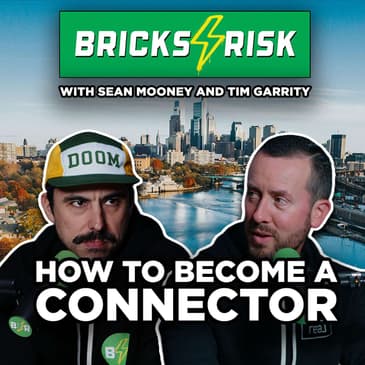
Being a good connector in business can be just as good, if not better, than paying for ads, sending postcards, making phone calls, and having client events. Reason being, you're constantly looking out for others, who will in turn start to look out for you. From The Go-Giver to speed-dating, Sean & Tim break down the differences between "connecting" and "networking" and why it pays to shift your mindset!
Our goal with Bricks & Risk is that you walk away with 1 or 2 valuable nuggets that can help build your own business. Our audience grows through word of mouth, so if you would please take a moment of your time and give us a review on the platform you’re on, that would be fantastic!
Please also help spread the B&R word by sharing your favorite episode with a friend. You can find all B&R episodes on Spotify, Apple Music, YouTube, and anywhere else you get your podcast content. We greatly appreciate your time and trust.
Until next week, keep learning and keep growing!
** Episode Shout-Outs **
→ The Secret: https://www.thesecret.tv/the-secret-documentary/
→ Episode Sponsor, Property Management Redefined: https://gopmr.com/
📲 Contact Info 📲
→ Sean Mooney, Mooney Insurance Brokers: www.mooneybrokers.com/
→ Tim Garrity, The Tim Garrity Team: www.timgarrityteam.com/
💥 Watch us on YouTube 💥
→ YouTube, Bricks & Risk Podcast, @bricksandrisk: www.youtube.com/@BricksandRisk/?sub_confirmation=1
💥 Follow us on Social Media 💥
→ Instagram, Bricks & Risk Podcast, @bricksandrisk: https://www.instagram.com/bricksandrisk/
→ Instagram, Sean Mooney, @sean.moonee: https://www.instagram.com/sean.moonee/@sean.moonee
→ Instagram, Tim Garrity, @realestateinphl: https://www.instagram.com/realestateinphl/
→ Facebook: https://www.facebook.com/bricksandrisk
→ LinkedIn: https://www.linkedin.com/company/bricksandrisk
Have you ever read the book The Secret? I watched The Secret, the DVD back in the day. Close enough. And that's the one where it's like if you like manifest it. Yeah.
SPEAKER_02Manifest. It's kind of like that.
SPEAKER_01If you if you are putting good vibes and good intention out there, I want to be a millionaire like next week, and then you wake up next week and Bitcoin went through the roof and it's like 250,000.
SPEAKER_02You're like, you're an afterworking millionaire. Yeah. Like that.
SPEAKER_01Welcome to the podcast dedicated to real estate, insurance, and building your business. Join us as we take you along our own business building journeys with additional wisdom from our network of local and national experts. Welcome to Bricks and Risk.
SPEAKER_02This episode is brought to you by Property Management Redefined. PMR is not just managing properties, we're creating partnerships that build long-term success for property owners. John and his team can be reached at manage at gopmr.com or by phone 267-753-6005. Tim. Yes, Sean. Who's a good client for PMR?
SPEAKER_01Property management redefined is looking for property owners who value three things accountability, reliability, and a results-driven approach. You want to maximize returns, but still provide client and tenant satisfaction. There's a lot of property managers out there. Yes, there are. What does PMR do really well? Biggest thing is they're seamless and they're worry-free. So with that approach in mind, it allows the property owner to put their trust in PMR and know that the results will be there. The other thing I think a property owner is really going to value because they do it so well is that they have a local expert team, boots on the ground, managing your properties and your tenants' expectations every day so that you feel good about your investments.
SPEAKER_02We have millions of listeners out there.
SPEAKER_01Tens of millions.
SPEAKER_02If they want more information, how do they find PMR?
SPEAKER_01Right here, guys. Reach out to John Sachs and his team at Property Management Redefine. We'll take good care of you. Hey everyone. Welcome to another episode of Bricks and Risk. I'm Timothy G. And I'm Sean Mooney.
SPEAKER_02What's up, man? Hey. What is cracking besides this rainy, dreary day in downtown Philadelphia, Pennsylvania?
SPEAKER_01Yeah. And you know, my glass half-full approach would say we need rain to make sure the grass and trees and flowers are healthy. Well, it's a bye week this week, so uh why don't you um why don't you educate us on where this this hat came from? Because uh you and I were talking last night on a late night Zoom about the podcast and all of our amazing to-do list items that we're running through right now. But we were talking about this hat.
SPEAKER_02What was the one? What was it? Godzilla uh Godzilla Giant Godzilla Marketing.
SPEAKER_01Yes. That was part of the nothing folder. Which we will be talking about at some point soon, but let's educate everyone on this hat here. What's going on? Uh it's my Doom hat. The Doom fan club out there, as I am a member. It looks like it looks like something that would have been worn at the Philadelphia International Cycling Championship circa 1996.
SPEAKER_02Well, they are bringing it back to Man Young. They are so maybe it is like bringing us back. Maybe it's appropriate. Um Gastrolls.com. Shout out, Gastrols. Shout out. Um, it's just uh now I mix it in as part of my repertoire. I love it. All right, what do we get into today? Today we're gonna be talking about business and being connectors in your business and your sphere and why it's a good thing, how to become a networker, or not a networker, connector, and some of the valuable uh things that can come from that.
SPEAKER_01Well, not only are we gonna talk about this from a business perspective, but I think this also plays a little bit more even into like a life perspective. How you live your life, which I'll get into.
SPEAKER_02Tim will talk about that. Yeah. I'll stick to the business topics of such.
SPEAKER_01All right, well, I think a really great way to start this one off is like what does it mean to be a connector to Mr. Mooney first?
SPEAKER_02Uh super simple. A connector, which I proclaim myself to be, likewise, is you go into a room, it could be a networking event, it could be wherever, a birthday party, whatever. Um, and in the course of conversation, me, this is how I operate as a connector, is that my brain, my mind is always trying to uh find out what a person does, and who can who do I know in my network uh of relationships who could potentially benefit that person or vice versa. Who can this person in my network benefit or work with or or such? Do you know what it is?
SPEAKER_01It's kind of like matchmaking. Uh it's very much like seriously, like like setting people up. I mean, on a business level. Yeah. But it really is not a romantic level. Not on a romantic level. Right. But you're really thinking about it in a way of who do I already know that would be a good fit for this person that I just met, or vice versa. I just met this person. Who does this person, who are they a good match for someone that I already know? Yep. You're really, you're, you're kind of like in the back of your mind connecting the dots because you're trying to help both parties. You're trying to say, like, hey, this is how I roll, this is how I've built my business, this is how I live my life. And therefore, if I can match you up with someone that I really feel like would be a strong introduction for lots of different reasons, I'm going to do that again, as long as you're open to it.
SPEAKER_02Yeah, and I think the important part of that is by having prior conversations with people in your network, right? To know what they do, to know what their strengths are, to know what their weaknesses are. Because if you can get dialed in on that in terms of your network and what you makes them tick, when you come across that person that's new to you, you just met them and they say, Oh, this is what I do, this is who I help. Then you're instantly able to kind of in your mind make that connection and say, Oh, you you know what? You need to talk to Bill, because Bill runs this painting company, and and he's having a hard time with some of this stuff that you just mentioned, and you might be able to help him. Yep. And so that's the connector mindset, and it's it's nonstop, it's always running on overdrive in terms of trying to take these pieces and match them together.
SPEAKER_01Yo, you had made a really good point. The difference between a connector and a networker. Yeah. What what was your thinking there when you said that?
SPEAKER_02So when you're a networker, this is so simple, it's so binary. It's total moon. Total moon yes. When you're a networker, you are going to a networking event to extract business for you from someone. That's the mindset. So I I'm going to go to get business out for me. That's the networker. And and you want to go to as many events as possible, and you want to talk to as many people as possible, and the hope being you're going to get more business. The connector is pretty much the opposite. Yeah. When you go to an event, you are walking into that event hoping to talk to people, to meet people, to understand what they do, in hopes that you can make that match for them for someone in your network. And by way of that, you get reciprocated upon at some point down the road because you made that match.
SPEAKER_01Do you know what's funny? So we just had our Bricks and Risk networking breakfast. We had three amazing panelists. Mooney and I were up at the front. We were asking questions, and we called it a networking breakfast, which again, to your point, is not really how we treated it. Because, and here's the best example I can give. So we had almost 30 people at our networking breakfast. Um, people came in casually, had something to eat, grabbed a cup of coffee, everyone sat down. We took about an hour to ask questions of our panelists. It was held at the Av. Pete was a terrific host for us. Shout out to Pete. Shout out to Pete McKenney, Av in Bluebell. Check them out if you're looking for a great place to live or short-term rental. Yep. And um what I thought was awesome is that like right at the end. So, you know, people are walking out, and you're like, all right, see you later. Thanks for coming, appreciate it. Oh, thanks for having me. Hey, Tim, do me a favor. Can you put me on top in touch with Josh? Yes. Shout out to Josh Meyer, Panorama Motions. We love Josh. Josh is the best. The best. Full stop. And literally, like, I probably had four or five of those interactions at the end. Not only that, during the networking part, like when people are grabbing their coffee and eating, I was like, Do you know such and such? And someone would say no. I was like, Let me introduce you real quick. Because that person, one, they're there because we already have a relationship with them. That's first and foremost. But two, now that they're there, you and I, all we were thinking about is who can we match with who? Who wants to meet who and why? And it's always, I feel like with connecting, we always, you and I personally always look at it. It should be a two-way street. Not I want to introduce you to this person so that you can uh get their leads for this need. No, I want to introduce you to this person because I think that person is gonna enjoy meeting you just as much as you're gonna enjoy meeting him or her. And that I feel like is the true mindset of connecting, is you're always thinking, it's like, who's a good fit for you? Yeah, and it usually comes through like conversation.
SPEAKER_02Well, number one, we're gonna have to change the name of the next event to a connector breakfast. To a uh connecting breakfast, which people might get the wrong idea.
SPEAKER_01What if I don't want to connect? Yeah. Isn't that what Sean and Tim do? I don't do that.
SPEAKER_02Yeah, that's why I go to these Sean and Tim can connect.
SPEAKER_01I hate connecting people.
SPEAKER_02But number two, it's really speaks to the uh group that we have within this community of Bricks and Risk that people are on that same level. Um, you know, at the event, there were so many people that were, oh, let me get a business card, let me talk to that person. Who's that? Yeah, like there was so much of that where in a normal networking event, it's like, hi, I'm Dave. Yeah, I do title. I'm in realtor. What do you do? I'm a realtor, right? And then and then you're in a normal networking event, you're sizing that person up. Yeah, can this person give me business? Yeah, right?
SPEAKER_01Well, I mean, you and I did those things back in the day, yeah. And and you should do those things, you should go out and meet new people, as many people as you possibly can. Not to say you shouldn't go out and network. That's definitely not what we're saying. But what we're saying is that networking and connecting are definitely two different things, yeah, two different ways of thinking. You can do you can do both at the same time, yeah, but I think you have to understand that being a connector is I feel like a smaller part of the business population has that mindset as often as you and I do. Part of the reason we did this podcast is to help and give back. One of the reasons. I always give the three reasons could because why wouldn't there be three? Because I always have three reasons for everything, right? Yep, three tips, three reasons, three non-reasons, top three, bottom three, middle three, whatever.
SPEAKER_02Top three Timmy G? Yeah, or top three, Shawnee P. Right. All right. Um, so there's a difference between the you can be both. Um, it goes back to Gary V 51, 49. If you're giving 51%, you're gonna be taken care of, you're gonna win in the long run. And that's just my mindset uh when it comes to business. But I would say to people, be cognizant of that. And when next time you go to the networking event of choice and you get in a room with people, don't just make it about what can I get out of this networking event.
SPEAKER_01A hundred percent.
SPEAKER_02Really try to go in with the idea that yeah, you can meet people and and have that uh interaction to kind of look for people who might be a good addition to your network that you can get business from. But I would say take a little bit of time to think about the people in the room, the people in your network, and try to make those connections because it really can go a long way when you become that person that is connecting people and your network becomes bigger and it also becomes stronger because now you have those two people that are connected by way of you.
SPEAKER_01All right. So here's my analogy because we all know by now, not only do I love top three, but I love analogies. Networking is like speed dating. You're literally just meeting all these people, you only have a certain amount of time with them, you're shaking hands, you're kissing babies, you're passing out business cards, you're just like, okay, on to the next one, on to the next one. I want to walk out of here with like 10 business cards, just like I want to walk out of this room meeting like five women or five men, whatever it is. There's always a romance angle with you. Well, hey, that's part of life. Um then the uh connecting is a little bit more like a blind date. So that's like, hey, I want you to meet this person because, and then the two of them, if they agree, yeah, will go out. So that is like that is kind of the analogy I'll make. There's nothing wrong with speed dating, and there's nothing wrong with blind dating, they're just two different things. That's a good top three. You like that's not a top three, it's an analogy, bro. Wake up, Mr. Analogy. Wake up all right. So let's get to the second point that we had. Why don't you introduce this one?
SPEAKER_02This one is the top three of becoming a better connector.
SPEAKER_01Well, before we get to that, let's just talk about why it helps build your business. Why? Why? And honestly, it's like the first one I said is I say it all the time, you say it all the time, is know like and trust. Yep. So again, when you are going out, meeting people, intentionally putting them in touch with others, introducing them to others, sending warm text intros, sending war warm email intros, just saying, hey, I met Bill today. Uh, do you want to be introduced to Bill? Yes. How do you want to do it? Just send them my contact. Like these are all the kind I have these conversations almost every day. Like, no lie, I probably have at least one basic conversation a day of like, hey, can you, Tim, can you put me in touch with such and such? Or hey, such and such, would you like me to put you in touch with this person for this reason? And it happens maybe not every day, but multiple times a week. For sure, I am connecting people. And part of the reason I do that is because I feel like that's gonna add value to both sides. Like I always look at it that way. Like, if I say, like, hey, like if it was like a real good example, a real estate agent and a loan officer, and I'm like, hey, you should meet this loan officer because they do mortgages and your buyer clients are gonna need mortgages. That's not connecting. Connecting is like, I want to introduce the real estate agent to the loan officer, one because I think they're like-minded, maybe they do business the same way, maybe they're like of a similar age or they have similar interests, or like they have similar backgrounds, like they were both in corporate America, they both became entrepreneurs, so like their stories are the same, like whatever it is. Me and South Philly Vinny. Yeah, you and you and your long-lost brother, you know, I can't South Philly Vinny. He had a birthday the other day, and I sent him some Shout out to Vin.
SPEAKER_02I sent him some Fagazi music for a birthday. Like physical music, or are you just so my digital music? My uh choice of sending music is uh do you know Bandcamp? I know Bandcamp, yep. So in Bandcamp, you can send, you like literally put uh an email in and it sends like the digital files. So I've been harassing Vin a little bit with some music. With some punk, because you guys are like like-minded punk. Yeah, and then he said he was into I forget what who he was into. He's like, I'm gonna take a break and listen to this one. Nice, that's awesome. Um, so no like and trust. No like and trust. Fine, you know, vibe as you try, that kind of thing. Connecting builds trust within your network and people that are outside of your network.
SPEAKER_01Yeah, like another way, no like and trust, another way you can look at this is is karma, is kind of reciprocity. It's like, look, I want to just help people. If you have that mindset, chances are, and these are to all my people out there who have this mindset who like to just help people first. Something will happen at some point in the future. Very, very likely. It could be next week, it could be next decade, but something in the future will happen by way of that helping someone that someone will want to reciprocate, help you in some way. It might be an intro to a lead, to another person that they think you would like to meet. For us, we do development. Maybe someone says, Hey, I know uh this homeowner and this is a fixer-upper, and they don't want to sell on the open market. Can I introduce you? Like I've met people's family members literally just saying, I want you to sell my grandmom's house because this is where they are, and we think you're gonna take good care of it. But it's really like kind of like the karma aspect. Have you ever read the book The Secret? I watched The Secret, the DVD back in the day. There you go. And that's the one where it's like if you like manifest it, yeah.
SPEAKER_02Yeah, it's kind of like that.
SPEAKER_01If you if you are putting good vibes and good intention out there, I want to be a millionaire like next week, and then you wake up next week and Bitcoin went through the roof and it's like 250,000, you're like you're an F.
SPEAKER_02Like that. Um doing good with the thought that if you just continue to do good by others, there's gonna be a return on that investment. Yep. That's karma. Agreed. Just keep it going.
SPEAKER_01You can't, and you can't just say I'm gonna do it once. I helped them. There's no opt-in and opt-out of karma. Why didn't they help me? No, no, that's like that is the complete opposite of what we're saying. This is a way of thinking, this is mindset, this is training yourself, if you don't think this way already, to just look at it a little bit differently. It's not tit for tat, it's not lead for lead. That's not how there's no scorecard. There is no scorecard. Like we've talked about this on multiple, multiple episodes. Yeah. And it really, it really ties into one of our better interviews when we interviewed Bob Berg from The Go Giver. Shout out to Bob Berg. And one of the best interviews we've probably done, because the entire conversation was about this, was about thinking of others first, is that you're really focused on giving rather than getting.
SPEAKER_02Yeah, serving, serving your clients, serving your prospects, figuring out their problems and finding a solution for them. And that's that's his book, that's his methodology, that's the way that I approach work and business and and life, life to a certain extent. Yep. Um, but a great interview, and it it was like uh we're sitting there talking like, yeah, like we are go givers, like we're roll.
SPEAKER_01Yeah, like prior to me actually reading. Reading the book, I mean, probably took me like six months to read like a hundred and twenty pages. Didn't you just watch the DVD? I wish the Go Giver was on DVD because I would have watched it. Or on VHS.
SPEAKER_00Yeah.
SPEAKER_01Yeah. Would have been good on VHS. Hey everyone, this is Tim, your favorite bricks and risk co-host. But don't tell Sean. I hope you're enjoying this episode, and I'll get right back to it in a moment. Our audience grows through word of mouth. So if you would please take a moment of your time and give us a review on the platform you're on, that would be fantastic. Please also help spread the BR word by sharing your favorite episode with a friend. We greatly appreciate your time and trust. Now, back to the show. Well, all right. So one thing that Bob said too about the, you know, focus on giving rather than getting is that you have you have to be open to receiving. And that may be like an assumption for most. Well, yeah, of course I'd be open to receiving. Why wouldn't I be open to receiving? No, it's it's not in that vein, is that just say, like, look, I'm gonna help people purely for that aspect. But if someone in the future ever wanted to help me, I would definitely be open to getting that help. And I think thinking about it that way also helps with your mindset. Because if you're just saying, I'm supposed to give, I'm supposed to give, I'm supposed to give, you're you're gonna give it, you're gonna give three times and get frustrated. Like, why is why is nothing coming back to me? I don't I don't understand. I've helped this person twice, I've helped this person four times. Like, why is no one helping me? I need help.
SPEAKER_02It's removing the expectation of I need to receive it's it's the scorecard, right? Like when's my turn? Right. And so you you just have to eliminate that, and it's hard.
SPEAKER_01That's a hard thing to do. I mean, I struggle with that. It's difficult, everyone does.
SPEAKER_02It's difficult because you're like, I'm putting all this time in, I'm trying to do this, I'm trying to do that. And when when is it gonna come back to me? Right. And and I guess early on in your career, it can be even that much harder. Yeah, because you're trying to build, you're trying like it's easier for us as established business owners to kind of sit back and and and give and give and give. When you're early on, it's not as easy because you're trying to correct make deals and trying to make money.
SPEAKER_01Make money. How do I make money? Yeah, and then that's like your focus. I need to eat, I need to survive. Yeah, how do I make money? Yep.
SPEAKER_02So I would say that during the early years of your career, uh definitely try to be the hybrid networker connector.
SPEAKER_01Well, and if you're if you're doing like networking all the time, chances are you will connect just like it'll just happen. And then when you connect six months or six days or three years later, something will come across your plate and they'll be like, Hey, remember, I just want to let you know that was a great introduction. You know, I have a buyer client looking in this neighborhood. Tim, would you like to help this buyer client in this neighborhood? And it's like, uh, of course I would, I would love to.
SPEAKER_02Yeah.
SPEAKER_01All right. So let's go glass half empty style before we get into Timmy G's top three. Yeah. And let's talk about what you were saying, that theory about weak ties.
SPEAKER_02Yeah.
SPEAKER_01That was interesting. You know, we're all like positive, well happy. Now you're like, let's talk about the weak.
SPEAKER_02It's not, no, no. So it's not, I'm just kidding, it's not negative. It's granite's theory, it's a sociological theory that the most powerful components within your network can actually be your weak ties. All right. So explain that. So if you think of your network or your sphere of let's call it 100 people. Yep. 100's a good number. You might have 20 people in your network that are super strong. Correct. Yep. You could pick up the phone today and they're your people. Your cheerleaders, let's call them. Whatever. Put them in that bucket. And now you have 80 people that are still in your network, but they're not your core first degree connection.
SPEAKER_01So that would be considered a weak tie. A weak tie. They're not a cheerleader yet. They're not part of your top 20.
SPEAKER_02Yeah, they're on the periphery of your network. Okay. And the theory is just that those connections can actually be more impactful for you than your core 20. Really? Yeah. And I I don't know the exact what I took from it or what what I glean from that uh way of thinking or that theory.
SPEAKER_01Read this in one of your business books?
SPEAKER_02No, no. This is sociology and theory.
SPEAKER_01Okay. This is from one of your sociology books? Textbooks. Okay. Cool. Yeah.
SPEAKER_02Um, is that number one, there's more. So just from a sheer number perspective, there's going to be more of them. More opportunity. So that it could be more impactful just from a numbers perspective. But also, two, that I find, and tell me if you agree or disagree, but it's oftentimes easy for me to have a referral for someone that I don't have an immediate connection with.
SPEAKER_01Okay, so let's call it one of your 80, one of your weak ties, and then you're almost putting like more effort, more thought into trying to connect someone. No, no, no, no.
SPEAKER_02What I'm saying is if I am okay, so if if if I'm connected to someone, but I'm not their 20. Okay. I'm I'm one of their 80 sitting on the side, and we know each other, we're connected, but it's a loose connection. It's it's oh, I know them through this person. Yep. I sometimes have an easier time floating that person's name to someone. Yeah, yeah.
SPEAKER_01Be like, oh, give them a call. Yeah, you don't really truly know each other yet. Maybe it's like, let's call it an acquaintance. Right. Maybe you met them somewhere, like they know me or they know someone you know, whatever. Yep. And out of the blue, you're like, talk to that person because even though they're an acquaintance, I think that would be a good connection for you. And there's that kind of there's also too less pressure. It's true. There's no expectation of right, you're not each other's friends, boys, right, homies yet. Right. You're just like, you kind of know who I am, and I kind of know who you are. Yeah. But here, just I know enough about you to think that this is a good person.
SPEAKER_02Yes. I know that they do business with uh Jim. Uh I know that there's a relationship there. So I know that he's not, you know, gonna take one over on you. Yep. So for me, there's a relaxed effort in trying to connect that person that sometimes works out to be the best. I think that's the Yeah, I mean, that's happened to me. That's the point of this, is that your core 20 are always gonna be like, oh yeah, yeah, yeah, yeah. But at times too, they're like, well, yeah, he's your boy. Of course you're gonna, you know what I mean? But but if it's like, oh, I know this person.
SPEAKER_01It's like me telling someone to work with you for insurance. Right. It's like, Christ, we're doing a podcast together. Like obviously we know each other and do business together.
SPEAKER_02I've been on the World Wide Web and you guys, I see your pictures everywhere. It's like, can't escape you. It's true. So the theory is the power in that second level, you know, six degrees of Kevin Bacon, we'd be at two degrees.
SPEAKER_01Yeah. Two, maybe three. Right. Okay. All right. So let's do let's get into the uh the drum roll. Please. Tim's top three.
SPEAKER_02Timmy G's top three. Three, three, three. Of getting better at connecting. Welcome to Maui, Maui, Maui, Maui.
SPEAKER_01No. All right. So let's get in this. So number one. Number one is my favorite thing. You've said this so many times. I have heard this so many times. You become a trusted resource. Yeah. Being a trusted resource, let's just talk about in relationships. This happens on so many different levels. Like, people will ask me for anything and everything these days, just because I've been connecting. I've been connecting as long as I've been able to be connecting. Let's say all the way back into like bus parties. Yeah. Like bus parties. Yeah. At LaSalle University. I'm like, that's where you go to get the keg. I know that place is cheap and/or doesn't check. I think you were so buy three kegs there.
SPEAKER_02I think you were probably a networker more than a connector at bus parties because you were always trying to extract something for yourself.
SPEAKER_01Oh, oh, really? But like an extra drink or an extra dance on the dance floor? Yeah. All right. Okay. That makes sense. But you graduated. True. Yeah. And and I did graduate on time. So that's overrated. So again, being a trusted resource, you you what you get. You're an authority. Yeah, you get credibility. Yep. And you become valuable to your 20, let's call it your 100, your 80, maybe a couple of hundred people after that, that you third, fourth, fifth, fifth degree. Someone just finds you online, knows your name, let's say, knows who you are, and they're like, hey, I'm gonna talk to Sean. I'm gonna see if Sean knows someone who does this. That's the future episode we talked about as the Rolodex episode. We will. Um see if we can find like some spirit Halloween like Rollodex outfits. Yeah. And we'll just roll in with those.
SPEAKER_02But it's it's you are the resource, you are the go-to. They've they've put uh so much uh reliance on you, and you were able to deliver. You know, we we get these calls all the time. It's like we're the insurance agent for this person, yep. But do you have a painter? Do you have a roofer? Do you have a plumber? Happens all the time. All the time. And and I'm sitting there scratching my head, like, why are you going?
SPEAKER_01Why would you ask me for a roofer? Yeah. Why would you ask me for a painter? Yeah.
SPEAKER_02It's just because you've delivered. Yes, you you've proven value time and time again. And if something occurs that's kind of related, you know, you're the go-to.
SPEAKER_01Absolutely. It's providing value. All right. Number two, and we've already kind of talked about it. You're seen as a giver, not a taker. Now, again, that's pretty, that's a little uh bold, a little black and white. I don't want taker to sound like a bad word. But no, no, you're giving at the forefront. But sometimes people will label other people like that. Oh, you know, I've I I helped that person do this, or I've connected this person to that, and I've never gotten a thank you. I've never gotten this, or never, however, you want to look at it, everyone is totally different and everything is completely situational. But some people might say they're just like, you know, they just want what I have, and they might consider that a taker. So just know that that label exists for a reason. Some people's perception is that's the way you roll in business andor in life. So it's really like putting into your network, adding to your network, connecting within your network, you know, networking breakfast. We had guest speakers. Not only are we bringing people into our network, we're providing information to all these people that actually took two, two and a half hours out of their day on a Tuesday to drive someplace that might have been a half hour to an hour for some. People came from the city, you know, and they came in and sat there because they knew that we were going to deliver value. Yeah. And that, and that I think is just a great way. It's again, it's reciprocity. It's almost like the golden rule. It's like treat others as you want to be treated. That's that's a personal philosophy of mine.
SPEAKER_02Yeah, and it does, it does come around, right? That idea of doing right, and you will be rewarded.
SPEAKER_01Absolutely. All right, Trace. Trace. Trace, opportunities compound. Oh, yeah. So you said something in a past episode. It was, I think it was like fairly recent. I think, oh, do you know what was? It was the year one, the part one and part two of like getting started in business, year one. And one thing you said that I thought was really good is you were like, okay, my year one, like, I'm kind of like faking it until I could make it, because no one wanted to allow you to sell their coverage. Like you were like, I don't have any business. They're like, go take a hike. Yeah. And then finally you found Iron Peak. Yeah. And then you had an opportunity to write insurance business. Yeah. And you had said you're like, okay, in year one, like, let's say I did like a hundred, a hundred policies or something like that, just throwing a number out there. You're gonna get juice in year two and future years from the hundred you did in year one. Yeah. Because if you do that hundred, let's say like five of them are absolute raving fans, and you know, another 20 of them love you, and then it's like, and then you have your your weak ties, let's call it. But they also they like Mooney Insurance Brokers, they're working with you, they want to stay with you. Yep. But what happens is that the opportunities through those people you're helping, even though you're just helping as like as a service provider, those opportunities that you're creating for them, you're helping them. It's good for your business, but that will compound. And they'll go tell. I used to tell people in real estate if you really care about customer service, and like let's say you help a first-time buyer, and you just go, you're they're like over the moon about how well the transaction went. Thank you so much. I appreciate all your time, your communication, your knowledge, whatever. Like, they will go tell five people they know what a great real estate agent you are. Like, that's what they're gonna do. And it's it's the opportunities compounding is is in that vein.
SPEAKER_02Yeah. And if you continue to deliver, right, then you get more opportunities, more opportunities into more referrals and more business. And the snowball effect just happens over time, and that's kind of the point and the purpose in being a connector.
SPEAKER_01100%.
SPEAKER_02All right, why don't you go ahead and do that? That's all we got. Listen, fans, if you want to get in touch with us, we'd love to hear from you. I'll say it be I said before we got about YouTube, 27% on YouTube that watch our content are subscribers. Okay. So a big ask from everyone out there if you're still with us here.
SPEAKER_01We want to take the 73, and we would love for them to go like this on subscribe. Yep. That's what we're asking. Yep.
SPEAKER_02Okay. So you can reach out uh on YouTube. Please subscribe. Shoot us an email with any topics, ideas, questions. We'd love them. Or if you just want to connect, bricks and risk at gmail.com. And on the Apple Podcast, you can leave a review for us. Written review. We'll share them on the on the show. And if you're on LinkedIn, hop into our network, uh 700 or so 700 plus cruise in our community there. Uh great place to find content that you're not going to catch anywhere else. And check us out and drop us a note.
SPEAKER_01All right. That's all we have for this one, folks. Thank you for tuning in again to another episode of Bricks and Risk. See you next week. Yo, folks. Thank you for joining us on another episode of Bricks and Risk. Our goal is that you walk away with one or two valuable nuggets, and we greatly appreciate you sharing your time with us today. You can find all BR episodes on Spotify, Apple Music, YouTube, and anywhere else you get your podcast content. Until next time, keep learning and keep growing.