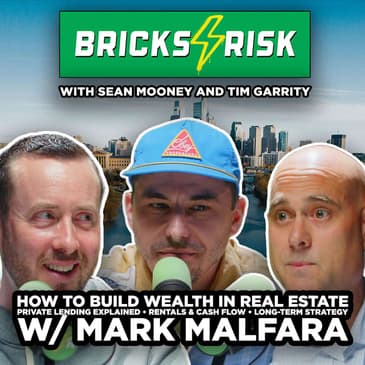
Sometimes, a lack of tech is not the reason why your business is not succeeding the way you want it to. Take Mark Malfara for example. He still operates mostly off of pen and paper, as well as Excel spreadsheets ... and he's crushing it as an agent! Not only that, he has built a successful private lending business using the same success formula. Build a pipeline, and follow up with them. Sean & Tim go fishing for answers on why Mark's success formula works for him, and how it can also work for you. Dig in to another B&R guesty!
Big shout-out to our show's loyal and dedicated sponsor: Property Management Redefined. John Sacks and his property management squad love our show and continue to support our mission of helping people through podcasting!
Our goal with Bricks & Risk is that you walk away with 1 or 2 valuable nuggets that can help build your own business. Our audience grows through word of mouth, so if you would please take a moment of your time and give us a review on the platform you’re on, that would be fantastic!
Please also help spread the B&R word by sharing your favorite episode with a friend. You can find all B&R episodes on Spotify, Apple Music, YouTube, and anywhere else you get your podcast content. We greatly appreciate your time and trust.
Until next week, keep learning and keep growing!
** Episode Shout-Outs **
→ Go Warriors: https://www.esu.edu/
→ Episode Sponsor, Property Management Redefined: https://gopmr.com/
📲 Contact Info 📲
→ Sean Mooney, Mooney Insurance Brokers: www.mooneybrokers.com/
→ Tim Garrity, The Tim Garrity Team: www.timgarrityteam.com/
💥 Watch us on YouTube 💥
→ YouTube, Bricks & Risk Podcast, @bricksandrisk: www.youtube.com/@BricksandRisk/?sub_confirmation=1
💥 Follow us on Social Media 💥
→ Instagram, Bricks & Risk Podcast, @bricksandrisk: https://www.instagram.com/bricksandrisk/
→ Instagram, Sean Mooney, @sean.moonee: https://www.instagram.com/sean.moonee/@sean.moonee
→ Instagram, Tim Garrity, @realestateinphl: https://www.instagram.com/realestateinphl/
→ Facebook: https://www.facebook.com/bricksandrisk
→ LinkedIn: https://www.linkedin.com/company/bricksandrisk
Uh, going back to the beeper story, when I first got into business and like, all right, uh, here's the business card platform. You know, do you want your cell phone number on there? And I remember one of the old-time real estate agents said, do not put your cell phone number on the business card. They'll be calling you at all hours. Yeah. And now looking back, could you imagine people are gonna call your office, leave a message, and you might get back to them in a couple days. Like, it was out, it was mind-blowing.
SPEAKER_00I know the expectation of like when you'd hear from someone versus today. You didn't call me back in a half hour. It's like, what? Welcome to the podcast dedicated to real estate, insurance, and building your business. Join us as we take you along our own business building journeys with additional wisdom from our network of local and national experts. Welcome to Bricks and Risk.
SPEAKER_02This episode is brought to you by Property Management Redefined. PMR is not just managing properties, we're creating partnerships that build long-term success for property owners. John and his team can be reached at manage at gopmr.com or by phone 267-753-6005. Tim.
SPEAKER_00Yes, John. Who's a good client for PMR? Property management redefined is looking for property owners who value three things accountability, reliability, and a results-driven approach. I want to maximize returns, but still provide client and tenant satisfaction.
SPEAKER_02There's a lot of property managers out there.
SPEAKER_00There are. What does PMR do really well? Biggest thing is they're seamless and they're worry-free. So with that approach in mind, it allows the property owner to put their trust in PMR and know that the results will be there. The other thing I think a property owner is really going to value because they do it so well is that they have a local expert team, boots on the ground, managing your properties and your tenants' expectations every day so that you feel good about your investments.
SPEAKER_02We have millions of listeners out there. Tens of millions. If they want more information, how do they find PMR?
SPEAKER_00Right here, guys. Reach out to John Stax and his team at Property Management Redefine. We'll take good care of you. I'm Tim Garrety. And I'm Sean Mooney. Today, Sean, we have a real estate superstar with us, local guy. We have Mark Malfara, realtor with Berkshire Hathaway Home Services. What's going on, Mark?
SPEAKER_03You make me blush when you see love it.
SPEAKER_00All right. So Mark has extensive knowledge of Philadelphia and the surrounding suburbs, providing real estate services to clients and tourists to relocation clients since 2003. He has a passion for the residential real estate industry and takes great pride in helping his clients, whether it's their primary home, an investment property, or a private lending need. Mark is a lifelong resident of Greater Philadelphia, spending most of his life in some of our area's finest neighborhoods, 14 years in Fairmount, 14 years in Mount Erie Chestnut Hill, seven years in Manioc, Roxboro, what what? And currently 16 years in Springfield Township, Montgomery County, just down the street from me. He owns several investment properties. Several investment properties, purchasing his first home at the age of 23, still owns it today. Roxboro. That's right. Yeah, baby. And recently purchased a home in Brigantine, New Jersey. The teen, congratulations. Thank you. Thank you. Mark is married to his wife, Val, and is the father of three children. Triplets, Brody, who's now in the Coast Guard, and then Fiona and Ariana, who are both at Westchester University. He loves biking, golfing, bourbon tasting, and IPA drinking. Sounds like our kind of guy. I I thought we'd have a few pops here today, but. Oh man, why didn't we think of that? We just went with Mooney's shirt. You know, that was the excitement. Uh all right, so fun fact at East Stroudsburg University, Go Warriors. You played rugby and also represented the U.S. collegiate rugby team at the Collegiate World Cup in England. How did that happen?
SPEAKER_01Very fortunate, actually. Uh, we had an Australian coach, David New, thank you very much, who took a bunch of Philly kids basically. The tryouts happened to be in Philadelphia, so that was the fortunate part. By no means am I one of the best players in the United States. It just so happened that locally the tryouts happened.
SPEAKER_02I don't think you're giving yourself enough credit, man.
SPEAKER_01Yeah, man.
SPEAKER_00Scoring a couple tries while you were out there.
SPEAKER_01We we had a lot of state school players from Pennsylvania on that team, and tryouts were local, so it was easy for me to get to. Um, I went just to play rugby for the summer, didn't know that there were necessarily tryouts for this team. Um, coach took a liking to me, like what I was doing out there at the time. I was very confident. I had total disregard for my body, so I was throwing it all around, lots of injuries, whatever it was, but uh concussions and everything. But um it worked out and it was just an awesome experience to be in that crew.
SPEAKER_00How's the East Stratsburg program? Is were they a pretty, pretty solid rugby team?
SPEAKER_01When I first got there, not so much. Um, you know, and then after the first year, we started to win and started to improve, and that all came down to coaching and just everybody buying into the fact that we needed to be fit and we needed to learn more by going to coaching clinics and then listening to those who were a little bit more experienced.
SPEAKER_00Any rugby experience prior to college or is that where you got into it?
SPEAKER_01Oh, and I'm disappointed. I wish I did. A lot of guys from McDevitt had played for Blackthorn and they mentioned it too. Oh, yeah. Yeah.
SPEAKER_00Are they yeah? Are they still around? Is Blackthorne still a still a club?
SPEAKER_01Still a great club. Yeah. And and they're getting younger and younger. So they'll have these youth teams that do start out at Flag and then you go up to the uh still a men's club as well. So all between.
SPEAKER_00Oh, I love that. Cool. Well, you are a rock star agent, let me just say that. Super successful, but you also have a private lending business. You know, I have some knowledge of that because I invest in real estate. The heck did you get into private lending? Like, what's the story there?
SPEAKER_01So, like real estate, it's a spider web of connections and relationships. So, like, there's a lot of people that I need to give thanks to. So, you know, from from those connections to get me into private lending and start out with CJ Fitzgerald. Shout out to CJ, mortgage guy, McDevitt Pride. So CJ introduced me to Chris McGarraty, who's in commercial real estate at the time. Chris introduces me to Brian Halligan, who's doing flips and getting into commercial stuff and development. Shout out to Brian Halligan. Brian gets me into private lending. Um, and then another friend of mine, Carrie Bacella, introduces me to Jim Lee, who's a shout out to Carrie Bacello with Compass. Right. And then Jim Lee is a mortgage broker uh who also does private lending. And then just between all those connections, we started to team up and wow get business relationships and it worked out really well.
SPEAKER_00All right. So you're learning about it, like people you know are like in this space. I mean, real estate, I mean residential real estate, more than a full-time job. Uh you know, if you're good at it, you can make a lot of money. What why'd you why did you jump into private lending? Like what was it about it?
SPEAKER_01It was a little bit more passive than the day-to-day grind of real estate. So if you find a good operator who can operate their projects, yeah, it's a let's vet them out. You know, are they a good candidate to lend money to? Are they they have their own money in the deal? And what is the project and is there value in the project? So if all those, you know, are looking good, you're lending someone money who has skin in the game that if they default, you either take the property back or they have enough money in the game where they're not, you know they're not going to. They're gonna hustle, they're gonna make it happen one way or another, they're gonna get to the settlement table.
SPEAKER_04Yeah.
SPEAKER_01So that was a little bit more passive of just collecting interest checks either monthly or when the project ends, getting your interest at the end. Um, and they kind of grown, you know, just started with one or two guys and then it became five guys. And then when I teamed up with my other partner, Jim Lee, you know, we both have access to the many, many people. And it's just it's grown over time. So and then that's where the compounding kind of comes in. If you you take from one deal to the next, if you keep getting a little bit bigger slowly, you know, over time and build your portfolio, it becomes almost like having a rental check coming in at the end of the month.
SPEAKER_02So guess where he bought his shirt at the Army Navy store, uh Harley Davidson store.
SPEAKER_00Right. One of the two.
SPEAKER_02What I don't even know. What you gotta go like three layers deeper on this with private landing. Are you putting your money in? You're lending out your money. Are people coming to you? Like, where are they finding you to say, hey, I've got a deal? Is it all word of mouth? Can you just go a little bit more into how what the mechanics are within this?
SPEAKER_01Yeah, it's it's all of that. So uh it first started out with just my own money, whatever little bit of cash I had to put into those deals. Yep. Then I was like, well, why don't I get a line of credit on my house? I can use the bank's money. Let's just say when interest rates were 3.75%. Right.
SPEAKER_00And if I can lend it, charge a couple points on that.
SPEAKER_01And if I can lend it at 10%, you know, I'll just make it in between. Yeah. Now interest rates have gone up. I still use my line of credit to invest, but I try to use cash where where possible just to keep those interest rates in line. Um I I do also bring in other investors. So we backfill with friends, family, people we meet. So if we go out and service a loan for $100,000, I put my own money up front. And then I say, I send an email out to my investors, friends, family, whatever it may be. I get the emails. Yep. Yeah, you get your own email list and uh just say, hey, we we just close on a loan for $100,000. I want to keep $25,000 in. Does anybody want to fill the other $75? You can do it with $25,000, $50,000, $75,000. You can take a part of it, you can take all of it, and and everything's documented with notes and and things like that. That's great. What are the returns?
SPEAKER_02Like, like now we're sitting at you know, six percent, seven percent, whatever the the mortgage rate would be. Um so you're in it for twenty-five, you find three other people to come in at twenty-five. The investor's gonna, you know, do his purchase, flip, he's out in a hundred days. What's the what's the return on?
SPEAKER_01I know they vary, but yeah, typically when someone asks just a blanket, what's your what's your rate and fees? We're 13% interest and three points. Now that could vary depending on how much money they have into the deal themselves, yeah. Um, what their experience level is, how many deals they've done that have been successful, and how many defaults they may have had. Um so if I close on a deal at 13%, it's just with the investor who's doing the flip, I'll go try to backfill that at 10%. So I'm still making a servicing fee. So it's not my full 13% or 10%, but you know, if I can make two or three percent for the servicing of the loan, charge some points, and then the friends and family are in at 10% for doing nothing and just kind of collect passively collecting the income, you know, it works out well for everybody. How do I get on your email list?
SPEAKER_02Yeah, yeah.
SPEAKER_01I had you on the email list.
SPEAKER_00You will be on the list. Hey Jim, I'm here to invest. He's like, I'm I'm investing in Texas. You'll be on the oil, how oil down? Yeah, yeah. Um, all right. That's dude, that's super interesting.
SPEAKER_02So wait, are okay. One more one. I promise this will be.
SPEAKER_00Sure, go ahead.
SPEAKER_02Like, are you actively looking for is it just passive stuff that comes your way? Are you actively like pushing it?
SPEAKER_01Like, what I'm doing, like I would say that we have not turned the faucet on from a marketing perspective. So it's all relationships that we currently have and repeat borrowers. And then occasionally someone new will come to us, or people in my office know that I'm doing this. Uh, sometimes the mortgage guy will come to me and say, Hey, this is a non-conventional loan. We can't touch this. Is this something that you can do for us? Now it cannot be residential, so it's all commercial loans. We don't deal with residential loans. Right. Oh, everything's commercial. Yeah, so it has to be investments, flips, rentals, uh, business loans, things like that, but it can't be for a residential purposes.
SPEAKER_00Oh, interesting. Yeah. Okay. Dude, super cool. Um, all right, let's talk about real estate. Yeah. So you didn't get into real estate right out of college. You had another job or two right before you got into real estate. Had had quite a few, yeah. Yeah, well there we go. Well, what were you doing? Okay, so you finish you finish your your rugby career, you get out of college. What was your major, by the way?
SPEAKER_01So it was business management, but focused towards hospitality and recreation. So recreation and leisure services is the uh topic or the title of the degree.
SPEAKER_00You had a really fun job when you got out, right?
SPEAKER_01It it was. So I worked, I did my internships at two different resorts. So I did one at the Breakers Resort in Palm Beach, which is world-renowned. Nice. Uh, then I did another one in Tampa at Weston Innisbrook. When I was and when I was at Weston Innisbrook, um the the older called him counselors, they actually were employed by you know the recreation department would always talk about this guy who was an intern the year prior. And I was like, What is this guy doing? They're like, Well, he just left us and he's got a job on a cruise line. He works for Royal Caribbean. I'm like, how the heck did he do that? He's like, I'm can I talk to him?
SPEAKER_03Yeah.
SPEAKER_01They said, Well, here's his parents' number, the landline back to the house, because we didn't have cell phones back then. So I called his parent's number and they said, Well, he's still in the boat for two more weeks. We'll have him call you as soon as he gets back.
SPEAKER_00Very cool.
SPEAKER_01He calls me up and we're chatting it up. I said, Well, how did you get a job on a cruise line? Like, where do I even start? He goes, Go to the library three blocks down, go pull the book that the book is titled How to Get a Job on a Cruise Line. There's a bunch of contact information in there for different cruise lines, jobs you can have at the library and fax your resume.
unknownWhat?
SPEAKER_01Oh, I love that. Old school. I ended up getting a call back from Carnival Cruise Lines, and uh as soon as my internship ended, I think I had two weeks at home to just kind of hang out, and then I started the Carnival Cruise line gig right away. And that was uh six they could do like six month contracts. Oh wow. So while I was with Carnival, I got to work on two different ships, uh, mostly the Mexican River or the the western side. So our dock was in California, just outside of LA. And then we would just do that coast of Mexico essentially. Awesome.
SPEAKER_02Do you think there's a book in the library how to get a job working for the Philadelphia Phillies?
SPEAKER_00Possible.
SPEAKER_02Like wax your resume here. You want to work for the Phillies? I don't know. What about the birds? Nah, I'm not nah. Nah. No. Phillies is like a little more leisurely. That's the weather's a little bit nicer.
SPEAKER_01No one wipes seats off anymore at the stadium. You could be that one guy. It does the whole stadium.
SPEAKER_02That has been a lot of people. A lot of steps. Yeah. Might be uh to look into that.
SPEAKER_00All right. So your hospitality, you do uh cruise lines, you know, a couple resorts, cruise line. What what'd you do after that? Like what what was your job after that before real estate?
SPEAKER_01I ended up getting a job with a national property management company. So they would go out and get contracts for stores like Target national stores, so Target, CBS, Right Aid, things like that. Like commercial property management. Commercial property management. And um they would get the contract, they would give it to their team, and then the team was responsible for finding contractors to do the work at the new pricing, which was always at a discount. It was a very, very tough business. And all the phone calls that came in as a project manager were just bad calls. You know, the contractor didn't sweep the lot today. The landscapers did a horrible job. So that was draining. Um, and while I was there, I had a great friend of the family, Tim Ryan, who has since passed away. His brothers have been in the real estate business for years, a lot in Roxborough and Fairmount. And um, he's like, Hey, I'm gonna retire from the railroad. I'm gonna get my real estate license and work with my brother. He's like, Why don't we take the real estate class together? He's like, You'll help me study, it'll be awesome. So we took the classes together. We both pass our exam. I get in with prudential at the time, who's now Berkshire Hathaway. Um, so thanks to him, um I got my license to get in the business. It's actually my sister, who is a catalyst of really getting me interested in real estate, and she doesn't know this, but uh so when I bought my house at 22, 23, yeah, she's I'm living at home with my mom, things are great. I have my own apartment, refrigerator's got food in it. Yeah, laundry. It's like you should come look at a couple houses around the corner for me in Roxburgh. I'm like, why would I do that? Sounds like the dumbest idea of everything. Uh so didn't have an inkling of buying, but we looked at three houses at the time. They didn't know whether Roxboro was going up or down. Yeah. Everything was priced at like 80 grand, 79, 78, 80, 85. That's hard to believe. All three houses were exactly the same the brick row homes, airlights, you know. And uh I left there that day. Like that was a great tour. I had no, you know, instincts to buy or anything like that. A couple days later, the realtor calls me back and he goes, Hey Mark, one of those properties we looked at, I didn't care which one it was because they all look the same, just reduced 20 grand. So 20. Went from 80 to 60. Whoa. So I put an offer in five percent discount. Put an offer in, got the house. Two years later, a realtor is knocking on doors and he says, Hey, I have clients who want to be in this area. At the time, I think he said they'd be willing to pay 125. This is like two years later. I mean, Roxburgh, that's when it just started to go on the upswing. Yeah, that'll be your money in a couple of years. Pretty good. I'm like, I think I should buy 10 of these. So then my goal was like, I should have 10 rental properties that, you know, never matriculated to 10. I kind of just like stumbled into it.
SPEAKER_00Uh yeah, oh absolutely. Friend, friend got you interested. Yeah, you know, mom being a good mom's like, hey, let's let's invest, you know, buy buy something, which was very good advice.
SPEAKER_01Mom helped me out. She gave me a little bit of money for closing costs. Awesome. So it was it all worked out great. Um, I house hacked, so I always had roommates living in the house. So I was doing I was paying for the renovations. They were kind of paying for the for the mortgage. Yep. You know, so that all worked out well. Um, and then the values in Roxburgh just continue to increase. And I still I still own that house today. So I bought it in like 1999, and I still own it today as a rental.
SPEAKER_00All right. So you get into real estate, you're with Prudential, um, you're doing some let's call it investing on your own. House hacking is investing. Like you're getting the house for yourself. You're like, I I want to live here. It makes sense. Like it's great, it's mine. I can do what I want with it. I have my freedom. It's it makes sense financially. Then you got friend or friends coming in, paying you rent. So now you're a landlord. You're like, this is cool. So when you started prudential, were you kind of just starting with like the traditional route, like friends and family when they need me, but were you also going down the investor path at all? Like were you finding investors and trying to like help them acquire and or not initially.
SPEAKER_01So when I first got into the business, I kept my my full-time job with the property management company for two years. Oh, smart. So I was able to get my feet wet in the real estate business. I, you know, I can work the floor, I can answer the phones. More importantly, I became known as the guy in the office where Mark won't turn anything down. So everything that grinder, uh, the garbage can, right? Mark will do it.
SPEAKER_02This is Mark's.
SPEAKER_01It's they would literally say, I don't, I don't work in this price range. You know, would you like to take this? Mark will do it. So that's how I built my business. And I did a lot of rentals because I was familiar with throughout the time. Um, I still do rentals too. So do I, you know.
SPEAKER_02I love it. Here's Mark's beeper number.
SPEAKER_01Dial him up. I have a story about that in a second. Yes. Please. So I made my business off of not turning down business.
SPEAKER_02And I still though. You learn the business, you kind of deal with all kinds of different people. I mean, it's just a way to get in quick and really get the know-how.
SPEAKER_01And a lot of those deals weren't easy deals because nobody else wanted them. Right. They were difficult clients, low price points, whatever it is. So it was a great learning experience right off the bat. I mean, talk about like the school of hard knocks and learning on the job. Yeah. I mean, it was, you know. Learning by doing. Yeah, it was fire.
SPEAKER_00Figure it, you know, follow. I used to say I just follow my face and get right back up. Follow my face, get right back up.
SPEAKER_02Yeah, but you speed up because if it's difficult deals, you're learning so much more and so much quicker. Yeah. That when you get the routine stuff, it's like, yeah.
SPEAKER_01And even to this day, like when a lot of people get in a jam, they'll like be like, S Mark, he's probably had that problem before. So uh going back to the beeper story, when I first got into business, and like, all right, uh, here's the business card platform. You know, do you want your cell phone number on there? And I remember one of the old-time real estate agents said, Do not put your cell phone number on the business card, they'll be calling you at all hours. Yeah. And now looking back, could you imagine? I don't know. People are gonna call your office, leave a message, and you might get back to them in a couple days. Like, it was out, it was mind-blowing.
SPEAKER_00I know the expectation of like when you'd hear from someone versus today. You didn't call me back in a half hour.
SPEAKER_02It's like, what?
SPEAKER_00Exactly. Thought you were dead.
SPEAKER_02What happened?
SPEAKER_00Awesome. All right, so you're big on routine. So here's here's one for you. Are you uh are you an all-day routine guy? You more of a morning routine, night routine? What's how do you look at routine?
SPEAKER_01Morning and and weekly, right? You know, it's uh you know, four or five days a week, waking up early, going to the gym.
SPEAKER_00Yeah, talk about your morning routine. Like what are some of the things you do to like get up every day, like get ready?
SPEAKER_01Very traditional. I mean, so it's you know, Monday, Tuesday, Planet Fitness, Wednesday, basketball, Thursday, Friday, Planet Fitness. Uh, occasionally, if the weather's nice on a Friday, I have a group of people, you know, we'll send a text to each other, like, hey, the weather's nice, can we get out at 3 30 for a bike ride? And of course, you know, we'll end the Kachakin Brewery or something like that. So a nice little social gathering. Um, and then on the weekends, I'm not hitting the gym, but I'll be doing something else, you know, if a bike ride comes up or something along those. Lines. Maybe I'm bringing teen some pickleball or something. We'll see. We'll see.
SPEAKER_02Listen, my uh can't imagine Mooney playing pickleball. When you say early morning routine, you're gonna have to uh you're gonna have to come out with Uncle Tony one night. And we uh I want to go out with Uncle Tony. We go to the Elks, we go out, we we end up in Atlantic City because the bars are open 24 hours. So that's when you say early morning routine. And you can gamble.
SPEAKER_01I lose you at early morning because early morning is during the week it's 5 30. Wednesday is 4 30.
SPEAKER_02So I thought you meant like three o'clock early morning where we go to Tony's Baltimore Grill.
SPEAKER_01But but you know, bedtime is nine-ish.
SPEAKER_02Yeah.
SPEAKER_00Hey everyone, this is Tim, your favorite bricks and risk co-host. But don't tell Sean. I hope you're enjoying this episode, and I'll get right back to it in a moment. Our audience grows through word of mouth, so if you would please take a moment of your time and give us a review on the platform you're on, that would be fantastic. Please also help spread the BR word by sharing your favorite episode with a friend. We greatly appreciate your time and trust. Now, back to the show. Yeah. Okay, so you're a morning guy. All right. So how did you learn morning routine? Was it a book? Was it just natural for you? Someone taught you something like how did a morning routine become important to you? Just more alert and have more energy in the morning.
SPEAKER_01If I tried to save working out at a gym for the afternoon or the evening, it is not happening. Just my I don't have the energy level. Something else is distracting us. We're showing houses, you get a phone call, whatever it may be, kids, you know, all that stuff. So it's just I am I can't do it in the afternoon. Yeah. It just doesn't work.
SPEAKER_00Interesting. I mean, I'm a morning guy too. Yeah. Um, I'm trying to think where I even learned how to like I used to be a go work out after work kind of guy. Like you get off, maybe you got off early on like a Friday, I go to the gym at like four o'clock or something like that. Or it's like, hey, you get off normal time, like 5-5:30, you're at you're at the gym at six. And I used to remember to like doing that and then going home and eating or grabbing something out, and then you know, you'd have just enough energy to like watch something on TV or something, and then you'd crash. And I'm trying to think where I even switch to like morning, but I I will life.
SPEAKER_01I mean, yeah. In grade school and high school, practices are in the afternoon, right? So you're attuned to it. But yeah, as you get into working, uh, and you have to be at work from eight to five or whatever it may be, and then you have evening routines, like only so many windows opportunity to do that.
SPEAKER_00It's true, man. All right. So, routine, that's how you start your day. How about in your agent business? Like, what what kind of things do you do? So you've been successful at real estate for over 20 years. Um, I'm sure you've built it through word of mouth, friends and family, repeat clients. Like, what kind of things are you doing on a routine to like grow your business?
SPEAKER_01I'm an office guy. I love being in the office. So after the workouts over, the morning routine at home, you know, I like to be in the office at 10:30 and I'm there until it's time to leave, um, unless I'm showing houses or something. But um, I'm just more productive in the office. You know, uh, I I don't have I don't time block like a lot of these guys say I'm I'm cold calling. I I'm not I'm not a cold caller, so I'm not cold calling for two hours and then answering my emails and phones in the afternoon. So um, you know, some of it's reactive because of the business, but I when I'm in the office, I'm just I'm flowing, things are getting done, I'm being productive.
SPEAKER_02Yeah, interesting. I need to be in the office. Yeah, you guys are both office guys. I'm like the complete opposite. I love it. I have to be like, I'll be at home like working at my home office, and I'm just not as productive. No, but I can do it. Like I can I can work at home and I can, but being in the office, I don't know what it is. I I can do 3x the work in the office.
SPEAKER_01But we all say we're trying to get paperless, but there's so much paper in our business. Having a great copy machine and a scanner available to you like is really important. Yeah.
SPEAKER_00You know what's funny? I'm the complete opposite. I go to the office and I get distracted. Like, I think it's by all the human beings. Like when I go to an office, I just want to be like, yo, how you doing? Like, catch up, or like, hey, well, how's life, or how's work, or how's the family? Whatever. So, like, for me, personally, I am way more productive at home. Always have been. Yeah. Ever since I got in this business, I remember when I got into real estate was uh 2010. Markets sucked, as you remember, uh, just you know, in the thick of the financial crisis. And um, I'm living at Green Tree Run. Shout out to Green Tree Run. And uh Maria had like a nine to five. And I remember I was like, yeah, it's just like we had a guest room, we had our room, and then we had a room where I had like some exercise equipment. Yeah. And I said, I'm just gonna throw a desk in in the guest room and just work there. And she was like, Really? And I'm like, yeah, it's all I need. Like, every I got another monitor. So I'm like two screening all day, and just like, for whatever reason, that just worked for me. But I totally understand like why an office works for like you guys too. It's just like I need to get away from my house, stop thinking about my house. Like, I've had other people tell me the opposite. It's like, if I'm at home, I'm gonna like want to do something at home.
SPEAKER_02Well, I also like my three little kids, like that too. I'll be in the basement and be like, do, do, do, do, do, dad, let's go throw the football. I'm like, no, like it just doesn't quite work.
SPEAKER_01Unlike you, like I can see you like talking to everybody and getting to know everybody and being a little chatty. When I'm in the office, office mode, my desk faces the wall, not glass. So I can't see who's coming behind me anyway. And I'm not very engaging unless I get out of my office and walk somewhere. And in that case, I'll say hi to somebody, but I'm not at the water cooler.
SPEAKER_00Like you're controlling the fact that, like, you know, you got you got your vision right here.
SPEAKER_01Anything's happening around you're like just I have no problem sitting at my desk for five, six, seven hours, just head down and doing stuff.
SPEAKER_00Yeah, it's awesome. Um, all right. So biggest struggle, something we talk about with all of our guests. So you said the constant hustle year after year, and the occasional client that just takes all of your energy away. Let's focus on the year after year. So, again, when you're in sales, you know, we're all producers, you just you grind it out year after year. It it gets tiring. You know, you start to like get burnt out a little bit. Like, why am I doing this? Is there something more to this? Am I doing something wrong? Am I doing something right? What why why is that a struggle for you?
SPEAKER_01Uh the last couple years, especially, uh I I think you read the book uh Die with Zero, right? Yeah.
SPEAKER_00You recommended that to me. I did the audio book.
SPEAKER_01Yeah. So I mean, just changing your perspective. And it's it's it's hard after you've been in that grind for so long, but seeing people pass too young, you know, things like that. And there's uh die with zero is about time blocking your events that you want to do almost like your bucket list, right? Like you're you're not gonna climb Mount Kilimajaro at the age of 80. Could you do it at 60? Maybe. Could you do it at 50? Yeah, you could. So if that's your goal, when are you gonna do that? Yeah. Um, so it's not about spending all your money crazy without a purpose, right? There's got to be a purpose behind it, but also that you have a certain amount of time to do certain projects in your life and you have to choose them wisely. So, you know, the the brigantine situation was one of those, right? Like, yeah, we could wait. I wasn't ready to buy, I could wait another five years, but at that point, what is you uh you know how enjoyable for the next five years?
SPEAKER_02Yeah, yeah.
SPEAKER_00And now you got all you know, all three of your kids are their first year out of the house, you know. So you're like, now we have this as like their summer home. They can come here whenever they want. Are you guys planning to like go down there like all summer type of thing?
SPEAKER_01Yeah. My wife's a school teacher and she's on sabbatical, so she has off this spring and next spring and the summers. So she's gonna be down there almost exclusive.
SPEAKER_00Phenomenal. Yeah, dude, it's it's funny you bring up Dive Zero because I don't read books. Mooney knows this. But when me, me, you, and Tom, Tom, shout out to Tom Mellett, sitting at the airport, and we were talking about all this stuff, and you mentioned that book. I was like, I don't know why, but I I have to pick that one up. Did you do the audio or I did the audio? Me too, yeah. So I uh I looked online, I read about it, I was like, oh, it's just like totally up my alley. Yeah. And just, you know, where I was in life, too. And uh, dude, amazing book.
SPEAKER_01Look, you only have your kids for so long, too, right? You know, now my kids and my wife use it against me, right? Right, right.
unknownYeah.
SPEAKER_00Remember what the book said.
SPEAKER_01Uh should we upgrade our our seats on the plane? Right, right, right. First class, Dad.
SPEAKER_00I already got our hiking guy from Kilimanjaro, so you know, we're ready. That's great. Awesome. And then how about the other one? So, occasional client takes your energy away. We've all dealt with that.
SPEAKER_01But I mean, they almost put you out of business, like they make you rethink like, should I be doing this? And then, you know, after they drain you down to zero, you get this great client that can't say enough good things about you. And it's like, you you changed our life. It was amazing. Like, they're the ones that you want to have a hundred percent of the time and that really give you the energy and boost you up. But you know, sometimes you get that little gap between the two and they really beat you up. And it hurts your, I mean, it's it's it's kind of an ego thing. Like we always want to do a good job, and we're trying our best, but they may not see it that way, you know, and they might feel like something went wrong in the transaction, or they're just miserable people mostly.
SPEAKER_02But if you want me to share my disqualification process with you, please. It's called a deadbolt. Deadbolt's like phase one, and then we work them through tiers, and if they get through five tiers, then we'll work with them. Okay.
SPEAKER_01That that goes against it taking as much business as you can.
SPEAKER_02No, no. But it's so so what it is, is we've been I've been doing it long enough. You've been doing it long enough. You can almost see them coming. They have the same traits, right? So someone that like comes to you, and you know, for us it's like online lead, or they try to like knock on the door, and then we like draw the shades down, and we're like, we're not not open today. Um there's similar traits that they share for people that will leave you in a heartbeat, or you know, they will give you headaches, or they will whatever it may be. Um, there's some ways for us to to sniff that out on the front end, and it's like we uh we provide them an alternative place.
SPEAKER_00Is there a book in the library called How to Get the Dead by like How to Properly Install a Deadbolt for Keeping Clients Away? I mean, there's just some clients that drive you nuts.
SPEAKER_01Yeah. But in our business, like when you're in so deep from a timing perspective, yeah, I want to get something out of this at the end.
SPEAKER_00It's hard, it's hard to give up. Then you almost like want to do it, be like, I need to like persevere, I just need to like get through this. But to your point, like, you know, sometimes it's clients. It can also be business contacts, it can be like vendors or people you've done business with, and I've been through this. And um, I don't know if you're like this, Mark, but uh, I'm just too nice. Like, I can be too nice. I I give everyone the benefit of the doubt. And then I I had to go through a partnership breakup a couple years ago. It was basically like going through a divorce. It was the worst thing I've ever been through in my entire life. Right. I don't need to go into it, but it was a time of my life too where I also looked at it, it's like there were other people that I was working with, and some people are just not gonna like us. They're not gonna like you for whatever reason. Call it jealousy, call it personality conflict, just call it they're miserable, whatever, it doesn't matter. Yeah. And when someone for whatever is like they're not picking up what you're putting down, realizing that and and calling it for what it is and just saying it might be best to like just go separate ways can sometimes be the best thing you can ever do for yourself because I've wasted so much time with lots of people I never should have been working with in the first place. Right. But what's also good about that is like you you do learn from it. Not as strict as Mooney is with the deadbolt and the and the forums and stuff, but um I like that you make that point. How did you get my number? Right, right, right. Who was on the Google business profile? Damn.
SPEAKER_01Um, yeah, it's just good advice. And for me, I I I give a shout out to uh Jim Breslin, my other partner. Like shout out to Jim Breslin. Working together when you have an exhausting client, it's like, hey, you take him out this time, I'll take him out next time. Like it gives a little bit of subject. Give me a break. Yeah, yeah, yeah. And it's been he's been amazing, he's been very helpful, so it's been great. Love it. Awesome. It does make, you know, like they've exhausted me. I can't do it anymore.
SPEAKER_02It's your turn, right? I had a bad day with them, like you're up next kind of thing. That's like to alleviate that where it's not all you, like that is a tremendous uh benefit.
SPEAKER_00Absolutely. Um, your tip for our uh bricks and riskers is be genuine, take care of your clients, work hard, and have a very large funnel and pipeline. Talk about that a little bit. Why, why, why that tip?
SPEAKER_01When you have a large pipeline and a lot of people in that funnel, you never know when they're gonna drop to the bottom. You know, there's people who say, I'm ready to buy in the next four weeks, and they're the ones that take four months to a year. And then you have those ones that say, I'm not in a rush, and they buy in 30 days, right? So when they're gonna fall to the bottom. Um, but I always feel less stressed when I can look down the pipeline and say, these folks are gonna buy in the next six months, these folks are gonna sell in the next six months, I'll have X amount of deals lined up before the end of the year, and it kind of calms those nerves a little bit because our business can dry up in a heartbeat. Yeah, the funnel can shut off in two days if something goes on with mortgage rates or politically or something like that. So we know we've been through the ups and downs, and you know, totally that it can stop. When things are good, we forget about that.
SPEAKER_02But is there anything that you're doing strategically to build out the funnel right now? Like, yeah. Or is it for you just by way of I've been doing it long enough, there's enough people out there. Like, is there is there one or two things that you might be doing differently um to make sure it's filled or to ex to to ensure that it's expanding?
SPEAKER_01Yeah, probably not differently than what most people are doing, but when I get a lead, I'll put them in category of buyer or seller. And then I'll make sure every once in a while I look at that sheet and say, Oh, I haven't talked to them in three months. Let me just give them an email, quick email, quick text, say, hey, how are things going? Thinking of going out there looking at some more properties. I saw a couple things pop up in your market. Um, I think it's the the follow-up. I'm not a follow-up every week kind of guy because I don't want to hound people. You know, I don't like that when someone does it to me. Yep. But I'm touching them enough to they know that I'm still here and I'm still thinking about them. Um, but it's not it's for me, I do it's still a lot on paper, right? I operate off of manila folders, I operate off my spreadsheet, you know, things like that.
SPEAKER_02Um, you know, it's not Did you say Manila folder?
SPEAKER_01Oh, old school to all the Gen Zers out there to RM.
SPEAKER_02Yeah. Wait, so so wow.
SPEAKER_00So you uh you are a paper guy. You're more like pen and paper. Yep. Wow, that's awesome. So Excel sheets? I love Excel sheets. Yeah. Okay. So no C I like to do this. Like not like a CRM kind of guy. No, not really. Yeah, neither, and I'm not really either. Which is which is interesting. So it's more or less, it's like you have your routine, you know who you're talking to, you have your pipeline, people that are interested, and people that you just keep in contact with, let's call it. Uh, you have your follow-up system of like, hey, it's it's been a little bit, it's time I check in. Are you kind of email text guy? Are you a phone guy? You uh are you all three? Like, how do you operate to keep in touch with your network?
SPEAKER_01I I think I try to get a feel for the client. I'm probably more of uh an email guy. Um, texts kind of get lost, you know. You get somebody texting one day, some of them get buried. So I try to do email because if it's in my inbox, I know it's something I have to address.
SPEAKER_04Yeah.
SPEAKER_01If it's in a text, it could get lost and not get addressed. But uh for the client, I'll reach out to them usually via email and maybe follow up with a text. If they're a person that I know likes phone calls, which are far and few between, not too many people want to pick up the phone, um, then I'll I'll call them. Yeah.
SPEAKER_00Love it. It's awesome, man.
SPEAKER_02So if I walk into your office and your desk is facing the wall, do you have uh like a cabinet of manella folders that you have set up, like that you're like paging through, like, oh Joe Weiss. I haven't talked to him. Like, is it a is it like a manual thing like that?
SPEAKER_01But on top of the desk, actually, yeah, yeah. So I have those, you know, the folders that are set up, you know, progressively. And um right on my desk are active deals, like things that are going on, and then on my filing cabinet next to me, which is you know, all these file racks as well, are separated by buyers and sellers, and then settlements that are coming up. So everything's in front of me every day. So every morning I'll quickly flip through like, okay, do I need to and I'll shuffle them. Yeah. So what needs to happen today? Uh bring them up to the front, bring them up the front. Yeah.
SPEAKER_00So we we just had a guy on uh today, upcoming episode, Clint Houck. Shout out to Clint. Um, one of the things that he says very much like that, he's like, I'm a very like fundamental, foundational kind of guy. And we were talking about like shiny object syndrome. And people are like, I was making the example. Well, what do you use for CRM? Like, how much is it? Like, how cool is it? Does it have AI? Does it have it? Like everyone wants to, everyone wants that next thing they think that's gonna make their business great. And as you just talked about, I'm similar. It's not about that. It's about do I have people to talk to? What kind of rapport do I have with them? How often am I reaching out? Do they have what they need from me? Are they set up with an MLS auto search? You know, do they understand the pre-approval process? Uh if they're an investor, do did I educate them on the numbers or like private financing or whatever? Yeah. You know, it's it is more about, it is more about the pen and paper. Like really getting dialed into a sales business, it's what real estate is, it's what private lending is. It's a relationship game. You're trying to help people get to where they want to go. And in order to do that, you have to know them. You have to know how they like to communicate, you have to know how often, right? You know, and it's like if you just throw them into a CRM and you're like, yo, tell me next week, yo, tell me next week. Uh that may not be what they want, but if you walk in the office every day and you got your active people, right, you know what you have on your plate. And the people that are gone get crossed out, and the people that are new get written down.
SPEAKER_01I'll hold one of some folders for a couple of years. Yeah. I'll go back to them and be like, these folks never bought or sold. Let's let's give them a call. Let's see what's going on. They just weren't ready at the time. But there's a lot of these expos and events you go to, and they're always trying to sell you something, or someone comes into your office and speaks, and like, you should be using this CRM because it's got all these bells and whistles and blah, blah, blah. And everybody gets all excited about it. And then I feel like, oh, am I doing a bad job because I'm not using that? And I'm like, well, no, I'm busy. Like, I'm closing deals, I'm busy. I don't necessarily need that system, but they make you feel like you do, and it makes you feel like a bad person, right? You know, they're like, what? Paper?
SPEAKER_02Yeah, but it's also too is is like what what is the problem, right? That sometimes you have the solution in search of a problem.
SPEAKER_00Like, yeah, I don't have a problem, right? So it's like, why do I need a solution? Why do I need something new?
SPEAKER_02But there are people that, hey, I don't have a system, I don't have the folders, I need a way to engage with my clients. Right. Okay. How about this? Right? And and then you start using it. But for you, it's like, no, I I have my system. This this works, and you know, I don't need that. But but people are so in a rush to, you know, go sign up for for something that's new because they think that it that system is going to fill their pipeline.
SPEAKER_01It's gonna make them money, and it's not always the case, right? So, like we have an internal CRM system, and I'll get alerts every day and say you should reach out to these four people. And I look at it and I'm like, why? Yeah, yeah. It doesn't make sense for me to reach out to these four people. So I'm gonna go.
SPEAKER_00Like, I know better than you. No. No, not yet. Or for whatever reason, the answer is no. Exactly. Yeah, interesting, man. Um, all right. So your quote was great was get 1% better every day, never stop learning, keep an open mind. The compounding effect is a real life superpower. Why? First of all, was that a quote from someone? These are just things you like you like to say personally.
SPEAKER_01So Darren Hardy, I think, had a book called The Compound Effect. Um that was that was a good, easy read. And that got me thinking too it's like you don't have to go from 50% to 100% immediately, right? So if you're at 50%, you know, get to 55, get to 60, you know, just 1% better every day. Same thing with going to the gym. I mean, you know, you every day you're trying to push yourself a little bit more, run a little bit further, maybe a little faster, maybe lift a little bit heavier, but you're not you're not going from 100 pounds to 150 pounds, you're going in increments of five or smaller increments.
SPEAKER_03Yeah.
SPEAKER_01Um, but that's also true, you know, when it comes to finances and investing. You want to grow your pot to where it's producing interest for you, and that interest accumulates every month. So maybe you're earning $100 a month, and that $100 goes to 150. And then before you know it, you're getting $1,000 a month from your investments, you know, collectively. Um, you know, that's just kind of the way I try to live my life. And same thing with relationships, you know, just try to grow them over time. Doesn't have to happen super fast.
SPEAKER_00Love it. Awesome. All right. So before we shut this one down, why don't you tell our listeners and watchers where they can learn more about you and everything you got going on?
SPEAKER_01Again, not super technical. I mean, you can find me on the Berkshire Hathaway website, but also on Facebook, I have a business page and also a personal page. Don't use Instagram much, but I'm on there. Yeah, you are on there.
SPEAKER_00LinkedIn as well. LinkedIn. Awesome. Cool. All right. That's all we have for this one, folks. Thank you for tuning in again to another episode of Bricks and Risk. See you next week. Thank you for joining us on another episode of Bricks and Risk. Our goal is that you walk away with one or two valuable nuggets, and we greatly appreciate you sharing your time with us today. You can find all BR episodes on Spotify, Apple Music, YouTube, and anywhere else you get your podcast content. Until next time, keep learning and keep growing.